LYDIA STONEHOUSE: Taking Her Body With Her

ORGAN PROJECTS at One Church – Florence Road, Brighton

24 to 29 January 2025

Going to church can be so rewarding. Naturally it’s a Sunday and I find myself outside the One Church building in suburban Brighton, quite close to my home. I have been here on a couple of occasions before for the crafts market, but now I learn that there is a studio where Lydia Stonehouse produces her paintings and that a space has been commandeered for a gallery.

Lydia Stonehouse – ‘Arrangements’ (2024)
Oil on canvas (97x107cm)

Just the one small room, but highly suitable for looking at a carefully selected group of works. Eight paintings from last year are more than enough to give the visitor a good idea of what imagery Stonehouse is developing after graduating from The University of Brighton in 2022 and spending a year at the Phoenix studios as the receiver of the CASS Art X Phoenix Art Space Studio award that supports graduates in that potentially challenging year after completing their first degree.

Six of the paintings are seen at first glance, displayed on three of the walls. Two of these are ‘An ongoing birth’, with a strong landscape feel; which vies with ‘Arrangements’, transforming this sense of a distant view with (possibly) two figures dominating the foregrounded pictorial space. They initially dominate the immediate impression of the display. Four other smaller works, however, actually work well by alternating the various sizes of the works. The viewer must step forward or back to immerse the eye into the variously sized compositions.

Lydia Stonehouse – ‘An Ongoing Birth’ (117x127cm) and ‘Lotus Birth’ (26x21cm) both 2014
Lydia Stonehouse – ‘Book Scan’ (2024)
Oil and coloured crayon on canvas (35.5x51cm)

After tuning myself into looking at the works, being aware that first impressions can be misleading, I realised that I was attracted most to ‘Bookscan’, a relatively small canvas that was predominantly a subdued green mini-vista that actually felt quite expansive, way beyond the 35.5 X 51 centimeters of its physical reality. The floating linear and rectangular drawn shape within the confines of the canvas edges certainly suggests (is that a contradiction?) an opened book. The impression of a patchy rectangle of light close to the bottom left corner of the canvas brings a notion of time revealed through the light of day. What we perceive, what things are, where we are, are on a continuum. All is in flux, despite the painter’s foolish project to fix things as they are. Yet Stonehouse does not illustrate this; rather, she appears to be engaged on a mission of sorts. Her painting project is nakedly, vulnerably open and questioning. There is no sense of superficiality in these works. She knows when to stop and not to over reach the phenomenon of observation as a painting trope; of visual rhetoric as a too-certain reality.

Then, I feel a little foolish. An arrow prominently marked on the floor points, most unequivocally, to the corner of a curtain. I have been in here for a good 30 minutes or so, totally absorbed by these engaging paintings, but where does this arrow lead? Parting the curtains I am welcomed into this intimate space by two (literally) glowing paintings. ‘Church State’, on my left, feels so small (21X26cm) compared to its equally lustrous ‘Not Even Trying’ (117x127cm) that might be exploding in slow motion. Each work has an embedded set of electric lights behind each canvas. I would like to sit here for a while. This feels like such a quite, meditative space.
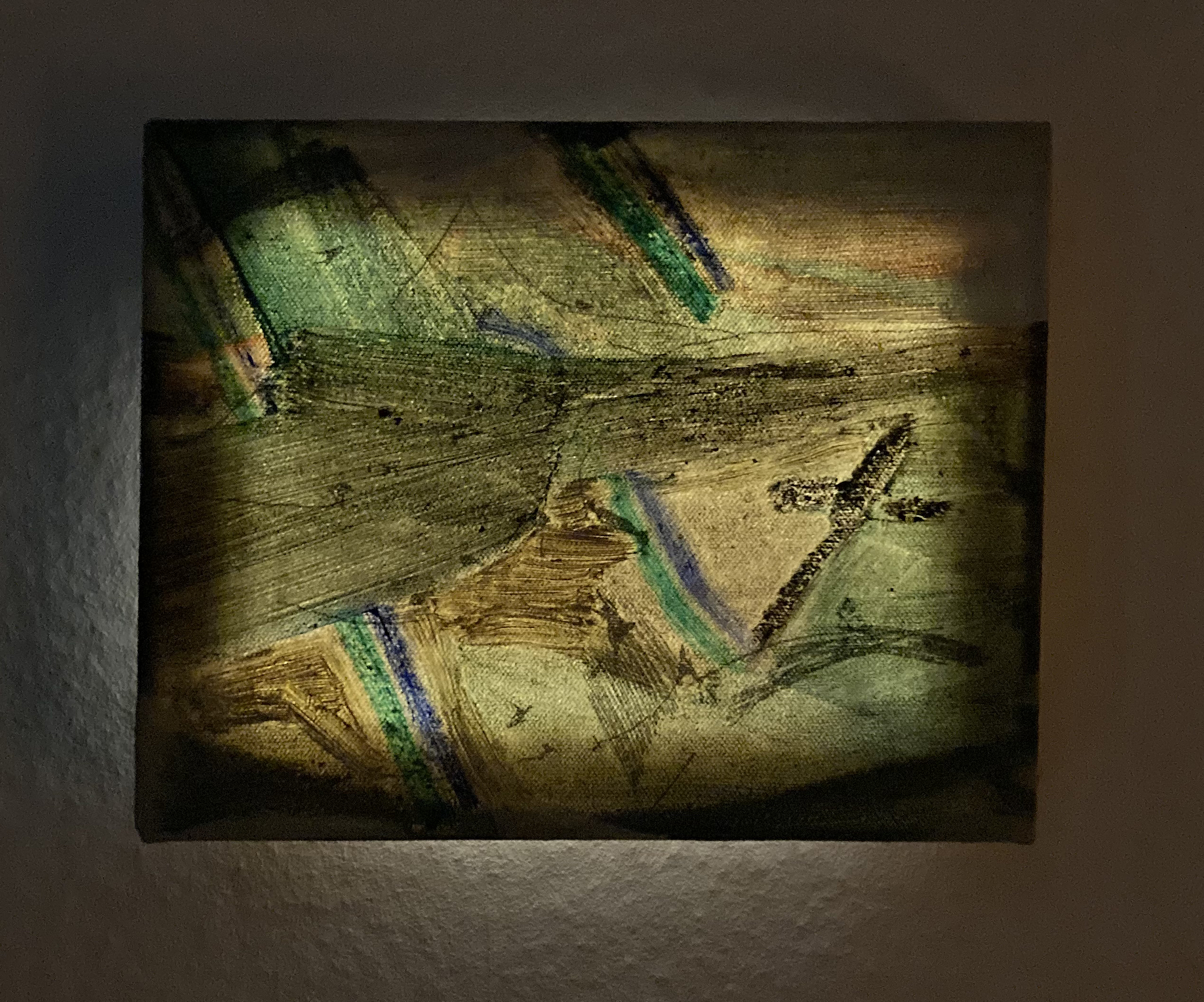
Lydia Stonehouse – ‘Church State’ (2014)
Oil and carbon print on canvas. (21x26cm)

I need a chair. I can imagine one. Or perhaps my consciousness is the idea of a chair. Either way, the emanating light and colour creates a sense of the physical painting embodying a phenomenon engaging with me rather than simply being observed. The much smaller work, ‘Church State’ (maybe it’s a landscape) includes a small Christian cross that floats in pictorial space on the right hand side. The larger canvas, ‘Not Even Trying’ is suggestively bodily, physical, earthbound – yet amorphous. I am not sure.
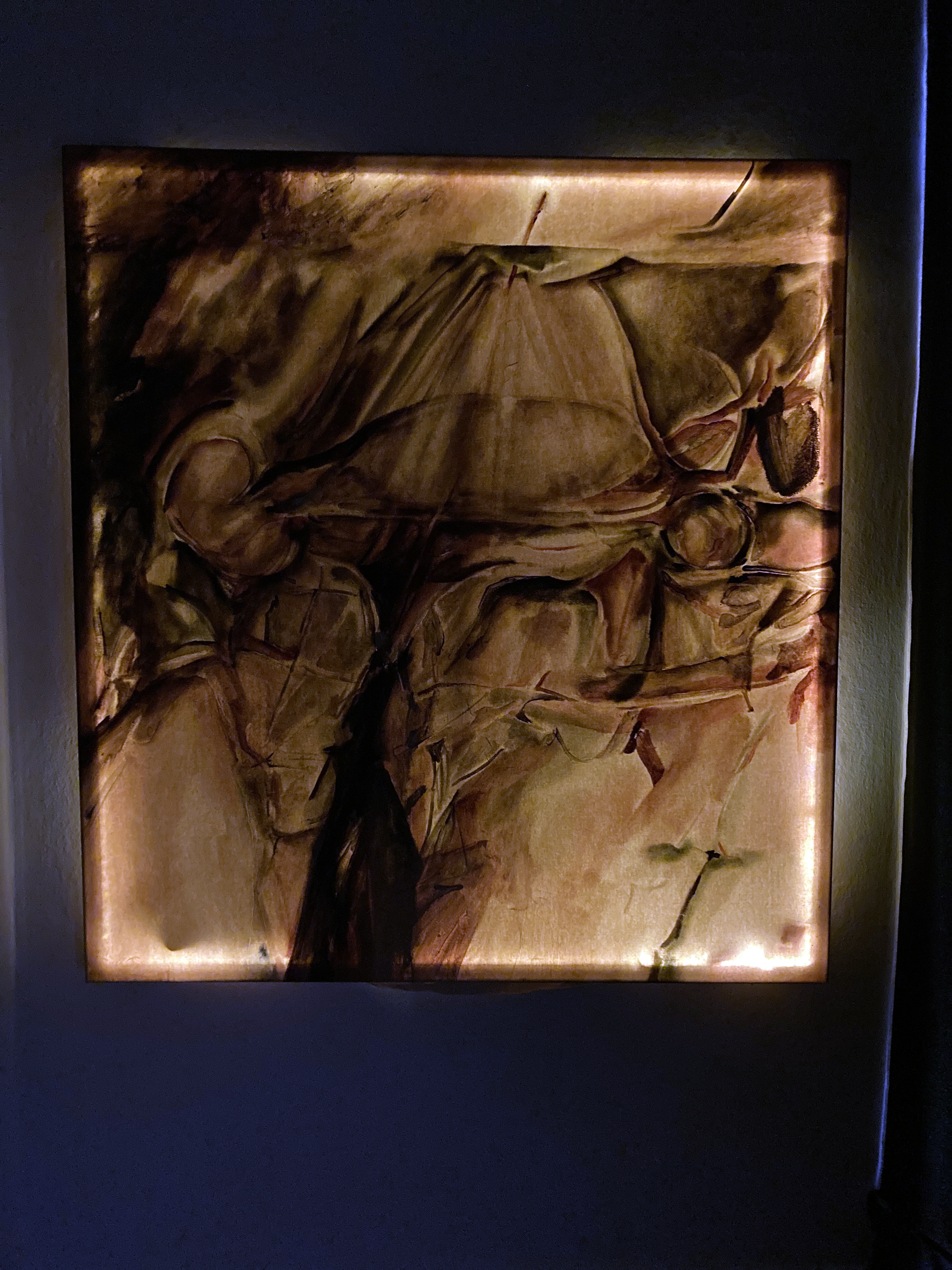
Lydia Stonehouse – ‘Not Even Trying’ (2024)
Oil on canvas (117x127cm)

This uncertainty (if I am on the right track) is starkly honest I feel, in Stonehouse’s work. The work is explorative, which is healthy. The fatuous notion of the artist as unattached observer is dissolved. The reward for looking at this work is to know that our sometimes felt disconnection with the world out there is ultimately one, non-dual.

Notes:

Organ Projects is an artist-run space founded in January 2024 and is located within a small room in a church in Brighton. The space exists to bring together and show the work of visual artists both local to Brighton and further afield. They are committed to working with artists and curators to provide space for experimentation, share parts of their practice they don’t often get to show, test ideas, and encourage dialogue with one another.

One House, gallery entrance

Links:

Lydia Stonehouse

CASS

One Church

CALUM LOUIS ADAMS: an elephant, a room

At Gallery Dodo, Phoenix Art Space, Brighton

24 January to 9 March 2025

Friday 22 November, the original date for an elephant, a room at Gallery Dodo in Phoenix Art Space, came and went. Then a poster displayed on a window next to the front door of the main entrance announced that the exhibition had been postponed. Expectation supplanted by disappointment. But this was to be an exhibition presented by a conceptual artist, Calum Louis Adams. So, that’s it – wait with Godot. Brilliant I thought – the anti-climax palpably real. No show (yet) constituted a show. Or at least the idea of a show, which happened imaginatively in real time and space, constructed in my mind. The potential object of an exhibition that was fabricated by a poster (a form of text) to manifest itself as an illusion of sorts. But no.

Then a new poster appeared in the window just a couple of weeks ago. There is an exhibition after all. I was disappointed initially, as the joke was on me. But hang on; I am getting two shows for the price of one here so long as I visit the exhibition.

During the afternoon of Friday 24 January I got a sneak preview of an elephant, a room that Jon Carritt, Dodo organiser, has installed. You really have to see this space, a former toilet and washroom, to appreciate how unique and rather special it is. How fitting, therefore, it was to hear the soundtrack of a woman urinating, recorded on a single channel looped video, from a screen placed on the back wall floor. Or at least the phenomenon of a common sound from this electronic device would convince the perceiver of the actuality of a necessary kind of daily performance: now become art in this physical and conceptual context.

The door entrance (it’s just one room) was wedged open with a carefully folded up sheet of the single page A4 gallery handout that had to be the right thickness to hold the door in place. This was the second of the three works presented. The third was the text and digital image printed on the reverse of the handout, though the stack of handouts were placed on top of a wooden plinth, which might be counted as part of the installation. Extrapolating from this of course, the floor, ceiling and walls are the exhibition too. As is any visitor. I found myself taking some photographs of the partly renovated walls, wondering if an elephant might lurk somewhere.

This interestingly rambling/stream of consciousness text, written by Adams (I assume), consists of three paragraphs that link stories of a “startled crow”; the notion of a “Brood”, a collective spirit, a small car parking on the nut that the aforementioned crow has previously been eating, an abandoned house, smashed windows, a previous exhibition of the artist’s during which, on hearing a line from a song by the singer Clairo, changes their thoughts about a moment during which a window changes its functional self identity. Next there is a reference to a woman who drinks her own urine (from the American TV series My Strange Addiction) – which may or may not link to the urination soundtrack mentioned above. The final section of writing summarises these various parts as personal thoughts about choice and the possibilities of the crow’s possible awareness of the observer and the car having some sense of the crushed nut under its tyre. It is quite possible that the visitor who picks up the printed sheet will not read the text until later. A common habit (of which I am guilty) is to read the text handout on the journey home or even later. I would now guess that Adams wants the text read whilst in the show as it is listed as one of the exhibits. Although it is possible that this does not matter as the text read later, elsewhere, extends the exhibition and enables the reader to possess one of the artworks and to create something through the act of reading.

So where’s the elephant from the exhibition’s title? Well, to be literal, there is a minimalistic linear sketch of an elephant printed on the front of the handout. A visual representation, alongside the word elephant itself, which only makes cognitive sense if such a word (a label or name) is already in the viewer’s cognitive lexicon. Alternatively, the creature may actually reside in the mind of the viewer as the imaginative synonym of the elephant in the room – which may or not be in the room at all but perhaps appeals to an art practice that explores arty aesthetic ideas and objects. I wonder if there is a self-deprecating aspect here too, including a possible negation of the artist (a form of identity and an idea as well as a career choice for an actual human being, an object of sorts) as being worthy of explanation.

I was told that the artist would not be attending the opening evening due to rail travel difficulties during inclement weather conditions in Wales, where they live. Or perhaps this was fortuitous, as perhaps the physical presence of the artist is not so relevant as it could detract from the show, the physical work and the non-physical ideas or potential concepts. How suitably anti-climactic.

LINKS:

Calum Louis Adams

Gallery Dodo

Phoenix Art Space

BREAKING LINES

Futurism and the Origins of Experimental Poetry / Dom Sylvester Houédard and Concrete Poetry in Post-war Britain

Estorick Collection of Modern Italian Art
15 January to 11 May 2025

These two exhibitions, historically related but decades apart, make for a fascinating visual experience at the Estorick Collection. Housed in the two rooms reserved for temporary exhibitions, usefully on the same floor, there is a palpable excitement about the graphical form of text and the (early) expanded field form of print that links poetry to the visual arts. The display as a whole has the feel of a contemporary installation work with texts enlarged to cover significant expanses of wall. Framed text works dominate, as one might expect, but video screens enable the page turning of books that are otherwise displayed in glass cabinets.

On the walls in both spaces there is much to read and/or to observe purely visually. Usefully, the expository texts are reproduced in the newspaper-type catalogue that further expands the exhibition to wherever the visitor might take it. In fact to miss the catalogue, designed by Studio Bergini, the visitor would be missing part of the exhibition.

Along with the other visitors at the Press preview I turned right into the Futurism and the Origins of Experimental Poetry display. Carlo Carrà’s ‘Atmospheric Swirls – A Bursting Shell’ (1914) from the Estorick Collection, stands out immediately. TUMB, ZANG, TUUUM, ZANG and EEE, onomatopoeia – sound words – are integrated with painterly applied ink, charcoal and collage on paper. In these present times (well, maybe all times) such as aesthetic celebration of the sounds of missiles seems somewhat absurd and in poor taste. But the potential elephant in the room, the Italian Futurist links with Fascism (in particular the poet Filippo Tommaso Marinetti who founded Futurism), was not ignored as the wall texts and the catalogue acknowledge this disturbing context.

Carlo Carra – ‘Atmospheric Swirls – A Burning Shell’, 1914 Courtesy Estorick Collection

Christopher Adams and other members of the Estorick’s curatorial team have, in effect, stood back to allow the visitor to make what they will of this discomforting aspect in the exhibition. But they have not downplayed the sheer visual exuberance of how poets and visual artists freed the conventions of text display in publications such as ‘L’Italia Futurista’ (published from 1916 to 1918) through to Carlo Belloli’s ‘Texts-Poems for Walls’ (1944) that predicted the very public space of walls (and now the digital screen) as the common space for readers/viewers to be impacted and affected by the word. The show also includes rare original editions of works including Fortunato Depero’s famous book, ‘Depero futurista’ (1927) which is now more commonly known as the ‘Bolted Book’ with two aluminium bolts binding the pages together.

Transferring to the second display, Dom Sylvester Houédard and Concrete Poetry in Post-war Britain celebrates the work of Dom Sylvester Houédard (aka dsh), a Benedictine monk who is a contender for godfather of Concrete Poetry up to the present day. As the visitor would expect, dsh’s work is well represented here with works loaned from the Lisson Gallery. There is also material from Edition Hansjorg Mayer via the Chelsea College of the Arts Library (UAL) including Carlo Belloli’s ‘sole solo’ (futura14, 1966).

As with any exhibition holding works in cabinets you just want to get in there, although all six concrete poems from the Brighton Festival of 1967 are laid out for all to see. There are also works by several other British exponents of concrete poetry, including Ian Hamilton Finlay, John Furnival and Bob Cobbing. A signed copy of Cobbing’s ‘chamber music’ (futura19, 1967) adds a human dimension to the strongly graphical ingredients of the show. I mention this as a bombardment of the graphical might get wearisome if your main interest is in painting – the Estorick is full of paintings, of course.

I was also wondering whom the audience might include over the next few months. In addition to the loyal Estorick crowd I would hope that poets, graphic designers and art and design students from all disciplines, new cohorts perhaps, will see the show. For the fine artist with an involvement with text and collage the exhibition will not disappoint either. If anyone is unsure, just go along and support this organisation. The bookshop is full of goodies too – including that highly collectable catalogue.

Oh, and get that old typewriter out of the attic.

Edition Hansjorg Mayer display (1966)

LINKS:

Estorick Collection

Catalogue design by Studio Bergini

Lisson Gallery

Edition Hansjorg Meyer

Jonathan Jones in the Guardian

Vintage typewriters at George Blackman