Open: 13 January to 11 February (closed on Mondays and Tuesdays)
Phoenix Brighton (Photo – Mike Stoakes)
In preparation for writing a review of the H-A-R-D-P-A-I-N-T-I-N-G exhibition at the Phoenix gallery in Brighton, Ian Boutell allowed me a sneak preview of the some of the work as it was being arranged for display. As might be expected there was still much to do just four days before the opening event, but the essential decisions on placement of the many works had already been decided after a couple of days of ‘tweaking’. The signs were good for what might prove to be one of the visual arts highlights of 2018 in Brighton as good quality, contemporary painting is lacking a regular stage in the city.
Habitual visitors to Phoenix Brighton will probably be well aware of its history since it was established by a group of artists in 1992 with the primary aim of providing low cost studio space. Today the Phoenix has charitable status and is the largest artist run space in the South East of England, providing workspace and opportunities to share experiences for over 100 hundred local artists, designers and craftspeople. Situated near St. Peter’s Church, barely ten minutes walk from the beach (to the south) and a little closer to the main rail station, Phoenix Brighton provides studio spaces, short-term project space for community groups and supports a gallery and education programme. This brings together professional artists and the general public in a friendly and creative environment – but even more is being done to forge additional and meaningful associations.
Although well known as one of the major visual arts venues in the city (in addition to Brighton Museum & Art Gallery, Fabrica, ONCA, Coachwerks in Hollingdean and the University of Brighton, Faculty of Arts in Grand Parade) in many ways, the Phoenix Brighton is still an evolving institution with huge potential. With a view to taking the organisation to another level, last year the trustees appointed Sarah Davies as Executive Director to develop the range and scope of existing resources and to further develop a well-established public profile. This will clearly be a demanding task, but various developments (including the Exhibition, Spotlight and Forum programmes) are already enabling the Phoenix to engage the resident artists and visiting arts professionals with positive public engagement, enabling the charity to maintain one of its central aims.
Ian Boutell
For example, H_A_R_D_P_A_I_N_T_I_N_G will link the Exhibitions programme to the now regular Spotlight initiative in which Phoenix artists showcase their work and professional practice with opportunities for the public (and the other resident artists) to ask questions about any aspect from the daily life of the artist (thereby demystifying any pre-conceptions) and the conceptual basis of their work. The next Spotlight will be based around a tour of the show with five of the exhibiting artists: Ian Boutell, Philip Cole, Stig Evans, Johanna Melvin and Patrick O’Donnell. The artists have advertised that they will be discussing their practical working processes and what motivates the creation of their work, as well as exploring shared themes and affinities as painters. The selection of work will, in effect, aim to provide a visual forum for a wide-ranging and potentially rigorous dialogue around what might be considered as ‘non-expressionistic’ (or ‘controlled-gestural’?) abstract painting. We shall also see if the ‘show and tell’ session raises questions, and provides answers however tentative, concerning the continuation (some might say, re-emergence) of abstract painting vis-à-vis the pluralistic range of media and formats in contemporary art – or even of the so-called ‘death of painting’. At least that’s my assumption.
Stig Evans
Interestingly, in H_A_R_D_P_A_I_N_T_I_N_G the temptation to exclusively show work by Phoenix artists alone has been avoided by inviting three other participants. Of particular interest for followers of hard-edge abstraction is Tess Jaray RA, who is represented by Karsten Schubert in London. There will just be one of Jaray’s works on show (a screenprint, ‘Minuet’ from 1967, which was at the framers when I visited), which I am expecting to provide an historical touchstone for the exhibition – despite not being a painting. The two other guests are London-based, Johanna Melvin and John Bunker. Melvin is primarily a painter (with a printmaking background), whilst Bunker works in a collage process with painted and printed papers and other materials. I do not know if there is an agenda here, but future collaborations with similar institutions around the country are possible – or even further afield if the Brexit decision plays out as less negative and narrow minded as it appears.
John Bunker
I briefly mentioned the Forum events above, and linking this exhibition to a recent Phoenix event was the Curating: a Concept in Transition forum. This wasa day formed of presentations, group discussion and debate, “…designed to explore the new possibilities that emerge when artists, researchers, curators, educators and their publics join forces to examine and re-specify what a gallery can be, what an artist is and how the borders between curating and creating might be tested and stretched.” (See link below.)
The four resident artists/curators in H_A_R_D_P_A_I_N_T_I_N_G (Ian Boutell, Philip Cole, Stig Evans and Patrick O’Donnell) have demonstrated, in a small but meaningful way, that distinctions between creating and curating are now overlapping. This is not unusual nowadays as curatorial practice merges with studio practice as two aspects of a contemporary artist’s life. Undoubtedly there will be many reasons for this, including limited access to commercial gallery opportunities; the influence of professional practice educational imperatives in higher education; and an inherent social-engagement agenda that motivates artists to share their practice in a positive community spirit that runs counter to some negative aspects of modern life. They also provide evidence (as if it was needed) that a range of professional expertise exists within the Phoenix studios that will, undoubtedly, continue to be nurtured by the Phoenix as an institution, which has the potential to lead the showcasing of contemporary visual arts in the city, not just for a local audience but for the many visitors who visit this unique coastal resort.
Ian Boutell
To quote David Garcia (Vice Chair of Phoenix trustees), this show should go some way to supporting the current aims of the “Phoenix (as) an organisation in transition… Phoenix wants to think again about how we programme and use the gallery… The more recent shift in the role of curator will influence programming too, curating itself has become democratised, everyone is able to engage with personal curation projects such as ‘curating’ their Facebook page, also the function of the artist in relation to a curator should be explored.”
Patrick O’Donnell
Well, here’s the exploration – not only of curating but also of painting – which is better than any digital or virtual format. H_A_R_D_P_A_I_N_T_I_N_G is the real thing, and I very much look forward to reviewing the exhibition for Abcrit after it opens. (Link below.)
All images, ‘Courtesy the artist and Pippy Houldsworth Gallery’.
Uwe Henneken at Pippy Houldsworth – Installation shot.
The last time an extraterrestrial was spotted in Heddon Street, Ziggy Stardust had arrived from Mars. It was 1972 and the hippy-trippy ‘60s were well gone. But, where the imagination was required, Sci-Fi (even when glammed up for rock ‘n’ roll) was still creating a futuristic mythology for audiences and the promises of other lands were appealing, if only someone might lead us there. Escapism, perhaps, but visual artists and writers (poets and story tellers especially) have always enlisted and augmented their imaginations to extend the boundaries of the sensible and balanced mind-set. Historically, this is the role of the Shaman in a multitude of guises and cultures and the notion of a purely rational consciousness is surely too much of a limitation to account for the scope of the mind.
Enter: Uwe Henneken. In reviews from previous shows, and from the press release for this exhibition atPippy Houldsworth, much has been said of the shamanistic nature of Henneken’s fictive world of diverse characters and settings. His first solo show in London presents eight canvases, all completed this year. Entitled, The Teachings of the Transhistorical Flamingo, the exhibition showcases deceptively challenging imagery for his expanding audience. The work offers fascinating portals into a strangely familiar world – but where the inhabitants are out of the ordinary. Henneken’s troupe of exotic, cartoon-like or flamboyant beings, some glowing with inner energies, seems to either beckon the viewer, or a second character in the painting. The relationship of the viewer to the imagery is either one of invitation to imagine, perhaps in a dream-like state; or to encourage and provoke a more probing desire to make sense of the evidence presented.
Uwe Henneken – ‘A Lesson in Polarity’ (2017)
Displayed slightly away from the central space of the gallery, but seen first on entering the exhibition, is ‘A History Lesson in Polarity’. This is the only landscape format canvas in the show and Henneken’s influences may have been affected by Paul Gauguin’s paintings, such is the sense of synthétisme in the implied narrative and settings. For example, at least three characters are subsumed into this rocky landscape (others are suggested with some sketchy use of pencil and paintbrush) and the figures and the environment merge as one undifferentiated fiction. Looking for something to make sense of, the animal on the left suggests The Lion King atop a rocky prominence, but the translucently white, big-eared creature opposite stares as if mesmerised. Overlaying the horizon line that might depict a raised escarpment, the young girl who will reappear in other paintings floats above an orange shape that might depict a field or a drawing of a bison from an ancient cave painting at Altamira. I don’t really have a clue – because the clues don’t add up. The lesson is a process, not a definitive statement of facts. Dream on.
As in the paintings that follow, the more you look the weirder it gets as a sense of initial comprehension is undermined by the various characters and beings who occupy these external spaces. A glance at the works before investigating close up immediately reveals a variety of environments. The inhabitants give them a narrative function integrated with the figures – even though these meanings might be unfathomable or deliberately open to interpretation. The various backdrops might be recognisable from personal experience (holidays abroad perhaps) because the scenery is not so otherworldly: starry night skies, mountainous vistas, rocky desert outcrops, and woodland or forest environments are earthly delights. These places provide the kind of theatrical or cinematic settings that we find in classic fairy tale illustrations from the past and popular, animated, children’s films for a more screen-engaged audience today.
Uwe Henneken – ‘Kin’ and ‘Transhistorical Waterfall’ (both 2017)
In ‘Kin’ and ‘Transhistorical Waterfall’, appropriately hung side-by-side, the two figures appearing in each could be located in far away locations that are new to the viewer. An implied exoticism, most especially in the latter composition, where the colour and visual style shifts between a post-impressionist, illustrative and cartoonesque style, is sensed in the (possibly) masked and wild-eyed creatures. These two wonderfully colourful, but unidentifiable figures, stand either side of a narrow V shape parting of trees. Just beyond is a waterfall and in the far distance a youngish human visage peers out from the cliff face – but it does not feel like a joke or play on words. The viewer is invited to approach, delving into the jungle simultaneously, into pictorial and imaginative space. What appears delightfully decorative, slowly takes on a nightmarish feel – it will freak you out.
In ‘Kin’ [2017] a pair of wide-eyed creatures, arranged (on first reading) in a Mother and Child pose from the Early Renaissance period, merge into the Spaghetti western landscape. Incongruously, mum wears a pair of spotted tights and a red-gloved hand reveals the child’s face to be a flower head, not a plump infant. Their facial features and body hair merge into cloud and frilly costume alike. As with ‘A History Lesson in Polarity’ discussed above, my visual and mental confusion seems to increase rather than clarify. Why are the characters exploding in bubbling, billowing colour? Am I hallucinating in the desert? Or is the implied viewer who must complete the story on LSD?
Uwe Henneken – ‘The Art of Jumping Timelines’ (2017)
What might be a mediaeval castle in, ‘The Art of Jumping Timelines’ (the largest work here) also suggests the modern urban cityscape, where we could assume a band of party revellers are winding their inebriated way through the streets. But two foreground figures suggest another reading. A young male leads a taller figure away, out of the picture framed setting. Both wear strange headgear, suggestive of exotic animals and ancient cultures. Whatever the implied narrative, Henneken leaves it to the viewer to transcribe the imagery into some kind of understandable tale – albeit aided or mystified by the various titles.
Uwe Henneken – ‘A Meeting at the Desert Shore’ (2017)
Some images look complete, whilst others appear to be still in progress – ‘A Meeting at the Desert Shore’ is a case in point. The two foregrounded figures are ’coloured in’, as is the sunset and reflective surface of the lake backdrop. In between, the sketchy landscape appears to be reserved for the forlorn but glowing figure that observes the rainbow-girl and the Moomin character that gaze at each other. This latter personage might look quaint and child friendly at first, but closer inspection reveals a penis-like red serpent with three testicles hanging between his legs. This contradictory figure also holds a three pronged spear, or trident, which points down to the ground. If it’s a weapon it comes across as symbolic and ceremonial rather than menacing and its colouration from the sunset or the rainbow figure further diminishes foul intent. Perhaps two worlds are depicted here: one of colour, the other drained of unnecessary flamboyance.
Uwe Henneken – ‘A Call’ (2017)
Above a woodland scene in, ‘A Call’, flower-like stars appear amongst the woodland forms. They could be imagined as fruits from the trees or as stars beyond the earth. A sickly yellow mist cuts across the base of the huge blue trees. One tree has been felled, its purple roots transformed into claws that imply danger in this eerie setting. Placed on a pathway that leads into (rather than out of) this space for the imagination, stands the child from three other works on display, including ‘Space in Space’. As if against the light, in both of these particular paintings, she is almost featureless, flat and blue and has the same emanating glow that might be protective in some way. The stars revealed within her body shape in the latter painting are missing in ‘A Call’, but at the end of the curvaceous pathway is a golden light, which must be her destination. Whether she gets there or not might be up to the viewer to imagine.
Uwe Henneken – ‘Space in Space’ (2017)
In ‘Space in Space’ this cut-out figure appears to float in outer space whilst looking towards an implied planet or cosmic portal. The globe-like form to the left of centre is created by the Ouroboros – a serpent that bites its own tail – that symbolises the cycle of life and death in many cultures. The blobs of white paint within the inner circumference of the sleeping snake, its one visible eye closed, creates a planetary form – or an implied multitude of planets – and the white moon-like shapes are repeated within the human figure. Around these forms some of the stars resonate like wild flowers, creating a sense of animation. In this painting the notion of being at one with the cosmos (we are stardust after all) is implied. Contradictorily, because the meaning of the painting (including the title) might be the most obvious in the exhibition it might be limited by this degree of clarity. Obscurity or an implied, but unexplained, exegesis suggests a broader potential of meaning so that it is not fixed and holds more potential for the imagination.
As a phenomenon, the subject matter of Henneken’s paintings will surely appeal to an audience already interested in the likes ofRui Matsunaga,Raqib Shaw, orChris Gilvan-Cartwright. A surreal, illustrative, narrative-heavy trait that enlists rather than rejects the past in contemporary practice appears fecund, alive and well. So, given the burgeoning problems of the world, whoever and wherever we are, we all may wish to escape somewhere at times. The shamanic spirit in any art form may not provide clear answers – but questions might prove more useful given our individual natures. That we experience inner and outer worlds simultaneously, and that the imagination is universal and timeless, might go some way to grasping the many potential meanings of Henneken’s paintings.
A final thought – in more recent times, the artist formerly known as Ziggy Stardust, asked: “Where are we now?” How apt.
Geoff Hands (September, 2017)
Note: Henneken adds his imagery to the shamanistic tradition that Professor Michael Tucker has examined in ‘Dreaming With Open Eyes: The Shamanic Spirit in Twentieth Century Art and Culture’. Tucker investigates the visionary and super/mythic-consciousness of the Shaman in world cultures – and especially in relation to the modern artist. (The book is out of print, but is easily available on Amazon.)
‘The History in Repeat Mode – Symbol’ at Morena Di Luna, Hove
Open Saturday and Sunday from 12pm to 6pm. Until 15 October 2017.
So, the word on the street was true: Maureen Paley really is in town – or ‘Hove actually’, as the locals like to say. The gallery, named Morena di Luna, is Wolfgang Tillmans’ nickname for Paley and the renowned East End gallerist has further established her presence in the city as Maureen Paley was previously involved in the HOUSE 2016 event when, in partnership with the University of Brighton, Gillian Wearing’s ‘A Room With Your Views’ was presented during the annual Brighton Festival.
This inaugural exhibition at 3, Adelaide Crescent presents the Brazilian artist, Paulo Nimer Pjota, in a Regency town house that is situated in a prime location on the seafront. Pjota previously had a one-man show at Maureen Paley in Herald Street in Bethnal Green in 2016. The works displayed in Hove are similar to those displayed in London, and these additional works further establish Pjota’s reputation as fast developing name in contemporary practice – especially in the field of what is now labeled ‘expanded painting’ or ‘Post Medium practice’. The so-called expansion of course is into sculptural and installation-type manifestations of painting, where the space of the viewer is often encroached upon by physical elements in the artwork. The paint itself is not hierarchically superior to any other medium in use – and, likewise, the image becomes an object too.
In this exhibition the most immediately obvious intervention in the space is as much on the walls as on the parquet floors of the two main ground floor rooms. Pjota has used both acrylic and oil paint on canvas (another support is metal), which is conventional, but the paintings ‘hang’ unframed and feel like intrusions into a traditional domestic space that, historically, is designed to accommodate an oil or watercolour in a guilt frame.
Paulo Nimer Pjota – ‘Garfield’ (2017)
Whilst still on the subject of the wall, a few of the cartoon-type images appear to have escaped from the paintings and appear in unlikely places. A teenager’s bedroom might be implied and the imagery could appeal mainly to a younger audience. For example, whether in the implied painting space, or let loose from the restrictions of the artwork, we see Garfield the cat; a grinning Halloween smiley face; a sad face; Pocahontas; and Skeletor from Masters of the Universe in various locations throughout the show. This creates a sense of a subliminal reference to a Gothic tendency in contemporary visual culture where the fictive but everyday becomes scary, even in the child-centred aesthetic of the cartoon (Garfield) or by twisting the sentimental or superficial lightness of the Smiley face, in what has become an emoji icon in an all pervading digital culture.
(Note – see Gilda Williams’ ‘The Gothic’ from the Whitechapel Gallery’s Documents of Contemporary Art series for a collection of writings examining this ‘Gothic’ phenomenon in art today.)
Paulo Nimer Pjota – ‘Skeletor’ (2017)
Other imagery in Pjota’s work includes the representation of fruit that is commonly seen on walls, shop windows and, of course fresh fruit at the supermarket – whether in Brazil or other countries. This apparently innocent category of imagery in commercial visual culture – which takes on an indigenous identity – is juxtaposed with more traditional and non-European imagery too. For example, the Priestess Medusa from Greek mythology, shares the same space as modern, commercialised images of fruit in both ‘Black Paintings part 2’ and ‘Vacaciones in Europe’. This latter work, a diptych, has previously been exhibited with the two panels switched from left to right, casually subverting any fixed arrangement. The pink panel has a painterly area in the top left hand corner, but may be no more than an area used as a smeary palette. The over ripe bananas and a forlorn pineapple might reference traditional still life painting – but look quite unappetising. They are merely display objects, unfit for human consumption.
Paulo Nimer Pjota – ‘Vacaciones in Europe’ (2017)
In ‘3 reis magos part 2’ what look like three pre-Columbian mask images are presented, one in the centre of each of the metal sections of the triptych. The historical reference here might be to the Fortress of the Three Wise Men near Natal in Brazil but circular, geometric, contemporary glyph-type symbols bring the imagery into the present day, as if someone from the invisible hoard of street ‘artists’ have intervened in the gallery setting as a change from the high street. Eight melon or nut-like forms are casually arranged on the floor – they seem petrified like fossilized vegetation.
Paulo Nimer Pjota – ‘3 reis magos part 2’ (2017)
The largest work in the show, ‘Black Paintings part 2’ appears to represent an aerial view of a four sided pyramid, with three heads from a mixture of world cultures. The five labels at the bottom seem to be passing through, as is indicated by a sixth symbol that is applied to the wall outside of any notion of the picture-plane. In front, and on the floor, are five resin cast basketballs. The colour gives them a melon-like appearance but the Nike sportswear symbol reduces the name of the Greek goddess of Victory to a graphical ‘tick’. It is not only the post-modern artist who appropriates – the mythological past is available for exploitation by big business too.
Paulo Nimer Pjota – ‘Black Paintings part 2’ (2017)
In ‘The History of Colonialism’ several versions of Smiley faces are torn or turned upside down to invert the smile. Is this a visual joke or a sad reflection of notions of freedom or happiness? I guess it’s up to the viewer to decide. The four large water jugs, one on its side, another with a missing handle, seem to allude to something lost – but not in a nostalgic sense as the forms look infinitely reproducible. Pjota’s graffiti-artist past is referenced by a handwritten comment – “THIS GUYS TURNED MY CONTINENT IN BAD VIBES BABE” – which was written by a visitor to his studio in São Paulo. Pjota is as seriously irreverent about his own imagery as any other, offering another element of irony as he is clearly committed to his practice and his modus operandi as an urban artist.
Paulo Nimer Pjota – ‘The History of Colonialism’ (2017)
Are such facile, commercial interventions giving the finger to high-culture? The purposely-ironic contradiction here is that the contemporary art gallery is the epitome of such elevated status. Pjota’s engagement with the viewer seems to be one of presenting visual information from a world in which hierarchies have broken down and ‘history’ and ‘culture’ (high or low and interchangeable) are available as ‘product’, as much as a lesson to be learned. Images and objects from any era are indigenous artifacts of sorts. The ethnographic visual representations and symbols of modern cultures are as loaded as those from way back in history. In repeat mode? Maybe, time will tell.
Louise McClary is a native of Cornwall and is well known for producing evocative landscape paintings with an emphasis on colour, linear rhythm and an effective use of chiaroscuro. Her work is informed, geographically, by the Lizard Peninsula and from her own expansive garden developed with her partner, Matt Robinson. With a Quaker background and an interest in Buddhism her practice is more broadly, and politically, affected by vital ecological concerns.
McClary’s paintings are held in many private collections in the UK and USA, and several galleries represent her, including Artwavewest in Dorset. I travelled to Cornwall in the summer of 2016 to see the latest developments in her painting. On this occasion, I was left alone in the Caervallack studio at her home in St Martins, near Helston. In retrospect, this was a mini-writing residency, lasting just two hours or so. The subsequent realisation, and gestation, of this text took a further nine months to complete.
‘Doing A Good Thing In One Place’ not only constitutes an experiment in a form of reviewing a body of work, but also attempts to connect with the spirit of McClary’s painting that accompanies the visual into the metaphysical. Like the works in the artist’s studio, a text can be speculative, where language trips and meanders: extracting questions rather than answers. And, unlike a more ‘journalistic’ review that is written with some urgency to meet a deadline, the prose poem, with many possibilities for form and content, demands time to dig deeper into the relationship between the visual and the written form.
DOING A GOOD THING IN ONE PLACE
(Louise McClary’s painting studio, Summer 2016)
In the silent studio
From the comfort of the sofa
Ambient sounds add a contingent counterpoint
To the visual contemplation
An invisible fly
Buzzing
Then birdsong from outside
One thing
After another
Then all is fused
Searching for a narrative
Interpretations of an imagined Eden emerge
Ominously, as questions are raised
The various hortus conclusus
Offer small vistas that perplex
And the canvases become portals
To lush gardens and intimate landscapes
Places of the cycle of life, death and re-birth
An immersive experience manifests strangeness and mystery
Germinating the numinous space of the imagination
All is energy where, incessantly,
The growth machine hums quietly and
Fixed liquid colours flow and dissolve into painterly mists
Suggesting forms, solid or ethereal
Echoing the Caervallack garden we walked in this morning.
The paintings reveal a spirit of place
Where seeds are sown
In the wind and the rain
In the light and dark hours
Forming a slow burn,
That engages with tacit, sympathetic looking
Igniting an increasingly restless gaze
Revealing the phenomenal
As event and material form.
*
After the downpour
The quietest place
Is now bursting from within
Evolving into a critical mass
The inner sanctum of the studio
Takes on an ever increasing sense of disquiet
Where the paintings toil against idealised notions
Of the picturesque landscape
Composing chaotic meanderings
Weaving disorderly diagonals
To celebrate impermanence
And new patterns in nature
In rhythms of visual energies
Variegated carpets of colour
Form a series of undulating nets
And structure can appear definitive
But with capricious qualities
A sense of change persists
Yet symmetry prevails, and
Balances are built
On quirkiness and uneven growth
Presenting an entangled domain
A liminal threshold
To be realised and entered by the observer
In patches of colour
Extracted from keen or dreamy observation
Intimate recollection or intuition
As spaces and forms are constructed
Guiding the eye purposefully
As the best paintings do
Forming a nucleus –
A Cubist-like configuration of pictorial space
The images are provocative
Allowing the indicative flatness
Of a particular kind of visualisation
To reject logical, selfish perspective
Wherein the viewer is never exhausted by variety
As the scenarios oblige active participation
To see through the dark glass
That clouds perception.
*
An alchemical process
Combines time
With visual experience,
Creating new territory
On the largest canvas
A crimson river, winding
Travelling across the multi-faceted surface
Via the twist and turn of a round headed brush
Ending in a single leaf-like form
And adjacent,
A scumbled light green
Suggests a leafy branch
A linear limpid overhang
Gesturally applied, reaching
Forward into space
Towards the viewer
Alternatively, a wall, a rock, or a tree form
Holds the two-dimensional plane and
Impedes the eye by occlusions
To send the looking on alternative routes
Backwards then forwards
Pushing and pulling an elasticised space
Where new thresholds open out, extending dimensions
Then to enfold, pinpoint, into small voids
The enclosing backgrounds
Which turn into foregrounds
In grey, gentle lime-green, or raw umber
Surfaces over-layered
By snail-slime white weaves
Forming entangled pathways
Mapping journeys
Towards a terrain without borders
Although this initial confusion requires time to digest
It is meditatively resolved
Prompting a still gaze
That gives way to accumulative scanning
Taking in detail, colours, shapes, textures
Then simultaneously, all variety is resolved
By the orchestration of content
To produce harmony and wholeness
Making relationships of contrasting colour fields
Skeins and linear strands
The mind’s eye feeds eagerly
As new configurations are constructed
And surprisingly
This conjured revelation
Comforts a poignant moment
Of potential loss and devastation.
*
On the studio sofa
A book has been discarded:
A page is randomly, or fatefully, opened
Skimming the lines a comment is noticed where the author has written:
“…doing a good thing in one place”
To fortuitously acknowledge the purpose of McClary’s labour
Where suspended and reconsidered decisions
Loosen into gestural outcomes
Offering a lingering sense of things falling
Apart, fractured
And where final images may not consciously conspire
To state anything profound
A metaphor of TheFall is coaxed from the imagery
Pricking the conscience, so subtly
A cryptic pathology bears itself
Of protest in the face of
Induced pandemonium
Divined in this localised subject matter
But the wild places are fighting back
By way of persistence
Becoming abstract, deregulated, burgeoning forms
In an enhanced cartographic language.
*
A warning is embodied
By skilful applications on the canvas surfaces
In a budding galaxy of small
But insistent, landscapes
These incomplete paintings reveal evidence
Of momentary skirmishes
Apparent dead ends
And chaotic entanglement
But, actively and obstinately
The paintings astound and seduce
With an indulgent palette
And chiaroscuro indulgence
From atmospheric islands of colour
Scumbled into deep shade pools
Leading to luminous passages of light
Making the compositions
Immediate and inevitable.
The imagery become fixed
Sieved through a relentless process
Realised in painterly configurations
That declares an ecstatic dance:
Seeing the moves, in silent rapture.
Note:
The book on the sofa – ‘Buddha Mind, Buddha Body’, by Thich Nhat Hanh. (Parallax Press, 2007)
Peter Dreher at The Mayor Gallery, Cork Street, London
7 April – 2 June 2017
“What is abstraction? What is its purpose? Why does it not incorporate recognizable imagery? For two reasons. One is so it is neutral in its way. So it can be read equally… The second and even, especially now, more important is that it is a structure, a language that can be read out of context.” (Sean Scully, 2012)
Peter Dreher – ‘Tag Um Tag Guter Tag’ Nr.1334 (Day), 1997
En route to attending a reading of extracts from ‘Inner: The Collected Writings and Selected Interviews of Sean Scully’ at Waterstones in Piccadilly, I had time to visit the Peter Dreher exhibition that was opening later that evening at The Mayor Gallery in Cork Street. I previously only knew of Dreher’s work from acquiring a copy of, ‘Peter Dreher – Just Painting’, (published by MK Gallery with Occasional Papers, 2014). Even in reproduction, Dreher’s studies of an empty but heavy, leaden-looking drinking glass placed on a flat surface have an engaging attraction for their apparent simplicity and matter-of-factness. In this instance, the reproductions are small and the paper glossy – which suits the reflective qualities of the glass receptacle depicted. But of course the ‘real thing’ is always different – for paint cannot (yet) be reproduced as facsimile. In the flesh, the carefully applied oil paint is not only textured by the brush and skilfully nuanced; it is also perceptively manipulated by the human hand and coordinated by the eye and the mind.
Peter Dreher – ‘Tag Um Tag Guter Tag’ Nr.2642 (Night), 2011
At The Mayor Gallery, a small selection of Dreher’s 5000+ studies of the same drinking glass, typically painted in two sessions per day (since 1974), is presented on three walls. The sequence of 58 linen canvases are only interrupted by one barely noticeable corner break in the interior architecture, and the installation creates an integrated hang in a gallery space that is neither too large nor too small. The square format seating in the centre of the floor allows for contemplation of one wall at a time; but a slow, stop-start, walk along each horizontal expanse is ideal before the guests arrive for the Private View.
Initially, the observer might play at ‘spot-the difference’, but each painting is clearly unique. The sequencing is one of pairs; from the am/pm sessions that Dreher structures his typical painting day, providing a binary structure or mirroring of sorts; but in this arrangement you can look to left or right to make comparisons. At a stretch, you can compare any of the paintings, but each one pulls the viewer in to its own self-contained arena. A notion of non-identical twins, or an extended family portrait comes to mind, where the same faces will differ, despite a shared DNA. Or perhaps each image, an almost head sized 10X8 inches (25X20cm), is a self-portrait? But the inverted reflections in the glass do not reveal the artist’s face, although the evidence of his attentive gaze is clearly and astutely visible.
Each canvas could be considered a document of a visual manifestation of time, witnessing the lights and darks of both opaque and reflected surfaces in and around the glass, tabletop and backdrop wall. The surrounding but anonymous studio room, plus the external window view of a building, clouds and sky, adds a context or theme of the ‘inner’ and the ‘outer’ volumes of space that sends the eye in macro or microscopic directions.
Peter Dreher – ‘Tag Um Tag Guter Tag’ Nr.1229 (Day), 1996
This is not photo-realist imagery (a painting made from a photographic print would look utterly different), but the pictures that appear to represent so many mundane moments have a snapshot quality. Thousands of observations within one sitting of several hours is not so much condensed, but expanded into the momentous grasp of a Cartesian endeavour to make an observed judgement reveal the complexity of the visual world. That Dreher admires Giorgio Morandi and Robert Ryman – and the serialist music of Philip Glass – is unsurprising. By comparison, Scully’s paintings might be too loud and vigorously constructed in comparison – though their works are similarly produced with reference to an inherently architectonic structure and the visual necessity of each unique image to travel beyond the literal.
In considering Morandi, Scully has written: “To see and to work. To paint in a way that was always virtually the same. Thus simultaneously to liberate the painting style which represented the subject without prejudice, as I would call it, and to read that subject as space, light, color and form.” (Sean Scully, 2005)
The same could be said of Dreher’s, ‘Every Day Is A Good Day’ paintings.
Peter Dreher – ‘Tag Um Tag Guter Tag’ Nr.1491 (Night), 1996
Though I have co-incidentally brought Scully into a consideration of Dreher’s realist paintings, their respective achievements as painters may represent two sides of the same coin: where true value lies in a total commitment to painting – as substance and image. Both artists make paintings work making – and worth seeing. Therefore any argument about categorisation is superficial – or limiting.
Delving back into the ‘Just Painting’ publication, from his 80th birthday interview with Hans Ulrich Obrist in 2012, Dreher referenced abstraction in painting: “If someone finds the painting of the glass abstract, I don’t mind, for the painter simply sets down islands of colour next to each other, intent on reconciling the islands or letting them contrast with each other. He doesn’t think about producing the illusion of a glass, and is astonished when at the end, the illusion of a glass is there on the painting. Thus, an abstract painting has come into being, in which one can also see as glass… Paintings are – and always have been – abstractions, colour surfaces on surfaces.”
Aficionados of abstract painting should not miss this show.
The argument over Abstraction in art (especially painting) still drags on. In Elephant magazine, issue 29 (Winter 2016/17), the prestigious American painter Kerry James Marshall makes some interesting, if debateable, comments on “Abstract picture making” as little more than an “academic mode”. He claims that “The fundamental principle of art making is representation… There are quite enough problems to solve to keep you going for sometime. If you never succeed there, and you go to abstraction because it seems easier, you miss the philosophical and aesthetic questions involved. Besides, how many more abstract pictures do we need to see in the world, really?”
Though tempting, it would be too easy, and crass, to say that there are also too many figurative paintings in the world. There are probably far too many bad paintings of any classification. But there can never be enough good ones – which is partly what drives an artist on, if that’s not too romantic a notion.
A strangely contrasting point-of-view was made more recently on the (highly recommended) Two Coats of Paint blog. Sharon Butler, reviewing ‘A New subjectivity: Figurative Painting after 2000’ at the Pratt Manhattan Gallery, makes the fascinating observation that, “In adopting imagery without direct reference to the objects that underlie them, the artists seem to be noting – indeed, demonstrating – the disconnected manner in which life is now lived. Fragmentation and detachment – a kind of existential abstraction – are the norm.”
Whether appropriated by some contemporary figurative painters or aligned with some sort of new figuration, where the painters “find everything to be a matter of images” (to quote Barry Schwabsky from the online catalogue for ‘A New Subjectivity’), Abstraction clearly and demonstratively engages with the problems of painting (and collage and sculpture) despite the surprising conservatism of Kerry James Marshall. Indeed, Schwabsky’s comment hits the proverbial nail on the head – for the result of Abstraction is always the image (2D or 3D) – which is, surely, the ‘thing’ we engage with in the gallery?
Stephen Lewis – ‘Confluence’ (2017)
Take the current, but brief, show in Unit 3’s gallery space. Conceived of by John Bunker, Testing 1,2,1,2 gives a little taster of the current scene in Abstraction as a snapshot experience for the viewer. The comfortable 3:2 dimensions of the gallery (about 14X22 feet) introduced an appropriate containment for the display. If there was a temptation to show more, or larger, examples the impulse was well controlled as the exhibitors had approximately adhered to similarly sized works.
Matt Hale – ‘Oilscape’
Bunker’s personal, professional and critical enthusiasm for Abstraction (and a genuine, open-minded, belief in the value of complementary and contrasting relationships in the abstract community) is speculatively explored. In curatorial mode, John Bunker invited six artists to invite a peer to forward a piece for the show. Hence, fourteen works are on display. No doubt, had the show been more conventionally engineered there might have been a tighter mix of materially similar works – confined to collage and painting perhaps. But the open-minded mixed-media characteristic of the selection as a whole pushed boundaries to include Matt Hale’s , ‘Oilscape’ (oil on gesso on board with plastic tube, engine oil/grease and rubber stops) and Nick Cash’s, ‘Drumming Part IV. 9 mins 47 secs 2″ @15ips’, which was covered by sellotape.
Nick Cash – ‘Drumming Part IV…’ and Charley Peters – ‘Hard Edge/Soft Focus’
Intriguingly, the lone sculpture (Stephen Lewis’, ‘Confluence’) and the framed collagraph (Georgina King’s, ‘Threshold’) sit comfortably amongst the other twelve works. In fact the presence of a sculpture opened an imaginative door for future combinations of a constructivist and additive type of forming of image and/or object that would sit easily with painting and collage.
This sense of a building and overlaying process was conveyed in particular by two collages which happened to be placed opposite one another: namely Matt Dennis’, ‘Easy, Tiger’, which offered a more geometric counterpart to Bunker’s organic and busy, ‘Umwelt’.
Matt Dennis – ‘Easy, Tiger’ (2017)John Bunker – ‘Umwelt’ (2017)
As he has been so pro-active, it is appropriate to say a little more about John Bunker’s contribution. There is an inherent passion and (positive) bloody-mindedness in Bunker’s wall-mounted collages that has benefitted from escaping the confines of the frame. This lends his work a sculptural/objectified sense of colour and shape as materialised imagery. His work presents, and holds, a chaotic frisson that is somehow controlled by the careful placement and juxtaposition of disparate elements of colour, shape and the revived materiality of potentially discardable ingredients. In ‘Umwelt’, a mixed media, shaped collage, a frame would be superfluous as the various sections visually hold together, whilst allowing the immediate environment of the gallery space to notionally ‘frame’ the work – if you should need it.
EC – ‘Brouhaha’ (2017)
Also presenting a considered collision of fragments was ‘Brouhaha’ by EC (as she likes to be known professionally). Despite being the smallest piece in the show, this rectangular amalgamation of oil paint, acrylic paint, household paint, varnish and mixed media collage on canvas (then mounted on board) had that rare feeling of monumentality. ‘Brouhaha’ suggesting a maximalist indebtedness to the likes of Robert Motherwell: proving the point that bigger does not always mean better. As with Lewis’ sculpture, one wanted to see more from the enigmatic EC – and a combined show by these two artists would be fascinating to devise.
Stephen Buckeridge – ‘We have expanded our space and intensified our time!’ (2017)
As already mentioned, half of the exhibitors had chosen a guest collaborator, but the works had not been programmatically paired up side-by-side, or opposite, one another on the four walls. There were however inevitable pairings to be made. Amongst the paintings there was a reflection of sorts between some images: for example, in Stephen Buckeridge’s, ‘We have expanded our space and intensified our time!’ and Karl Bielik’s ‘Target’, an affinity for a dissolving geometry and a shallow watery space, with some strong red visual punctuations in each, provided a kind of visual anchor (one of John Constable’s tricks of the trade) for entering each mini-environment.
Karl Bielik – ‘Target’ (2017)
Another correspondence, of painterly contrasts in this case, between Lisa Denyer’s, architectonic, ‘Sands’, and Tony Smith’s more organic, ‘Magnitude’, was proposed. Where the pixelated but dissolving grid surface and multicoloured cross in the former could have somehow fragmented and morphed into the looser rivulets of curved meandering lines in the latter: the qualities of one emphasising the features of the other as a binary contrast of sorts.
Lisa Denyer – “Sands’ (2017)Tony Smith – “Magnitude’ (2017)
Where a characteristic, (and maybe temperamental?), visual language appeared autobiographical, though unconnected, there was a ‘mapping’ or terrain-like association between Emyr Williams’, ‘RATS’ and Simon Pike’s, ‘Untitled’. Williams’ canvas had that colourful, painterly exuberance (with some texture paste added) which is a well-established feature of his work – whereas Pike’s immaculately controlled painting skills referenced a surface grid or net, overlayered by ordnance-survey type contour lines. One painting may have been waving, or undulating, to the other.
Emir Williams – RATS’ (207)
Of course, there is no preordained or planned correspondence between any of these superficial pairings that I am making, but the conversations (of a sort) were made in a social context by the almost arbitrary coming together of a loose affiliation of like-minded people and their artworks. Old friends making new friends, as it were.
Simon Pike – Untitled’ (2017)
Ideally, some future version of Testing 1,2,1,2 should be seen in a more prestigious space – although the gallery amongst studios provides a rare treat. John Bunker’s conception for a communal form of presentation and collaboration has created a prototype for a larger show, which expands on several previous exhibitions, revealing the broad and multifaceted range of Abstract art. Examples would include ‘Slow Burn’ (from way back in 1998 at The Mead Gallery in Warwick – featuring Mali Morris who attended the opening of Testing); ‘The Indiscipline of Painting”, curated by Daniel Sturgis in 2012; ‘Ha Ha What Does This Represent?’ (curated by Katrina Blannin and Francesca Simon in 2012); and ‘From Centre’ (2015), a Slate & Saturation Point Project which included Charley Peters who showed ‘Hard Edge/Soft Focus’ in this show.
Good abstract art is far from easy to achieve – and this exhibition presents various deliberations, findings and conclusions that should be seen by a larger audience.
Charley Peters – ‘Hard Edge/Soft Focus’ (2017)
Note – Copyright of artwork is with the artists listed.
Phrases can be politically powerful and loaded – or just provide an effective shorthand of sorts in our daily lives. Trawling the media might provide a Phd student with pointers to the troubled collective unconscious in the current social climate – aided and abetted by consumer targeted song titles, advertising slogans, newspaper headlines and party political rhetoric (you know, all that Post-Truth truth). Good writers, and speechwriters especially, should avoid clichés of course – unless irony is intended. The doubleentendre (a British specialty) generally provides both mirth and sexual undertones: innocence is interchangeable with guilt; light becomes dark.
The titles of Cath Lee’s paintings exhibited in Ties That Blind at ONCA – “for one weekend only!” it has to be said, are loaded (or should I say, impregnated?) with various possibilities. Take the title of the show, (courtesy of listening to The Boss’ Ties That Bind) and look at some of the teasingly overt sexual imagery on display, and notions of forced role-play come to mind rather than positive familial and community ties that the Springsteen song eulogises. The culturally induced expectations, particularly of women, that render them as eye-candy for the male-gaze, provides an appropriate subject matter for a young female artist with an active feminist agenda to explore: but begs the question as to why audiences might need reminding of the pressures of appearance and behaviour that remain both insidiously and blatantly prevalent.
Notwithstanding the third-wave (post?) feminist view that might claim empowerment through the twerking exploits of Miley Cyrus or Nicki Minaj – who provide entertainment for men and women alike – there’s still an argument that contorting the image of the body (physically and visually) remains an exploitative and degrading expectation that society generally purports to challenge. Part of Cath Lee’s mission is to present such disquiet through her painting practice – particularly in the largest painting in the show, ‘Religion and Righteousness’ (a triptych) – and even more so in ‘Equality in the Workplace’, which is painfully difficult to look at if such a pose were imagined. Linked to human rights and enlightened by some common understanding of a fair society, the expression of ‘equality in the workplace’ is in danger of becoming a truism if it remains no more than a well meaning, but dull statement, and actions fail to speak louder than words. This graphic image is shocking for the right reasons.
Catherine Lee – Installation shot with ‘Equality In The Workplace’ (left).
‘A Woman’s Worth’ (Alicia Keys?); ‘Fight or Flight’; ‘Theft’ and ‘Whoopsie!’ are some of the other titles of the paintings in this early career show. Some of the imagery appears to have been appropriated from pornographic sources, but a wider net is cast by depicting unnervingly, child centred, imagery from the cartoon characters that incongruously appear in some of the paintings, to provide disturbing juxtapositions. For example, ‘Sweetie Pie’, depicts two Tweety Pie portraits, with their yellow bulbous heads illuminating a pink-bikini clad, buxom blonde, staring creepingly at her body. Perhaps it is the rendering in spray paint that lends a wide-eyed wickedness to their presence? Likewise, ‘Just Keep Praying’ includes a drooling Winnie The Pooh with three sad, grey figures holding empty vessels before them.
Also undermining an innocent reading of the infant(ile) imagery are a kissing pair of Smurfs, appearing in ‘True Blue Love’, presented against a painterly abstract-like background, displayed with half a dozen other canvases in the basement section of the show.
Catherine Lee – ‘Just Keep Praying’
What the twenty paintings (there are also two drawings on display) also have in common – in addition to the figurative subject matter – is a predilection for the painterly brush marks and vivid colours of gestural abstraction. Here the influence of the work of Marlene Dumas, Cecily Brown and Willem De Kooning is clear. The use of the ubiquitous spray paint (Brighton is awash with self-centred name-tags and crudely rendered cartoon imagery to affront or please the eye) also intervenes in Lee’s developing style and working process and lends a suggestion of ‘street art’ subversiveness into the mix.
The most overt ‘abstract’ painting in the show is ‘Tripping’, wherein the near luminous psychedelic colour scheme dominates what appear to be graffiti-type body parts and three crudely rendered human faces. The dripping paint emphasizes the wall of colour on a surface that eschews visual perspective in favour of the abstract expressionist’s insistence on non-illusionistic imagery. As the drips flow in virtually all directions and the aforementioned heads are shown the right-way-up, diagonally placed and upside down, the steady gaze of the onlooker is also challenged.
Catherine Lee: ‘Tripping’
Undoubtedly there is still work to do, with various avenues to explore on the blending of the imagery; with important decisions to be made whether to pursue the contrasting abstraction with the figurative imagery, or to drop one or the other; or to advance a knowing undermining of the tropes of abstraction (for example: autographic gesture, mark-making, colour and shape; formatted in to controlled aesthetic judgments and/or intuitive decision-making). But, as the opening comments reveal, there is much to be read into subject matter that remains current and vital – and will sustain a promising career.
This is just a fleeting show (less than three full days) but the now you see it – now you don’t format fortuitously suggests a peep into Cath Lee’s practice and leaves the viewer hungry for more.
Despite rumours of a UFO incident in 1980, from the evidence of Kate Sherman’s recent paintings, Rendlesham Forest in Suffolk retains a human characteristic: albeit deadpan, but with a fascinating personality that is revealed subtlety if you look long enough. Sherman has worked on this ‘portrait of a forest’ project for two years and the results are impressive.
Kate Sherman – ‘Rendlesham 8’ (2016) 60X60cm
A quick scan of the display at the ONCA gallery, before a slower and more contemplative viewing, establishes the solemn, greenish-grey and essentially ordered nature of the modern forest site. Representative of this almost detached and nonchalant form of representation is, ‘Rendlesham 8’, which might remind us of John Constable’s, ‘Cenotaph to the Memory of Sir Joshua Reynolds’ (1833-6) or Paul Cézanne’s, ‘Avenue at Chantilly’ (1888), both of which can be seen in the National Gallery, London. In Sherman’s painting, a manmade pathway wide enough for a Forestry Commission tractor, leads the eye to a fuzzy portal, where space is occluded just before mid-distance. Initially, the subject seems obscure.
But if Constable was paying homage to the first President of the Royal Academy; whilst Cézanne explored the possibilities of rendering a subjective experience of landscape, objectively on to a flat surface; Sherman, it seems, contrasts an arguably outmoded Romantic subject matter with an instantaneous, and digital, sampling of the countryside that we might be passing rather than entering.
This dialectical proposition signifies the economically efficient arcadia that society strives for, whilst encoding environmental concerns that grate with a sense of foreboding and loss. Or, as a statement on Sherman’s website explains: “This photographic source is important because the paintings capture a reflective notion of memory, of the emotional distance between a real landscape and a photograph, between experience and longing.”
Kate Sherman – ‘Rendlesham 7’ (2016) 100X100cm
The deliberate transcription from photographic sources is strongly maintained in this body of work, and emphasises a certain distance from a more personally adoring, singular and emotional interpretation of landscape. Presciently, in many of the images in the show, the original photographic source is cropped at the bottom edge, or the viewfinder is raised above the immediate foreground, to cut the base of the trees from the land. Also, referencing the photographic, or more pertinently today, the digital is significant to what we might accept as the interface with the way we record and view the ‘natural’ environment. On a day-trip to the countryside most of us will frame the view through our iPhone or some lesser equivalent – and this may be enough to satisfy the peculiar need to record places we may otherwise forget.
Kate Sherman, however, has taken the time to carefully select and render such views in paint, offering a far more reflective and substantial experience than the snapshot. In her paintings, the compositions, influenced via the framing devise (a Panasonic DMC-GF6 to be precise), are pervasively structured to repeat how the camera ‘sees’. The subject matter, a seemingly regimented typology of ‘nature’, consisting mostly of trees, appears to offer a dispassionate view. But this would be a misinterpretation.
The considered viewing of these paintings, extending the gallery glance even just for a few minutes for each one, facilitated an interpretation of Sherman’s project that revealed a genuinely engaged analysis of picturing. Posing questions of the relationship, emotional or otherwise, between the viewer and a view of woodland (a deliberately manufactured forest of pines), and about the propensity of the medium of paint to engage the eye that the pixel cannot, is achieved with skillful, controlled, restrained application of oil on panels. Whilst photographs are instantaneously created, these paintings slow and extend the quickly fixed moment, due to a studio practice that is concentrated, disciplined and patient.
In the majority of these images there is also a sense of a comfortable, viewer’s distance. As we might observe a painting in an art gallery, the convention is to stand back from the ‘real’ subject that is ‘viewed’ in nature. And, just as we may not touch a painting, the forest is an alien place we may not venture in to, except in our imaginations.
Kate Sherman – ‘Untitled (1)’ (2015) 35X35cm
Kate Sherman – ‘Untitled (2)’ (2016) 35X35cm
By contrast, it provided some respite to look at two small but quietly emphatic paintings that contrasted in mood with the monochromatic greens and the tree-bark, greyness of the majority. ‘Untitled (1)’ and ‘Untitled (2)’ were each especially atmospheric in the context of the selection on display and a specific colour mood evoked a sense of time – the end of the day perhaps? The colour extended the images’ impact beyond the cold facts of a photographed scene and added a poetic feel and an evocative intimacy. Although most of the paintings projected a sense of detachment, ‘Untitled (2)’ pulls the observer in to the dark grey/blue entanglement of tree branches and sky. Whilst other works deflected the viewer’s gaze, undermining reflection by throwing back rather than absorbing the imagination, and, by implication, mirroring so much indifference to the plight of the natural world – these two studies invited the viewer in.
We might be there, at twilight – connected and integrated with the natural world – as we recognise the changing light of day: lost momentarily in sublime reverie. Or, imagination suspended, we might be here, estranged from the ecosystem, awaiting environmental apocalypse.
Kate Sherman – ‘Rendlesham 9’ (2016) 100X100cm
Sadly, there is a self-defeating point of view that might think the planet a safer place without a human presence. In ‘Picnic Bench 4’ and ‘Rendlesham 9’, each include, in the bottom left hand corner, a typical wooden picnic table. (One of those badly designed benches that are challenging to get into, and harder still to extricate yourself from.) We can read this as a sign of conquered territory, but no one is there (except, by implication, the artist). In fact none of the paintings directly show any people at all. But visitors may be close by, as ‘Rendlesham 10’ includes a number of parked vehicles. They appear devoured by the light. Motionless and abandoned for a while, the cars are encamped forming a momentary settlement, as if the occupants were from the same nomadic tribe. Perhaps these anonymous visitors, natives from the metropolis, have ventured into the forest?
Kate Sherman – ‘Rendlesham 10’ (2016) 60X60cm
As viewers – cultured folk who visit art galleries – would we dare to join them? If we are romantics at heart we might be too afraid, as woodland myth dictates that fairies, sprites, pixies and goblins animate these sites. And there’s the dilemma: our rational minds know that Jack-the-Green has scarpered, and we might, paradoxically, fear that the inhabitants of ancient myth are not there anymore. Removed to a safer place by the UFOs.
The immaculately presented white walls of P420, invigorating the two generous, bright and voluminous spaces that might intimidate visitors and overpower any work installed in this arena, suitably acted to focus the gaze on Helene Appel’s recent work. Containing 13 paintings that conjoined somewhat disparate subject matters: shards of glass, a fishing net, pasta, sandy seashores, washing up water and images of raw meat, compelled close viewing of both image and surface qualities. In fact, such is the fiction and developing ubiquity of the digital screen, that, if you had first seen the images for Washing Up on the P420 website, you may have expected a form of photorealism. Fortunately, this was not so, for if a painted image eschews completely any of its painterly qualities, it may as well be something else entirely. In Appel’s images it is clearly paint media that we are observing. This matter-of-factness is emphasised by the simplicity of application, which often verges on minimal deliberation with the brush.
P420 installation view. Photograph C. Favela.
A sophisticated economy of practice is manifested in ‘Sink (2)’ (2016), where the outer framing device of the stainless steel form is almost crudely rendered – but the visual information is just enough to represent the domestic receptacle that holds the somewhat unpleasant state of the water that threatens to overflow beyond the sides of the canvas. The post-washing up debris that floats beneath the surface barely approaches the grandeur of, say, a Dutch still-life of the seventeenth century, and might prove disconcerting. But, like the Dutch genre painters’ predilection for representing everyday life, Appel’s selection of un-elevated imagery offers the viewer some threads of spaghetti, a little green vegetable, and a piece of salmon (perhaps) that might otherwise still be lodged between the diner’s teeth.
Helene Appel – ‘Sink (2)’ (2016) 49 X 39.5cm
Undoubtedly, there is a certain degree of quiet discomfort in some of these images, including ‘Shards (3)’ (2016), which instinctively generates a sense of the trompe l’oeil that so often renders images vacuous, faux and trite. Intriguingly, ‘Shards’, as just one example, avoids the pitfalls of mere imitation, as the simple imagery acts as a trigger for interpretation, despite an initial assumption that the subject matter contains little of substance. ‘Shards’ not only reveals Appel’s fine painting skills, but also invites the viewer to pick up the pieces with their eyes as a haptic rather than reflective response. And also, despite depicting glass, the visual self is not reflected in these fragments, as by visual implication the inert subject matter has its own sense of being. There is an implication of the before and after of an event (the breaking of the glass) and so time is implied in an instant.
Helene Appel – ‘Shards (3)’ (2016). 88.5 X 60.8cm
Illusionistic realism aside, a relationship between the hand made and the mechanically (and digitally) produced image is not the focus of debate in these paintings, but rather an implied dialogue between the cultural and experiential value of the depicted subject matter, and the qualities of painting, for promotion to the arena of the canvas.
There is also a sense of magnitude and substance of a particular cultural event generated by a very interesting curatorial decision to place relatively few paintings in such a privileged space. The juxtapositions of the images are neither arbitrary, nor overwhelmed, by the rarified gallery environment. Arguably, the most outrageous example of placement was made in the pairing of ‘Fishing Net’ (2016), a super-sized canvas at over two by four metres, situated alongside ‘Pasta’ (2016), a diminutive 6X2.5cm mini-work. Like an ill-matched pair of anything, it shouldn’t work. But it does. If there is a rulebook for the arrangement of paintings placed together, it breaks the rules splendidly.
Helene Appel – ‘Pasta’ (2016). 6X2.5cm
The viewer is also aware of walking in and around the space, by approaching each canvas directly as a degree of detail pulls one in to inspect, after surveying from many steps back. For example, the two versions of ‘Seashore’ (2016), one vertical the other horizontal, and ‘WaterSpill’ (2014), also engage the viewer’s close scrutiny and a sense of surface as ‘real’ ground, whether it is sand or canvas. The actual linen transmits the fiction of the surface transformed from a visually experienced woven screen that is materially real to the illusionistic ground where space is occluded.
‘PillowCase’ (2014) is an intriguing composition, where the implied materiality of an actual pillowcase that would typically be constructed from woven material, though preferably cotton and not linen, adds an extra degree of object-ness to the image. The interrelationship between reality, allusion and illusion permeates the reading of the image. Suggestively, if it were not for the presence of the buttons, there is also a hint of Agnes Martin’s minimalist aesthetic in the linearity and light colouration of the canvas, which may not be so arbitrary a reference for Appel’s ability to quietly and meditatively connect with the viewer.
Helene Appel – ‘Pillow Case’ (2014). 79X43cm
Helene Appel’s paintings prompt reflection on things and situations, in various states of transformation (a net hung up to dry; meat waiting to be cooked; broken glass not yet swept up; a slow moving, shallow wave) – but such scenarios are situated on the edges of our attentive states, as we carry on with our everyday tasks. Provocatively, the actual, or original, materials and forms (pasta, water, cloth, glass) are neither the subject nor the object when rendered as painting. The artist may have painted the images from life, eidetic memory or from reproductions (e.g. a photographic image). We do not know (without asking her) and have the option of constructing our own mini-histories for the making and becoming of the images. Surprisingly, this process magically transforms generally unremarkable content and consequently produces a reverse transubstantiation, where the substance of the body of materials; liquid or apparently solid, natural or artificial, reveals a transformation from painterly materiality to a subtle staging for visual ingestion that is simply, but gloriously, perceptual.
And so, ideally, the paintings force the viewer to look afresh, knowing that one views, and analyses, a proposition of particular forms (pasta, meat, water etc.) presented quite humbly on a surface. Here, the physical depth is shallow, even when the illusion is otherwise. The touch, or gesture, that applied the medium, constructs a fiction. But, nonetheless, Appel’s paintings make concrete propositions that invite interpretations that go beyond superficial appearances.
Interestingly, and somewhat provocatively, the exhibition promotional essay claims that the:
“ …painting is anti-capitalist, because it lingers in a space of authentic and original reflection, hovering where the eye would otherwise skim rapidly, without interest… The artist’s quotidian universe seems to be purified, cleansed by the pictorial gesture whose slow pace might be seen as obsolete in the speed of the contemporary world.”
Certainly, the viewer consumes in the act of looking, which of course is a mental/conceptual process of consciousness, rather than a negative materialistic act. But an ingestion of this imagery might be closer in spirit to the Japanese notion of wabi-sabi, in which the discarded and the peripheral is appreciated for its inherent beauty and character, rather than encompassing an implied political act of defiance.
But hey, let’s lighten up. Any item or scenario can be significant, however unremarkable, on a number of levels. This work grows on you, and if it is ultimately successful, nothing can ever look the same again because you will have learned to take more notice – and will be all the richer for the experience.
To mixed reviews, the eagerly awaited Abstract Expressionism show has opened at the Royal Academy. On AbCrit, a UK based blog dedicated to discussions on abstract painting and sculpture, artist and writer John Bunker had predicted, well in advance of the opening, that: “The RA blockbuster autumn extravaganza promises to seduce us with its knock-out line up of Abstract Expressionist paintings in its lofty neoclassical halls.”
So, I suspect it was with great anticipation that people visited the RA, where twelve galleries of mostly paintings, but also sculptures, works on paper and photographs clearly gave room for displaying the broad church that is Abstract Expressionism. As a display there were strong punctuations of sets of individual’s works – paintings from Gorky, Pollock, Still, De Kooning, Rothko, Newman, Kline, Reinhardt, plus David Smith’s sculptures. A carefully selected addition of other key players – most notably Gottlieb, Tobey, Francis, Guston and Motherwell – gave all visitors something they could treasure.
But the paucity of works by female artists, especially Krasner, Mitchell and Frankenthaler, was a probably disappointment for many. Perhaps the room of photos etc. could have been omitted to create extra wall space for these three? Arguably, the works on paper could have sufficed as catalogue content or, ideally, another show? Although the Robert Motherwell composition, ‘New York City Collage’ (1959), suggested the possibility for more collage works to be included in this section, or to form a more significant collage and print display within the show. A smaller work by Motherwell, ‘At Five in the Afternoon’ (1948-49), and Kline’s ‘Untitled’ (c.1951), an oil on paper, demonstrated that diminutive size can equate to large scale irrespective of format.
Ab Ex leaflet. (c) Royal Academy.
The essentially male ‘line-up’ was certainly impressive, with the RA promotions department highlighting the surnames of Still, Pollock, De Kooning, Rothko, Newman, Kline, Reinhardt, Mitchell and Smith on the advertising leaflet for the show. Just the one female featured on the list was enough to hint at the lack of works by women to be included. This was confirmed by the inclusion of just two of Joan Mitchell’s paintings; including, ‘Mandres’ of 1961-62, which particularly impressed – challenging and extending De Kooning’s gesture induced, painterly skeins towards an unashamed and indulgent painterly abstraction. Surprisingly, there was just the one Helen Frankenthaler (the pale, stained, ‘Europa’, from 1957), which must have left visitors wanting more. If you caught the ‘Making Painting: Helen Frankenthaler and J.M.W. Turner’ in Margate a couple of years back, you would have seen what a contribution her work would have made at the RA.
Taken together, so few canvases from some significant individuals diluted the much broader range of the show as the women are clearly underrepresented. This was despite David Anfam, co-curator, stating that, “… presenting Ab Ex as a male preserve is a clanger that should be silenced for good”. (Note: see the recent Huffington Post article on a dozen of Abstract Expressionism’s women.)
But I should not quibble too much, for we are treated to several small, but significant, one-man shows that overlap and segue accordingly. In fact, the Arshile Gorky display in Room 2 was a real and unexpected treat, and his name could have replaced Mitchell on the aforementioned promotional leaflet as he was so well represented.
And as for the ‘seduction’ that John Bunker promised, so it did – to some extent. But something niggles. No doubt every visitor will eyeball something that they find outstanding and exciting en route from start to finish. For me this was provided by the painterly dynamics of gestural compositions by Pollock, De Kooning and Mitchell; and with quiet reverence experienced from viewing Clifford Still’s understated, yet daring (or stubborn?), vertical patchworks of jagged colour shapes. Without a trip to the Clifford Still Museum in Denver, visitors would never have expected to see these canvases in London.
With relatively few Abstract Expressionist works in public collections in the UK, (although the Tate has six Pollocks and 13 Rothkos), the distant locations of much of this great body of work, added to romantic notions of the New York School (and California), might conflate a fascination for the post-war era as a Golden Age of sorts. The great canon of European painting (especially) had been extended across the Atlantic, supporting the development of an American art, albeit with promotional assistance from the CIA.
This may beg the question as to why Pollock, De Kooning and Rothko are seemingly as revered as many of the Old and Modern painting ‘masters’? Should they be added to a list including Fra Angelico, Jan van Eyck, Caravaggio, Rubens, Rembrandt, Velasquez, Goya, Turner, Cézanne, Degas, Gauguin, Van Gogh, Monet, Matisse, Picasso, Dali, Bacon? Add and subtract as you wish. (And why no women, or non-white artists?)
Or do we hold these three American masters in too high esteem? It seems to be a problem when looking at work by the ‘greats’. Arguably, objective seeing is impure, for we seek structures and contexts to formulate understanding; and we can be in danger of developing biased views that wrap tentacles around all we peruse. But already the gender argument has appeared in this discussion, and the cold-war political aspect lurks in the background too. Objectivity is a challenge if an unquestioned bias exists. But I am sure that visitors will more-or-less have received what they expected, most especially from Pollock, Rothko and De Kooning.
But, irrespective of personal art historical interests, and awareness of the wider social and political contexts looking at abstract images should ideally be about experiencing something of the essentially visual, leading to or from the conceptual. The very notion of abstraction (in art) offers the experience of seeing beyond the figurative reference, sign or symbol. Harold Rosenberg stated it much better in 1952 when he claimed that the Abstract Expressionist canvas is, “an arena in which to act… the canvas was not a picture but an event.”
This ‘event’ is the subject matter, perhaps a reflection of the ‘self’ at times: even if, for example, De Kooning’s ‘glimpses’ of realism might slip in, or be evoked, from time to time.
On other occasions, in other exhibitions, anticipation can lead to disappointment. Expectations, especially positive ones, can be thwarted by over enthusiastic presumption. But this was not the case. Which, paradoxically and perversely, is a shame. Very little was truly disappointing, as so much was on display. But, as with any large exhibition, trying to take everything in is impossible. This is a show that needs at least two, or even three, visits.
Mark Rothko display in the Wohl Central Hall. Installation image (c) David Parry.
Actually, the Rothko room (not the one we all love in Tate Modern), but Room 7 at the RA, created a visual conundrum: selection and arrangement-wise. Despite being placed in the Wohl Central Hall, a Temple-like sanctum that added to the reverence afforded to Rothko, we were shown too much in too small a space. These various canvases would have been better presented in a white cube environment, with more empty space around them. This arrangement was too staged and claustrophobic.
Interestingly, Rothko is Pollock’s foil in a survey exhibition of this type. Commonalities and differences between the various artists can create a visual dynamic if selected and presented carefully. Rothko presents the quieter antithesis of Pollock’s more gestural engagement with the image. Not that Rothko’s floating islands of colour cannot suggest a deep and spiritual dimension – if you are so inclined – and can circumscribe clichéd readings.
With his less conventional use of the brush, Pollock’s use of tins of house paint appear to have liberated his process of image-making for the better, where chaos is avoided with dexterity and control. Pollock’s work really takes off when he flicks and pours, or puts down the brush. He could be quite ‘cack-handed’, with inappropriate (traditional) painting techniques for what he needed, or eventually found himself saying, with paint. For example, ‘Portrait of HM’ (1945) is a transitional work that renders stick-like figures that retain a graphic element of the symbol: but soon after, Pollock develops the all-overness of the non-easel image in ‘Phosphorescence’ (1947) and other prematurely late works. In his last decade he unleashes a less laboured process of painting and embarks on an all too short journey towards his tragic (and idiotic) death: but establishes his reputation forever. Or to offer another example of this transition, a marked curatorial highlight conjures the impressive, ‘Blue Poles’ (1952), opposite the important, but transitory, ‘Mural’ (1943). This pairing demonstrates Pollock’s rise to a higher level of accomplishment as the revolutionary American painter of the 20th century.
Jackson Pollock – ‘Blue Poles’, 1952. Installation image (c) David Parry.
Another intriguing curatorial decision was made in selecting and placing Lee Krasner’s, ‘The Eye Is The First Circle’ (1960), on a dominant wall in Room 3. Within breathing distance of, and as if to confront her late husband’s final period, the massive ‘Eye’ takes pride of place. But Pollock’s ‘Number 7’ (1950), much smaller and painted a decade earlier, and in almost the same colour scheme, wins the argument. In ‘Number 7’, Pollock has carefully placed black and white arabesques against a graffiti-like background. The painting looks assured and orderly to imply a decorative intent.
As with the female painters already mentioned, I also wanted to see more of Hans Hofmann’s paintings – there were just two included. One of these, “In Sober Ecstasy’ (1965), stood out from the crowd and even dominates the catalogue if you flick through quickly. Hofmann was also pouring paint back in the early 1940s and, as with Mitchell and Frankenthaler, seemed to have been considered almost marginal with so little representation.
But, understandably, we do get a lot of De Kooning. From ‘Collage’ (1950), an interesting placement at the close of Gorky’s display in Room 2, to several women. This included the unforgettable, ‘Woman’ (1949-50), ‘Woman II’ (1952) and, ‘Woman as Landscape’ (1955). One of the curatorial highlights was the placing of, ‘Villa Borghese’ (1960) and ‘Untitled’ (1961) either side of an exit you could not pass through without spending time with this tremendous pairing. Typically, the paint wrestles on the surface and the painter continues to slip and slide fortuitously with aspects of figurative ‘reality’ – in this case a sense of landscape. This is better illustrated in De Kooning’s own words:
“You know, the real world, this so-called world, is just something you put up with like everybody else. I’m in my element when I’m a little bit out of this world: then I’m in the real world – I’m on the beam. Because when I’m falling, I’m doing alright. When I’m slipping, I say, ‘Hey, this is interesting.’ It’s when I’m standing upright that bothers me… As a matter of fact, I’m really slipping most of the time. I’m like a slipping glimpser.”
Willem De Kooning – ‘Villa Borghese’, 1960. Installation image (c) David Parry.
Another memorable feature of the exhibition was seeing David Smith’s sculptures arranged throughout the show on floor-bound plinths. Some Calder’s suspended from above would have been interesting from a curatorial point-of-view (though we have already been treated to the ‘Alexander Calder: Performing Sculpture’ exhibition at Tate Modern earlier this year). Also, Pollock’s, ‘Summertime: Number 9A’ (1948), contained Gorky and Calderesque primary coloured organic shapes (predominantly blues and yellows, with a few crimson reds) and this invited the inclusion of a Calder in this particular location.
On reflection, whilst travelling home on the train back to Brighton in the evening, I wondered if my expectations of the great Abstract Expressionism show had been fulfilled by this selection? The ideal Ab Ex show is probably impossible to arrange given the challenges and great expense of loaning all of the works necessary. Pre-show enthusiasm had created that sense of waiting eagerly for the big event. But we probably cannot expect any shock of the new from Abstract Expressionism given the historical perspective, although the relevance of this ‘American-type painting’ (a la Greenberg, 1955) will still resonate for painters today who knowingly and programmatically engage with the medium specific characteristics of their trade. We also see what was considered as cutting edge painting just before conceptualism promoted the power of intellect, and irony, over the visual.
This me left thinking about the proverbial ‘elephant in the room’ for some members of a British audience. Namely, an underlying disenchantment that the British artists of the same generation as the Americans now have less of an international standing. How would the likes of Patrick Heron, Peter Lanyon, Roger Hilton, Bryan Wynter, Anthony Caro and John Hoyland (plus the post-painterly, Bridget Riley and maybe, Gillian Ayres) compare? A combined show would be more than interesting. After all who, apart from Rothko and Hoffman, could begin to compete with Heron’s claim and achievement, that – ‘Colour is both the subject and the means, the form and the content, the image and the meaning in my painting today.’ (Painter as Critic, 1998).
Yes, that’s it: even with the works already mentioned; the acres of Barnett Newman’s canvases on display and Sam Francis’ overtly colourful patchworks and drip-scapes, I probably wanted even more colorito and less disegno.
‘If you go down to the woods today’ with Nick Bodimeade… or rather, travel the highways and byways – the B roads and the dirt tracks of rural Sussex – you will not be troubled by any bears. At the various ‘cycle-rider-friendly times of the year, when inclement weather is not an issue, you will probably find what you expect: glimpses of green and yellow glades, clusters of leafy trees, vistas of blue skies punctuated by the odd telegraph pole or lamp post; plus undulating pathways of asphalt, briefly recording the fugitive chiaroscuro of shadow and light.
Presented in the homely setting of St Anne’s Galleries in Lewes, the vibrant and swooping mini-vistas of the quiet and intimate rural scenery immerses the visitor immediately. Initially this felt like curatorial overenthusiasm for an abundant body of work, but once fully enveloped by the blue/green/purple colour scheme it was clearly an appropriate way to set out the show.
Nick Bodimeade – ‘B133a’. Oil on canvas (35X40cm)
Because the subject matter for the exhibition is so programmatically focused on a very particular aspect of the English countryside, one might sense a degree of repetition in this body of work. This is true to some extent, but after a while you start to notice variable characteristics in many of the paintings. It’s rather like a huge family portrait of one side of the family, where the various cousins are clearly related, but then the personalities (including their interesting oddities and idiosyncrasies) slowly emerge. For example, in ‘B133a’, a predominantly blue sky with fish-like vapour trails criss-crossing in a loose weave depicts a typical Sussex sky scene (thanks to the ever-present Gatwick and Heathrow pathways imprinting their presence on the earthbound sky-gazer). But on the left hand side of the composition, creating a diagonal intrusion from the bottom left hand corner, a thin sentinel-like figure intrudes. It’s just a street-lamp, but the dark visage seems to stare back at the onlooker. This may be a small reminder that the so-called landscape we generally think of as ‘natural’ is a constructed and technological space too. Or is this purely in the viewer’s imagination?
Interestingly, in an interview for his previous ‘B-Roads’ exhibition at the same gallery in 2013, Bodimeade spoke of the viewer’s role in completing the image. He wished, through the paintings, to meet the viewer, “on ground they are already familiar with”. In turn, we might interpret this position, as the landscape images are purposely un-romanticised, as encompassing a desire to present the world (or at least an aspect of it) without ideal or irony. For they are everyday scenes of the ‘countryside’, framed by our leisurely or impressionistic looking, and invariably linked to previous experiences of travel (especially by bus, bike or car – rather than train) where the localised features are encountered without surprise. A Romantic disposition, in art historical terms at least, might formally rearrange and overidealise from the tradition of Claude, via our inherited Constable or Turner-type cultural filters, to make something rather unnecessarily grand of such subject matter. But ‘Tracks, Trails and Tarmac’ simply presents the mundane and the ordinary – which, with a positive twist, achieves the opposite.
Certainly, to recognise the extraordinary in the commonplace is not uniquely Romantic or even surreal, and we all possess the ability to do this. To pitch a more redemptive note, these paintings might remind us of the opening lines of R.S.Thomas’ poem, ‘Bright Field’:
“I have seen the sun break through
to illuminate a small field
for a while, and gone my way
and forgotten it. But that was the
pearl of great price, the one field that had
treasure in it…”
From ‘Laboratories of the Spirit’, published by MacMillan
Nick Bodimeade – ‘B108’. Oil on canvas (66X77cm)
Alternatively, another example of the implicit extension from the taken-for-granted ‘everyday’ landscape view, to a more portentous or ominous presence was generated by, ‘B108’. The shadowy knot of entangled green forms virtually writhes on the canvas surface and a rich purple protuberance snakes across the unusually bright road. (Note to painters: try recording tarmac – it’s almost impossible.) The ‘snake’, of course, is in the eye of the beholder. And like all words applied to a form of abstraction, the personification or adaptation to the word for explanation is fundamentally flawed: these paintings demand to be consumed by the eye and felt by the body.
From the 28 paintings on view, the one that most immediately undermined any notion of unashamedly pretty landscape painting (for the subject is now dangerously clichéd) surreptitiously dominated the first room of the show. This was ‘B129a’. At a diminutive 35X40cm it could have been easily overlooked, as it was almost instantly located behind the viewer’s back when entering the gallery. The prospect of so many paintings pulled you into the colour-animated space.
The subdued light in B129a suggested the dawn or early evening; and a fellow viewer intriguingly described it as the Ur-landscape – by which he implied that it was the primitive, or original painting, for the show.
Nick Bodimeade – ‘B129a’. Oil on canvas (35X40cm)
Whatever the implied time or place in any of the images, this may not matter, for we are looking at paintings, in the flesh, so-to-speak. The “dialogue with people” that Bodimeade seeks, transforms into a two-way process, or active meditation, on painting. So, although B129a might, at first glance, record a rain soaked or greasy strip of tarmac that reflects the colours from the sky, the medium of oil paint provides the true substance for our gaze. An apparent ease in applying the buttery medium reveals a painter of consummate skill, gained through the daily labour of the studio. The calligraphy of the handling is robust, but retains a vibrant, De Kooningesque freshness. The visual language teeters in that fascinating zone between the figurative and the abstract and so one might be attracted to either aspect. There is also a great intelligence and reflective questioning of the act (or task) of painting in an era that eschews the relevance of paint on canvas. This is answered by the celebratory impact of the paintings.
It would be perverse to be overtly expectant of paintings that clearly exude such confidence and a sense of arrival at a suitable outcome – but it will be interesting to see where this artist travels to next. The threshold into abstraction might provide the pull, or a reinforced figuration may prevail. Either way, we can look forward to the next stage of a long journey – where the arrival points are rendered en route – and not at some fictitious end.
Contemporary artists explore new media (doesn’t that sound dated) and expand (as in fields), or merge disciplines (post-medium): but the stubborn still choose painting. Not because they are bound to an anachronistic medium; but because paint, and the compulsion to imagine through the very process of painting, constructs a speculative relationship to the imagination.
On the northern edge of the burgeoning gallery district of Mayfair & St James’s, Jessica Carlisle continues to develop a fascinating and varied exhibition programme. The latest show at this venue, it’s only the fifth, presents recent paintings by three very different figurative painters: Marcelle Hanselaar, Rui Matsunaga and Nahem Shoa.
‘Hard Boiled Wonderland’, consists of relatively small-scale works, each drawing on an aspect of the Surrealist impulse to render the imagination visible. In this respect, these painters are linked conceptually rather than stylistically. Their particular differences (from the use of colour, incorporating drawing skills, to presenting varied subject matter scenarios) provide proof that imaginative ambition is relevant to any notion of contemporaneity.
The title of the show references Haruki Murakami’s surreal/sci-fi novel, ‘Hard Boiled Wonderland and The End of The World’, a double narrative tale of the imagination that explores notions of the ‘self’ and the necessity for memory and for history. Applied to this show, the depiction of our fellow humans, or spaces we might inhabit, connects us to the past and future in the present, or the presence, of the paintings.
There is a clear sense of historical tradition too, echoing back to the Symbolists and the Surrealists in particular. But Hanselaar, Matsunaga and Shoa demonstrate that artists continue in a particular role to be visual diviners and prophets for the 21st century and beyond. In these paintings, human relationships (personal and societal) are played out in the broader environment of endangered, or indifferent, nature. Without sentiment, a scenario of post-industrial breakdown, war on the streets and global conflict underlies much of the imagery. There is ample room for the imagination to make presumptions and assumptions – or to remain baffled but intrigued.
Marcelle Hanselaar is a London based, Dutch artist obsessed with drawing and has an established reputation as a printmaker. The paint application reveals her draughts(wo)manship bias as the medium is drawn on with the brush, or palette knifed just enough to just take the eye back to the surface of the support. The paint is generally thin and sparse – adding a visual frisson. The visual force of her work is Goyaesque in intensity and her imagery draws impressive parallels with the Portuguese/British artist Paula Rego. When we discussed the work recently, Hanselaar commented that she sees herself as a “straightforward painter” and that she wants her images to “rattle your cage”. And so she does.
She also acknowledges a feminist voice of dissent against the pressures forced on people, especially (though not exclusively) women, within a patriarchal society. In ‘Snake Charmer’ and ‘Sweet Nothings’ (both 2016) she presents two ‘busty’, but not so young, females – sexualised, as is their fate for the male gaze. Understandably, both are featured with dissatisfied expressions. In the former, the snake (or the serpent from the Garden?) is clutched at the neck, whilst two clown-like figures view her from a safe distance. In ‘Sweet Nothings’, another shapely female, dressed in athletic costume, indifferently holds a small monkey, suspended on a string or a lead. Perhaps the animal has untied or broken its tether? When asked about this painting she replied that, “my monkeys are like 17th century (Flemish) genre paintings, referring to lust etc. – but in this painting men/mankind. Often in paintings the monkey has a chain and is either chained to something or has escaped, for a bit at least.”
The most narratively loaded work in the show is undoubtedly, ‘Adoration in the Wilderness’ (2013), and she describes her process of composition as employing a “stream of consciousness” approach. ‘Adoration’ presents a small group of four figures that take part in a kind of psychodynamic ‘play for today’. They form a troubled band of commedia dell’arte performers – only the comedy presents a dark humour that clearly invites interpretation.
A naked woman, eyes closed, appears to kneel before a smoking chimney (bandaged as a limb would be) placed on a chair or stool. A tarpaulin, suggestive of a temporary shantytown feature (or a migrant shelter at Calais), is supported on four stakes, penetrated by the chimney. The adoration may be for a broken god of sorts and the viewer might interpret the Holocaust; a Freudian phallic symbol; a reference to Lautréamont’s surreal, “chance meeting on a dissecting-table of a sewing-machine and an umbrella”; or simply an absurd object that is no more than a chimney.
A figure to the left, (presumably a man) wears a rabbit mask and holds an ineffective whip – or a tail. To one side, and staring at the woman and various props in the centre, stands a black African boy – a child soldier – with two rifles tied to his upper body. But his arms are tied too, disabling any use of the weapons and enslaving him in a post-colonial war. In this instance, appropriated in part by Hanselaar from ‘Head of a Black Man’ (c.1640) by Govert Flinck (a pupil of Rembrandt), the link to her Dutch forbears is maintained.
Furthermore, in the distance, a factory-type building with a watchtower, reminds us of the proto-surreal atmosphere of De Chirico’s architectural settings. But the title of the composition focuses the mind and we see that not only the naked woman, but also the whole group, are arranged around the centrepiece as representatives of humankind. This, Hanselaar explained, creates an “adoration in togetherness (and) desires creating objects”. Therefore, her painted objects and figures act as signifiers, but the meanings are moveable and non-didactic.
If Hanselaar’s visceral imagery was hard-hitting, shocking and raw, the titles of Nahem Shoa’s images, including ‘Holy Family’, ‘New Dawn’, ‘Coke Head’ and ‘Drug Dealers’, might suggest an equally disturbing range of subject matter. But the stained patches of colour will draw you in seductively. Here the world is filtered through kaleidoscopic spectacles, but the characters are not so at ease, or they appear lost in thought.
The figures, and implied relationships between them, dominate but there is initially a pleasurable encounter with the backgrounds of greens, reds and blues. A symbolist feel, reminiscent of Paul Sérusier or Odilon Redon, is re-imagined into narratives that undermine simple aesthetic visual pleasures. There is some awkwardness in the depiction of the figures, but this potential flaw is overcome by the creation of immersive and vibrant atmospheres. This is especially so in, ‘Emerald Pool’ (2016), one of the more uplifting images on display, in which a yellow light filtered into a magical realism, lights up the sky. In the teal-blue pool a distant planet or star is reflected and glows with an aura. The lone observer reaches out as if about to embrace this otherworldly apparition.
Coming back to earth, ‘Brightly Coloured Birds of The Night’ (2016) appears to offer a surreal twist on the fateful encounters of individuals in dangerous places, such as the modern city. A central figure, a child, is lost in thought as a predator lurks from within a hedge and two other figures appear oblivious to any danger. With a poetic rather than a gritty sensibility, Shoa’s tantalisingly visionary images propose a social realism that eschews black and white starkness or the more obvious narratives of urban despair, and engages in pure joy with colour. This apparent contradiction heightens the visual impact.
Offering yet another set of characteristics to the semblance of another world – creepily related to our own, but distilled and disfigured by the imagination – Rui Matsunga, is developing a hybrid visual language from the background of her Japanese culture.
After graduating from the RA Schools in 2002, an inherent ‘hipness’ with hints of psychedelia and a pop cartoon scenario, her work has evolved more recently to acknowledge the more traditional Japanese aesthetic of a non-perspectival space. But the works on display here references an earthbound, physicality, albeit with spacious, empty backdrops that suggest we view the action from an elevated position.
These might be illustrations for fairy tales not yet written. The animated figures, slightly unhinged, enduring ritual, sleepy or playful, seem at home in their habitat. There is a painterly rendering amounting to a distinguished super-realism, demonstrating impressive technical skill, in Matsunga’s visual language. The great attention to detail makes her world convincing.
This invented landscape might be a place we could visit. Maybe it’s on the edge of town where the countryside begins; or perhaps this wonderland is ‘beyond the pale’, where we are no longer safe. Either way, it’s a strange, unknown domain. It’s a bit weird out there and scraps of cloth in some of the images indicate strong currents of air. There’s a lonesome kite too; plus numerous feathers, skulls (human and animal), live frogs and a lot of rabbits.
In ‘Chanting Chrysalis’ (2016) the frogs might be celebrating the end of the world and the beginning of a new dawn. Post apocalypse.
This time and place conundrum is perceptible in ‘Moonlight Muncher’ (2016) and ‘Traveller’s Track’ (2016), making a fascinating pairing. Skeletal remains represent the past and Matsunga’s own paintings are depicted on wall debris in an eerie futurescape. Again, the landscape is almost barren (as is Hanselaar’s), the trees indicate some semblance of a fecund nature, but are almost leafless.
Mother Nature got into trouble whilst were here. Though soon the animals will be free to do as they wish.
Matsunga’s strange scenarios add up to a believable fiction, which has the filmic quality of CBI animation meeting Hieronymus Bosch and Richard Dadd. It’s not-quite-Anime, but there’s a Japanese twist and the images are morphed into the future. These works, and her earlier series, make for an interesting hybrid that will be interesting to see in a future retrospective that charts a longer period of this artist’s nascent career.
Does this exhibition sound bleak? Not necessarily. This diverse, and at times perverse, range of imagery reinforces the characteristic of painting for making sense, and non-sense, of this world. Whatever other media are acquisitioned in the pursuit of having something to say; paint remains an option.
For painting works in its own unique realm and can impose unwavering conditions for apprehension. This includes duration, and paintings demand time to be comprehended (sometimes over decades). Paintings also rely very much on the viewer’s input and a willingness to suspend overreliance on the quotidian. We have to meet painting on its own terms, where any implied narrative is, first and foremost, purely visual and embodied in the medium itself – independent of verbal or written commentary. Which is not to say that criticality does not have a place, especially where the contemporary status of painting is concerned. But, if we thought that paintings were mute, in the literal sense, the images in Hard Boiled Wonderland might be setting off fireworks in the mind.
Everyone is in high spirits. This includes the young gallery attendant who approached voluntarily and engaged in conversation about the generosity of Damien Hirst’s venture into gallery provision (free entrance for all); the restaurant manageress (in Pharmacy 2) also started up a conversation readily and we soon got on to great music of the 1960s and ‘70s (she remembered it all, as she had not been there – but her father had); so too, the bearded hipster in the gallery shop, who also thought the catalogue was a bargain… What’s not to like at the Newport Street Gallery?
This selection of Hirst’s collection of Jeff Koons’ art has a retrospective feel, as examples from throughout a 35-year period are on display. An initial impression, on entering Gallery 1, is that everything has its space. There’s plenty of room to stand back; and a lack of barriers allows viewers to get up close (the security team are both vigilant and trustful), making for comfortable viewing. These virtually unrestricted conditions continue throughout the whole show, in a space that is light and airy and accommodates all sizes of work. Despite the gallery protocol of not touching (it’s in our DNA by now), you might be in a department store. But whether this is the Pound Shop of Anytown, or Asprey of London, you cannot be sure.
The very notion of display, visual punch and spectacle is an important aspect of Koons’ oeuvre. Images and objects exude a sense of saying, “look at me – I’m a Jeff Koons”. There’s a strong feel of the ‘kitsch’ on show, especially when the transformed inflatable toys, the Jim Beam bourbon (train set) containers, or the Statuary are encountered. But, to make an oblique reference to Clement Greenberg’s ‘Avant-Garde and Kitsch’ essay (written way back in 1939), the boundary-pushing, avant-garde, pose of much of Koons’ artwork is now comfortably neo-pop mainstream and highly revered by aficionados of ‘high culture’ (as in the most affluent of collectors). There’s certainly no more of what the late Robert Hughes termed ‘the shock of the new’. For a contemporary audience aware of the YBA phenomenon of the late 1980s and the dissolution of painting and sculpture into appropriated and the installed, Koons might be the American Godfather of Kitsch – especially for Hirst. Interestingly, this post-modern facet of the avant-garde is not detached from society at all (as Greenberg warned us). It’s poptastically Warholian more than Duchampian, in the sense that Duchamp was in critical discourse with his fellow artists, and the media-savvy Warhol engaged more widely with a broader, celebrity conscious, public (and collector fan-base). Koons’ neo-liberal (as opposed to socialist) vision implies the aura of a malformed shamanism – capitalism and materialism forming a disingenuous and avaricious spirit world in the increasingly globalised culture we constantly hear of.
Koons is certainly a controversial figure, and he has as many detractors as supporters in critical circles and the art press. But despite the initial garishness of much of his output, Koons presents his ideas to provoke or induce the viewer to think with and through these images and objects. There is an implied permission to engage in a celebration of living and to be ‘in the moment’. At least we are invited to do so: the choice is ours. It’s dangerously spiritual.
With their various associations (cultural and personal; adult and infantile), his mini-spectacles of fun, absurdity and digression intrigue and annoy in equal measure. So, how seriously should we take this artist? Koons’ language of communication is constructed by the appropriated images and the insistent impact of objects: re-made, re-imagined and reproduced, albeit with the involvement of teams of manufacturing specialists and technicians. The work appears equally celebratory and mocking of the subject matter – including the audience. There’s a certain respect for craftsmanship and material excellence in most of the works: but is this apparent visual and material refinement no more than superficial display? There is often great attention given to surface, with depth implied by reflection, but this does not mean that the work is shallow – far from it. From the first view of the various types of Hoover cleaners, via various pneumatic forms (painted, printed and in stainless steel or polyethylene), enlarged toys, enlarged Jeff… the viewer is invited to get pumped up and to enjoy, nay, celebrate this wonderful, material world. Again, what’s not to like?
Throughout the show, colour and form, dominate – whether the meaning of the work is grasped readily or not. Electric colour, curvaceous reflection, smooth, baby-bottom, surfaces leave a lasting impression. If you choose not to intellectualise the work, you can simply enjoy the spectacle – which might just be the point. But Koons dumbs-up, not down.
To take a stroll through the six galleries at Newport Street and pick out a small selection of the exhibits, the scope and homogeneity of Koons’ work is apparent. On the whole, it’s explicitly fun to look at, even if the meanings offer a dialectical paradigm of cultural questioning and interrogation; contrasted with a sense of celebrating alive-ness (being human) and of an acceptance of the often kitsch nature of commercialised, aspirational societies. There is no space for the abject.
That said, ‘Snorkel Vest’ [1985] and ‘Snorkel (Dacor)’ [1985], both bronze casts of ‘readymades’, appear as the odd couple in the exhibition. Perhaps this is because of the use of a traditional material, or due to a disheartening sense of death, as these items are denied the necessary air required to operate correctly. On the other hand, this phallic and vaginal pairing might be some kind of joke that Koons is inflicting on the erudite viewer who is looking for some deeper meaning in the work. Gravitas is superseded by witty crassness.
‘Balloon Monkey (Blue)’ [2006-13], at almost four meters high and six metres in length, occupies a room by itself. The metallic, blue-wow factor hits the eyes immediately; “fantastic”, is the initial response heard from a Japanese tourist, who’s partner follows from behind, already preparing his camera for another shot. In fact, many of Koons’ pieces are overtly photogenic, and there are no restrictions on photography, apart from in the next gallery displaying two sexually explicit images, which ironically, would be effectively photogenic in a pornographic context.
Back in the ‘sixties, on the classic psychedelic-rock ‘Surrealistic Pillow’ album, Marty Balin of Jefferson Airplane sang about a ‘plastic fantastic lover’ – well here was Koons’ reflective, inflatable monkey, with extended phallic tail, giving any itinerant Freudians a great day out. Manufactured from mirror-polished stainless steel with a transparent colour coating, this is a sculpture made to be seen ‘in the round’, inviting viewing from all angles, including from an upstairs balcony that this great space (in both senses of the word) enabled. But the inherent eroticism of ‘Balloon Monkey’ is countered by a sense of naive fun and the reference to innocent play.
As mentioned above, in Gallery 3 photography is forbidden. There is in fact no need to record the moment, as the two photo-silkscreened prints, ‘Exultation’ [1991], and ‘Ice – Jeff on Top Pulling Out’ [1991], will stick in the memory anyhow (and they are reproduced in the catalogue if you really must have the images). Incongruously, these two pictures appear after the initial confrontation with ‘Bowl with Eggs (Pink)’ [1994-2000], a polyethylene enlargement of a child’s toy that looks like it craves symbolic meaning. It may have been a calculated curatorial decision to juxtapose a child’s artefact with images of adult behaviour as a startling contrast, or as a form of visually blocking the explicit works. Or perhaps there is a closer connection between the sculpture and the prints. Whatever the intention, suggestion is often more potent than outright, ‘in your face’ imagery (literally for ex-wife Ilona Staller); and so the bowl of eggs might ultimately have more staying power than the photographs selected from the artist’s ‘Made in Heaven’ series. One could easily argue that a work of art that plants a seed of thought, for germination at a later date, has greater longevity than the type of image that provokes an immediate response.
But a Koons gets under (or into) your skin as, leaving the ground floor, the handrails of the ascending stairs are experienced as rounded off as the bowl and its eggs we have just been taking in. This satisfies a tactile urge established from viewing, ‘Inflatable Flowers (Short White, Tall Purple)’ [1979], that chronologically opened the show, to most of the sculptures already seen and still to be viewed.
Interlude in italics
Now the hallucinogenic fun finally kicks in. Every visitor seems drawn to ‘Play-Doh’ [1994-2014], and spend time circling this megalithic monstrosity. Initially, it looks like the biggest multi-scooped mountain of ice cream you could ever wish for. But it’s not melting, it’s freeze-dried. This is a facsimile of Play-Doh. D’oh – it’s a Homer Simpson moment too as the colour is cartoon tinted. Nothing is real. Everything’s distorted and stupid; is this where the American Dream has taken us?
Monumentalism in sculpture does not always have to be realised as bigness. This work is not imposing and nor is it made for a permanent public space – it’s gallery fodder – but fucking big nonetheless.
Most of Koons’ work would be categorised as sculpture, but there are many examples of print and painting too. There is something more convincing about his sculptures (which might also be said of Hirst). At the NSG the three-dimensional works make the biggest impression (even when they are suspended from the wall – such as the Hoovers), which emphasizes the realisation that Koons is neither a painter nor a photographer really. Appropriated Nike posters are framed and displayed like they should be returned to the company boardroom from where Koons seems to have acquired them. There may be some social, racial and cultural commentary going on here – but any due credit for the images should surely go to the advertising agency that conceptualised and produced these adverts.
‘Girl with Dolphin and Monkey’ [2009], is perhaps the most memorable painting on display. An oil on canvas, the image demands attention like an advertising hoarding (it’s 3.5 metres wide) and it’s colourful and brash. The imagery of the pin-up girl riding the dolphin, about to kiss the monkey (potentially with a ‘monkey kiss’), lacks any serious sensuality. She’s a tease. Two Hulk cartoon figures roar in the background. Is that a train carriage drawn in white paint? Whatever narrative can be discerned can be as simple or complex as you wish. The image is trite, but if you look close-up, you see that it is painted so expertly, that even the grain of the canvas pulls you in for inspection. Is the dolphin smirking or smiling?
One of Koons’ most well known works, ‘Three Ball 50/50 Tank (Spalding Dr. JK Silver Series)’ [1985], provides a tantalising link to Hirst’s own work (e.g. the unforgettable tiger shark in the formaldehyde filled vitrine). Of course, artists have always influenced each other and Hirst’s devotion to one of his heroes has probably paid off well for both of these purveyors of good taste.
Koonsism raises issues: as appropriation hi-jacks anything and everything, with the context of fine art operating as a field of critical thought, albeit linked to the production of engaging objects. This is understandable if we accept that the artist is to be defined as director, or product manager. The giving over of the making process to others negates any necessity to learn the craft of making for the artist. This is an abdication of production that has ethical consequences and, effectively, leads to the end of the Artist as we traditionally envisage him/her. Just as the Novel has been pronounced dead at various times over the past 100 years or so (how slow can death be?), does the example of Koons (and Hirst et al) lead to the same conclusion? Do we blame or compliment technology for this? For, despite the sophistication of mechanical, and now digital, reproduction techniques, the gallery becomes a sort of Madame Taussauds showroom for visual art forms. Simulation replaces originality – but, damn, this is reality.In his Richard Hill memorial lecture in 2014 (an edited version appeared in the Guardian – and is still on-line for free, no printing necessary), Will Self proclaimed:
“I believe the serious novel will continue to be written and read, but it will be an art form on a par with easel painting or classical music: confined to a defined social and demographic group, requiring a degree of subsidy, a subject for historical scholarship rather than public discourse.” (Will Self, 2014)
Substitute novel for painting or sculpture and Self’s assertion might be applicable to the kinds of artwork that Koons’ work supercedes. Fine-arty seriousness becomes inverted; as new images are generated, produced and manufactured from a mass-media, design aesthetic.
Can you enjoy a show and yet feel deflated afterwards? Can you feel confused, yet certain? Much of the work oozes, and reflects, Koons’ self-confidence. The Guru Jeff spreads happiness. The Shaman of Appropriation is the smiling wise-guy and he invites His audience to swallow an entertaining elixir of joyful vulgarity, which is both gratuitous and excessive. This nightmare vision of our world might be a warning. And that’s why Jeff Koons is an artist not to dismiss too readily.
So, rest your head on Koons’ pillow and enjoy the Sleep of Reason.
“Paintings are there to be experienced, they are events. They are also to be meditated on and to be enjoyed by the senses; to be felt through the eye.”
John Hoyland (Serpentine Gallery, 1979)
Ruminations: Introduction
Looking at works of art gets us thinking, producing reactions of approval, disinterest or dissatisfaction. Such reactions appear instantaneous. Thereafter, one can move on or get involved. Further pondering, or ‘rumination’, might result in seeing a different painting, print or sculpture etc. Time is key.
In the quotation extracted from John Hoyland’s catalogue statement (above), the active and eventful meditation alluded to, fuses emotion (that which is ‘felt’ and ‘enjoyed’) with a visually stimulated encounter (via the ‘senses’). Paintings and other art forms are empowered by being perceived by the viewer. To “see through the eye”, rather than with the mind, is a statement affirming a visual poetics that has a particular, though not exclusive, relationship to abstract painting. Conceptually, and ironically, it establishes an anti-conceptual position.
Like all first-rate researchers, I checked on Wikipedia and read that the term ‘rumination’ has a passive aspect and may reveal a compulsive and repetitive frame of mind. I have to admit that I thought the term was more active, with thoughts taking one on a reflective journey that could accommodate doubt and unknowing as much as certainty and ignorance; albeit with speculation, surprise, questioning, revelation and summarizing all jostling for position. In other words: thought as a creative act.
Undoubtedly there are both positive and negative modes of ruminating. Perhaps meditation would be a better term – but meditation per se suggests an emptying of the mind. The unconstructive aspect of ‘rumination’ sounds self-defeating and, I assume, engages in circular reasoning at best. But the affirmative mode of reflection holds creative possibilities that might be realised if one perseveres with the material to hand. For example, in looking at abstract, non-narrative, non-figurative imagery: especially paintings.
Returning to Hoyland’s comment (above), he appears to be speaking on behalf of the viewer as well as himself. However, purely from an artist’s point of view, Gerhard Richter offers an intriguing insight when he says:
“Painting has nothing to do with thinking, because in painting thinking is painting. Thinking is language – record-keeping – and has to take place before and after. Einstein did not think when he was calculating: he calculated – producing the next equation in reaction to the one that went before – just as in painting one form is a response to another, and so on.”
In some forms of abstract art at least, an aspect of open-ended, non-linear thinking is crucial in the making, or process, of production for many painters – but not all. A visual form of enquiry can, of course, involve mathematical planning and consciously ‘conceptualising’. Having looked so much at Hoyland’s work over the past couple of months, especially with the ‘Powers Stations’ show (and in re-reading Mel Gooding’s essential monograph, plus several catalogues from this and previous shows) I took a look at the more overtly geometric aspect of abstract painting by visiting ‘Annodam’, a solo show from Katrina Blannin at Jessica Carlisle.
Lady Madonna
Jessica Carlisle’s new gallery opened recently with an exhibition displaying a dozen or so of Katrina Blannin’s abstract/geometric paintings. The majority of the works were quite small, measuring 30X30cm, with three others at 100cm squared. All of the works are given ample space between them, despite the limitations of one room that has a domestic sense of size and scale about it. However, a modern, voluminous ‘white cube’ environment would have visually engulfed these works. So, even with the obligatory white walls, the hang invited intimate contemplation of each painting and, by extrapolation, mental space for rumination as active meditation.
I reference the ruminative aspect here because, despite the presence of a ‘packed house’ at the private view, where space was tight and the atmosphere was one of high spirits, I found myself attracted by a silent, meditative kind of engagement with the paintings: most especially the smaller ‘Blue Madonna’ (30X30cm), that calmly but insistently held my attention.
Katrina Blannin – ‘Blue Madonna’ 2016. Acrylic on flax. 30cmx30cm
This typical first engagement with an exhibition, where all too frequently there is hurried and inadequate engagement with the art, and a disproportionate amount of time given to social chit-chat, hardly encouraged a fair viewing of the work as I eased around the throng. But, contrarily, I found that engagement with ‘Blue Madonna’ was unfazed by the party-like atmosphere and, rather like the attractive girl (or boy) at the party whom you first set eyes upon, you cannot avert your gaze.
Even a quick hello to Trevor Sutton and Carol Robertson, two of London’s most interesting abstract-painting practitioners, did not distract me from my task. Task? Hardly a chore, per-se, but a pleasure. And the nature of this gratification? Pick any from: uplifting, elevating and inspirational, visually intoxicating, nourishing, blissful or calming. But none of these terms will quite do. It was all and more. It’s difficult to pinpoint or summarize.
Can I, dare I, propose an aesthetic experience, without sounding oddball? Rationality and image ‘deconstruction’ has moved on, surely? Nor was I was privy to something deep and profound that only a specialist audience might be enabled to experience, despite the cultural context of an art gallery. But, the ‘aesthetic’, is a culturally loaded term. The phrase might refer to having ‘good taste’, or an ‘educated’ visual palate. These definitions are uncomfortable and implicitly hierarchical in cultural terms, but I suspect that the purely visual, affective, impression is as dominant as any other reading of an image (e.g. forefronting symbolic, narrative, theoretical or technological imperatives).
In Blannin’s work, especially in the Madonna paintings, there was a measured and minimalist kind of beauty, featuring a limited range of tonal colours, infilling structures of deliberate clarity and simplicity rendered with exquisite control. Like ‘sublime’ or ‘affective’, ‘beauty’ is another difficult term if only because discussing the visual is not referencing a literal language. (See Simon O’Sullivan’s ‘The Aesthetics of Affect’ for a more informed discussion.)
If I were to assume that we would share the same engaging response I can only gauge this by saying, “go and see it for yourself” and then engage in discussion. There’s no guarantee we would agree, of course. Some might find geometric abstraction dull, too inorganic, or empty of expressive content. But expression, like body language, is communicative as much by still poses as in gestures.
What was the explanation for this particular uplifting experience? Certainly there are contextual frameworks. This could include personal mood, which is ephemeral; or fashion (as in what’s ‘in’ or ‘out’), which is best avoided. Then there are personal histories shared by generations: for example, from an extensive art and design education. Educational contexts mold and influence us, even if we have to purposely react against them, for better or worse. The second art historical textbook I read at Shrewsbury School of Art in the 1970s (the first was E.H. Gombrich’s ‘Story of Art’) was Clive Bell’s ‘Art’ (1914), in which he proposes ‘significant form’ as a quality of objects (especially paintings) that rouse our aesthetic emotions. This was probably in conjunction with reading Roger Fry to introduce our specialist fine art group (this was a pre-degree Foundation Studies art course) to Modernism and notions of the avant-garde. Not bad, considering our main studio tutor, Anthony Vettise, was also an art historian with an interest in the Early Renaissance. Does this formative exposure to art history and theory act as my rose tinted art-spectacles? Maybe.
As an active viewer (‘active’ sounds more reciprocal than ‘observer’) there is an opportunity to both access already acquired art historical knowledge, but with the promise of more, of the unexpected, by adding personal analysis. This interpretive paradigm can result in an affective state that eschews a clearly rational, word-bound, explanation or exegesis. The ‘authorship’ of the work transfers to the viewer – the artist must ‘let go’.
The proviso that the viewer contributes his or her own interpretation is a relatively modern concept and the belief that the artist is offering an experience highly dependent on the viewer making an effort to engage, with eye and mind, has a democratic implication. The ‘space’ where the viewer meets the painting is therefore both political and physical. The viewer completes the triangulation of artist/artwork/observer. Can we believe that Abstract art, developing from Post-Impressionism, appears ideal for this potentially classless and uncensored role for painting? It’s a purist notion.
The title of the show, ‘Annodam’, spells Madonna reversed, and gives prominence to four particular canvases: ‘Blue Madonna’ (two versions), ‘Red Madonna’ and ‘Green Madonna’ (all 2016). Whether the viewer is Christian or not, the Madonna image, as a kind of universal Mother Goddess, will possess human relevance. The Madonna of Christianity has various roles to play in the history of European iconography (and beyond) – most especially in painting. If we take Blannin’s pre-disposition towards geometry and a sense of the abstract, metaphysical aura, of form and colour, then add the Madonna into the mix, it is, perhaps, no surprise that Blannin has transposed and transformed the visual essence of a Piero della Francesca fresco (specifically his, ‘Madonna del Parto’ c.1455-60) into a Constructivist-type, systematic composition. The visual scaffolding or architecture, in a controlled colour scheme, appears to echo Piero’s original in Blannin’s various ‘Madonnas’.
Piero della Francesca – ‘Madonna del Parto’ c.1455-60
Would thoughts and reactions be different if we did not know about Piero’s Madonna in considering Blannin’s ‘Madonnas’? I think that we need to, even if it was realised after attending the show, when images, especially good ones, linger in the memory. And we ought to, for an expanded experience, because the curatedexhibition is always a conceptual event and the parts include ideas as well as paintings. But the bottom line of experience must be the physical paintings, even with an aura of mystery: metaphysical, spiritual or aesthetic.
Blannin’s images presented in ‘Annodam’; physically and visually, constituted by a support, flax and paint, are paramount to authentic, non-simulated and concrete, image realisations.
An antidote to the hyperreal.
I shall leave the last word to British artist, Ian McKeever:
“I think a painting that tells you everything has lost it, it’s revealed itself and it’s gone. Whilst I think really good paintings have this ability to draw you in but at the same time, at some point, to push you back out again.”
(Copyright: Louisiana Channel, Louisiana Museum of Modern Art, 2014. See Ian McKeever)
Choosing to visit two exhibitions on the same day should always be considered with care, for one might critically overshadow the other. If you are fortunate the two will complement, or resonate with one another in some way. So, having spent the morning looking at the predominantly cinematic John Hoyland canvases in the inaugural ‘Power Stations’ exhibition at Damien Hirst’s Newport Street Gallery (NSG), an afternoon session viewing John Bunker’s comparatively small collages at the Westminster Reference Library was a suitable combination and, by good chance, seen in the right order.
After the impressive, no-expense-spared, attraction of the curatorially upmarket Newport Street location (just a 15 minute walk from Tate Britain), the unassuming public library, almost surreptitiously skulking down a side street, but only a stone’s throw from the National Gallery and the National Portrait Gallery, provided a haven of quiet consideration amongst the all-pervading commercial enterprises of central London. This scholarly location encouraged silent contemplation.
John Bunker, ‘Old Roan’, 2015, 70cmx85cm, mixed media
In a small but adequate space, eight of Bunker’s recent collages were arranged in linear fashion, encouraging the viewer to step up to each one to inspect the various elements. Something like double-portrait sized and displayed at head height, all but one of the collages were nailed to the wall – the odd one out was framed and a little superfluous. These islands of matter floating, though fixed, presented unassuming stuff from the urban world and, by association with the process of collage, the studio floor.
The collages were intimate, despite the attention of the spotlights, and fell silent in appropriate surroundings; whereas the high ceilinged, well-lit chambers, of Damian’s gaff in Newport Street created an uplifting sense of awe that could have elicited cries of “wow” from visitors. Not that a comparison between Hoyland’s paintings and Bunker’s collages is crucially relevant, or even fair, but the range of sizes and the visual impact of imagery in these works, posed questions of audience experience of the exhibition as spectacle – which can create a fulfilling encounter, large or small as the show might be.
Certainly, the aptly titled ‘Power Stations’ display would have impacted on the viewer for the sheer physical size of many of the canvases. And also, with an emphasis on visually explicit colour subject matter, and a celebratory exposition of the act of painting, the compelling experience of offering examples of a range of tour-de-force performances from the studio (a Rachmaninoff piano concerto perhaps – though with Hoyland there’s a New York city jazz twist) may not be too fanciful. It depends on the viewer’s preferences for painting, and music, I dare say.
Temperamentally, Hoyland was always an ‘action’ painter of sorts, at times not unrelated in fervour, to Jackson Pollock: but in nature (I want to say organically, but not sound naff) more European, like one of his esteemed seniors, Hans Hofmann. The show also provided a pointer to the hard to imagine optimism of the 1960s for young, and middling, generations of artists today might find disconcerting. A sub-theme might also reference the changed cultural and media specific, fine art, contexts from which the work was produced as the show is experienced now, in 2016.
On the subject of size, it should be noted that the dimensions of 28.10.65 (1965) by Hoyland (approximately 2.3X4.6m / HXW) is a little more than 10 metres square: translated into floor space this would provide a small studio in London right now – where prices are making both studio and gallery rental challenging. Is this comparison arbitrary? Not in the sense that available spaces, and materials, have always partly affected the possibilities and limits of what artists produce and, if London is to remain a centre of the international art community, there could be trouble ahead. Apparently, John Bunker’s studio in east London is twice the size of a Big Hoyland painting – a sobering thought.
Hoyland’s works, in Hirst’s 1964-1982 collection presented at the NSG, represented three distinct phases from the very early, post-figuration, years of Hoyland’s career. ‘Power Stations’ confirms Hoyland’s boundary-pushing attitude to embracing change and development in the history of modernist/abstract painting on a very personal level. Hoyland’s painterly, ‘expressionistically’ inclined, version of colour/shape abstraction steered clear of the sometimes aloof, emotionally reserved, minimalist aesthetic embraced by, say, Frank Stella, Ellsworth Kelly or Kenneth Noland. The inherent, expressive, visual, physically challenging characteristics, “dependent upon the act of looking”, to quote Andrew Lambirth of The Spectator, placed Hoyland in the European wing of abstraction, despite his career enhancing links to the New York avant garde.
But Hoyland was never obliged to be non-European. He indisputably straddles both a European and a North American, transatlantic, fusion of interests in developing the scope and subject of painting. The ‘classic’ Hoyland’s of the mid to late ‘60s present a commitment to colour-shape monumentalism, although this super-sized intimacy, generally constructed from a few rectangular shapes, or colour-fields, of greys, reds, oranges, blues and greens, could be imagined as the achievements of a Giorgio Morandi on LSD, taking colour on a trip and expanding canvas sizes to almost literal, mind-blowing proportions.
Hoyland was truly ‘out there’, unafraid to push his engagement with the visual and psychological experience of colour. He was untainted by any additional figurative referencing – despite possible representationalist readings of doorways, skyscrapers, monoliths, perspectival planes, cosmic portals or other associations generated by the viewer (not the paintings). Attempting to define abstract imagery for anything other than what we are actually experiencing in front of our eyes is understandable – but worth avoiding.
In spite of needing to stand well back to view these paintings: e.g. 12.6.66 [1966] is approximately 2.6X3.6 metres; 28.6.67 (1967) is 3 metres in height and 9.11.68 [1968] is over 3.6metres wide – to fit the whole of these compositions into your field of vision, you also have the contrary option to get up close to experience the colour, the shapes, and the very physical, almost haptic, presence of visual space. (A quality echoed later at the Bunker exhibition.) But this is not a didactic quality of the works – it’s more of an invitation to experience something quite straightforward, and raw. Indeed, to coin a phrase from Stella, “what you see is what you see”.
Coincidentally, the American art critic Barry Schwabsky references Morandi’s still life paintings in relation to the “pale tones of earth and flesh” (in the ‘Out of The Trap’ essay in the ‘Power Stations’ catalogue) from Hoyland’s next series on display (from 1970/71). These may have been the more challenging paintings to take on board if, as is generally the case, strongly hued colours are often expected in non-figurative painting (a misnomer, of course). In the nine canvases displayed, the pastel and tertiary mixes of colour, enlivened by controlled, expressionistic, splashes might be interpreted as manifestations of an exceptionally brave move away from the colour palette that Hoyland typically used in the preceding stage of his career. Perhaps being away, albeit intermittently, from New York and London at his Market Lavington, Wiltshire, retreat influenced his decision to add so much white? In this chalk downland landscape, not far from Neolithic Stonehenge and the Avebury stone circle, it is conceivable that Hoyland unconsciously absorbed a naturalistic palette mediated by the external environment. A heresy to some back on the East Coast, where the sublime was to be found on the canvas, and not in nature anymore.By some oblique association, I was reminded of Tuscan architectural colours in Hoyland’s canvases from this intermezzo period: namely, the chalky, coloured stucco walls in representations of those stage-like props of interiors and exteriors in 13th and 14th century Italian painting. Duccio’s ‘Maestà Predella’ panels in the NG are a prime example. In such works there is an aura of simplicity in constructing layers, segments or passages of visual space on a two-dimensional surface, which is not quite yet subjugated by the doctrine of clever perspectival systems and sophisticated illusionism. But I digress, again.
Duccio, active 1278; died 1319. ‘The Annunciation’ 1307/8-11. Egg tempera on wood, 44.5 x 45.8 cm. Part of the group: ‘Maestà Predella Panels’. National Gallery, London
At some point an artist will simply experience a need for change. Was there a struggle with personal doubt in the loneliness of the studio? Or was Hoyland extending his boundaries, vigorously challenging where his painting could go next? There is always a sense of optimism in his work, despite the risk of being denounced as being reactionary, or nature inspired, about what was developing from a body of work, still unfettered by figurative imagery. Whatever the circumstances, Hoyland’s paint application loosens up. He becomes more gestural and splashy, but retains a strong flavour of his own developing visual language in which there would always be a Hoylandesque characteristic present, who or whatever, was influencing him.
In the third and final stage of the show (1978 to 1982) Hirst presents eleven of Hoyland’s canvases that are now identified with a named title, in addition to the dating system he had been using for many years. ‘Longspeak 18.4.79’ [1979], still quite large at a little over 2.4X2.1 metres, like other works from the 1970s and ‘80s, appears to connect with Patrick Heron’s ever developing achievements for abstraction in painting, as much as Hoffman’s example clearly reveals itself for both of these painters.
Replete with more pronounced diagonal content than before, Hoyland’s project now emphasizes flatness and abstract pictorial space even more expertly. Interestingly, Bunker, who is actively interested in Hoyland as, for example, he has commented at length about the ‘Power Stations’ show and his contribution to British abstract painting for ABCRIT, is critical of this period of Hoyland’s output, characterising it as a “burn out”, and is distracted by his “old Marxist teachers”. My advice here would be, trust your own eyes, and not someone else’s theories or political agenda.
Though admittedly, in the wider context, both political and cultural (let’s blame the Conceptualists, the Punks, Reaganites, Thatcherites, Critical Theorists, the Higher Education system, the new wave of curators espousing the ‘new media’ of film and video, the Arts Council with their new-fangled ‘inclusive’ policies, ‘bureaucratisation’, futuristic agendas, other publically funded organisations anywhere and everywhere, the zeitgeist, Uncle Tom Cobley…) art is never produced in a vacuum. But Hoyland did go on to make loads more vital work that is not represented in Hirst’s collection as it ends as the dominion of the YBA’s was on the horizon. But I digress into territory beyond the scope of this article.
Tribe
John Bunker is a guest speaker at the Chelsea College of Arts (UAL) symposium – ‘Colour, Emotion, Non-Figuration: John Hoyland Revisited’ (March 2016), where “The day will explore Hoyland’s art and times, while opening his painting up to new perspectives and the peculiar pressures of the ‘expanded field’ in which art now operates.”
This expanded field for many painters has taken them into sculpture, often with an installation vibe. If this “pressure” still persists in questioning the relevance of painting today then, indeed, Hoyland might be a standard bearer for the ongoing interest in painting. Before Hoyland died in 2011 the ‘new media’ had started its transformation (more of a segue) into the digital realm, and subsequently, towards the post-Internet era that appropriates and references the phenomenon of the digital for the sake of modernity.
But that pesky painting and a ‘back to materials’ approach are not so unfashionable after all. For many young (ish), would-be-painters, it’s a form of ‘painterly-objecthood’ that the likes of Lydia Gifford, Helen Marten, Laura Owens; or Fiona Rae, Katharina Grosse and Pia Fries, (the latter, painters that appear to see paint as overtly medium specific), espouse in their work. And that’s just the girl-band. There you go lad, digressing again.
An aspect I found refreshing in this small exposé of Bunker’s collages in the Westminster Reference Library was in the materiality of the contents. Like all of those words and pictures reproduced in the books and periodicals (pre-Internet formats) under the same roof, you have to deal with the real. The collages, consisting of purposely fragmentary, torn and cut materials, we have all seen somewhere before in another form. Most especially if we are painters or collagists, these materials come back to confront us with a sense of redemption. The bits and pieces that litter our studio spaces, congeal in the Brownfield car park, or blow around in the alleyway, are materials with nine lives.
Bunker’s collages are disarmingly straight talking, pick ‘n’ mix patchworks of materials that have had other uses – maybe even as failed paintings, collages or out of date posters from advertising hoardings. Maybe as stuff ready-made for or from the bin or skip. Out of the discarded – and way beyond a corny aesthetic, school project, ‘up-cycling’ exercise, you can nail it to your wall without recourse to a designer trash Habitat readymade frame.
Additionally, looking like an arrow or a devil’s tail in one composition, the odd acrylic painted paper segment interjects like signs do in the metropolis outside might do. In the glass, metal, brick, asphalt and concrete jungle the colourful neon, stencilled or hand painted sign sometimes offers surprising visual delights.
John Bunker
That we live, work, and play in a collage – a competing assemblage of forms, structures, colours, textures, fragments, attention grabbing commercial visual dross, graffiti, pealing paint, sounds and actions – combining old and new materials in transitory environments – might be a matter of opinion, perspective, or reveal a Dystopian state of mind. But Bunker’s collages have a vitality and freshness about them that I found surprisingly uplifting, because out of the abject sprouts an optimistic reconfiguration. Bunker re-presents real surfaces, colours and shapes that we may otherwise have overlooked. It’s all very Wabi-sabi – but not in a precious, pseudo-spiritual kind of way.
For these collages (except Widows Son, [2015] which is framed) there is no physical ground or support. We see skins of paper and other fibres; two-dimensional objects that are image and object combined. There is no actual, physical, subjectile (to loosely reference Antonin Artaud), for there is nothing under the surface. This feature suggests sculpture – though not overtly in an extended field context. But the artworks are surely subject and object (to very loosely reference Jacques Derrida) and situate the work in the historic direction, of Kurt Schwitters and Dada, Arte Povera and the NeoConcretists, as much as from the tradition of abstract art. For undoubtedly there are abstract tropes too: colour shapes, suggested geometry, gesture and the performative – offering visual-spatial readings, formality and expression, clarity and mystification.
So, are they wall-mounted sculptures? Does it matter? (Bunker also produces larger pieces that are better termed constructions – and perhaps owe something to Rauschenberg). I also wondered if these were collages produced by a painter – and admonished myself immediately with the retort that they do not need to be. Collage, like drawing, does not, is not, and cannot be subservient to painting. The language, like the medium, is similar, only different.
Rather like Hoyland, Bunker’s project is not programmatic. There is plenty of healthy individualism on display without any pretentious, self-expressive indulgence. Both exhibitions demonstrated a conviction to explore the endless realm of the visual in the concrete. Abstract or otherwise.
“All art constantly aspires towards the condition of music.”
(Walter Pater, Fortnightly Review, 1877)
Ray had travelled from South Wales for this gig. He had followed Lou Reed (1942-2013) around Europe for many years, as every concert was an event to enjoy and savour. Here he was, an hour early for the UK premiere of ‘Lou Reed – Drones’, part of the Brighton Festival programme devised by none other than Reed’s widow, Laurie Anderson. We got talking, as strangers who share an obsession do, about where we might have experienced the same concert as each other. For example, Ray had bought a ticket for the Reading Festival in the summer of 1975, but Reed had been too ill (according to his management company) to attend. So we shared the same non-event.
However, the date is significant, for this was the year of the release of ‘Metal Machine Music’ – an art-rock proto-masterpiece of industrial flavour that few were able to comprehend, let alone listen to. MMM might, derogatively, be considered as ‘noise music’ by some: but to aficionados of the Modernist avant-garde in the twentieth century, most likely informed by Dada associate, Kurt Schwitters’, ‘Ursonata’ (strictly speaking, a sound poem) and John Cage’s enticing and challenging ‘4’33”’, via Stockhausen and La Monte Young, ‘Sound Art’ was a manifestation of music that is as revered and imperative as Contemporary Art in any other form. Via his association with John Cale (co-conspirator in The Velvet Underground) and Andy Warhol, Lou Reed enabled Rock to overlap with the experimental urges of the visual art world.
‘Lou Reed Drones’ presented the rare opportunity to hear (experience or endure, might be better phrases), a five-hour ‘concert’, created, with the instigation of Reed’s last guitar technician, Stewart Hurwood. Not that the visitor has to stay for the full duration, as this was a drop-in session requiring no more than a willingness to suspend judgements for a while and see (or hear) what happens. It’s a ‘happening’ for the imagination and, if another fine art related classification is required to frame the piece, ‘Drones’ is probably a Sound Sculpture.
To be a little more technical, the artwork is set up on a small stage as an installation of guitars, arranged in audio feedback mode with the amplified speakers. The 36 guitar strings are set in motion from the push and vibration of magnetically driven cones (or ‘woofers’, deriving from the English word for a dog’s bark), which amounts to 360 partial harmonics aurally crashing against each other. Each guitar/amp pairing individually loops sounds within the ensemble, with a variety of electronic reverberations; interweaving, connecting, and rising up in a relentless cacophony that, paradoxically, integrates in the most unexpected way. The encounter is both aural and physical.
Of the audience, Hurwood has commented:
”I hope that they experience the gateway of their imagination to be opened! The Drones generate so many harmonics in the air that people hear different things within the drones; some hear birds, or horns, brass bands, others hear strings, or voices. In addition the sound waves hit the body perhaps penetrating and shaking internal organs, releasing endorphins etc. I like to think of it as a sonic massage!”
However, despite the sounds being generated by electronic means, a deep throated chanting is suggestively audible at times. Intriguing and strangely comforting associations from the evolving soundscape included hints of Gregorian chant – the guitars forming a sextet, with overlapping modes and electronic cadences that eschewed conclusions. And also, intimations of Buddhist incantations such as, “Oṃ maṇi padme hūṃ”, for six guitars rather than syllables, are sensed. Then, at manic intervals when the imagination is pushed into scarier territory, we might have passed through Dante’s ‘Gates of Hell’ from Canto III of ‘The Divine Comedy: Inferno’, where Spirits wail somewhat inhumanely in deep pain. Then, as if the mind of the listener still searched for meaning, or an anchor of some kind, these sounds appeared to reverberate with the DNA of our ancestor’s voices: creating a primeval soundtrack that perhaps still lurks in the 40,000 year old ‘cortex’ – where the subconscious shares experiences with our forefathers. What a fanciful, even outrageous, notion. But the imagination, prompted so heavily by Drone’s gut-wrenching sonic assault, embodies this time shrinking possibility.
Still hurting from Lou Reed’s non-appearance back in the ‘70s, now over 40 years later, Ray gets to hear Lou Reed without the artist again.
As Such And In As Much As: TIM AYRES at PM/AM, until 4 April 2016
I wrote this painting sitting by my muse; Until it runs clear; Sad, I hadn’t realised that I’d died; The beautiful thud; I’ll wait for you here; I am not in love (no, no); Revealing certain softened forms; Sing then… These are titles of paintings not included in Tim Ayres’ exhibition of paintings at PM/AM, a very short walk south from Edgware Road tube station in the direction of Hyde Park.
Words are, exponentially it seems, everywhere. William S. Burroughs likened words (language) to a physical and viral infection. Words, as thoughts, scripts or as speech, occupy and filter through the inner and outer worlds we all inhabit. In verbal discourse, words can be whispered, delivered calmly, or bellowed ferociously. Often formed in print, and increasingly in digital form, words are virtually ubiquitous. Thinking about thoughts could drive you crazy. So, at arms length, on the page, the iPad or the Kindle, there’s a distance that enables the reader some objectivity. Likewise, words on canvas could similarly, at eyes length, offer some handy detachment.
Ayres’ painted words and phrases may have been sourced from overheard conversations, the radio, or, out of the blue, they just popped up in his mind in a seemingly casual way. In a recent email exchange to get the back story on As Such And In As Much As, Ayres referenced his profound love of music, lyrics and the influences of the recorded song: ‘I love the synthesis of music and song text. Music is the colour; the song text is the image. I keep thinking of the word ‘timbre’ – the timbre of an instrument, or a voice. It’s a timbre that I’m looking for in my work.’
Tim Ayres – ‘Linger’, 2015
Historically, the visual lexicon of painting seldom requires words as formal, visual content. There are notable exceptions that become memorable of course, such as Rembrandt’s Belshazzar’s Feast (1636-8) in the National Gallery collection; or Roy Lichtenstein’s Pop masterpiece, Whaam! (1963), a visitors’ favourite at the Tate Modern. My impression is that text as image in contemporary art is increasing despite the notion that artists paint what cannot be expressed in words. But in Ayres’ paintings we can consider the words as formal, visual content in the same way that colours, marks, textures and shapes are. This work offers the viewer the intriguing combination of text as image, where words are concurrently literal and abstract. At first glance Ayres’ paintings appear visually uncomplicated, which in a way, they are. Images are created, either with words, in the Eurostile Extended 2 font, or constructed from a rigid, or collapsing, linear framework. The visual information invites a reading and interpretation beyond face value. We are purposely not being told everything and must bring or make our own interpretations from the typographic or linear image content in conjunction with the painted elements.
Culturally, we are so attuned to the image/text conjunctions that feature in advertising that initially I wondered if the word content in the range of paintings would capture a viewers’ attention more immediately than other aspects of the works on display, but in fact it was the colours that made the first visual hit. The colour impact in all of the paintings, especially the strong pinks, reds and various blues that Ayers has chosen, creates continuity in colour contrasts to hold the visual diversity of the whole show together.
The silvery orange in Dead Is Easy, (2015), applied with a wide flat brush in glazed layers, forming a skin over the canvas, is as luscious and sweet as the fruit itself. At 195X130cm the work felt like a commanding human presence in terms of its physical size. Another image with strength in colour and paint application is, I’m Pregnant, (2015), consisting of blue letters on a red foregrounded colour-field overlaid on a blue ground that emerges at the lower edge of the canvas. How do we read this? Were the words originally spoken or texted? It’s all in lower case – but there is no exclamation mark to suggest elation. Could this be a celebratory announcement or a moment of despair? Pregnancy testing kits show blue or pink indicators – so do the colour combinations reference chemical colour coding and the fateful outcome? It’s a fragmentary statement, as are the other word images. The various titles give little away and offer overheard or half-recalled quotations up to interpretation.
Tim Ayres – ‘Dead Is Easy’, 2015
There is no obvious context, which counterpoints a vacuum of sorts, and hence a possible dialectical reading of the work. A combination of the telematic (from the computer and contemporary) in relation to the haptic (related to hand-painted, gestural and evoking tradition) creates a tension. In what has been called Post-Internet Art (a term formulated by the artist Marisa Olson in 2009), many contemporary artists are appropriating images through or with digital technology in order to celebrate, undermine or exploit its presence. In the visual relationship between the modern Eurostyle typeface and the otherwise pre-Internet, painterly, faux-expressionistic surface I have a sense of an artist, with an instinctive, even Romantic, sensibility. The evidence for this is revealed through colour, albeit with a slightly reserved handling of paint. The paint treatment is successfully aligned to an anti-intellectualising decision making process that reveals itself in the almost offhand, witty or droll text casually, though carefully, integrated with the painterly backgrounds.
This text element is made from a vinyl-lettering stencil that is computer generated and machine made, but is not necessarily applied in contrast to the process of painting. Ayres has explained that: ‘Stencils have to be ordered and there’s an element of only getting one hit at it when it comes to it, so there’s a lot of mental preparation involved on the run in.’ This has changed my initial sense of the text content as imperatively mechanical, for even here there is the possibility of mishandling in applying the words during the painting process.
There is also a dominant visual and abstract sensibility in all of these works. They are non-figurative, non-perspectival, and concerned with the process of painting in addition to offering intriguing visual propositions. They stress surface and the materiality of the paint medium. Art historically, this approach to painting has antecedents in post war, New York School, Greenbergian, aesthetics. But in Ayres’ paintings there is a minimalist, detached, non-autographic presentation of the visual content: evidence of information (pictogram and digital text) for life in the new millennium?
All of the paintings in the show consist of forms, not only words, applied on top of layers of acrylic paint that opens them up for translation and meaning. Or no one meaning, but the potential of several? This is often a feature of poetry and songwriting, where improvisation or spontaneity, with a flow of words and sounds, is enough to create something persuasive, but with avoiding the obvious.
On a biographical note, Ayres had an inclination to be poet when he was much younger. Interestingly, two paintings at PM/AM feature the word poem: Poem (EPT), (2015) and another, smaller, mirror image: Poem (AK/AB), (2014), about a third smaller at 70X50cm. The larger work is coloured a hot, sexy, pink, whilst the other is dark grey. Both stress the double syllable of the word po-em, but the smaller work presents a mirror image of the word and has a sinister feel.
Tim Ayres – ‘Poem (EPT)’, 2015
Replying to a question about his early interest in being a poet, Ayres replied:
‘I’d like to avoid this question… but in all honesty, yes, I guess so. But it’s not fulfilment, it just transpires. It was never schematic or tactical. It’s an organic process, evolving as one moves through one’s self. Looking back, one sees key moments in one’s activity and can say ‘oh yes’ and ‘of course, that makes sense’ about one’s practice. But you can’t project that sense or understanding forward. I guess that’s half of the fun of it. That all said, I don’t consider myself a poet.’
Ayres, born in Hastings in 1965, now lives and works in Amsterdam. He was born into a generation adapting and developing to the post-industrial, information age. With the advent of digital technologies and the questioning of painting as a dominant fine art medium, to the post-modern artist, sound, words, images and even time/duration are tools, materials and mediums. A supposed equality was proclaimed between all media and disciplines and any ingredients were deemed available to reconfigure and present ideas in an interdisciplinary conjunction. For example, the choice to present, or toy with, an ironic disconnection with language and imagery is suggested in Ayres’ paintings. However, Ayres eschews an overriding theoretical basis to his practice and rejects labels such as Linguistic theory, Semiotics, Critical Theory – or even Post-Internet.
Commenting on his post-graduate experiences: ‘When I first arrived in Amsterdam at the Rijksakademie, at the end of the ‘80s, the place was abuzz with post-modern discussion and I dipped into that, probably as a reactionary move against what I’d been shown to see as the old fashioned modernism of my education in Britain. New clothes, a new wardrobe to wear, a shift in identity in a new environment.
‘You know, the artwork as a text, simulacrum, the end of the pursuit to be original and even, oh dear, that painting was dead… So this is what I mean about ‘concepts back when’. Clothes suit us and then, perhaps in time, they stop suiting us. So no, I don’t align myself to any theoretical or critical style or basis.’
I asked him if, from a technical or thematic point of view, how he starts a painting?
‘Technically? I’m using a glazing technique, so there’s a notion that the first layer is of equal importance to the last. So, a layer of paint (is applied) to step outwards with. That first layer will be crucial in the voice that I think I want the painting to have later. Maybe like a harmony that will perhaps be audible, if only barely, in the final mix.
‘Thematically? The painting starts itself when it sees itself in the mind’s eye, mostly long before the painting starts.’
Tim Ayres is a painter, not a poet, and what the artist chooses to communicate non-verbally, is delivered exclusively through the medium of paint, his primary and un-literal, material. This visual content includes a paradoxical sense of the word or phrase, which is as visual as it is literal when made the subject, or figure, in a painting. But these are not adumbrated poems, making haiku look long-winded. The imagination should be present, or invited to a painting (or a poem) otherwise there is little of value.
In the Tom Tom Club song, Wordyrappinghood (1981) ex-Talking Heads member, Tina Weymouth, sings:
‘Mots pressés, mots sensés,
Mots qui disent la vérité, mots maudits, mots mentis,
Mots qui manquent le fruit d’esprit’
Which translates as:
‘Hurried words, sensible words,
Words that tell the truth, cursed words, lying words,
Words that are missing the fruit of the mind’
The last line from this verse (the three lines rhyme better in its original French) suggests that any word, or expression, can possess a rich, even latent, potential.
Tim Ayres’ word paintings remind me that every remark may have poetic nuance, even from a non-literary, everyday utterance.
Tim Ayres- ‘Oh My Well God Fuck Yeah’, 2015
PM/AM is at 259-269 Old Marylebone Road, London NW1 5RA:
Merge Visible: New Digital Paintings by Dennis Loesch PM/AM Gallery, 259-269 Old Marylebone Road, London
Despite the variety of media and means available for artists to make their mark upon the world, or add another object to it, painting will not go away. In recent weeks, for the London-centric art viewer-visitor, ‘must see’ lists would surely have included the extremely painterly and mightily abstract, John Hoyland: Power Stations Paintings 1964-1982 (Newport Street Gallery) and the supreme and breathtaking Frank Auerbach (Tate Britain) exhibitions; and of course Frieze and Frieze Masters in Regent’s Park. Just before the recent spate of shows, the Sonia Delaunay and Agnes Martin exhibits at Tate Modern, in contrasting ways, would have revived (if needed) a battery re-charging of the potentials, and achievements, of abstract painting. With such major events filling the diary of necessary distractions (especially from the daily routines of studio practice, if you are an artist) smaller shows, or venues less well known, can be overlooked.
So, at the start of four days of consecutive gallery visiting, culminating at Frieze Masters, I headed for the mid-show breakfast event of Merge Visible: New Digital Paintings by Dennis Loesch at the PM/AM gallery, a newly renovated space located on the Old Marylebone Road, where the artist would be present. This venture, to introduce mostly German based artists to the UK, has been set up by Patrick Barstow (London) and Lee Colwill (Berlin), handily coinciding with many critics and collectors being in town for the Frieze events.
Berlin-based artist Dennis Loesch, who was trained in Interdisciplinary Fine Arts at the Städelschule in Frankfurt has not exhibited in the UK before and from the press release for Merge Visible we learn that Loesch’s imagery from this, and previous projects (not restricted to painting), present an engagement with “display management” and that he has a “fascination with the digital”. We also read that this recent work “Reveals a new discourse for the artist that investigates the interplay, temporal connections and history between digital imagery and classical painting technique”.
The general nature of this introduction was no doubt useful for introducing Loesch’s recent work to interested parties, but, when I met him, he commented that he did not want the press release to explain his work in too much detail. Though highly articulate, Loesch purposely gave little away in conversation as he wanted the viewer to respond with what he called their “first view”: that is, to the work itself, with no prior explanation to frame or influence an interpretation or understanding. (He did acknowledge that all viewers would, of course, have varying degrees of art historical awareness to affect the experience of engaging with the work – and it seems to me that this would, further down the line, be crucial to a better contextualised reading of the work.)
Post Internet Art?
It’s worth saying that I was drawn to visit this show, via receiving the press release and seeing his work on-line (how else?), because the apparently abstract imagery is derived, to some significant degree, from digital sources: but I could not really connect with the work from digital reproductions and felt that I really did need to see the originals – a decision most useful as the paintings are made to be experienced ‘in the flesh’ and not in a purely digital environment as some ‘Post-Internet Art’ might be. In fact, I wonder if this work teasingly almost becomes a form of post-Internet art? Critic, Brian Droitcour’s definition as “art being made in the context of digital technology” (see ‘The Perils of Post-Internet Art’ in Art in America) would appear to consent to this. But Loesch’s approach, to producing paintings in this instance, might be more accurately defined as Conceptual and/or Post-Painterly. If there is an element of teasing (my interpretation), I mean it in an ironical sense of requiring the work to be experienced as materially painting (by various means), and as continuing the long tradition of painting as we understand it, but in relation to the non-material, digital environment.
This personal interest was also abetted after seeing the small but suitably differentiated survey display, ‘Painting After Technology’, at Tate Modern where I was especially fascinated by Wade Guyton, Sigmar Polke and Christopher Wool’s imagery and means of production. It could be that overt contemporaneity is essential for some painters in the sense that the new technologies in image manufacture, appearance and dissemination (Walter Benjamin’s, The Work of Art in the Age of Mechanical Reproduction, is of course a key text) are programmatically allowed to impact on their practice – though I would argue that Auerbach’s daily record of his interaction with painting his portraits and urban street views are as contemporaneous, and empirical, as you can get.
In Merge Visible (note: Merging Visible is a Photoshop term for an action to fuse together, as one layer, a number of visible, overlaid images which makes them inseparable) the digital sources, or references, are not so obvious – a conscious ploy I assume – as not even pixilation was mimicked that one might see in, say, Dan Hays’ ‘Colorado Series’ (where the pixilated rendering in oil paint is crucial of course). Loesch’s paintings are exquisitely made, with brush marks applied with precision, and ink-jet layers are added to each composition in a variety of configurations and colour schemes, part-covering the various ‘brush marked’ surfaces. For the digital printing to be applied perfectly the surfaces are carefully prepared and this attention to immaculate production is carried through to the final gallery display in smart, well engineered, aluminium frames. All, this might suggest, is mere surface – and digital depth is shallow, despite an approximation with traditional painting.
Questions
My deeper reaction to the show, one that prompted questions that should be heeded but do not necessarily provide clear-cut answers; or reactions that are not definitively for or against, set me on a train of thought that I suspect will sustain me for some time yet. Synthetic, processed images (I’m trying to avoid the gendered term ‘man-made’) intervene and negotiate with the perception, representation and meaning of the physical and emotional world around us but, in this burgeoning era of digital technologies, many of us will quite possibly spend more time looking at and negotiating with a digital screen than in looking at original paintings, prints or photographs (that is, physical images, for even mass-consumption type pictures such as newspaper or magazine photographs are now virtual, or digital, too). One could expect therefore, for digital technologies to affect and influence contemporary painting in execution, form and content – for better or worse.
From the text provided by the Tate (curated by Mark Godfrey) for the aforementioned Painting After Technology display the explanation is given that: “Many of these artists are also concerned with working within or against the established traditions of abstraction… If gestures were usually assigned to an expressive artist, can a gesture be faked, or non-assignable? Artists also ask what other models of abstract painting can be retrieved, and look back over the history of painting to rediscover mark-making processes that may be associated with artists out of fashion…”
The referencing of abstraction is interesting here, as mark making and individual characteristics of gesture are questioned (post-De Kooning, I presume); and, secondly, a Post-Modernistic trait to revive, or appropriate, is referenced as a testimony to painters who have been superseded by the Minimalist/Pop generations (I speculate, again). In briefly discussing ‘Untitled (DIN)’, 2015 Loesch referenced what he termed the duktus that was so crucial an element in the realization of the work. The duktus, or touch, is a characteristic style, script or brush mark that traditionally might reveal the author of a work. Loesch employs a highly skilled assistant from his team to produce these literally backgrounded, non-figurative flourishes of loose pattern-like configurations, presenting flatly brushed, linear meanderings of colour. But rather than having a particularly expressive, individual characteristic, the hand painted simulacrums of abstract-like application possess a flat, undemonstrative, digital ‘touch’ that, paradoxically, might be anonymous, even when executed by brush and hand in the long-established ‘haptic’ sense.
In ‘Untitled (DIN)’, ‘Lime Window’ (2015), and other works by Loesch, the hand painted brush marks are subsequently located behind the various UV-inkjet printed, meandering weaves or geometric shapes of light blue, lime green or other colours, and modified by these virtual brush or stencil-like shapes that have been rendered with a mouse or pen on a drawing tablet in Photoshop (or some similar program). These painted areas are typically part obscured by the printed digital interventions applied on top (the literal foreground) that act as portals and semi-translucent or solid shrouds.
Despite the implications of the apparent digital-disconnect from the physicality of conventional painting tools, an actual, but somewhat removed, digital rendering tool, which never comes into contact with the actual canvas surface, has been legitimately employed. Thereafter, colour shapes are applied ‘by proxy’ by a digital printing machine having been created, earlier, by the intervention of the mouse mat or tablet. The so-called virtual/digital becomes real, materially – challenging definitions of authenticity and, paradoxically, creating the hyperreal.
Certainly, in the main series of works that dominated the display at PM/AM, one sees a kind of sampling of the gestural and abstract, creating pleasantly colourful, abstract-pop-paintings that are rendered as almost flat, referencing a reproduction aesthetic: The flat print of the ubiquitous imagery (say) of advertising, or the glassy smooth-screen digital interface, might suggest that a kind of degenerated image is the result, usurping and transforming the proto-image (the painting) to a state of bland nothingness or ‘mere’ digital decoration or re-framing. I wonder, too, if Loesch’s activity as a ‘painter’ approaches a situationist posture – critiquing traditions of easel painting and being fetishistic in sexing up, with seductive technique, the non-living, objectness of a painting? Or, is this post-painterly, cool? It’s almost (I’m not sure) emotionless – but I am affected by the visual frisson. Are these pseudo-paintings (made by a real-life artist, albeit with his technically expert assistants)? Are the works quotations of a sort – planned, rendered and delivered in a post-Rauschenbergian, anti-expressionist, neo-Pop-ness? Also, do I detect a certain wry humour? How have my various reactions been stage-managed? Are the painted marks truly, but tritely, meaningless?
However, there is a neat tastefulness about these paintings, which might signal a philosophical meditation on the relationship between analogue and digital. Digitally low-res information results in a degradation or subversion of the image (digital image files are not physical, concrete things like analogue negatives and prints) and the new arena for images seems a less secure environment (especially when your hard drive crashes and you have no back up); but the colourful digital screens and wavy cancellations are, superficially at least, more than satisfactory at that “first view” – perhaps because the eye can be mislead by initial appearances. Therefore, does Loesch’s juxtaposing of combined painted and printed surfaces question the nature of the engagement with paint to produce a dystopian vision for painting, where the digital introduces a veil of superficiality, despite the production of a beautifully crafted, lush, surface? Actually, nothing is really hidden as the final, merged, ‘image’ presents a self-reflective dichotomy in the real presentation of images of nothing.
Or, conversely, is there a positive revivalism, for abstract painting at play here? The works have a sophisticated and engaging visual impact that I find hard to dismiss. They look good on the wall. So, is the truth somewhere in between – in a state of limbo? Perhaps these sort of unanswered questions are what Loesch wanted his work to generate? In some circumstances, questions avoid answers – especially where the work might actually be provisional (to coin a phrase).
Some of my comments and reactions so far may have become overstated and I could be walking a tightrope above a chasm of ‘artspeak’ indulgence, but a selected example from Loesch’s Merge Visible series would certainly fit well with the premises of the ‘Painting After Technology’ exhibition at Tate Britain, and a larger survey in the future surely would have to include something from Loesch’s studio.
Serendipity
Whilst taking a break in the Reading Area at Frieze London, I picked up a copy of Art In America magazine (October 2015). This edition features Barbara Rose’s ‘More Is Less’ article published 50 years ago, an important art historical document for a definition of what became known as Minimalism. Rose proposed that “ABC art” was an attempt to define a zeitgeist that had given rise to expressions of “blank, neutral, mechanical impersonality” and that, “One might easily construe the new, reserved impersonality and self-effacing anonymity as a reaction against the self-indulgence of an unbridled subjectivity, just as one might see it in terms of a formal reaction to the excesses of painterliness.”
These words might be applied to many examples of, so-called, post-Internet art, although Loesch reacts to Minimalism’s desire to be rid of pictorial and traditional content by doing little more than morphologically referencing mark making (kind of), framing, and organized illusionism through pictorial or planar space. There is also a mechanical, perfunctory edge to the work, which perhaps questions authenticity in the age of digital media, where appropriation is endemic and the simulacrum is mistaken for the real.
As with many examples of abstract painting, rightly or wrongly, non-figurative manifestations will beg the question: What are we looking for/at/into – and why do we need to? I think Loesch’s work does this; and we may find many answers.
Post Script
If I might indulge in conjoining two comments I overheard in a conversation between two young, chic (female) collectors (or gallerists) at Frieze Masters, a few days after visiting the PM/AM gallery: “Planet Earth to Victoria: Are you still looking for a Cézanne?” I was reminded of Maurice Merleau-Ponty’s philosophical essay on Paul Cézanne’s self-doubt, uncertainty and lack of self-confidence (‘Cézanne’s Doubt’). From the self-conscious sense of modernity formulated, unwittingly, by the ‘Father of Modern Art’, notwithstanding the legacy of Duchamp, perhaps all painters (abstract or otherwise) remain indebted to Cézanne’s revolutionary achievement for painting (and sculpture, film, literature…). This might help to frame what Loesch and the greater, extended, family of contemporary painters, still strives for: “…Cézanne was always seeking to avoid the ready-made alternatives suggested to him: sensation versus judgment; the painter who sees against the painter who thinks; nature versus composition; primitivism as opposed to tradition… Rather than apply to his work dichotomies more appropriate to those who sustain traditions than to those… painters, who initiate these traditions, he preferred to search for the true meaning of painting, which is continually to question tradition.”
Certainly, the traditional is now challenged by the digital revolution that will shape the future of painting: and Loesch (and many others) are responding enthusiastically.
Geoff Hands (October 2015)
(All images should all be credited to Erik Saeter Joergensen)
Even an English flâneur may have imagined being on the Côte d’Azur in this heat, pausing on the Promenade des Anglais, to admire the view. On an outstandingly bright summer morning, if you looked south from the De La Warr Pavilion in Bexhill on Sea towards France, the sea and brilliantly dazzling sky dissolved the field of vision, eschewing aerial perspective. Space had flattened; somehow, confirming the shifting nature of perception as optically realised and, therefore (or thereafter), re-conceptualised, re-seen, rather than diminished without the culturally acquired safety net of perspective.
Bridget Riley might be categorised as a ‘classic’ abstract/geometric painter, whose practice engages with image making that, autobiographically, encapsulates her perfectionist tendencies. Her methodological practice is invariably characterised by tightly controlled, sensuously schematic, repetitive and minimalist, optically demanding imagery. She’s a serial, visual, thriller – of the highest order.
I am here today, as part of a small posse of writers from the press, to look at a selection of paintings and prints that explore Riley’s fascination with the curve. Petite and agile, Bridget Riley, one of the internationally most acknowledged British artists of the twentieth century, generously and energetically informs and entertains. In what approximated a subtle balletic performance, she is self-assuredly poised, both physically and intellectually, to address those present with great enthusiasm and vitality. Her explanations are as exacting and precise as her imagery and her confidence is assured.
My sense is that behind this apparent coolness, regularity and control in her work an engagement with the world as it is experienced (hence the opening paragraph), both visually and physically, continues to inform her whole oeuvre. Readers of Riley’s collected writings, cleverly titled ‘The Eyes Mind’, will be aware of her early visual and tactile childhood memories of the sea and sun. Confirming the particularly visual contingency of her paintings and prints, the non-perspectival experience of the sea front panorama referenced above was echoed and confirmed in Bridget Riley’s own words: “Pictorial space has to be about something on a two-dimensional surface, in which pictorial space happens by pictorial thinking… perspective is by no means the only way.”
A sense of the closeness of France was also fortuitous: “French and early Modernist art was clearly about perception… a connection with that line of looking.” Engaging with the works on display in this retrospective collection, and turning to scan her audience frequently, to explain the practical, formative training that her particular form of abstraction partly derives from, she referenced her traditional art school training in drawing from the figure: “Drawing can develop your insights – drawing is a tool that can open up the world.” But Riley also explains that the history of art (especially the painting tradition) creates influences, and visual language systems, as essential as the daily practice of planning, and making, work. From considering the spatial investigations of Cézanne and her journey to abstraction, via an interest in Cubism, she references Bonnard and Matisse to illustrate her defining interest in line and colour. Art historical knowledge, and a constant meditation on the rich history that informs her concepts and her entire output are consistently made clear, for there are many: “Respected and admired artists from the past and we can learn from them… according to [our] temperament.”
In explaining her burgeoning practice, as a young, aspiring artist in 1960s London, she says: “It was a sort of statement… I learnt to draw when I went to art school… I was taught to make figure drawings… I was very interested in colour… basic colour relationships… I would look at Matisse… How would Matisse be able to make that? From tonal painting, colour lightened and darkened… there had been an immense adventure in modern art… I went to work for J. Walter Thompson and in the lunch hour I went down to the ICA and Cork Street to listen to lectures by David Sylvester, Laurence Alloway and [Roland] Penrose…”
Her audience is captivated by now; she continued: “The development of modern art was halted by the two wars… I went to look at an exhibition of Futurists… (Visits to the Venice Biennale and Milan are mentioned too) … there were important and interesting things in it… abstract thinking… I carried on with making my own abstract work… instead of abstracting from things seen out there in reality… Bonnard and Matisse could do much more than Mondrian had done… I started from a line, what a line can do, a square, a circle… when I altered, changed or distorted something that was familiar to people… I found ways of making things active…”
Riley’s ability to clearly elucidate her practice as an abstract artist par excellence, and her measured use of a precise language, to objectively explain and describe the carefully selected examples from her Curve paintings, provided a simple exegesis of practice that absorbed the audience. That she believes that painting is still relevant was clear: “Painting is an incredible discipline and a great art form.” And again she emphasised tradition: “All my experiences [with the] figurative is a huge help in knowing what a painting needs if it’s to develop.”
Riley’s articulateness matched the refinement of her paintings. She drew the meaning out of the works, confirming the evidence presented to the viewer’s attentive mind. But her work is not purely cerebral, as the physical engagement and geometric coordination within her work is truly embodied: and not only in the eye. The sense of flow in the paintings echoes the movement of the human form and the environment that we occupy. Most especially, lines and angles of orientation are designed to evoke pictorial space: “Vertical had to bear the stripe… lead to the plane… the painting is very transitive… Verticals allowed one to have a rhythm, to contrast it with the curves.”
But, there was a period of 17 years of an insistence on the horizontal in her prints and paintings (1980-1997). This revelation had to be re-visited. Of the return to the curve she states, “the curve is more open to amazing changes than the straight line.” Again, Riley confirms her appreciation of the line, learnt from life drawing as a student, and that “The contrapposto is like frozen movement… The curve is so elastic and changeable.”
In discussing ‘Lagoon 2’ (1997) she admits that she was: “Trying to get the curve back”. And paradox is readily admitted: “Contour suggests a flat volume…” This elegant painting (quite large at approximately 1.5 X 2 metres, but absorbing visually, and not at all imposing) has the feel of a dense forest of colour-shapes, which is neo-Cubistic: Cézanne through Matisse’s eyes. Or, as Riley discloses, is based on the notion of her idea of looking at Matisse looking at Cézanne.
Superficially, Riley’s own personality, and temperament, as a painter appears less sensual than Matisse. But a flattened painterliness, where autobiographical marks are repressed, still allows colour and line to dominate with the joie de vivre we associate with the French master. The surface quality in Riley’s paintings is typically one of relentless smoothness, but colour sensation is still paramount.
In ‘Rêve’ (1999) contrasts and harmonies work with and against each other with a colour scheme of blue/green and cream/yellow. In ‘Painting with Verticals 3’ (2006) and ‘Rajasthan’ (2012) there is a pronounced sense of purposeful movement across the surface. In the latter, Riley describes the “march of the greens”, as this organic colour comes alive amongst orange, red, grey and white.
Bridget Riley’s abstract art is clearly modernist, but notwithstanding her traditional training as a painter (she still produces cartoons for her paintings), her work successfully combines a strongly characteristic feature of line through disegno (drawing) with form as colore (colour) to attain a synoptic temporality: intimating a psychogeographic relationship with space through physical positioning and perception; and a sense of time and rhythm integrated in and through the intrinsic properties of the images. The association of colour and line, especially the curve, is sensuous at a visual and an intellectual level. If this interpretation is correct, it might suggest that a purely non-objective abstraction is a fanciful notion – because contingency is unavoidable, so long as human beings continue to make art.


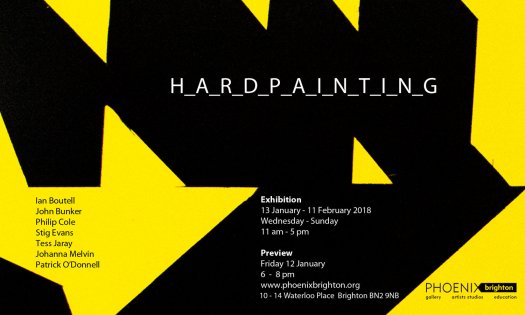


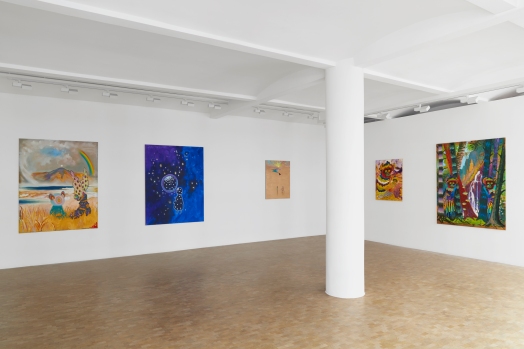

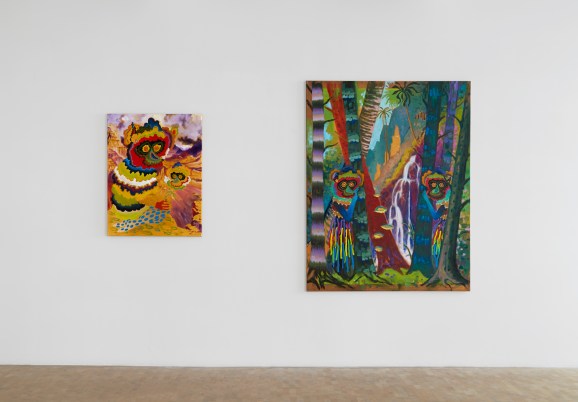
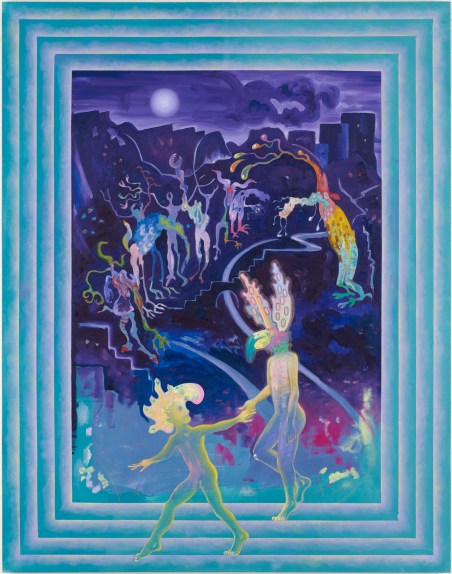

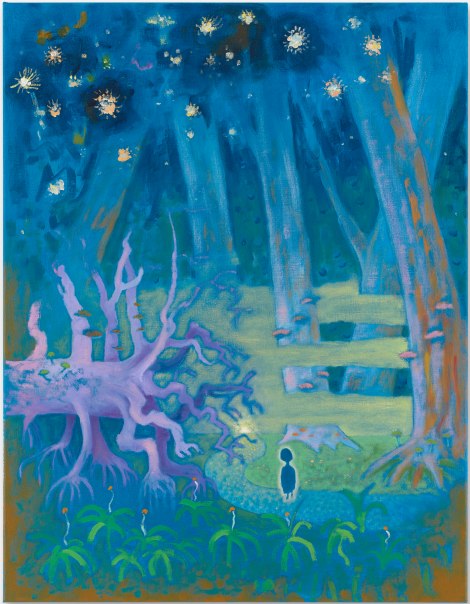


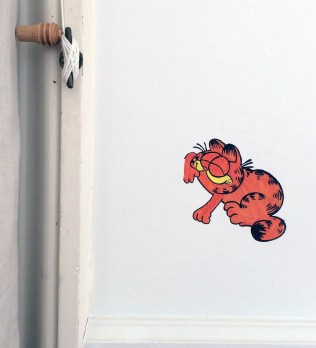


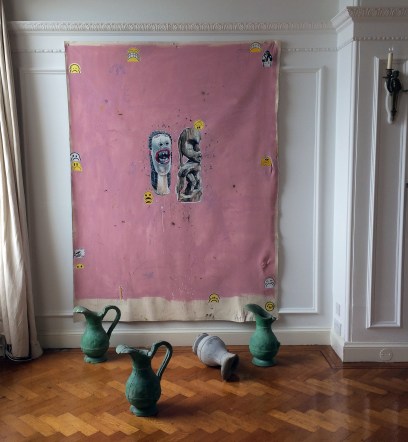
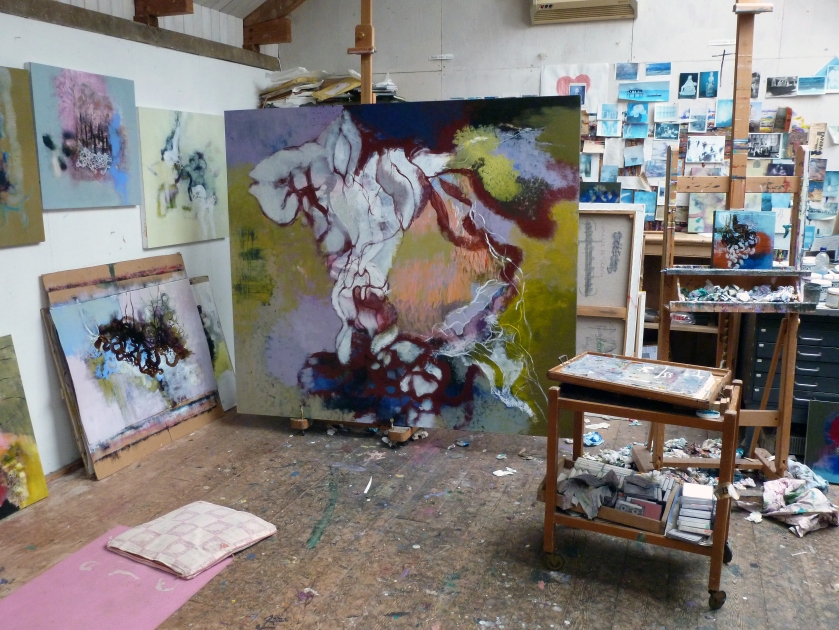
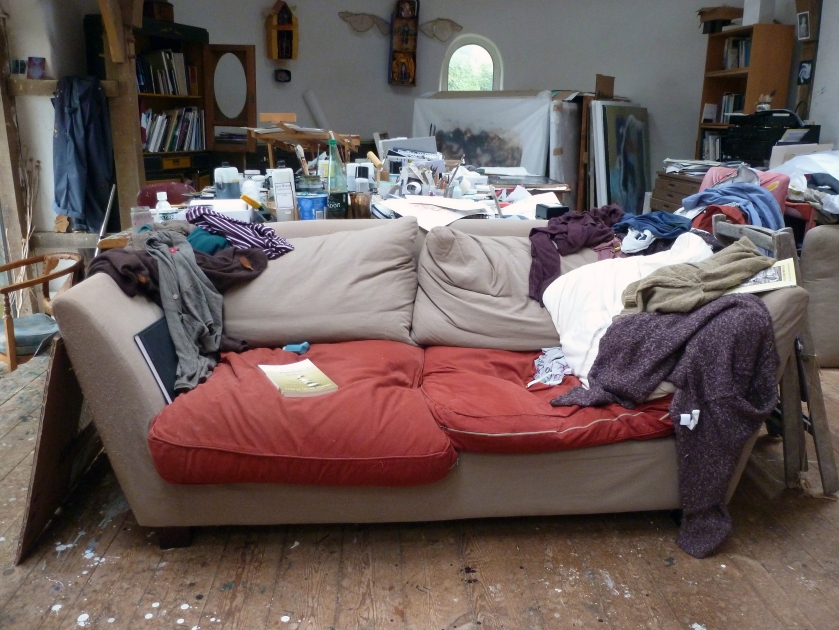


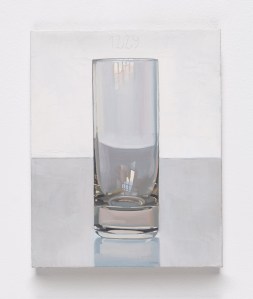

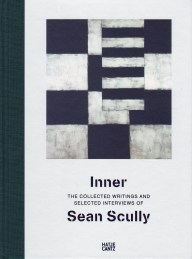

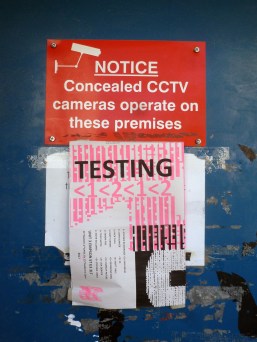
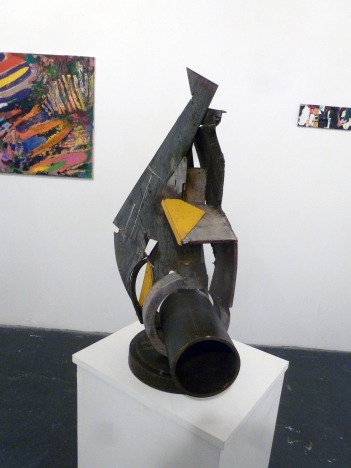
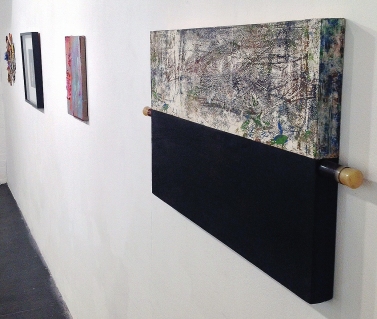
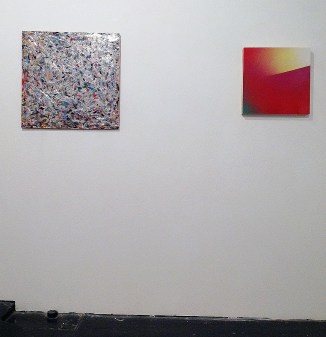
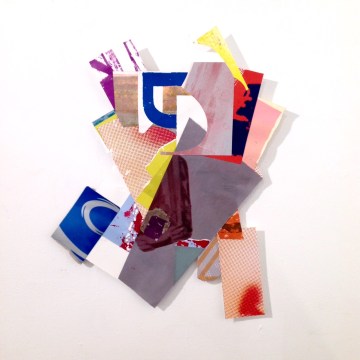
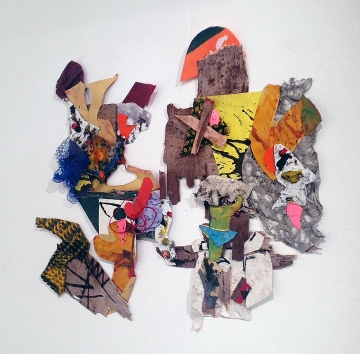
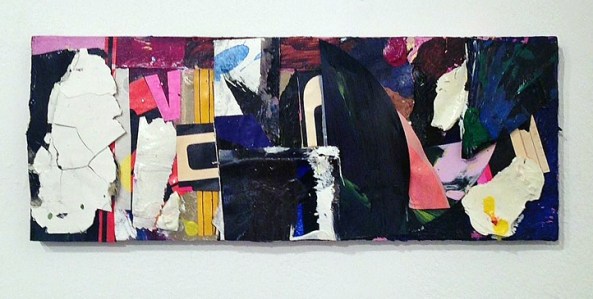
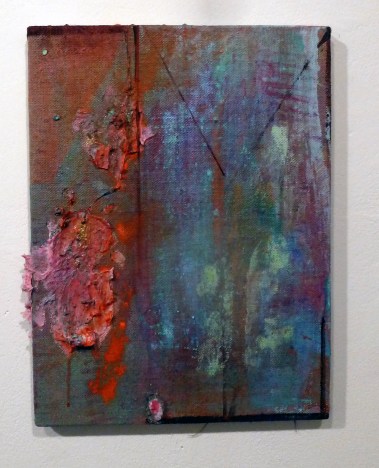
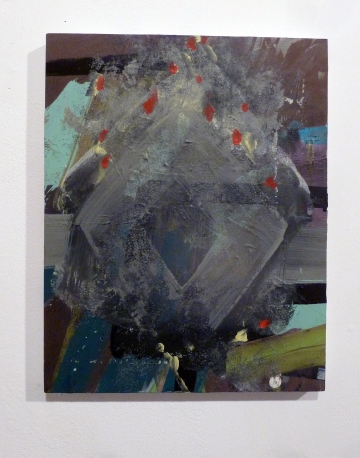
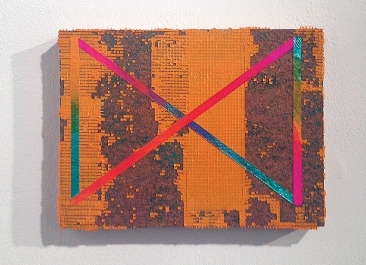
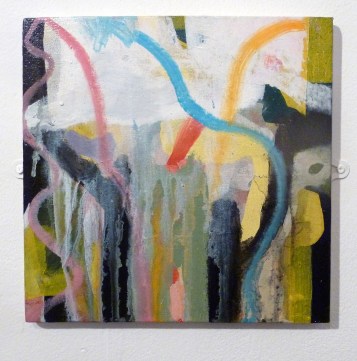
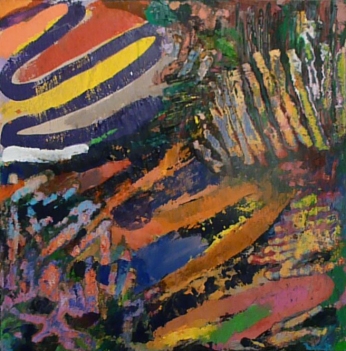
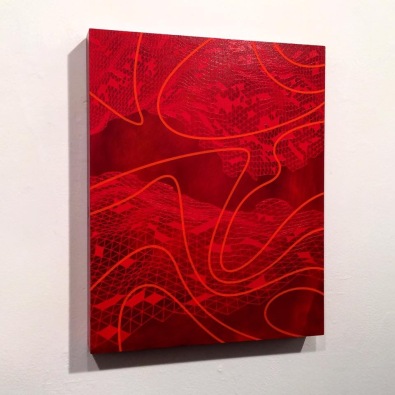
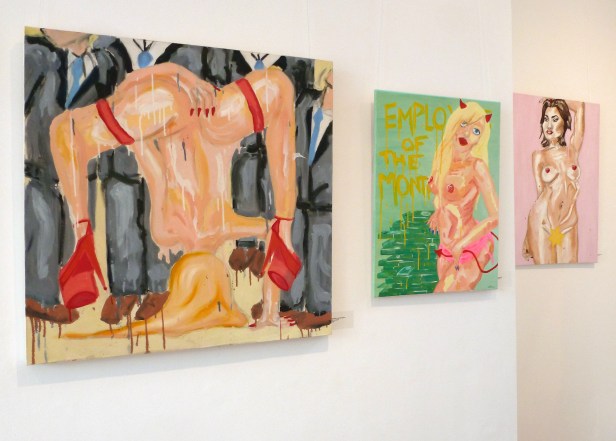
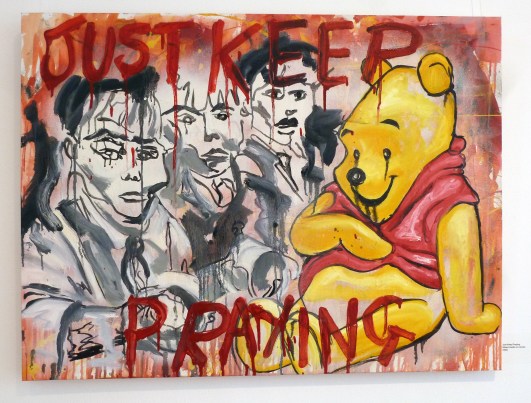




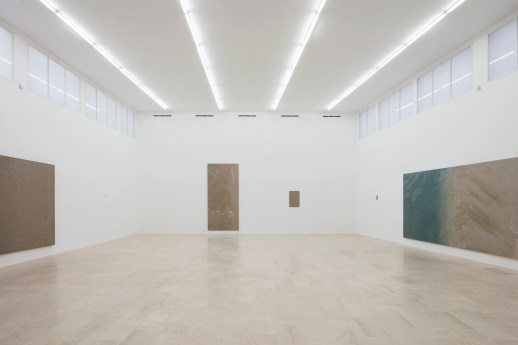
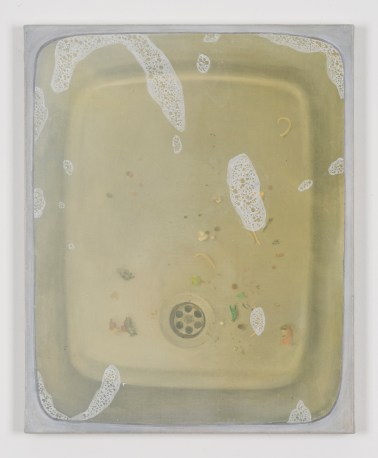


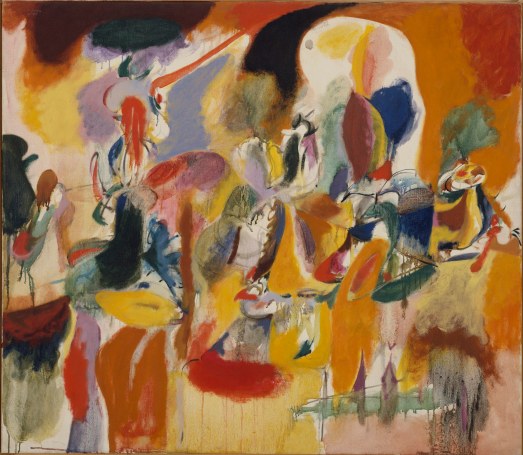
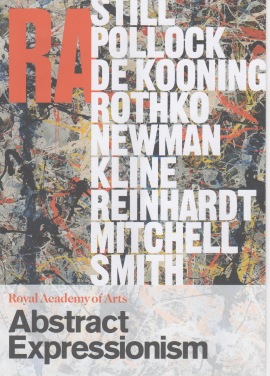
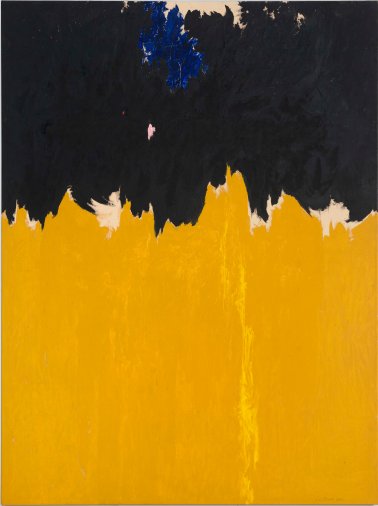
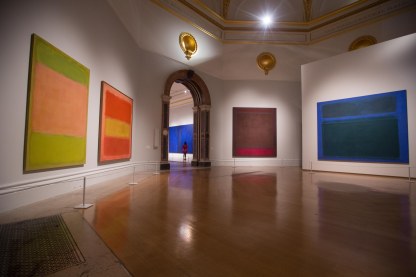
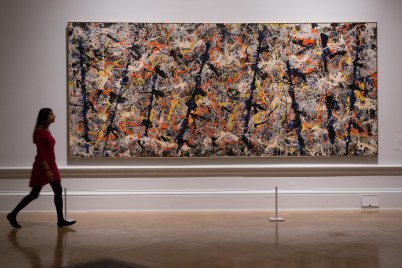
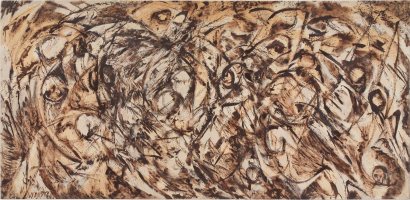
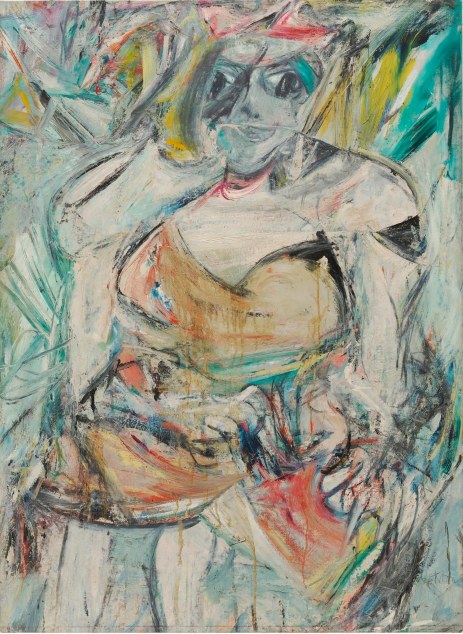
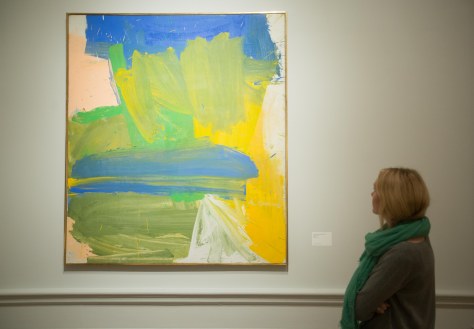
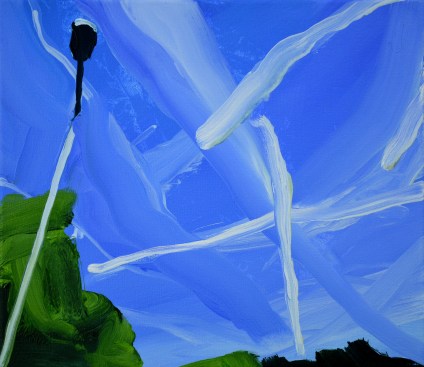






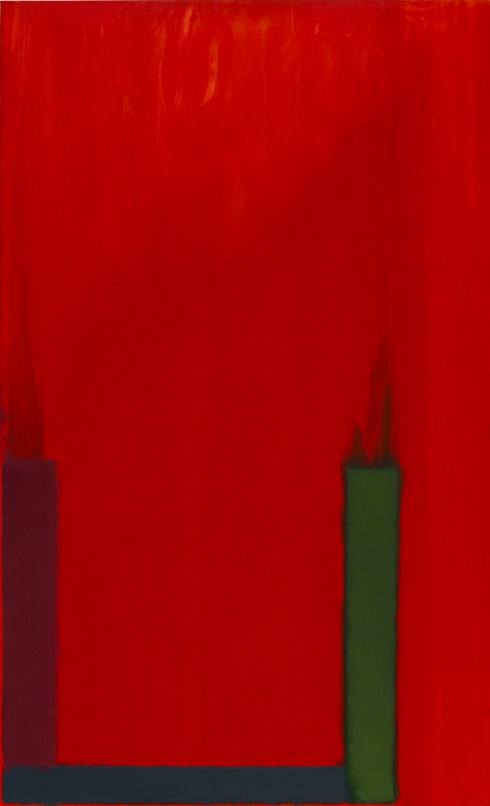
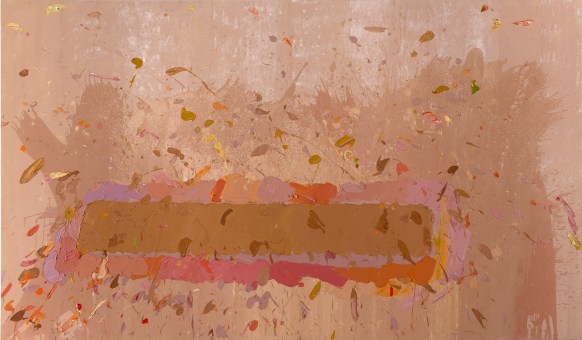


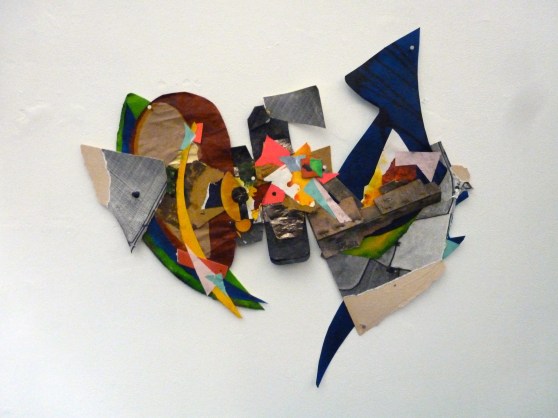

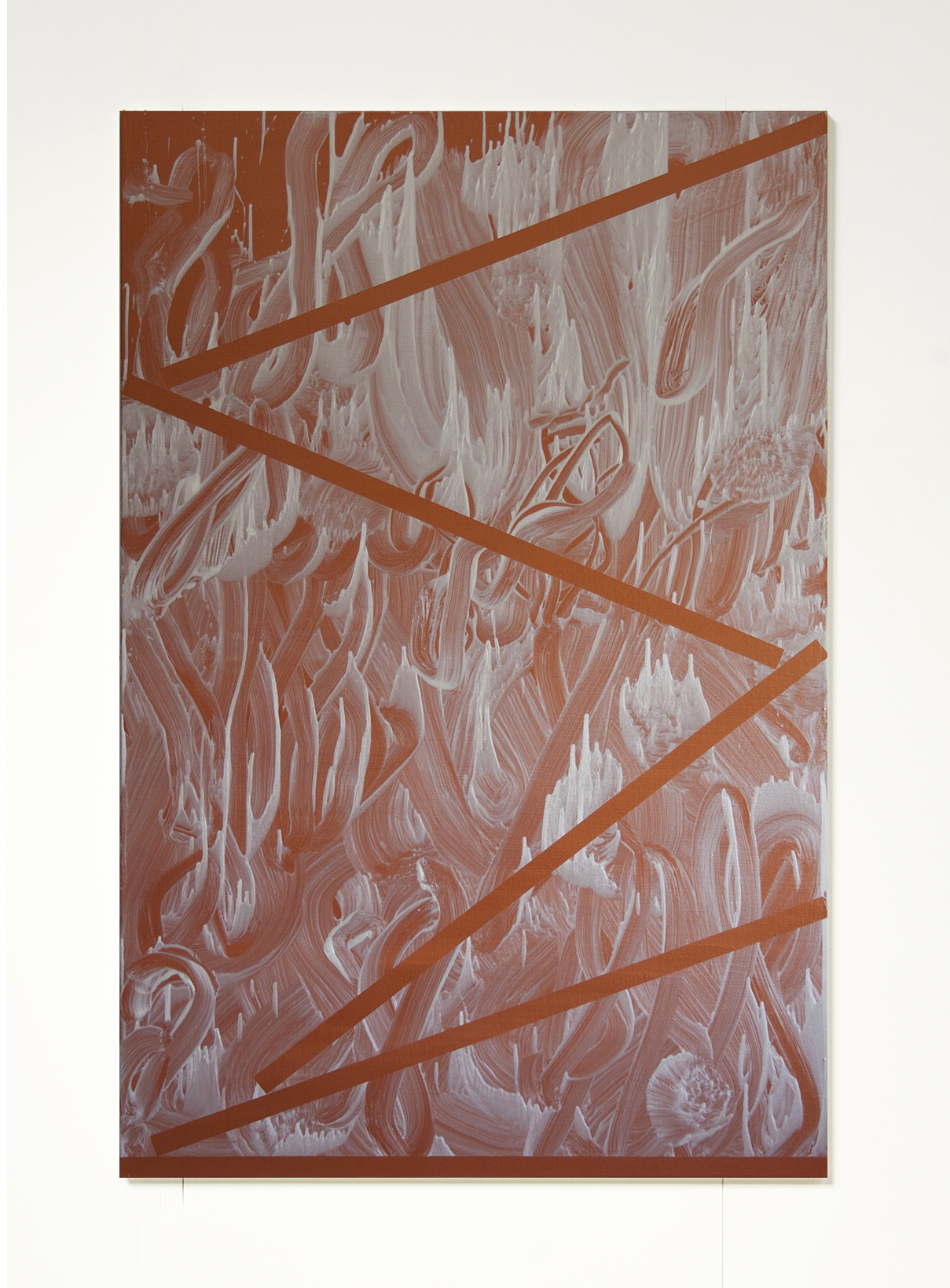


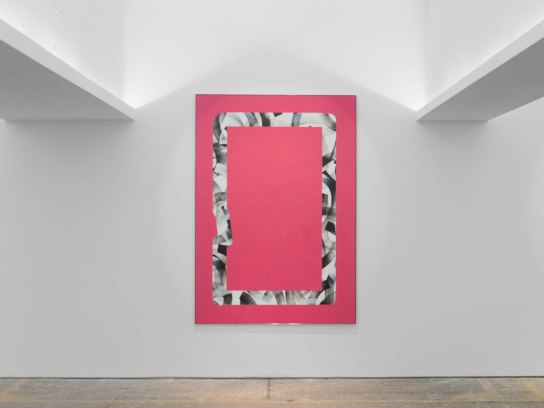


 Ruminations: Exhibition Reviews