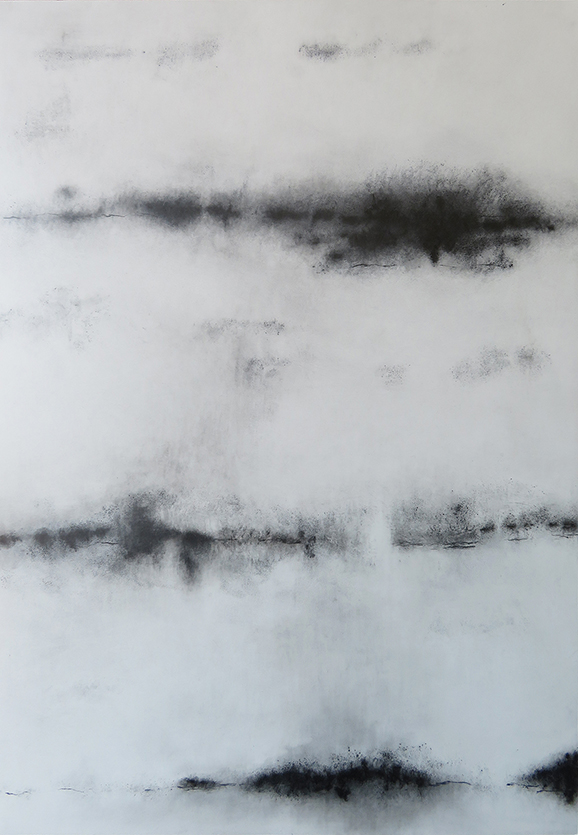
262 CHAIRS: Molly Stredwick and Becky Hancock

Coachwerks, Brighton

11 to 22 January 2023

“A work of art is a whole, and this whole contains many parts – the material out of which it’s made being just one of them. We could include the interpretive horizons of the art’s consumers, for example, and the contexts in which the art materials were assembled… In this way it’s obvious that there are so many more parts than there is whole.” (Timothy Morton)

Molly Stredwick

The chair in the art gallery has never been quite the same again since Joseph Kosuth presented, ‘One and Three Chairs’ (1965), in a Duchampian spirit of challenging the viewer to question representation in art. Subsequently we have learned, or been reminded, that everything is loaded with possible interpretations – especially when context is accounted for. A context that includes the viewer, of course.

Molly Stredwick (wall installation) and Becky Hancock (drawing and sculpture)

In 262 CHAIRS, currently installed in the Coachwerks exhibition space in Brighton, I find myself looking for a chair to sit on, as I need to rest awhile. Alas, this is not an option, which I find ironically amusing. But there are chairs galore in this warmly welcoming environment, thanks to the blazing log burner, which are represented in many drawings and two sculptures. Adam Spain, Exhibition Manager at Volt, Eastbourne, has neatly curated the exhibition, which may account for a certain ‘just rightness’ about a selective display that does not go overboard visually and presents enough physical content to engage the viewer.

The two exhibitors, Becky Hancock and Molly Stredwick (both graduates of Camberwell College of Arts) are presenting works that simply work well together. Not just because the apparent subject matter might be the same, but also because there’s an almost unassuming simplicity and innocence about the imagery as well as the means of execution. Though I suspect the content could be loaded.

Becky Hancock

Take Becky Hancock’s five drawings, for example, where each composition includes a pair of chairs placed at, what might be, a dining table. Domestic space suggests relationships, often about couples, and by extension, families. Here the furniture is, in a sense, naked. There are no figures directly represented, although the placement of, and spaces between, the various pairs of chairs are perhaps melancholy and at odds. The viewer might clothe these scenarios with their own imaginative interpretations or real experiences and any one of these drawings would be ideal to start writing a short story from in a creative writing class. The more visually dominant element in these drawings is the table, which distorts itself into angular hieroglyphs. The table might be a body that undergoes both voluntary and, as a domestic situation might dictate, forced distortions and poses – though not so much as a referee or arbitrator, but functioning as a victim of sorts. As sketchbook drawings, presented on the wall unframed, they might well function as studies for paintings or installations but they are intriguingly finalised statements that are impressive and compelling enough to be fully resolved outcomes per se.
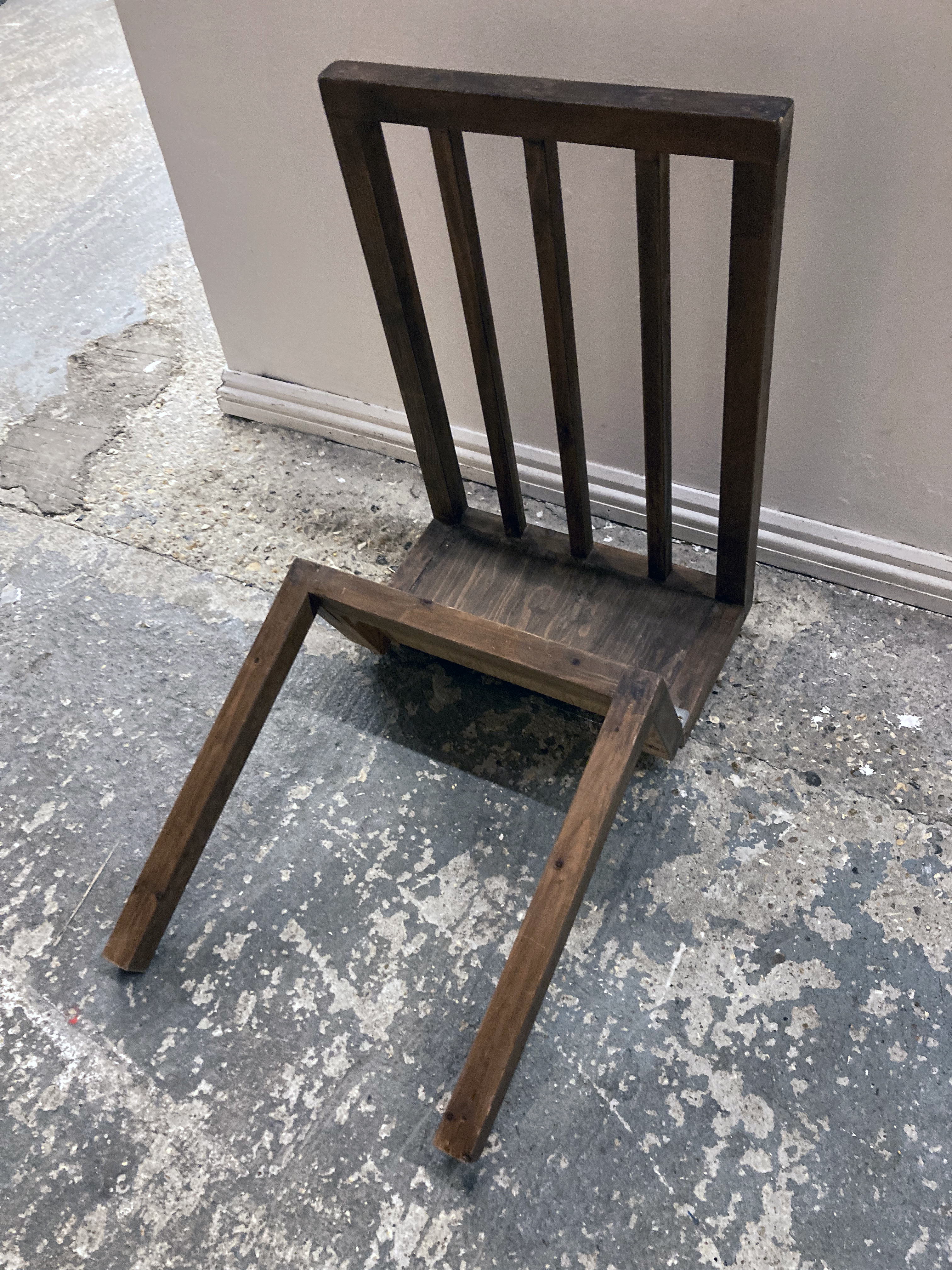
Becky Hancock

Also on display are two 3D pieces by Hancock. At first sight the viewer might read them as adjusted ‘real’ chairs. But they are human-scale simulacra. A chair can be an idea, a model, a prototype, an image, a word or even a functional item. Whatever a ‘chair’ has the potential to manifest itself as it can also be a sculpture, of sorts. These two pieces take on an anthropomorphic presence with one leaning forward, as if in prayer, adoration of the deity or submission, the other sat back in picnic mode – engaged in déjeuner sur l’herbe, perhaps. Either way, both are fallen, making a melancholic and downcast presence at the viewer’s feet. Or telling us that they are not really chairs, whatever our automatic reading probably is.

Molly Stredwick

Co-exhibitor, Molly Stredwick, has commandeered the largest, most expansive wall, upon which 176 small drawings of chairs are displayed (selected from a series of 251). These are, for all intents and purposes, imaginary chairs. The perspective is sometimes distorted, conventional three-point perspective reversed, or appearing to be floating or rendered flat without surrounding space or objects included. Any resemblance to Hancock’s 3-D chairs is superficial, though creating a coherent feel and appearance for the exhibition. This wall of 11X16 approximately postcard sized drawings might be a catalogue of chairs, but each is surely the same one, or maybe not, for very subtle personality traits might distinguish each speculative rendering. Drawn on G. F. Smith paper samples with the same red Muji Gel pen there is a suggestion of the series or the genus with variety being sight. The manufacturer’s printed text functions as an internal framing device too, with the different numbers, paper types and weight information changing along with the colours and the visual and tactile presence of the material. So what appears to be repetition and sameness calmly explodes into huge variety. In effect, this wall of assembled drawings functions as an installation that can be viewed as a whole grid-type shape or as individual drawings that must attract viewers to any one sample or part, which is nevertheless complete in itself.

Becky Hancock

In his book, ‘Being Ecological’, Timothy Morton has explained that an ecosystem of parts and wholes is an environment of “just lifeforms and their extended genomic expressions: think of spider’s webs and beaver’s dams.” That’s what artists do; they make their respective webs and dams alongside and sometimes in collaboration with others (or curators make the connections). The viewer is part of the situation too; not so much caught up in the web, as one of its constructors.

Note: Both quotations from: Morton, T. ‘Being Ecological’, Pelican, 2018 (p.113)
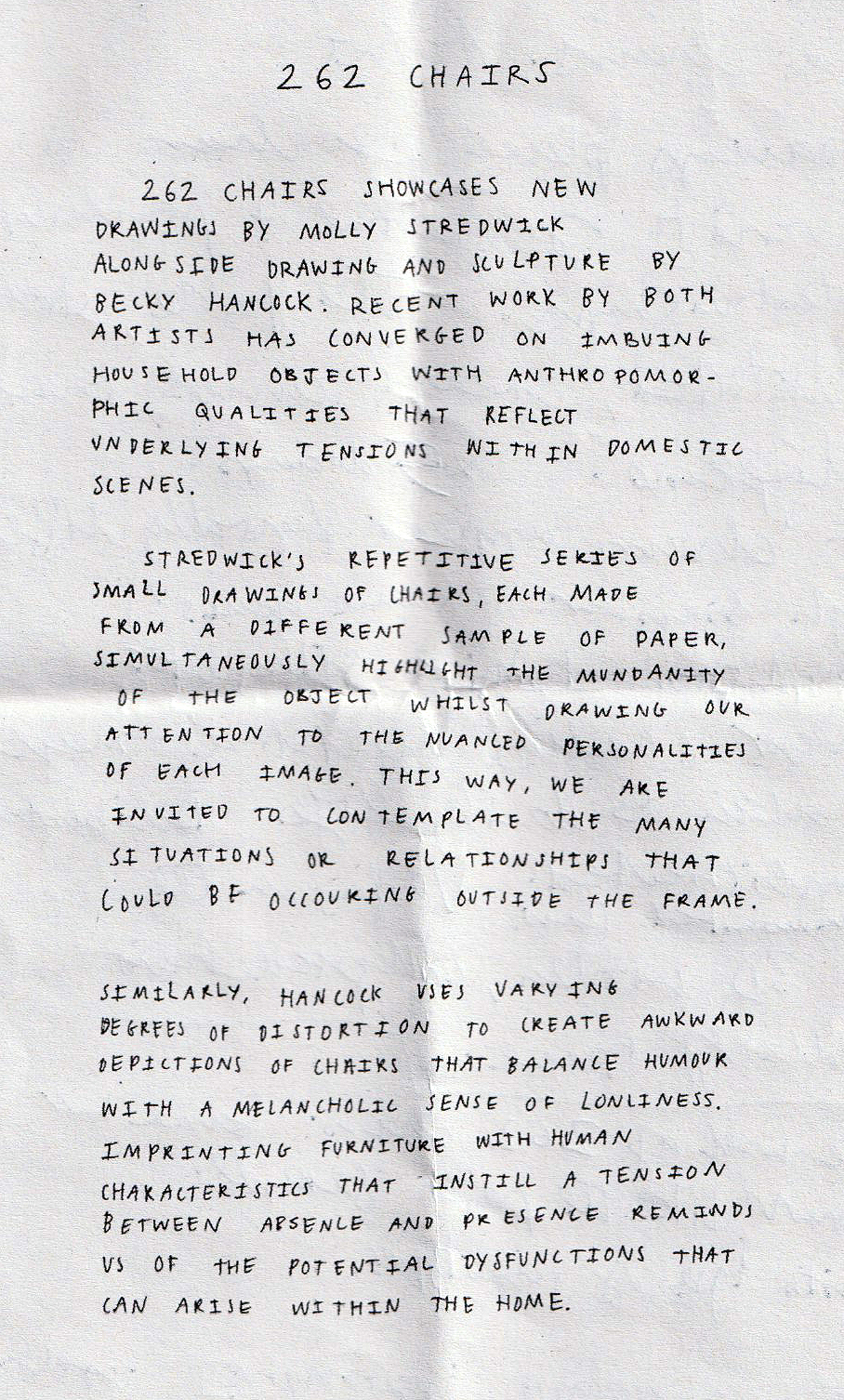
From the 262 exhibition leaflet

Links:

Becky Hancock – https://www.becky-hancock.com/bio

Molly Stredwick – https://mollystredwick.com

VOLT Eastbourne – https://www.volteastbourne.org.uk

G. F. Smith – https://gfsmith.com

Muji Gel pens – https://www.muji.eu/uk/stationery/stationery-gel-pens

MOMA – Joseph Kosuth – ‘One and Tree Chairs’ – https://www.moma.org/collection/works/81435
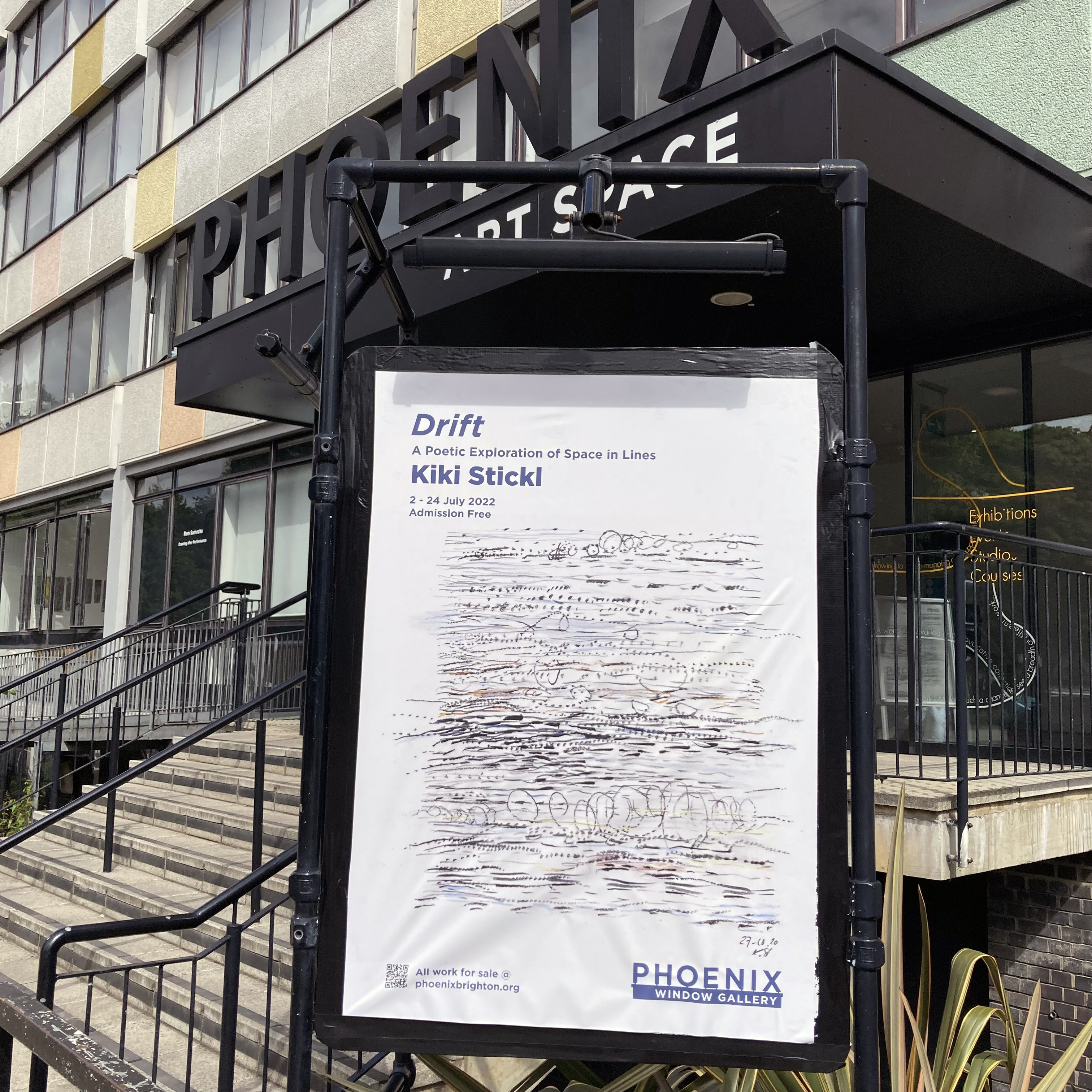
KIKI STICKL: Drift

A Poetic Exploration of Space in Lines

At Window Gallery, Phoenix Art Space, Brighton

2 – 24 July 2022 (Wednesday – Sunday, 11.00 – 17.00)

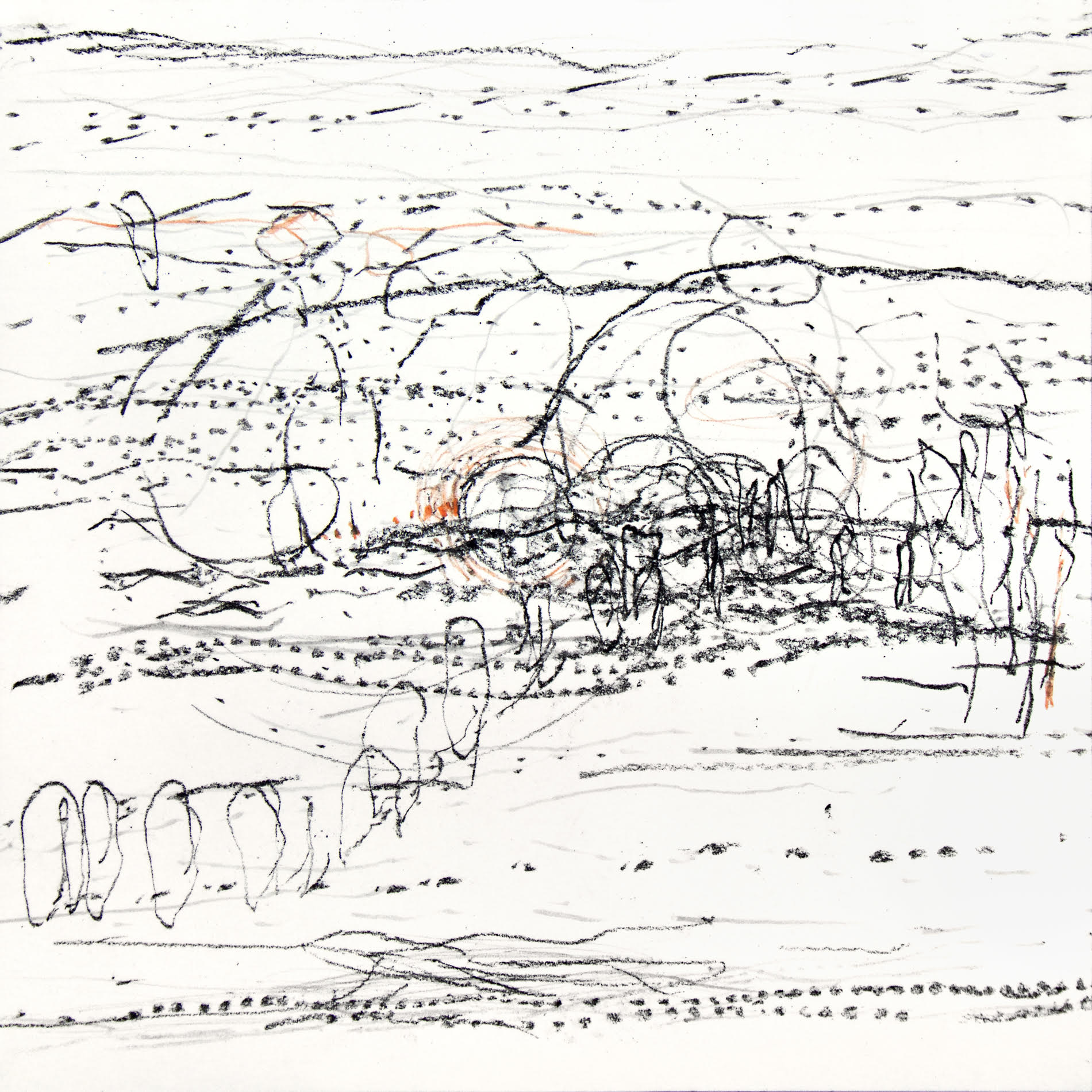
Outer space is right here, right now. It’s in front of us and in us, one and all – for there’s an inner space too. In terms of individual consciousness the two may as well be the same. When we think, we travel too, even if we remain physically still. When there is nowhere left to go, when we are trapped, marooned or sheltering from the storm we can rely on mental space. Still, but adrift in time, when memory kicks in to take us out of ourselves there is a palpable sense of space as an extension of self. Such are the conditions of splendid isolation, afforded most recently during the early months of the global pandemic.

Kiki Stickl – ‘Breath In Breath Out V’, 2020

Kiki Stickl clearly made the most of her own experiences of her family’s six months spent in countryside near Munich during the first lockdown in 2020 when she produced her ‘Breath in Breath out’ series of drawings, several of which appear in Drift. Here she encountered ideal conditions for creativity: time and space, duration and environment – and possibly sound as well – especially when the world is hushed. In fact, as I awoke on the morning after seeing Drift being installed at the Phoenix Art Space a couple of days before the opening I was semiconsciously thinking of Stickl’s drawings as visual soundworks. Not necessarily apropos Cage’s 4’ 33”, but literally, and deafeningly, silent. Stickl’s drawings suggest small arenas of silent sound consisting of visual counterpoints, full of emptiness inviting a form of meaningful mark making as an abstract response to recalling time and space. These are drawings made as an end result as they are not subservient to, or necessarily leading to painting as might traditionally be the case. Stickl conjures drawings from a meditation in the everyday physical realm of being that amount to sensory, environment-based studies. From a landscape environment to the literal sheet of paper that she works on, the drawings map out themselves. Sometimes she cuts the paper to reference, literally, a sense of layering as well as amalgamating marks on the paper surface as a form of recording what has been seen and remains to be seen: Cartesian, with Buddhist overtones.

Kiki Stickl – ‘Breath In-Out (A Walk)’, 2020

Drift presents 19 works. One is a temporary wall drawing (employing paint); another is a painting (titled, ‘Lines of Disruption’); plus seventeen square format drawings on paper, simply but immaculately framed. The painting is placed in the adjoining coffee shop, but cannot be missed on the main show wall as a little taster of her painting practice. The wall-based work, ‘Drift’, at about two metres square, is the centrepiece in the long Window Gallery space. Composed as an essentially linear structure from two tones of grey paint on the white wall, with the addition of ground up glass beads applied to the lightest grey paint when it was still wet, the darker grey mass suggests a resting figure, perhaps in meditation pose. An ephemeral, time-based work such as this will disappear at the end of the exhibition later this month. This work, therefore, demands that we hold it in our memories, just as we may do from our personal experiences of places beyond the gallery.

Kiki Stickl – ‘Breath In Breath Out (Cosmic Matter)’, 2020

The bulk of the show consists of the drawings that have been selected from a much larger body of works, the aforementioned ‘Breath in Breath out’ series. From drawing to drawing, as they are arranged in blocks and rows, there is great variety of imagery and mark making. Subtle use of colour is occasionally employed, although they still read as essentially monochrome iterations. In many, linear rhythms consisting of scribbles, dots and short or flowing lines are accumulated suggesting light and weather conditions. Forms are deconstructed to some extent, invoking that sense of recall that does not rest, preferring flux and instability as performative, shorthand approximations. Imagery that might be solid is no longer fixed as a conventional photograph might replicate for the viewer. The paper cut-out sections present voids and absences, shadow and light, useful contrasts and visual paradoxes. Implied shapes and lively line is reductive though essential as imaginative remnants of remembrance celebrated. These are motion pictures, mapping the psyche as much as the terrain.

Kiki Stickl – ‘Breath Walk Dance’, 2020

Stickl is not so much taking a line for a walk (re: Paul Klee) as inventing and playing with accumulations, sometimes in counterpoint mode, un-egotistically presenting a notion of drift through time and space.

Geoff Hands

Links:

Phoenix Art Space – https://www.phoenixbrighton.org/Events/kiki-stickl-drift/

Kiki Stickl – https://www.kikistickl.com

TANIA RUTLAND: Chip of flint – fragment of chalk

Tania Rutland: Chip of flint – fragment of chalk

Window Gallery, Phoenix Art Space, Brighton

2 – 24 November 2019

TR - Poster

‘Crowding the solitude’, ‘Ghost white path’, ‘Night’s first light’, ‘Silent reach’ and ‘Restless lane’ might be headings in a list of poems from a collection that constituted a volume of landscape inspired verse, but they are selected from the titles of drawings and prints from Tania Rutland’s exhibition at the Phoenix Art Space.

Another title, ‘Chip of flint – fragment of chalk’, makes reference to commonplace Sussex downland geological material that could have been gathered from her visits to Iron age Mount Caburn and Neolithic Cissbury Ring in East and West Sussex and is the intriguing title of this exhibition.

040 - TR - Chip of flint - fragment of chalk (28x21cm) pencil and graphite on paper.jpg
Tania Rutland – ‘Chip of flint – fragment of chalk’ (28x21cm). Pencil and graphite on paper.

The very idea of a ‘chip’ or a ‘flint’ suggests the collection of a memento, a physical token from a walk, picked up to place on a shelf when home. Such an item might be revered as a memory of a time and place spent in solitude or with a partner or friends from a Sunday walk. The cultural pursuit of walking might be a form of escape from everyday life, most especially the ‘working week’. A leisurely stroll or demanding hike, especially in the countryside, can be rejuvenating and refreshing. It might also be consoling during a time of stress. A walk is healthy for both mind and body; and for a landscape artist a place for research, inspiration and hard work.

Though superficially a landscape exhibition, on reflexion, ‘Chip of flint – fragment of chalk’ is loaded with speculative and thought provoking possibilities enabling the visitor to take away the non-physical souvenir: not to be placed on the mantelpiece but constituted in the form of ideas to consider and discuss further and, ultimately, leading to environmentally focussed action.

From the very start of the corridor space Window Gallery, making a de facto antechamber, two wall-mounted assemblies of small, unframed, preparatory drawings make it clear that drawing is at the core of Rutland’s practice. As an introductory display, sufficient in itself as a stand-alone exhibition, the 28 studies make an implied proposition that drawing is still of paramount importance towards painting, especially in landscape art. Whilst an en plein air approach is also possible, the drawing in advance of the essential schema for a final painting, even without colour content, provides the opportunity for intense consideration of composition and content; and for revision of the essential rectangular format. Rutland’s methodical approach also develops the initial ‘sketch’ to a more ‘finished’ state and therefore requires a more prolonged period of execution. In this respect, the lengthening of time to make what might simply become no more than a preliminary part of production, adds to the inherent conceptual aspect of Rutland’s greater project, namely that of time and duration.

001 - TR - Untitled 1 (Fatigue of early light - Mist's cover) (14x16) prep drawing
Tania Rutland – ‘Untitled 1 (Fatigue of early light – Mist’s cover)’ (14x16cm) Preparatory drawing.

Annotated on half a dozen of these relatively intense drawings are more titles, including: ‘Ghost lines’, ‘Eroded slope’, ‘Frozen light’ and ‘Fatigue of early light’. Without mounts, but with clearly measured and demarcated perimeters for consequent development into paintings, these studies may have come straight from the studio wall in her Phoenix studio. This informality in presentation might have initially diminished an observer’s attentive reaction to these works, but throughout the opening evening many visitors could be seen both standing back to view each of the two groupings of drawings and then be observed stepping closer to scrutinise each image as if through a magnifying glass. In relation to time a second aspect, that of concentrated visual observation of various locations, loaded with evidence of human interaction in and on the land (and sea), also implied itself in the bigger project.

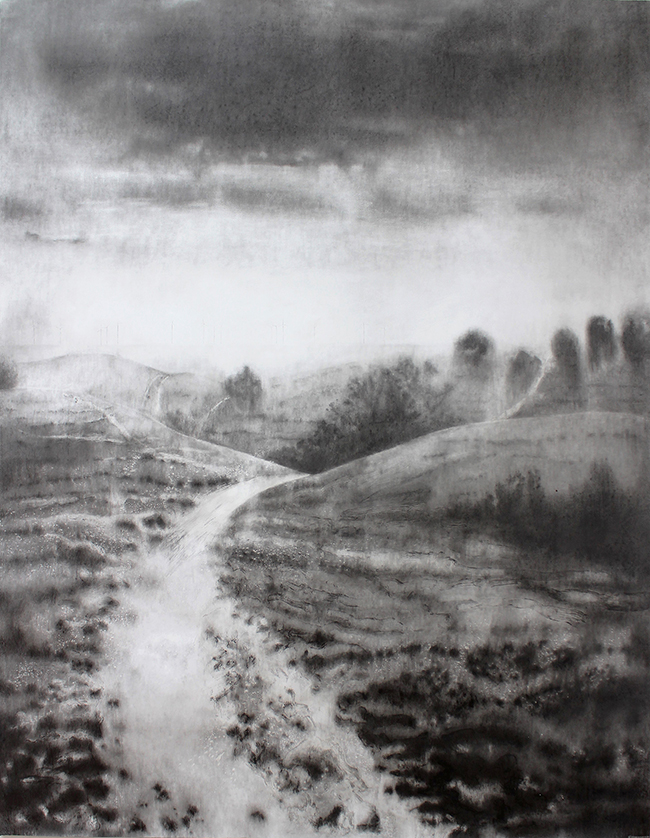
029 - TR - White ghost path (200x150cm) pencil and graphite on paper.jpg
Tania Rutland – ‘Ghost white path’ (200x150cm). Pencil and graphite on paper.

Continuing into the main display space the biggest piece in the show first greets the visitor in contrast to the small studies just encountered. The pencil and graphite ‘Ghost white path’ impresses not just by size alone (200x150cm), but also by a display of controlled elegance in mark making and an example of compositional skill in which the viewer might literally fall into this Downland vista. As a completed drawing, ‘Ghost white path’ is as consummate and exhaustive as a painting might be and therefore expands the notion of drawing as going beyond the supportive role that it often takes.

In this significant work the viewer will certainly gain a sense of the past and the present day in one hit. In the bright distance, where the intense light dissolves the sea from sight, the Rampion wind farm turbines that now dominate the view from the Sussex coast have been recorded. Whether these technological structures please the viewer or not, like the telegraph poles we may barely notice anymore, or the electricity masts that cannot always be buried beneath the ground, we will inevitably have to become accustomed to this burgeoning technology for generations to come.

The past and present (an ancient landscape and an off-shore development) combine in one monumental vista so that a viewer has to contemplate a challenging and controversial journey to the future in this era of climate change awareness and necessary proactive behaviour.

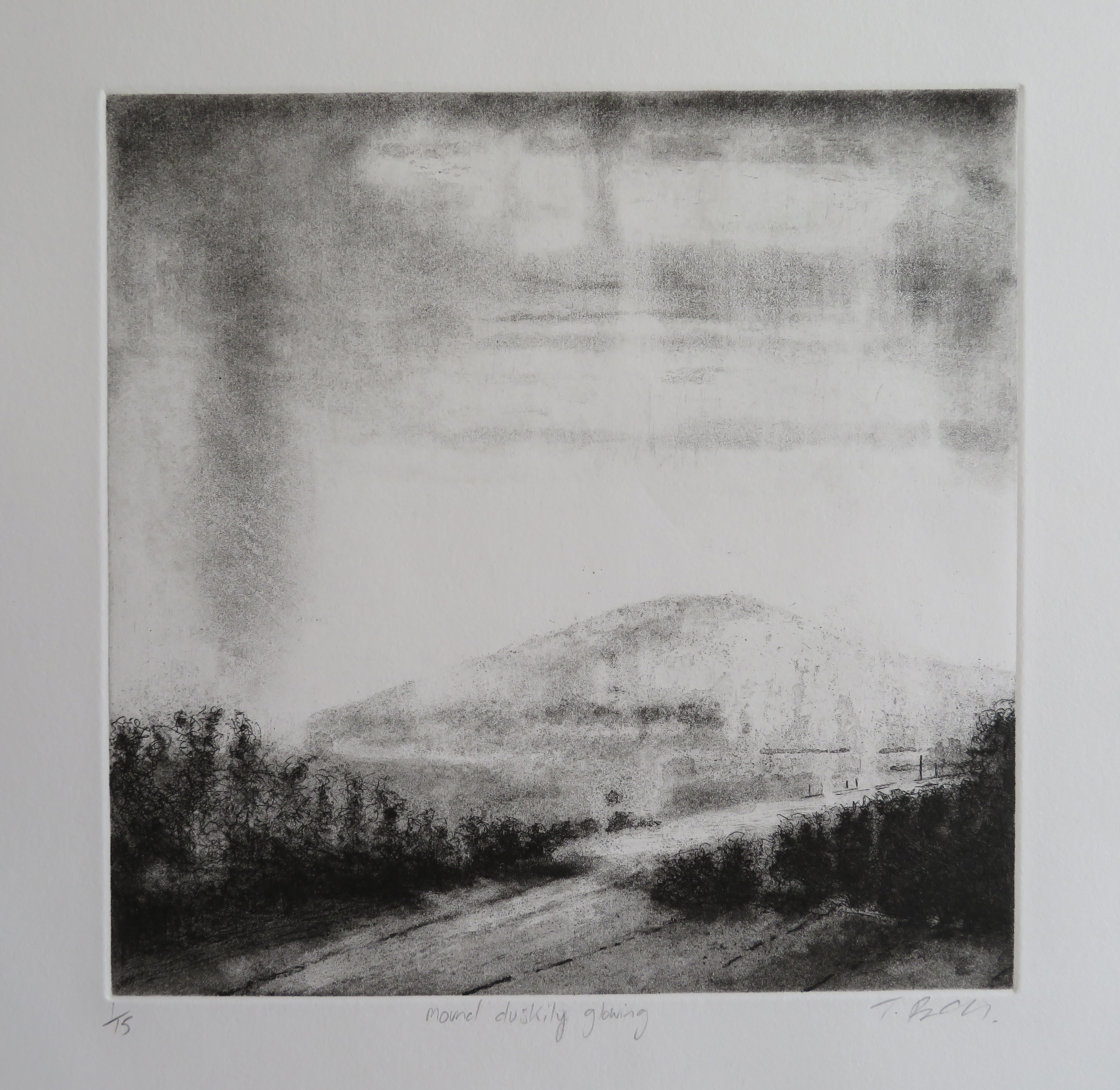
031 - TR - Mound duskily glowing (24x24cm) etching.jpg
Tania Rutland – ‘Mound duskily glowing’ (24x24cm). Etching.

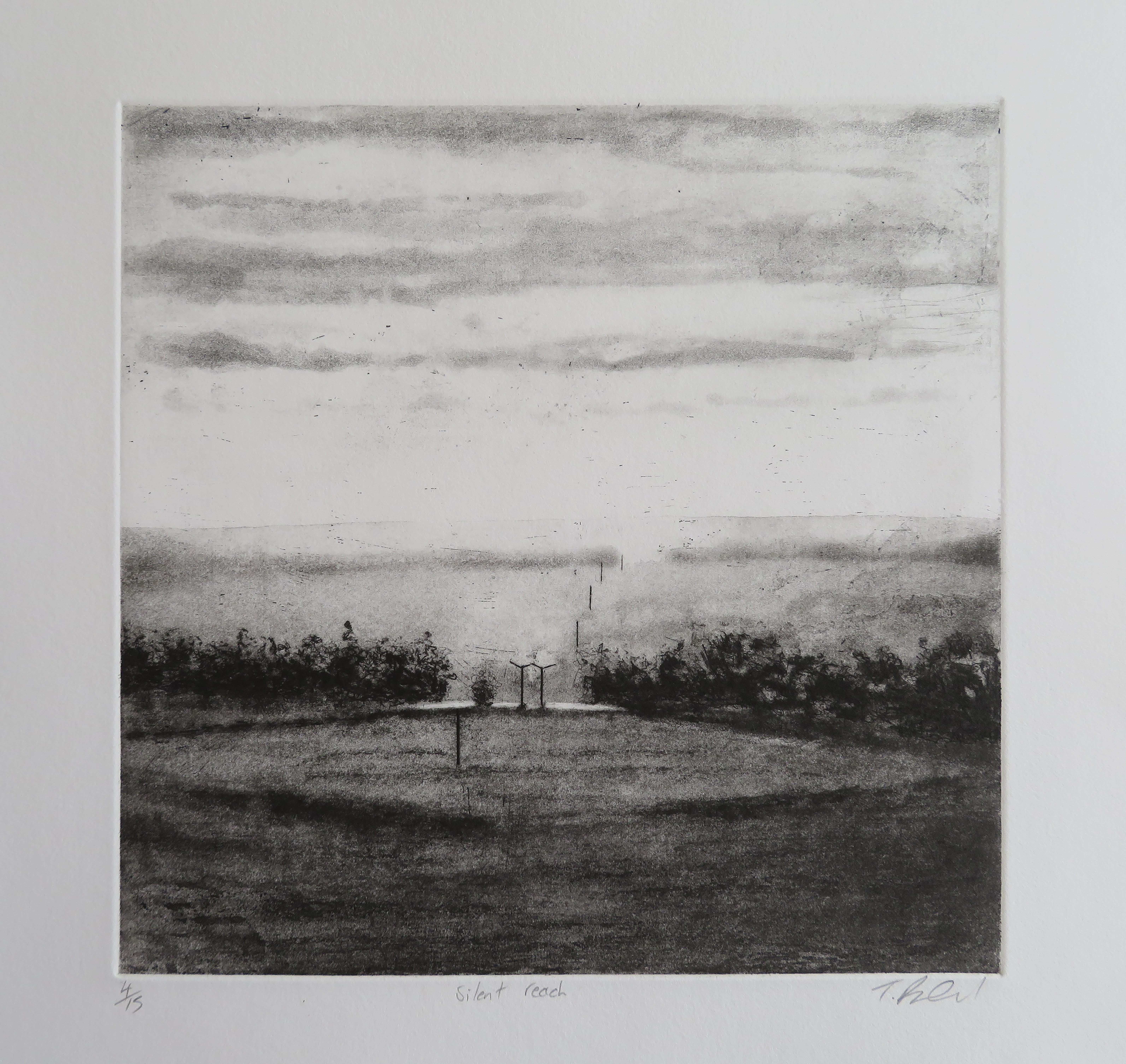
Four monochromatic etchings are displayed next, including ‘Mound duskily glowing’, a title merging topography with time and light, which again suggests a poetic counterpart (a haiku perhaps) that may one day be written. In ‘Silent reach’, telegraph poles located in a flattened mid-grey rhombus in the central area of the composition leads the eye from foreground to mid-distance. The poles could be traversing alongside a coastal area, or trace a communications route a few miles inland, leading to the next village or town. Very few regions of this relatively small island will be without such evidence of human habitation, as if such evidence of technology was as natural a phenomenon as the trees.

033 - TR - Silent reach (24x24cm) etching.jpg
Tania Rutland – ‘Silent reach’ (24x24cm). Etching.

With a change of process and medium Rutland allows a weathered, washed-out look in the thinned ink layers transferred from the surface of the metal that she has etched with. For example, in ‘Selvedge edge’ the distant hills are visually subject to mist dissolving form, whilst rain falls as weather conditions change appearances. In the bottom section of the image fence posts create a small enclosure, a signifier of order and land ownership. A telegraph pole, like a crucifix, in middle ground, merges at its base into foliage. Dark parallel lines in the foreground, perhaps suggesting the selvedge edge of fabric for the title, foretell the flint seams in the set of the four ‘Flint Seam’ drawings that are to follow.

032 - TR - Selvedge edge (24x24cm) etching.jpg
Tania Rutland – ‘Selvedge edge’ (24x24cm). Etching.

These more minimalist compositions, ‘Flint seam 1, 2, 3 and 4’, are placed at the centre of the show. They are undoubtedly complete in themselves but may well hold the prospect for further development as abstract paintings. Each is placed behind a clear acrylic sheet, rather than mounted in a conventional frame. Like its counterparts, ‘Flint seam 2’ is composed of a series of vertically placed horizontal bands of smudgy, burnished graphite drawn on to a gesso (i.e. chalky) coated, paper ground. Within these thin, dark, cloud-like strata are more defined linear marks suggesting a compressed handwriting with a slightly nervous, quivering organic edge.

035 - TR - Flint-seam 2 (66x46cm) pencil and graphite on gesso paper.jpg
Tania Rutland – ‘Flint seam 2’ (66x46cm). Pencil and graphite on gesso paper.

These often flat and smooth, mark-like shadow shapes are found in split flint nodules originating from sedimentary chalk that litter the farmland in Sussex and have been used as building materials for walls and buildings since the Roman era. Further back in time flint was fashioned as a Stone Age tool. But way beyond any human presence on earth they are a literal compression of geological time and materiality that seems beyond comprehension and may well suggest a natural kind of drawing. Dark and wave-like, these markings made from the chalk seabed reveal fissures of implied energy. As a form of visual poetics, the past is metaphysically now in these teasingly simple, but thought provoking and elegant drawings.

039 - TR - Crowding the solitude (28x21cm) pencil and graphite on paper.jpg
Tania Rutland – ‘Crowding the solitude’ (28x21cm). Pencil and graphite on paper.

At what appears to be the end of the display, a group of five framed drawings (including the title piece of the exhibition) are presented in suitably mounted and framed studies that, like the etchings, read as ‘finished’ works. They include ‘Crowding the solitude’ which is a similar composition to the aforementioned ‘White ghost path’. In the mid-ground the land builds steeply to two bulbous hills; to the right on the implied horizon are the perspectival rows of 14 vertical masts from the Wind farm out at sea. In the space between the hillocks, and particularly on the left hand feature, is a meandering configuration of chalky pathways. The closer foreground is patterned by a gentle arrangement of subtle tones that visually pock mark the paper surface. The notion of the landscape as corporeal and libidinous is difficult to deny.

042 - TR - Flint (42x42cm) pencil and graphite on paper.jpg
Tania Rutland – ‘Flint’ (42x42cm). Pencil and graphite on paper.

The last of these five drawings is titled ‘Flint’. Initially it could be a drawing that goes unnoticed, such is the insistent or subtle presence of so many of the other works. One feature, however, hooks the gaze as one might head for the coffee bar and the prospect of seeing a painting from Tania Rutland. Within this rendering of what may be a recently ploughed and almost featureless field, a tiny but visually dominant grid-like structure interrupts the shallow curve of the land, just before the dark masses of a thicket of trees on the close horizon, revealed contre-jour, emphasising a sense of infinite space beyond. Its identity is a mystery: could it be a wooden or metal framework? From the bottom right-hand corner of the drawing a purposely trodden pathway leads to the unknown construction and it could be that the track across the field has been rendered into the surface by either animals or humans.

043 - TR - Remote dwellings (40x40cm) oil on canvas.jpg
Tania Rutland – ‘Remote dwellings’ (40x40cm). Oil on canvas.

Outside of the Window Gallery, but in a suitable display space that extends all of the exhibitions, one of Rutland’s oil paintings, ‘Remote dwellings’ is presented on a dark grey wall. This provides an example for those who do not already know her work and is now interestingly and more than adequately informed from seeing the drawings and prints. One painting is probably just enough exposure in this context and holds out the prospect of seeing a future exhibition of Rutland’s paintings.

Significantly, this work in the more ecologically minded attitudes of society today is made more potent by its combined references to the past, present and future. The human conquest of the environment is, of course, aided and abetted by the genius of technologies, open to interpretation and revision. The drawings and prints presented in ‘Chip of flint – fragment of chalk’ not only record and reflect the history of particularly special locations, but provoke the observer to contemplate the future too.

Geoff Hands (November 2019)

All images © Tania Rutland

Links:

Tania Rutland’s website – http://www.taniarutland.com

Phoenix Art Space – https://www.phoenixbrighton.org/events/tania-rutland/

Rampion Wind Farm article from The Guardian –

https://www.theguardian.com/commentisfree/2017/nov/11/brighton-rampion-wind-farm-turbines-renewables