At The Hayward Gallery, London
October 4 to December 30 2007
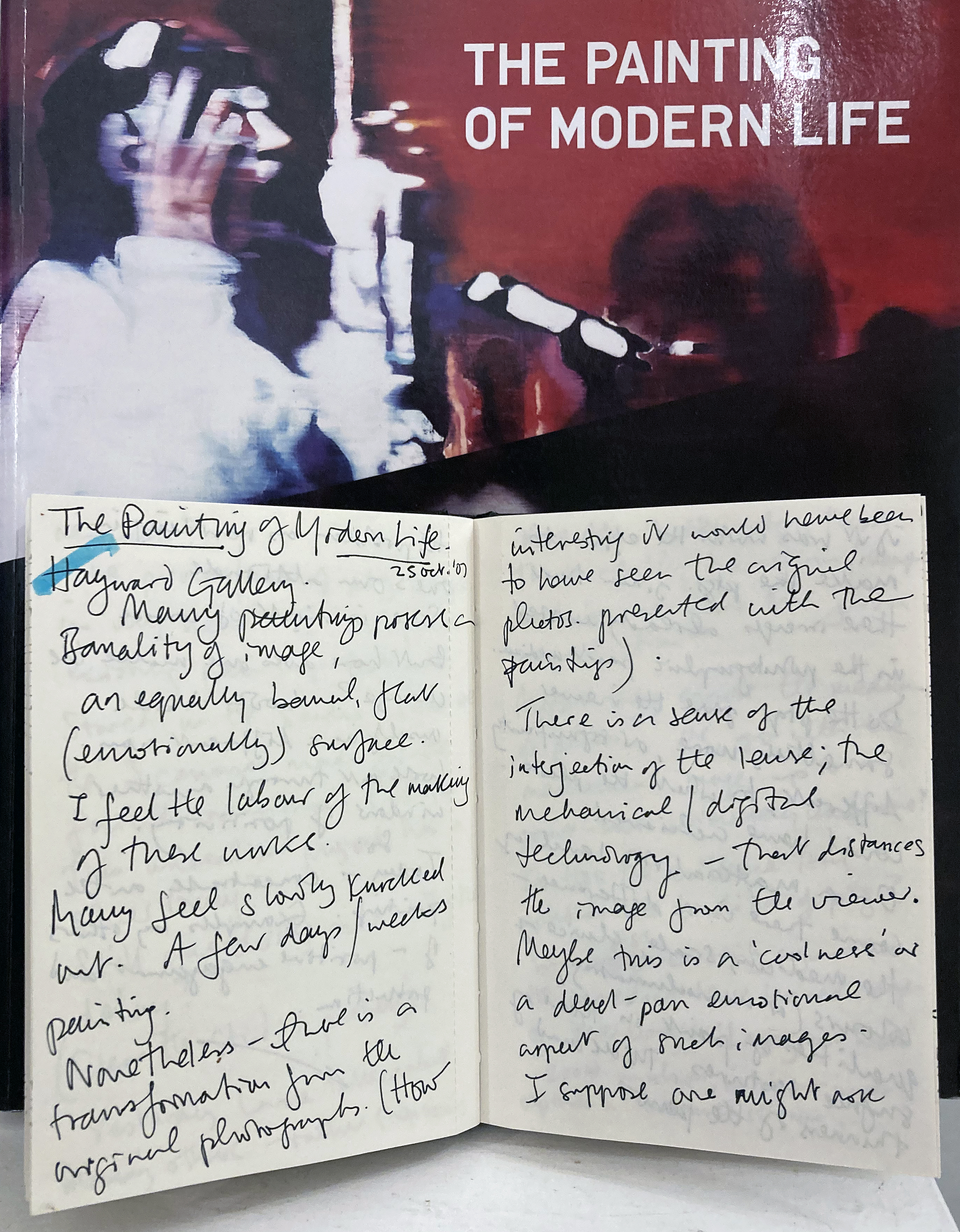
As a painter, I love to write as part of the painting process. I have kept handwritten studio notebooks (Journals) since 1995, which I am intermittently word processing (18,000 words so far – about two thirds of the content, I estimate).
This adjunct to the painting commitment was taken to a more formalised level by studying on the M.A. Creative Writing programme at the University of Sussex (1998-2000) whilst I was course leader for the Foundation Studies Art & Design course at Northbrook College in Worthing. The painter Mary Lloyd-Jones, who knew Prof. Peter Abbs the course director, recommended the course at Sussex to me. This shift from one educational field of study to another might have been rejected out of hand, but as an avid fan of Patrick Heron’s paintings and writings I could see that these two disciplines were not incompatible (although Heron eventually put a hold on his writing for the sake of maintaining enough time to devote to his painting).
I have been considering including some extracts from the Journals here on fineartruminations but have been unsure where to start (chronologically seemed logical but did not appeal). Throughout the seven books filled with my scribbled thoughts (I have no.8 in progress at the studio) I had also made a few notes on exhibitions visited, but have largely left these observations out of the typed up version as they were not written in the studio. But in Journal no.5 I came across a very lengthy set of notes written after attending The Hayward Gallery on the Southbank in London for The Painting of Modern Life show in 2007. Unlike most other exhibition annotations, which are typically written in the gallery setting, the documented thoughts for this show were written in my home studio in Brighton two days after my 51st birthday. Perhaps the Hayward visit had been a birthday treat?
Jumping forward in time, in June 2014 I began to write exhibition reviews in earnest for Conceptual Fine Arts (with thanks to the Editor, Stefano Pirovano) and I started fineartruminations of (mainly) exhibition reviews shortly afterwards in August 2014. (I expanded to writing for AbCrit the following year, invited by Robin Greenwood.) It appears that my potential Hayward review was written a little too early, although I would hope that a ruminatory flavour comes across in the writing. Apart from checking the spelling and changing the layout a little, the transcription from the Journal is relatively unchanged. This is not a formal review of the show, it’s a first draft at best, so please bear with the slightly fragmentary nature of the format.
JOURNAL 5 / 31
25 October 2007
The Painting of Modern Life at The Hayward Gallery
Many paintings possess a banality of image. An equally banal, flat (emotionally) surface. I feel the labour of the making of these works. Many (paintings) feel slowly knocked out. A few days/weeks (of) painting. Nonetheless there is a transformation from the original photographs. (How interesting it would have been to have seen the original photographs presented with the paintings.)
There is a sense of the integration of the lens. The mechanical/digital technology that distances the image from the viewer. Maybe this is a coolness or a dead-pan emotional aspect of such images. I suppose one might ask if it was worth the effort to make the paintings given that these images already existed in the photographic print medium. Do the paintings give the viewer something more, or significantly different, to what the photograph could have achieved?
On a materialistic level of course there is a difference – the medium, scale, choice of colours (or monochromatic), qualities of paint in terms of surface textures, thick and thinness of the paint. Are the ‘better’ paintings those that really transform/change and become more than just a reproduction? Might they oppose the medium of photography? Or go with the mechanical image up to a point but ultimately undermine? Is the evidence that upholds the tradition of painting? Some paintings certainly say more than the immediate lens derived image. For example, Peter Doig’s ‘Lapeyrouse Wall’ (2004) in which, in his own words captures a “measured stillness”.
“My painting is born out of a genuine distrust of imagery” Luc Tuymans (2005)
In many instances the paintings’ surfaces, and the physical manipulation and application, of paint is much the same. Is the simple crudeness of these paintings deliberate? (Probably.)
Often there is a burden factor, the ennui of our built environments.
For example, Johanna Kandl’s ‘Untitled (Ein sehr heisser Spätnachmittag…)’ 1999. (Translation – “a very hot afternoon”)
I am not so sure that I could live with this on the wall. There is a half finished feel about much of the picture. As if the artist could not be concerned about a more sophisticated completion (that we would see in a David Hockney painting from the same show). Perhaps the younger generation of painters invest that contemporaneous acknowledgement of the incomplete. Taste it, then move on.
There’s a sense of this apparent dismissal of a qualitative rendering of image and paint in Marlena Dumas’ work too.
A change of authorship takes place. Whether the artist made/took the original photograph or not seems irrelevant. I am most impressed by Gerhard Richter’s and Peter Doig’s works. There is a marked sense of a complete transformation of the original image into the artist’s own story. Richter seems particularly able to achieve in his black and white paintings (e.g. ‘Renate and Mariannne’ 1964). He masterfully exploits the potential of his paint medium (oil). So too Peter Doig – though he employs his (often) washed out colours (achieved by an overpainting of a thin veil of white).
It’s a shame that Dan Hays was not included in this exhibition too. I’m thinking of his Internet derived Colorado paintings with digital pixellated references (though Wilhelm Sasnal’s ‘Untitled (Hunters)’ from 2001 is made with reference to an internet hunt – but fails to acknowledge this in his painterly language).
The tradition of composition is significantly challenged. Essentially by the snapshot image – in both formal (Morley, Hockney and Bechtle) and informal ways (Richter, Peyton and Kandl). In Robert Bectle’s work second hand information becomes first hand – as if the photographic print or slide exists first (rather than as an image received from the photographically recorded situation).
Can the traditional artist who uses paint fantasise that from today ‘photography is dead’ by the evidence of this exhibition? Well, maybe this is too simple. There are many photographs that are vastly superior to a million mediocre paintings, and of course as many paintings that evoke and celebrate existence that countless billions of photographs do not. Is this an argument for painting? Or simply to register the accessibility of the lens-based image for painterly usage.
A photograph? Take it or leave it – that’s a message for painters today. In this postmodern sense the photograph is there to be acquired, appropriated or manipulated for painting purposes. Painting does not desperately need the photograph. But perhaps I has helped, in a contradictory way, to support and sustain painting in this technological age.
A spurious argument?
Is there a dialogue between the photograph and the painting? (Not for all painters.)
Painters paint. We refer to whatever is usefully available including photographs.
Painting is always informed and influenced by the technologies and ideas of the times.
“I want to slow down the reading of an image; I want to say, this is important – look at this.” (Elizabeth Peyton – The Painting of Modern Life catalogue p.133)
“I’ve become my own camera.”
Malcolm Morley Interview with Klaus Kertess in Art Forum (Summer 1980)
Materiality of the paint. A foil to the photographic plane. Surface tension. A veil of pigment.
Geoff Hands (from Studio Journal no.5 2006-2009)
LINKS:
The Hayward Gallery – https://www.southbankcentre.co.uk/venues/hayward-gallery
Images from the exhibition from the Guardian newspaper -https://www.theguardian.com/arts/gallery/2007/aug/31/art
Artforum –
https://www.artforum.com/features/malcolm-morley-talking-about-seeing-208842/
Conceptual Fine Arts –
AbCrit –
Mary Lloyd-Jones – https://www.marylloydjones.co.uk/
Peter Abbs – https://www.sussex.ac.uk/broadcast/read/54348
 Ruminations: Exhibition Reviews