JUNE NELSON: The Gloves Are Off

Diving Queens: Portraits of Resilience

Phoenix Art Space, Brighton

5 to 27 April 2025
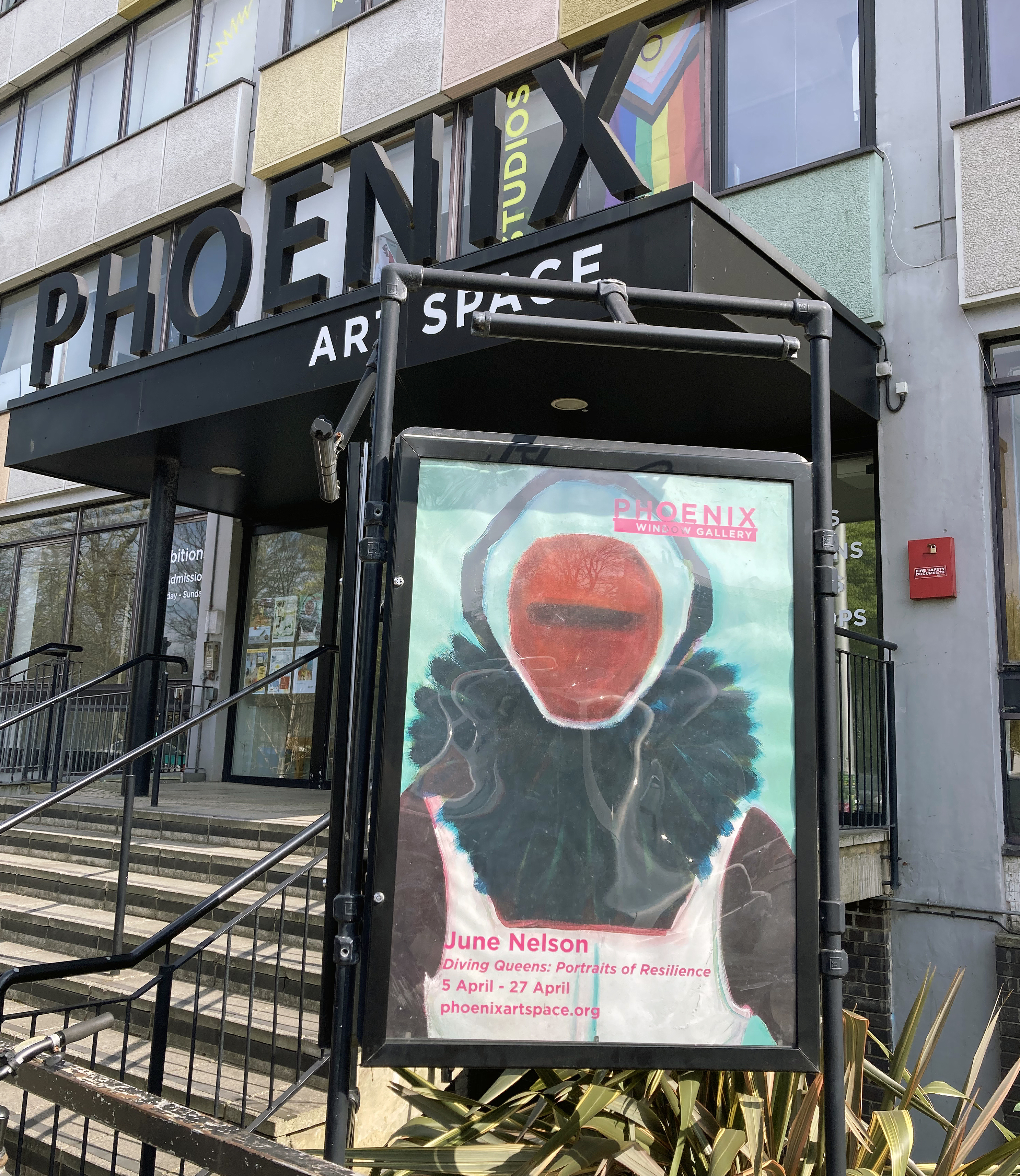
The gloves are off, or rather on. Diver’s helmets too, plus rigid ruffs and helmet-like attire from Elizabethan and Flemish portraiture. In this impactful exhibition by June Nelson the viewer will most certainly sense the presence of an implied wittiness and sense of humour conjoined in a serious and profound range of imagery.

The dramatis personae are unidentifiable as they are everywoman and, I surmise, the artist herself. It’s a clearly contemporary collection of works too, that take in historical references for the present day. What makes the choice of imagery for this exhibition at the Phoenix Art Space so pertinent for today are not only the almost cartoonish and comical images that might (but do not) undermine a serious visual discussion, but also forms a presentation of evidence of a dynamic and self-questioning undertaking aligning a feminist perspective with images to match. These portraits of resilience proclaim a contemporary voice operating from the painting studio, rather than from some alternative social media pulpit. Punches are not pulled.
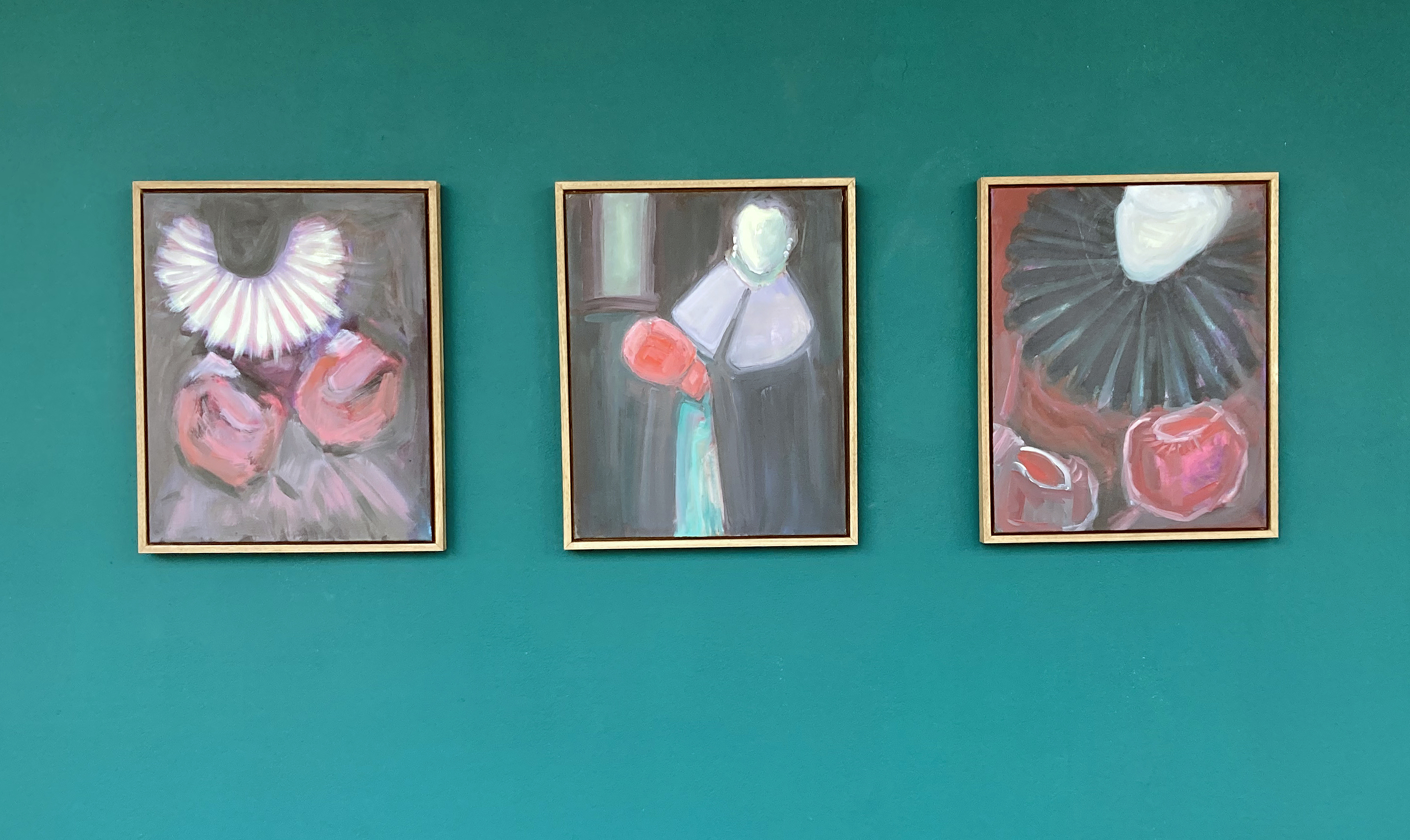
June Nelson – Beyond Countenance, Regalia and At The Court of the Pugilist (all 2025)

Aligned to a notion of portraiture, that is in fact far from trite or superficial, the works create, with narrative devices such as gestures, gender related costume and the blank gaze, a stage on which to enlighten the viewer. In these sixteen paintings, Nelson holds back from presenting too much detail and is being cleverly and purposely simplistic in not overworking the visual language or the immediately readable content. There’s something here about proclaiming painting as relevant as any other medium too, with a feeling for the materiality of this colourful but sometimes crude substance that is what it is – just as any implied narrative is presented with a rawness of self-awareness and realisation through the crucial activity of painting. Paint, and painting, offers itself up as alchemical process, turning emotion, anger, thoughts and feelings (personal, social and, maybe, familial) into a positive, dynamic realisation and outcome.

In a statement on her website, Nelson has stated:

“I am fuelled by an interest in female agency and our sense of self, using history, mythology, and personal memories to stand witness to often hidden or silenced lives, particularly those of women.”

With this declaration in mind, I therefore assume that there is both a rallying cry, aimed at female observers who share a common sense of unfair, ingrained prejudices in society, alongside a wake up message to the male audience. This could be challenging subject matter for someone like me (a male, liberal, Late-Boomer) who likes to think that he is liberated from gender-based prejudices, when in fact he knows that he still has a lot to learn and to understand. Nelson therefore imposes, via engaging imagery and painterly expertise, a perspective and a position that should not be ignored or discounted.

June Nelson – Diver, Deep Brown (2024)

The artist further explains that:

“Recent paintings… continue to explore the same themes and motifs – seeing and silencing, suppression and repression. In a union of the personal and the historical, paintings portray women wearing deep-sea diving helmets, ruffs or boxing gloves. Often taking Tudor portraits or medieval ‘Doom” paintings as a starting point, uncanny faces gaze out at or hide from the viewer. As a modern woman looking back along the matriarchal line, not much has changed.”

This is certainly an absorbing theme and the exhibition, which initially invites a stroll from one end to the other in the corridor-type viewing space, has enough range to encourage looking at individual works as well as carefully selected groupings of pairings or threesomes. This display policy creates a healthy sense of the artworks as an ongoing project, with further possibilities for all sorts of juxtapositions or giving individual paintings their own space. There is both a sense of self and of belonging to a community offered up in this project. With similarities in content, such as entrapment, silencing, battling against the odds, and understandable frustration with progressive developments in ‘modern’ society changing so slowly, there is yet the sense of a series growing quite organically rather than as a too forcefully premeditated or programmatic endeavour. On a more individualistic level for the painter herself, I sensed that there is a form of self-revelation through the practice of being a visual artist, expanding and advancing a challenging discipline, which might always be on the verge of failure. I mean this in a positive context, as both an exploration into conditions of identity and as a necessary condition of painting.
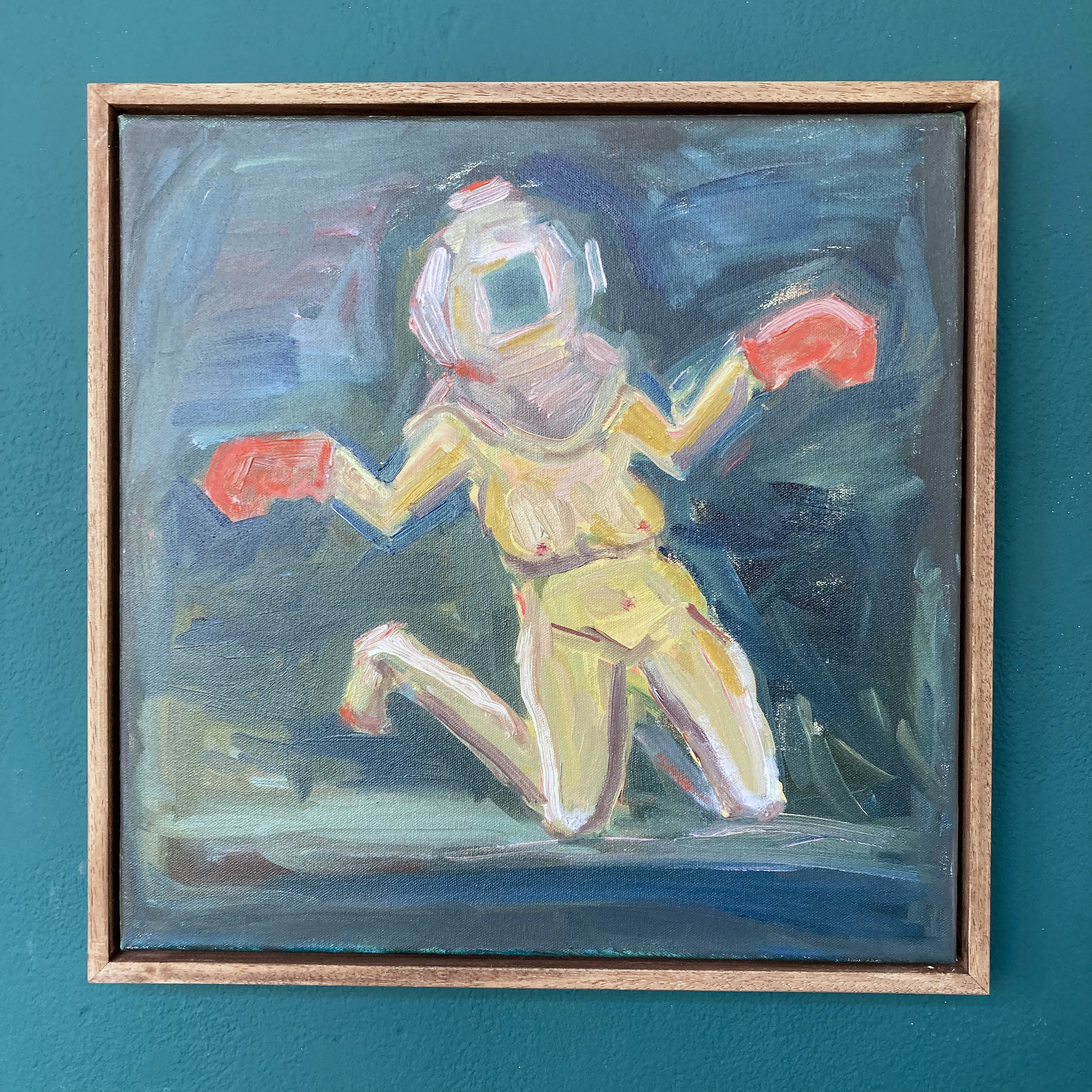
June Nelson – Red Gloves (2024)

There is also a sense of the work-in-progress, as the artist engages in a creative studio-bound journey that is open to trial and error and who refuses to fall into the trap of producing some colourful decoration for the living-room wall. This, I hope, is the kind of project that makes the viewer stop and think, to be unsure, and even to be left feeling a little uncomfortable – particularly if the image initially looks somewhat humorous. For example, as in ‘Red Gloves’ that reveals a naked woman, not conventionally delivered for the male gaze, but almost as a take on a crucifixion of sorts. The outstretched arms, with red bulbous, stump-like ends representing boxing gloves, rather than blood, has a potentially defeated feel to it, but, ironically proclaims a rising strength of character.

June Nelson – Helping Hands (June 2024)

I also felt (but could be totally wrong) a measure of sadness and loss. This unexpected reaction initially emerged from a very small work, ‘Helping Hands’. This was not so much from the caring yellow hands that cradle either side of the outside of the diving helmet, but there is something about the paint application and the gently applied, painterly wash of blues and greys, with perhaps three horizontal strokes of the brush blanking out the eyes, that implied a melancholic theme. A greenish oval floats beneath the helmet like a brooch, a medal or a heart. There is enough scope here for the viewer to bring his or her own interpretation to a subtle yet robust image.
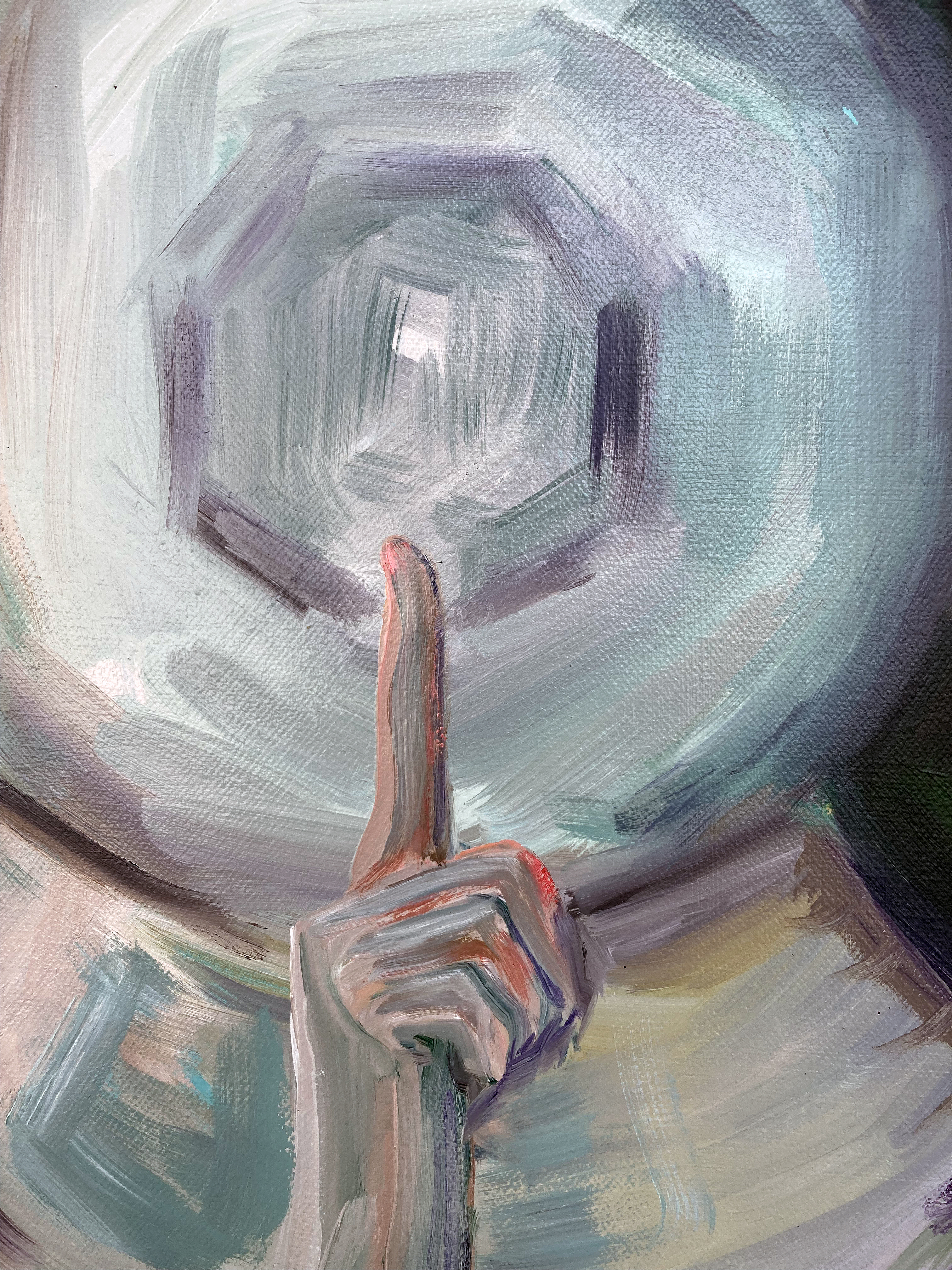
June Nelson – detail from Silence Sealed (2025)

Above this small work was a more immediate kind of message, a hand gesture implying secrecy or suppression, conveyed in ‘In Silence Sealed’. This striking portrait brought to mind the anonymous imagery of a nun from a silent order, with an almost halo-like disc that hid the face of the unaccredited portrait. Yet the icon-like image was not so much religious in a denominational sense, but more universal and quietly empowering, representing a vow of collective, female, knowingness. These are paintings well worth taking time out to see and to allow the imagery to enter one’s own thought-space. To prompt recollection of the roles, say, that our historical (and/or family) predecessors played, or that our contemporaries in society undertake today. Nelson’s characters form a sort of Commedia dell’arte for the past, the present and the future. But any implied comedic element is wittily and unambiguously turned into serious content. The female viewer is both in the ring and in the audience.

June Nelson – Diver, Deep Brown, Pink Diver and Diver, Jade (all 2024)

LINKS:

June Nelson’s website

June Nelson on Axis web

Instagram

Phoenix Art Space

CONSTABLE: Innocent Messenger of Doom?

DISCOVER: CONSTABLE AND THE HAY WAIN
At The National Gallery, London

Until 2 February 2025

NG1207 John Constable – The Hay Wain (1821)
Oil on canvas (130.2 × 185.4 cm)
© The National Gallery, London

A visitor to the latest Discover exhibition at The National Gallery could be forgiven for missing the star of the show, John Constable’s The Hay Wain, even as it is prominently displayed for visitors entering the main space of the Sunley Room area. The eager viewer might almost dismiss this magnum opus of British art as they might think they know it so well, as close to thirty other works fill this superbly curated space to engage their attention. This is one of the strengths of this exhibition as there is so much to look at and consider. It’s the kind of show that will, I am sure, not become tiresome if you can make several visits and that you could drop in to see just the one item on display.

In fact on first entering a kind of vestibule the curators had cleverly set up a palpable dichotomy of preparatory nudges to influence the visitors before the main space was entered. Constable is not only in the past, but is also now in terms of setting an example of painting as personal expression and for subject matter (*see another reference to Constable and contemporary painting in the notes section). The phenomenon of the European landscape tradition in art generally, and of English landskip in particular, is one of the more positive contributions that this sometimes narrow minded Sceptered Isle has, and continues, to contribute to the phenomenon of ‘art’. Our collective love and appreciation of the landscape (in some ways a constructed notion from the natural world that might best be called the environment) is worth celebrating and preserving.

But also displayed here in the introductory room are ten reproductions that sets up a duplexity that makes the exhibition so relevant, and modern, for today and tomorrow. These disparate but related images reveal, and in an odd sense celebrate, evidence of Constable’s ongoing influence on Britain’s visual culture. Including well-known imagery from Hockney (who like Constable no longer requires a first name), Peter Kennard and Frank Auerbach the viewer might casually eyeball the imagery and move on, feeling the magnetic pull of The Hay Wain. This is what I did, but something niggled.

But still in this first room, the viewer, if already a Constable fan, could be well satisfied with seeing Constable’s Cenotaph to the Memory of Sir Joshua Reynolds, that was the last painting he exhibited at the Royal Academy in 1836, to prepare them for an experience of looking back on an era when British painting finally made its mark on the already well developed great European tradition. After all, ‘Constable’ is one of those names, along with Hogarth, Reynolds, Gainsborough, Stubbs, Turner et al that harks back to the Golden Age of British painting. On this singular wall Cenotaph takes on the feel of an altarpiece.

So, appropriately on view in this space are a map of Constable Country (a.k.a. Suffolk), partly to make the point that the Grand Tour was not absolutely essential, plus the medal that the painter was awarded by King Charles X of France in 1824 for showing The Hay Wain in the Paris Salon that year (which, coincidently, was the year when the NG first opened in Angerstein’s London townhouse in Pall Mall – moving to its current location in 1838). The Centotaph canvas demonstrates Constable’s appreciation of the first president of the Royal Academy who insisted that ‘modern’ artists engage with the classical art of the past to reinforce their pictorial interests in depicting, and celebrating Nature in the present.

Then, on approaching The Hay Wain in the main space a wonderful Thomas Gainsborough, Cornard Wood, near Sudbury, Suffolk (1748) commands attention and shows the viewer where Constable was coming from geographically, aesthetically and stylistically in a contemporary context, via the influence and example from the painters who emerged in the previous generation. With Gainsborough the exhibition adds George Stubbs (The Reapers of 1783 hangs next to the Gainsborough) and George Morland (amongst others) as crucial forerunners, plus Constable’s near contemporaries including John Crome, Francis Danby, John Linnell and Richard Parkes Bonnington. As expected, J.M.W. Turner is here too, though perhaps in a quiet way as pundits could argue forever over who is the greatest British landscape painter. Turner was far more of an entrepreneur than Constable and so to some degree represents the development of the marketplace, often via the print or the washing line of watercolours drying above his bathtub, than Constable the rural conservative. Undoubtedly, this function of the landscape picture production as a moneymaking artefact was an aesthetically pleasant aspect of the growth of the capitalist marketplace that, as it happens, was born in the agrarian context of English countryside (see Ellen Meiksins Wood: The Origin of Capitalism).

Maybe it was this culturally sober yet complex young man from Suffolk who took British art into Europe (well, Paris and Berlin) despite his tendency to balance professional London life with his beloved Dedham Vale in his home countryside. Constable painted Landscape: Noon (The Hay Wain) in 1821 when he was just 44 years old. Not unusually, the large painting that we know and love was actually produced in London. Also on display are the ‘six footer’ study (the third of six), and a relatively tiny study, Sketch for ‘The Hay Wain’ (c.1820), that can be considered the first version of his most revered work. This latter work is the one I think I could return to see if only one painting was made available on my next visit to the NG, particularly as it will have to be returned to the Yale Center for British Art in Connecticut when the show ends next February. Being hung next to the ‘six footer’ was curatorially daring but apt and demonstrates to any aspiring painter that preliminary works can be any size in relation to the final product.

But I had surely been taunted by those other images and so returned with some sense that something very relevant right here, right now, was being manifested. After my preliminary stroll around the show to tune in, looking more attentively at the last three images I was a little unnerved, perhaps intimidated. After all, I assume that like most visitors I am here to marvel at some impressive landscape works. Social reality (Chris Shaw), satire and humour (Cold War Steve) and climate change (Quentin Devine) was implied so strongly yet so innocently by the reproductions, undermined, or at least questions and recategorises every other image in the exhibition. Miss the display wall of contemporary works and an engaging display of paintings, prints and drawings – plus a rather quaint set of country folk figures purportedly made by Constable himself (though, I dare say, unlikely) – is certainly visually pleasurable, aesthetically satisfying and informative. The show is rich in social and political history, and in setting the historical context that Constable was affected by, engaged with and duly influenced himself. Constable is in our lives, in our visual psyches. How many homes in the UK have a landscape print, photograph or painting on a wall? The art historical thrust of this exhibition – of the whole institution – confidently insists, as always, that the viewer should be aware of any artist’s influences and the context of periods of style and subject matter. Paintings are never just lonesome, singular, objects even in the broadest context and are not merely decoration for the living room (** see personal memories in the notes). But the modern works, even as reproductions, give the viewing an unexpected frisson.

In a way, Kennard’s Haywain with Cruise Missiles (1980) sets up what could have been far more exploited as the major theme for this exhibition, as imagery from this later generation of artists, (Shaw, Cold War Steve and Devine) reinforce a message of shock and despair, obliging the viewer to take stock of any so-called beautiful or awesomely sublime landscape scenario as various regimes wage war with nuclear arms in the background and as global warming continues to affect the climate. Though, to be fair to the curators, this political aspect is acknowledged in the catalogue – which if you cannot get to see the exhibition I fully recommend that you acquire the publication, as it not only records this marvellous display, but also is a useful primer for the burgeoning art history aficionado who must understand that the visual arts always has a social, cultural, economic and political context, and a reinterpretive one at that.

Ignore the contemporary works at your peril. Are they (to appropriate a Constable term for highflying clouds) Messengers? Via Constable, these contemporary artists may well be saying something we all need to hear. With the revered Constable to reference they might challenge the mindset of the masses with less derision from some quarters than the environmental protesters. Which made me wonder if they attack the wrong targets? These passionate and well-meaning iconoclasts could choose to celebrate rather than diminish their respective responsibilities of protecting our cultural as well as our natural environments by preserving and developing our survivalist consciousness with more integrity. Art might save us yet – and Constable was right there as the agrarian revolution took hold.

We can all drink to that. (***)

Geoff Hands (October 2024)

NOTES:

* Reference to a painting in Late Constable at the Royal Academy (2021): https://fineartruminations.com/2022/01/29/contemporary-british-painting-prize-2021/

“A woman and her partner are standing in front of A Farmhouse near the Water’s Edge (‘On the Stour’) by John Constable. “Does he ask questions?” she reactively inquires. I think it’s a rhetorical question. It’s certainly a gift of a question and I now wonder, was the painting asking questions about subject matter; perception; time; self; the painting process or the fiction of imagery and invented composition? Constable also appears to have gouged his palette knife into the surface of the oil painting and it is an unsettling image. I doubt that the subject matter is merely a farmhouse or a landscape. Paintings have so much to offer and so much potential for interpretation, with endless ground to cover. It’s no wonder they continue to intrigue viewer and maker alike.”

** The first ‘work of art’ I recall in my parental home, way back in the mid-1960s, was a reproduction of The Hay Wain that came free with the electric fire that my mother purchased to replace the coal fire in our living room. About ten years later I was an art student and, on my first trip to a London gallery (18 February 1976), I was fortunate enough to see the Constable: Paintings, Watercolours & Drawings exhibition at The Tate Gallery, which of course included, The Hay Wain. Many thanks to Mr Vettise at Shrewsbury School of Art.

*** NG bans liquid after artwork damagedhttps://www.bbc.co.uk/news/articles/c89ljnwgpqwo

LINKS:

National Gallery

CBPP review with reference to Constable’s Farmhouse painting

Alexandra Harris writes on John Constable’s last decade, which includes Constable’s Farmhouse painting (The Phillips Collection, Washington, DC)

From the BBC news website

Climate protestors glue themselves to John Constable masterpiece