OLIVIA GUILLOT: Swallowed A Fly

At Phoenix Art Space, Brighton

26 June to 30 June 2024

Wow! Some paintings, some actual, real, “look at me I’m a painting”, paintings. Sometimes the best things happen when you least expect.

It has been a busy day and I am rushing around town. Dad’s taxi, paintings to collect from the framer’s, pick up a few things from Sainsbury’s, park at the studio (yes! there’s a space), say ‘hi’ to people in the corridor (make out all is well), pick up a notebook, water the plants and then, as I almost depart… there’s a new show just been installed in the Project Space at the Phoenix. But there’s no time to stop, but one has to.

Olivia Guillot, a recent graduate from the University of Brighton, has installed a display of seven paintings and a sketchbook in her first solo show, Swallowed A Fly. I am immediately drawn in by the painterliness and the strong colour hit. I might only have a few minutes, maybe 10 or 15 if I can dismiss the future awhile. Painting is so much more than the here and now, of course.

Olivia Guillot – Swallowed A Fly 2024 (120x150cm) oil on canvas

The works are lively and painterly, oh so painterly, and as fresh as the perennial daisy. This artist clearly has an almost unchecked love of paint and colour and image. I say ‘almost unchecked’ because there is a visual intelligence emanating from these canvases. There is a restraint too; revealing a painterly design sense that I suspect is intuitive. Whatever, these works are so refreshing to see with their vitality and energy. Paint and image are in transition, despite the fixed nature of the resolved canvas. What are these images peopled by? The figurative and the abstract meld. The act of painting, sucking something up from the imagination (whatever that is) makes new scenarios. Magic.
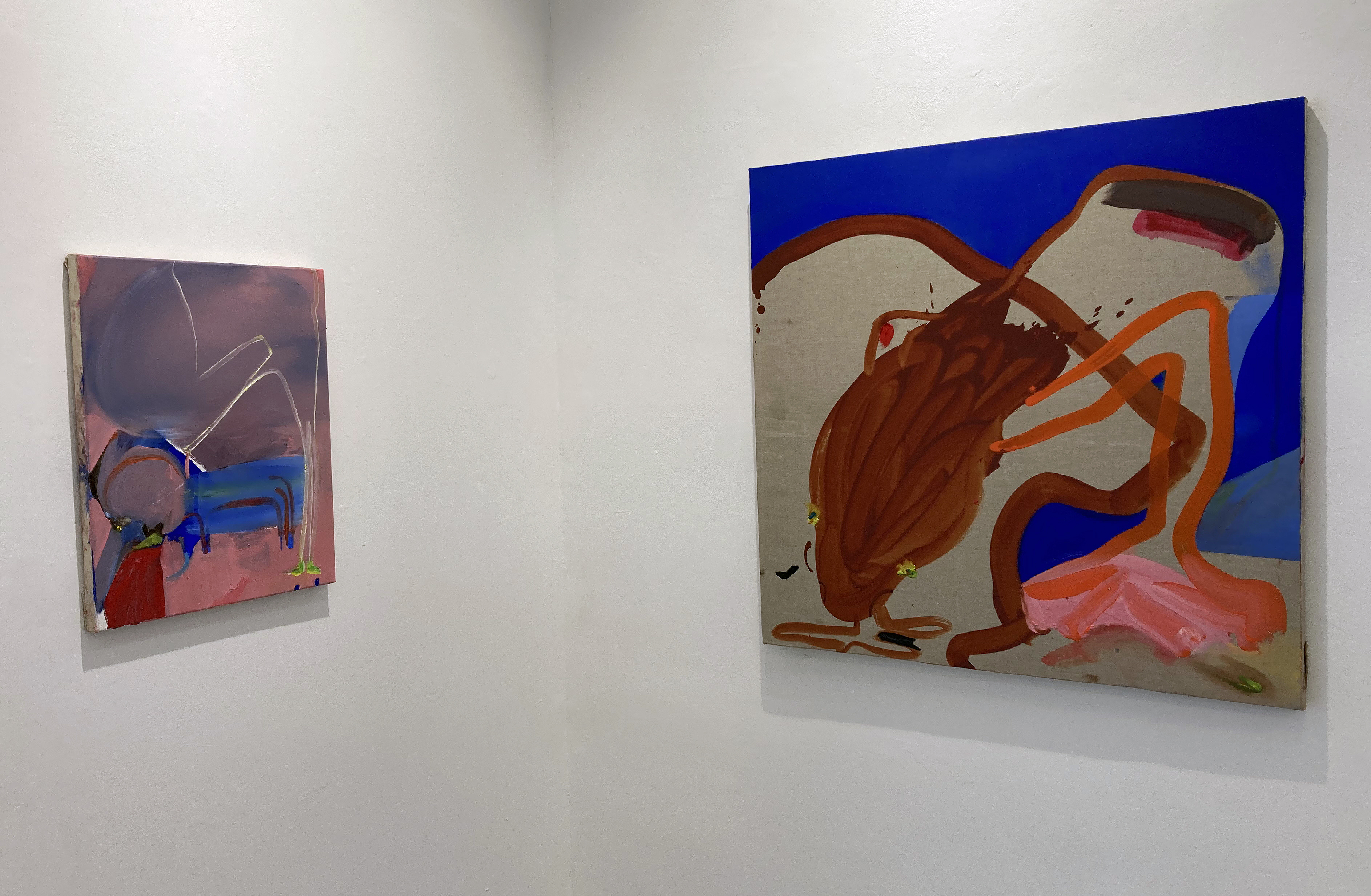
Olivia Guillot – Walkies 2024 (20x40cm) and Anteater 2024 (100x100cm) both oil on canvas

More joy: There’s a sketchbook (item no.3 on the exhibition plan, which gives an equal status with the paintings) that the visitor can leaf through. Why can’t artists show their sketchbooks more often? In some way this is an unusual, even a brave, decision. A document like this is such a personal document. Containing good and indifferent drawings and colour studies; notes from a tutorial; bare thoughts. But viewers should get the bigger picture (pun intended) and see some of the working and thinking process that determines the end result. That final canvas has a studio history. Discussions have taken place. Doubts work alongside discoveries and day to day planning. Ruminatory thoughts have floated by, sometimes recorded in scribbled notations. Perhaps there should be a clause that every painting exhibition includes a sketchbook or two.
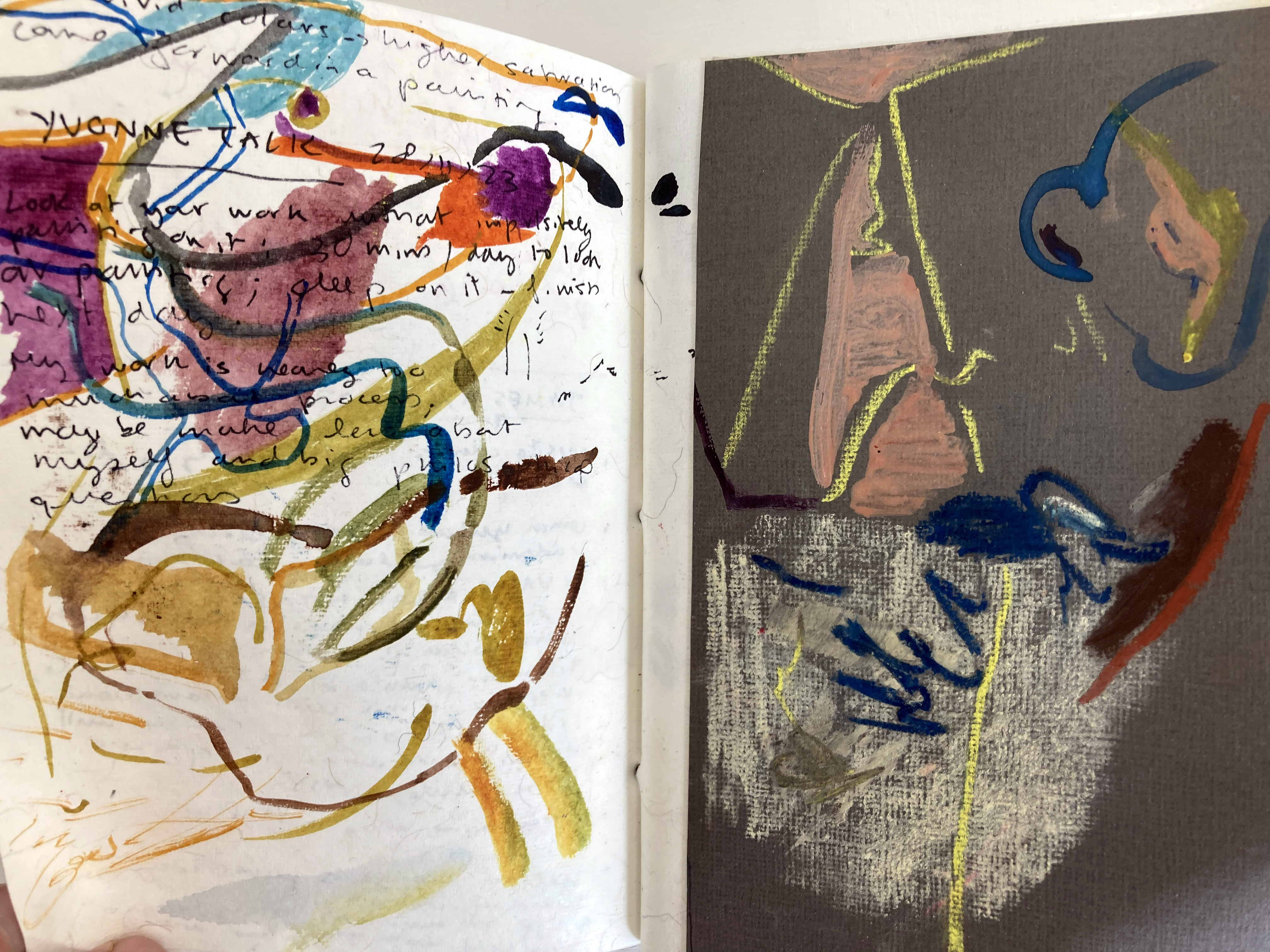
Olivia Guillot – Sketchbook

Painters have to have confidence of course, a resolve to climb on board for the journey. It’s an attitude thing. Guillot has this in abundance.

For contemporary painters the gallery system is not always open enough. The Gatekeepers are not always into painting, after all. Painters have to raid the bank account and rent spaces. Painters have to be self-confident and brave. But, despite obsessions with alternative media, painting persists. Painting courses, such as the one at the University of Brighton, attract students of a highly visual persuasion. The medium encourages investigation and thought; self discovery and realisation. Out there in the ‘real world’ there are so many painters – and they are, for the most part, a national treasure.

The end result, like this small but expansive show, is akin to a music gig. The various parts are given extended strength by the grouping, the set list. See the show if you can, get the ‘hit’. Let the experience dissolve into your consciousness forever.

Geoff Hands, June 2024

Olivia Guillot – I Cant Stop Making Mush 2024 (100x100cm) oil on canvas

LINKS:

Olivia Guillot on Instagram@livguillot_

Update: Tracey Emin Foundation
HARRIETTE LLOYD: When The Dust Settles

Gallery 19a, Hollingdean, Brighton

7 to 19 June 2024

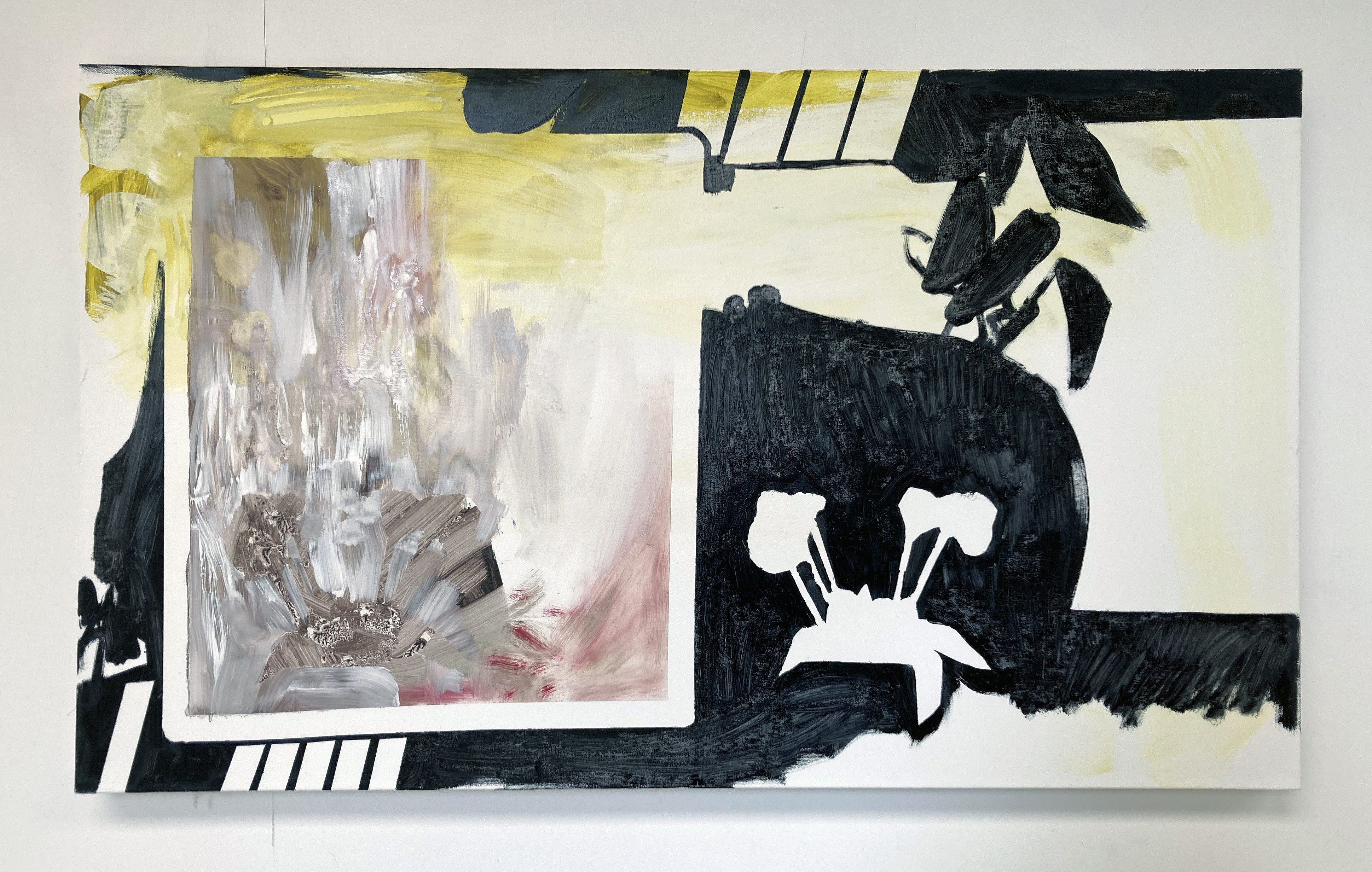
Harriette Lloyd – ‘After The Dust Settles’ 2024 Oil on canvas (67x112cm)

What are the painterly visual equivalents for the recollection of time and place? At a simple level we might think of the dark and the light, forms and space, the near and the far. Shapes, layers and geometric or organic forms, which despite the very clever invention and illusion of perspective, combine as an environment. Compositions from the visual field in the here and now, and potentially from memory (or become a version of memory), offer evidence. The future’s not so certain. There’s a sense of permanency unfolding into change of what is or was. Building, deteriorating or soon to be replaced scenarios are here or there. Surfaces reflecting or absorbing light enable differentiation in the visual field. Oh how we need light, and touch, of course.

Harriette Lloyd’s exhibitions of a dozen or so paintings at Gallery 19a in Hollingdean, Brighton conjure these notions of time and space as she makes these evidential documents. The painted memorials appear quite individual but make links from one to another and might be categorised as an extension of the traditional still-life, albeit expanded into architecturally interior spaces such as walls, floors and corners. The seventeenth century Dutch still-life painters of the vanitas recorded and presented objects as a sub-genre of the still-life that reflected a Protestant acknowledgment of the all too short duration of life and of the ultimately limited value of possessions. Lloyd’s project is also embedded in the everyday as a commemoration, but specific objects appear less important than the remarkable visuality of anything and everything around us – including the very process of painting which produces a kind of visual diary from actively engaging with a seeing in action. The application of and engagement with the stuff of painting is certainly endearing as I found myself imagining wanting to apply more of the medium, but Lloyd holds back. She does not get carried away or seduced by the oil paint. This is a promising sign of confidence and calmness in a demanding process. Graduating from the University of Brighton Fine Art Painting course she has clearly been well tutored.

Harriette Lloyd – ‘Grout’ 2024 Oil on canvas (138x82cm)

Lloyd’s visual vocabulary, including the inclusion and reference to of distortions or glitches in digital photography (a generationally related trope from a young painter?), of a near abstract style of painting appear wedded to a language of realism but allow for some degree of improvisation and, as she explains in her exhibition statement:

“The works individually are fragments that together archive fleeting beauty in melancholia.”

Melancholia implies depression or despondency but my take on this collection of paintings overturned any degree of personal dejection into a somewhat positive and celebratory frame of reference. These paintings might affect the viewer in a surprisingly positive and optimistic sense of being alive right now and of a consciousness of the here and now, even in apparent banality, as hugely wonderful. The viewer might leave the exhibition having been prompted to look around wherever they might be and to comprehend and value what’s here rather than some illusion of the elsewhere. This seeing does not have to be denoted as good or bad, or beautiful or ugly. These works might encourage us to accept what is, even if nostalgia, a sense of loss or even premonition creeps in. The paintings certainly stand up to a prolonged viewing as a quick glance was quickly developed into a compulsion to stay put. These paintings generously invite the viewer to stay calm and to carry on – and to deserve a place in your home.

Geoff Hands (June 2024)

Harriette Lloyd – ‘Hot and Cold’ 2022 (30x27cm) Oil on board

LINKS

Harriette Lloyd – https://www.harriettelloyd.co.uk/

Gallery 19a – https://19a.org/exhibitions

REMBRANDT: Paintings Must Be Seen For Real

Rembrandt in Brighton at Brighton Museum & Art Gallery

10 May to 4 August 2024

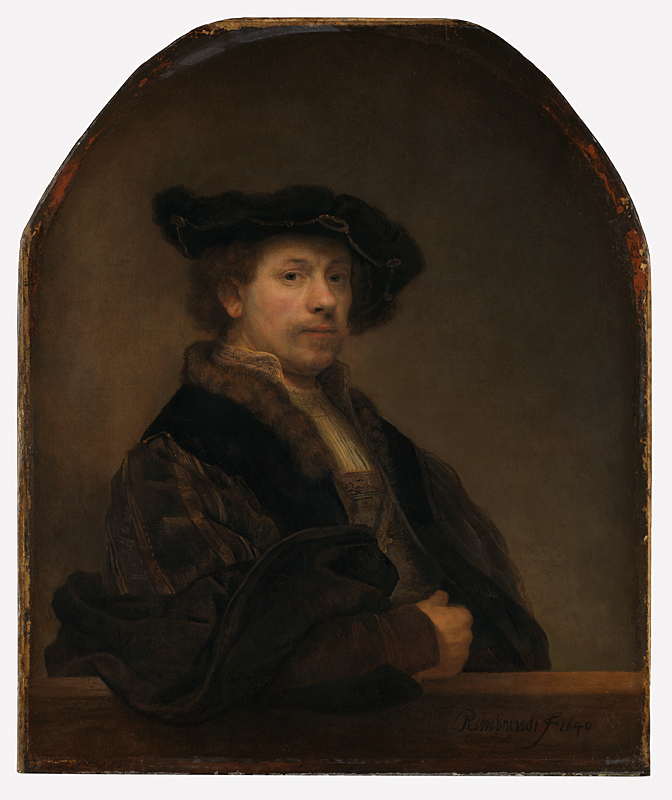
Rembrandt Self Portrait at the Age of 34 1640 Oil on canvas, 91 × 75 cm Bought, 1861 NG672 https://www.nationalgallery.org.uk/paintings/NG672

Earlier this year I posted the following advice to painters on my Painting Studio Strategies Instagram account: ‘Paintings must be seen for real’. Of course, it’s an obvious thing to say, but we all (not only painters) should see actual works whenever possible. The obvious reasons for looking at a painting are straightforward: the viewer sees the work without changes to its size, the colours and tones are not affected by a printed reproduction or the screen settings, the surface qualities are not smoothed out and you can get up close (within reason). But there’s another element, which is subjective and relies on the viewer giving ample time to experiencing the work.

In this instance I imagined the painter (myself included) in the studio surrounded by one’s own paintings with images of other artists’ work, especially our heroes, only being accessed through books or on our iPhone screens. There might be a few postcards on the wall too, although I suspect that card sales have plummeted since the advent of the mobile device and through being allowed to take photographs in most exhibitions for personal use.

When we do see a painting for real, by which I mean one from the greatest of all painters such as Rembrandt, there might be a degree of surprise or just a reminder that paint, most especially oil paint, is an astonishing medium. In the right hands a painted image can move into a region beyond what we might call ‘materiality’ today. The experience of looking might even go beyond ‘subject matter’ too. As I mentioned above, there is surely a subjective aspect to this point of view but I would advise a detractor to visit an institution, such as the National Gallery in London, to tune into the alluring charisma and sublimity of the paint medium. Or maybe just its ordinariness as an ingredient in a composition (I am thinking here of Piero della Francesca) will suffice.

So when a painting by your favourite Old Master is displayed in the local art gallery, just a ten-minute walk from the Phoenix Art Space studio for me, there is no excuse to not visit several times. In fact for the locals we just have to pay once and we can revisit the Brighton Museum and Art Gallery as often as we wish for twelve months. So I expect to pay homage to Rembrandt Harmenszoon van Rijn’s ‘Self Portrait at the age of 34’ (1640) quite a few times up until August this year. The painting is on loan from the National Gallery to celebrate the Bicentenary of one of the most important art galleries in the world. Twelve paintings from the collection are being lent to venues across the UK, which would be a great initiative to continue and to expand to even more galleries for many years to come.

If I try to define the impact of this astonishing self-portrait it’s difficult not to fall into well-worn cliché, particularly in relation to the gaze of the sitter connecting with the viewer, or the implied humanity of engaging with a fellow human being from so far back in time. Then there’s the art historical and cultural information that not unreasonably feeds into the experience of appreciating the painting (see the impressively curated NG website for a full explanation, link below). One could even make a connection, if contemporaneity is sought, to notions of the ‘selfie’ today, although the virtual instaneity of the self-portrait type image made with a smartphone will generally be quite superficial, even facile. Rembrandt’s heavily implied self-confidence and promoting of his painting skills are clearly on display. But this is certainly not a painting that celebrates selfhood or reveals the more modernistic sense of existentiality that questions the times one lives in. The painting is certainly a form of advertising as Rembrandt sought commissions from the wealthy Dutch collectors of the 1640s.

But there’s just something about the paint and its application, and about the control of colour and tonality that Rembrandt fuses so well with the subject beyond appearance. Does the face/head represents thought and ideas, whilst the hand on the parapet in the foreground represents the human hand that physically works in conjunction with the intelligence. Is this a manifesto of sorts that elevates the painter to the realm of the poet? Rembrandt, the painter, achieves a notion of image (visual art) with ideas (expressed through literature, most especially poetry) that we might consider ‘abstract’ – beyond but reliant upon the visual and the written or spoken word*. The indefinable ‘X factor’, to use modern parlance.

On my second visit another viewer commented to her partner, “The more you look the more you see. It’s the detail.” Yes, I thought, but it’s the aura too. This does not seem to be down to skill alone. It’s not purely about the painter’s choice of what to do and how to do it. It’s from a training, and a looking at other artists (Titian in particular) and of having some practical purpose in the subject matter. But more still.

You really have to see it to believe it. And, fellow painter, if you get the chance to visit buy a postcard for just 75p.

Geoff Hands (June 2024)

* This connection of painting with poetry was mentioned by Bart Cornelis, National Gallery Curator of Dutch and Flemish painting, in a public talk connected with the showing of the Rembrandt portrait.

LINKS:

Brighton Museum & Art Gallery

The National Gallery, London

https://www.nationalgallery.org.uk/paintings/rembrandt-self-portrait-at-the-age-of-34

Phoenix Art Space – https://phoenixartspace.org/

Instagram – @painting_studio_strategies