DANA AWARTANI: Standing by the Ruins

View Post↗

Towner, Eastbourne

29 November 2025 to 25 January 2026

Dana Awartani – Standing by the Ruins III

Visual art is never totally a form of escapism, even if a gallery visit takes us out of our ordinary, everyday for a while. In the UK we inherit a long-standing interest in the represented landscape and the people and places therein. Stepping into the temporary exhibition space on the ground floor of the Towner the visitor, like me, who essentially was there to see the J.M.W. Turner watercolours on display in Impressions in Watercolour, might already have felt more than satisfied with their visit having viewed a multitude of landscapes either aesthetically breathtaking or superbly sublime.

But an organisation such as the Towner pursues a positive remit to celebrate both the past and the present for a broad range of visitors. Thus, the Towner Emerging Artist Fund has supported a slightly reduced version of Dana Awartani’s exhibition, Standing by the Ruins, originally shown at the Arnolfini in Bristol earlier this year. Awartani, a Palestinian-Saudi artist now based in New York, references the craft, history and traditions of the Middle East in her broad ranging practice and applies her universal themes to the present day. This is a highly thought provoking exhibition – and I cannot see Awartani being designated as emerging for too long. She has also been chosen to show her work in the National Pavilion of Saudi Arabia in the Venice Biennale in 2026 and if you Google her name there’s much to read on-line already and this makes it unnecessary for me to echo what other writers have already written about this work.

Dana Awartani – Standing by the Ruins III

I do not really know what others will have thought of the Towner display, particularly as I was there on the opening night before I have had an opportunity to talk to friends who have seen it for themselves. Not all exhibitions linger in the mind for too long either – but I suspect that this one will. At least it should do, even if for lamentable and distressing reasons. Sadly, but necessarily, we are aware to some degree of the religiously and politically inspired cultural and economic destruction that is going on in the wider world right now. We may well be shouting at our TV screens most nights, but I doubt we regret the choice available to switch off both literally and mentally before retiring for the evening. There might be a sense of the elsewhere that protects us emotionally. Meanwhile we can have a good old gripe about the potholes the local Council fails to fix, the frequently poor performance of our various water companies, or that yet another public library is closing due to lack of funds. If we do still manage to follow the TV news without depression and/or anger setting in too overwhelmingly (choose your own issues to be frustrated by) we can always counter this by getting out and securing an aesthetic fix from visiting an art gallery. Oddly, though positively, in Standing by the Ruins both positive and negative emotions can organically combine.
Dans Awartani – Standing by the Ruins III

In Awartani’s work that element of visual delight, dexterity and excellence is certainly foremost, particularly in an applied design sense. The drawings and paintings for her Standing by the Ruins series in 2D and 3D outcomes, reveals an impressive level of skill in applying a traditional, age-old geometric system of drawing and pattern making employing a compass and ruler (not a digital program) into architectural references. Something that looks good draws us in. Form and content interweave.

Dana Awartani – Study Drawing 3 2025

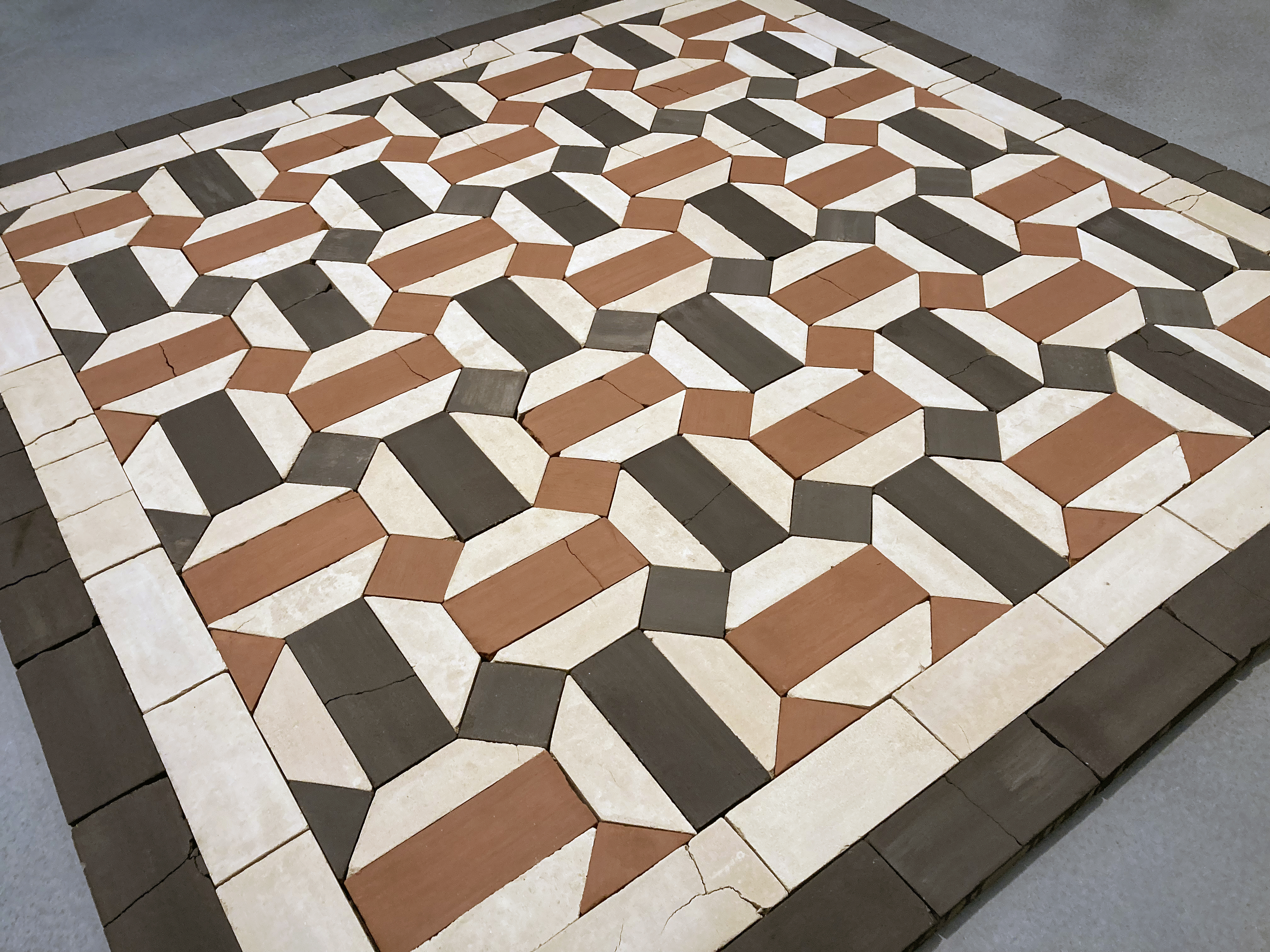
But before being drawn to the works displayed on the walls the works that the visitor will probably notice first are three floor-based arrangements of coloured bricks that the designs on the wall back up. These are the ruins that the exhibition title references – recreated sections of the floor of the Hammam al-Samara in Gaza, one of the oldest bathhouses in the region, but which has now probably been destroyed. To enhance the notion of destruction and obliteration the bricks are cracked and well on the way to further decimation. The artist worked with a collective of adobe brick makers (craftspeople of Syrian, Afghan and Pakistani origin) and deliberately left out the binding agent (hay) so the works are purposely intended to break up.

Whilst these would-be floors are adequately placed for the visitor to walk around there is a slight sense of the possibility of tripping, though no one does. The works are clearly installed rather than functioning as sculptures. Quite soon college tutor mode kicks in for me and, if I was questioning the young maker in an end of project tutorial, I may have commented that I want to see people walk on these floor coverings. Get on trend – employ the audience as active participants. In fact, I imagine being one of them myself. I visualise seeing the piece(s) destroyed, not because I dislike the work, but because the volume of the heavily implied message might, metaphorically, be turned up. If we accept that somewhere down the line we, and the governments we elect, are all complicit to some degree in the endless tragedies of the world, we are, by implication, the destroyers too, so lets be more physically involved here. Thereafter, more bricks could be made to replace the sculpture anyway, for a never-ending sequence of works to be installed elsewhere. But this is a male response. And that’s the problem.

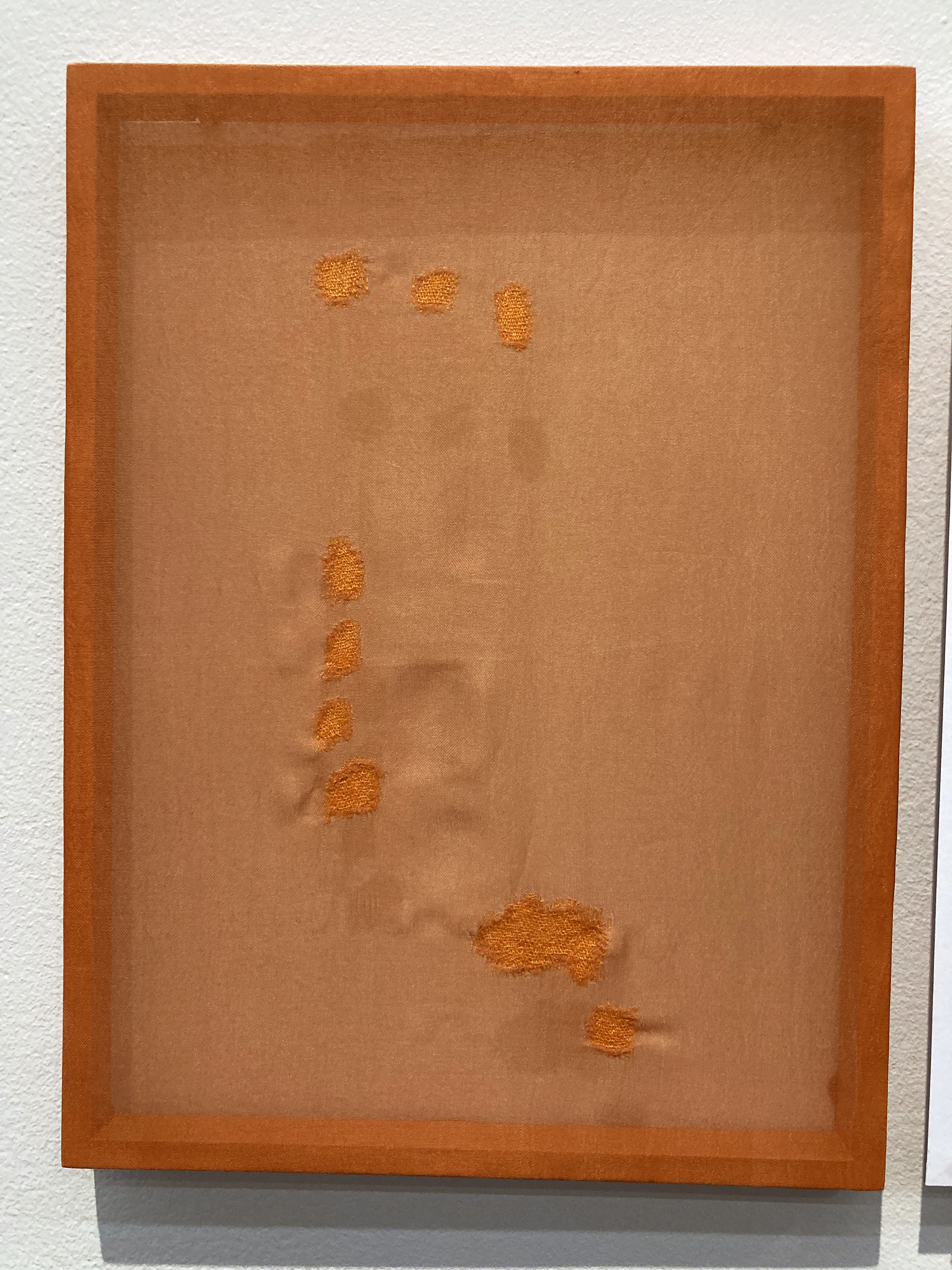
To reflect on this initial reaction, a quick summarising that has its routes in a previous modus operandi in fine art education, I was possibly thrown by that term emerging. I had too soon adopted an attitude that wanted to question and to advise this young artist. Arrogance, I know, but bear with me. My imaginary student might next have advised me to consider a set of other works displayed on the wall. These are from the Let me mend your broken bones series. In these works she has employed others to participate. Not in destroying but in making and mending by darning on medicinally dyed silk and implying a more positive attitude to life of preserving rather than wrecking. A female response – albeit embodied in hard reality.
Dana Awartani – Let me Mend Your Broken Bones

Initially the colour range might draw the observer to them, with attractive dyes of orange, red yellow and green. But get up close and we see a previously, a purposely, distressed surface that is fixed but permanently scarred. Paired paper panels display a text that records the scene’s recent history. The where, when, by whom, incident type and cause – listed methodically. Cold black text on a white background. Record keeping. Factual. Cultural cleansing is a term that terrifies and is certainly not confined to the Middle East. The interests, cultural background and broader context of an individual – such as an artist or any of the visitors to this exhibition – are always part of a much larger whole. This, of course, is stating the obvious. What may not always be so apparent or impactful is the fact that what might initially be considered as happening elsewhere, instigated by others, relates to our own history too. In a postcolonial age we now might think it’s in the past. Seeing this exhibition and letting it sink in for days after is sobering.

Dana Awartani – Let me Mend Your Broken Bones (text)

Standing by the Ruins is how Awartani operates. It constitutes an active positioning. Her work responds a little more quietly and contemplatively than a reactive, impulsive temperament might. The work acknowledges creation as a response to death and ruination; counters destruction with gentleness, positive even if piecemeal, literally re-making and mending. A slow and time-consuming process that is appropriate, for lives and lands are precious, and the relationship between each other and others can be far more accommodating of perceived differences. Hence the importance of landscape related themes in art from any era and of what is, and was, witnessed in various locations. So, if I might cheekily paraphrase a short statement from an essay in the catalogue* from the Impressions in Watercolour exhibition by Ian Warrell: “Turner had… contributed substantially to the transformation of perceptions of landscape subject matter…”

Dana Awartani changes our perception and understanding too.

Dana Awartani – Let me Mend Your Broken Bones

Geoff Hands, Brighton (December 2025)

* Essay: Nature raw or cooked: Approaches to Sketching in British Landscape Watercolours by Ian Warrell, published in Impressions In Watercolour: Turner and his Contemporaries. (Holburne Museum, Bath, 2025)

Links:

Dana Awartani

Towner

Arnolfini

Lisson Gallery

Goodwood Art Foundation

Verbier Art Summit (Youtube)

The elephant in the room?

Forms of postcolonial destruction continues today, aided and abetted by super powers to the east and west – even here in Brighton where L3Harris (the sixth largest defence contractor in the USA – and the world’s largest manufacturer of precision weapons) produces parts for the F-35 fighter jets used by the Israeli government to help destroy Gaza and the Palestinians living there.

Campaign Against Arms Trade

THINKING IN PAINT: Stubbs Turner Wakelin

At Tension, Maple Road, London SE20 8LP

18 October to 29 November 2025

I paint therefore I think…

AI Overview: Thinking is the mental process of manipulating information to form concepts, reason, and make decisions. It is a form of cognition that involves activities like problem solving, judgment, and memory retrieval, and it allows us to interpret, categorize, and make sense of the world around us. (From Google)

We surely do not know for sure what Michael Stubbs, Ken Turner and Julian Wakelin were thinking whilst making these works for Thinking In Paint. But we certainly have something to see, to experience and to think about ourselves now that their works have been selected and presented.

Michael Stubbs – Signal 502 [2024]

As an immediate reaction I prefer to avoid (for as long as I can) such sentiments as I like this or dislike that. Reactions can be direct and instantaneous, but ideally require a little time to ferment. Initial thinking, at least, can be characterised by simply taking various formal and material aspects in, such as colours, shapes, textures and the relationships between such features. This thinking might initially be described as feeling and perhaps usefully delays anything too conclusive. One can also see with the benefits of art historical knowledge – sometimes a prejudiced lense – and from personal experience of looking at paintings before, or from being painters ourselves. We may be susceptible to personal preference (I know what I like) and bias at times, but hopefully reasoning and rational judgement will enable an honest experience. Even uncertainty or ambiguity might take hold.

Ken Turner – Reformed [2025]

A group of paintings, whether by an individual or three individuals, sets up possible contrasts too. Yet I prefer to register works individually, even though my own practice invariably produces the series. Visual judgements can change of course, particularly as works sink in. Taking photographs of the works on the iPhone to view later is highly beneficial too, despite forming a bit of a contradiction as a real reproduction. For an exhibition called Thinking In Paint, that might eschew the digital in favour of the material object, it is imperative that the paintings are (ideally) viewed as they were created in their corporeal, material reality. Add sufficient time with the individual works in question to become accustomed, as it were, will also be a necessary factor. A lifetime might be ideal. But we generally only have our exhibition visits to provide such an experience.

At long last I had travelled up to London to visit Tension gallery. It’s a trip that has been on my arty bucket list for some time now and the promise of coinciding a visit with a live Instagram discussion between Ken Turner and Michael Stubbs – lead by John Bunker – was bound to add something special and noteworthy to the occasion. So, whilst the Instagramers on-line could see the exhibition content (ten paintings in all) on their computer or mobile screens I had the benefit of seeing the works for real. Gallery host, Alison Aye recorded the event for close to an hour as she smoothly and expertly moved from one painting to another with her iPhone guided by the conversation.

Michael Stubbs – Virus Bleed [2024]

It all felt a little like a contradiction in terms as the event was benefitting from digital technology by bringing us all together, despite not being in the same location as the paintings. Another distinctive and unique aspect for me was that, rather than having to generate my own thoughts and reactions as I looked at the works, I could jot down the commentary given to me in real time by the speakers. About this I have mixed feelings as focussing on one’s own thoughts whilst looking at the work on the walls is the usual – and most crucial – thing to do. I therefore had to suppress this activity somewhat and go with the contributions of the faces on the little screen held in my hand. I guess this is a little like being back at Uni making notes as the lecturer(s) speaks. One’s own thoughts, hopefully, emerge later.

Listening to three knowledgeable speakers, however, interweaving with each other verbally, and clearly being on the same wavelength turned out to be quite comfortable to deal with. In fact in some way I had been appropriately set up for this as I had spoken to John Bunker at his own exhibition called Antinomies at ASC Unit 3 gallery just the week before. As an abstract artist and an art writer himself he has that ability to distance himself into discussing works of abstraction in broad terms and then to apply his more intimate knowledge and experience as appropriate.

Julian Wakelin- Time (lag) [2025}

A few quotes follow in this paragraph, but they are not purely verbatim or chronological, so I shall not add quotation marks. The dominant theme that commanded the discussion was, as the title of the exhibition clearly states, thought (and its association with word related thinking) and the pure activity of painting that results in the abstract rather than the figurative. The notion of time, perhaps of a contemplative nature and being of a far longer duration than the immediacy of the digital culture that engulfs our visual experiences, was expressed by Bunker as thinking in paint, a slowing down form of looking and of contemplation. Stubbs added that when you are painting you are proceeding and that actions are made in advance of thought. Therefore thinking is contradictory and extends beyond itself. To this Turner added that thoughts and ideas couldn’t always be expressed in words, but by painting one is doing it (thinking) in different ways and that the activity of thinking is a long, drawn out process. There are overlaps too, an in-betweenness, a liminality in thought and painting, as there are things we feel but cannot say in words.

Julian Wakelin – Untitled [2025]

Bunker expanded the notion or understanding of thinking to the eye, mind and body – to which Stubbs referenced the studio and its literal, material content. The digital cropped up once more when Turner reminded us that subtle marks and textures in painting cannot be seen on a screen and that through painting we make some kind of sense of the world. This act of doing was crucial, he stated, between him and the canvas. To bring the absent Julian Wakelin in, Bunker remarked on the uncaniness about what Wakelin is doing and that in stillness there was that contradictory sense of paint moving. He pondered on whether the abstract painter might be hunting for stories and that by looking at the work (whilst in production) starts a dialogue with painting, giving a physical power to the work that cannot be underestimated.

In a broader context, and perhaps one that can separate painters from (superficially) opposing camps at times, Stubbs referenced the process based and the procedural – and perhaps the contradiction of the less saying more. The abstract painter might add or subtract things to rupture ideas of figurative painting. But the abstract painter, today, has the burden of the history of abstraction e.g. the expressive or American abstraction. But, to place his work in the digital present and the contemporary reality, he could bring the outside world in, juxtaposing signage with abstraction.

Ken Turner – Look into the distance [2025]

From this exhibition, not just the discussion, I was left with that welcome feeling of abstract paintings accommodating a real sense of place and space in the world – as concluded items. Finished and fixed so that the observer might concentrate on the paint and any additional media over the history of its painting. Works no longer in progress in the studio but here and now. Offering the promise of something maybe worth thinking or talking about. Or even reacting to, and accepting, in a pure mode or silence, just pure acceptance.

Geoff Hands – November 2025

Links:

Tension

We are an artist run gallery dedicated to showcasing the work and raising the profiles of emerging and mid career local, national and international artists. We show a mixture of contemporary & experimental art that questions what art is and what art could be.

Michael Stubbs

Ken Turner

Julian Wakelin

John Bunker / Instantloveland

John Bunker: Antinomies

THE STOLEN ORANGE

At Bond Street Gallery, Brighton

15 November to 14 December 2025

“Poetry helps us understand what we’ve forgotten to remember. It reminds us of things that are important to us when the world overtakes us emotionally.” (Brian Patten)

Georgie Beach – Talisman 2025 and Brian Patten – The stolen orange

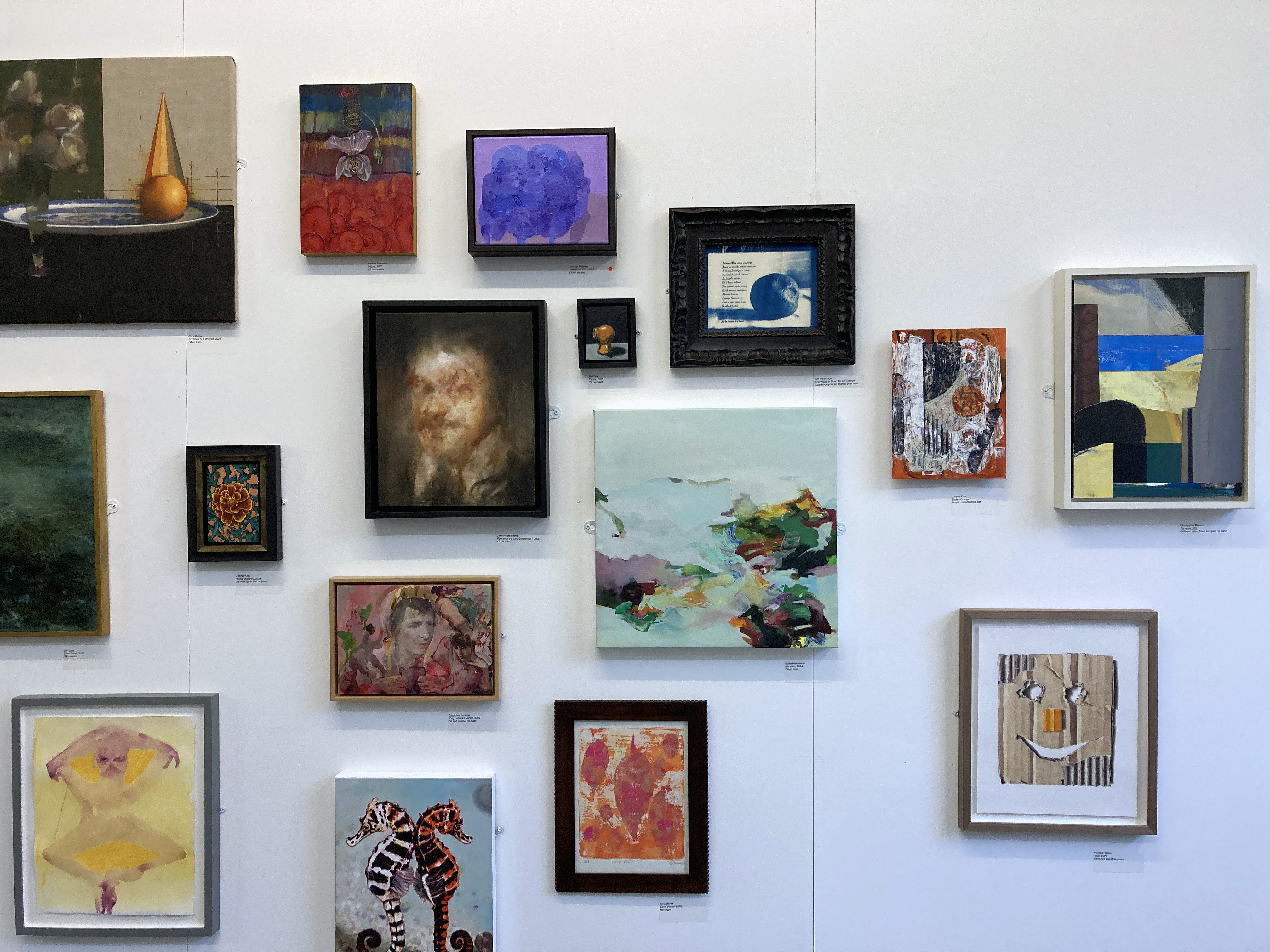
What might bring artists together for an exhibition? Well, a suitable space, a curator or three (who can contact artists already known to them) and of course, our Instagram community ready and waiting for a call up. Sarah Shaw, Hal Maughan and Anthony de Brissac present The Stolen Orange, inspired by the well-known Brian Patten poem, at a central Brighton studio space that has been turned into a gallery for the duration of this show. It’s a great initiative, particularly when suitable spaces are few and far between considering the significantly large community of artists and craftspeople who live here. Galleries are generally in short supply – although there is positive traction in the development of high quality exhibition spaces in the city with The Adelaide Salon, Kellie Miller Arts and Indelible Fine Art (amongst others) developing apace.

With the opening of The Stolen Orange clashing with the Anna Phoebe concert at the Hope And Ruin venue last week I was unable to attend the opening (Brighton is a great place for live gigs, by the way). In retrospect this wasn’t so bad as the event was fully booked and looking at the works on display – eighty or so – must have been challenging. So on a very sunny Monday lunchtime I took a break away from my Phoenix Art Space studio to recharge the visual batteries. This was a trip well worth making, not only for seeing several works by friends from the region, but for being introduced to some new names from near and afar. The installation was also very impressive. Poorly arranged displays can highlight the proverbial sore thumb(s) – but in this exhibition nothing looked out of place or clashed with unsuitable wall-partners. Figurative and more abstract works hung well together, and simple or more complicated and elaborate paintings (especially) commanded their own respective spaces. This was partly due to sizes not being too far apart with dimensions within 20 to 50cm in height or width, plus a handful a little larger or smaller. I also counted over a dozen 3-D pieces and a couple of videos – and the catalogue gave us two poems to take away, as well as the original poem from Brian Patten.

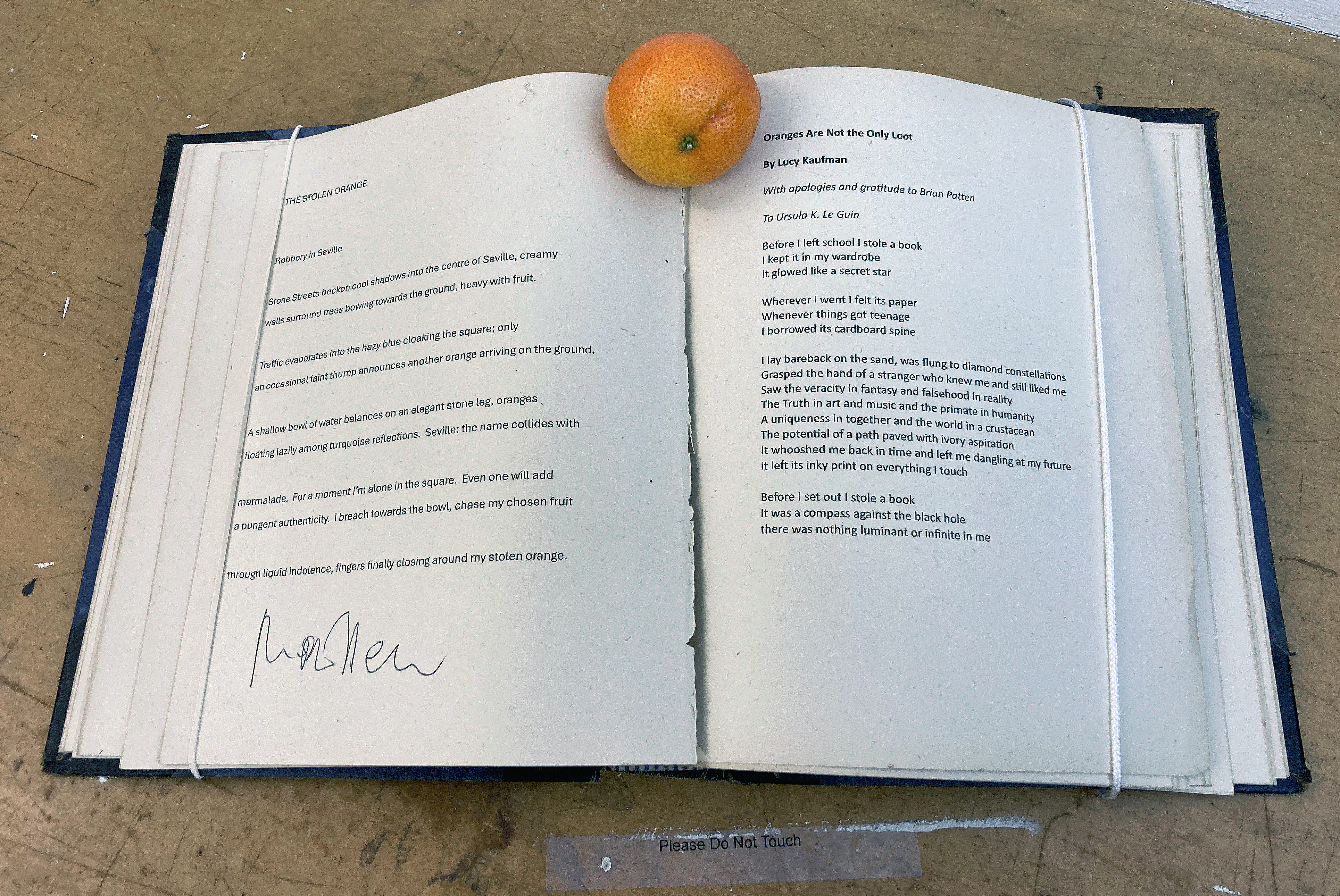
Mary Allen and Lucy Kaufman poems

Of course, the show was also held together in an organic aura rather than straightjacketed by any polemic. As stated in the catalogue the much-needed themes of joy and hope were intended as a positive theme to encourage a communion of spirit:

“Over the past few months, we have heard people talk of their stolen oranges as metaphors for something hopeful and totemic; something to hold onto.” (Hal Maughan)

The notion of joy as a positive and obligatory strength for the individual (artist or not) was also insisted upon for social cohesion:

“The exhibition reflects on how creativity can sustain optimism, humour, and connection in uncertain times, standing firm in insisting that joy isn’t optional, it’s necessary. Joy as an act of resistance. Joy as friction; a way to keep going, both with each other and for each other.” (The curators)

Carrie Stanley – I see the crescent 2025

Whilst walking back to the studio I pondered on the notion that a purist view of the visual arts (I plead guilty at times) to sustain a completely aesthetic independence for one’s work – unadulterated by ephemeral themes of the day – is nonsense. The content of this exhibition celebrates our many diversities and disparate interests. It’s what we share in common. It also keeps the memory of the amazing poem by Brian Patten alive. There is so much that is bright and special in the world.

Geoff Hands

Julia Williams – Türkis ist mein orange 2025 Diary

Note:

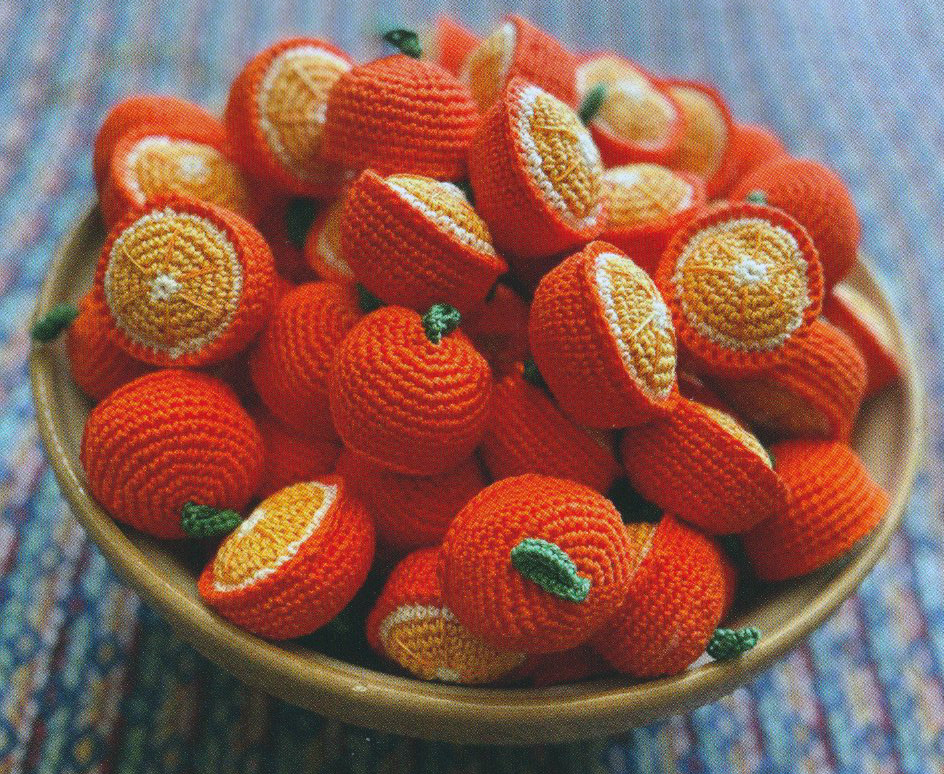
I have purposely not focussed on or highlighted any individuals from the exhibition, as there are just too many. I cannot feature all of the work here either, so please treat my choice of installation and specific artwork photographs as random. Although a special mention might be permitted for Phyl Callaghan’s fantastic cotton, silk and terylene oranges that are readymade for the pocket at just a fiver each – I bought a few for Father Christmas to distribute next month. I must add that there is a very well produced catalogue available from the gallery that features all of the participants’ work – and visit the website too.

Phyl Callahan – The Gifted Orange 2025

Links:

Bond Street Gallery

Brian Patten

Katya Adler and her daughter reading The stolen orange (BBC Radio 4)

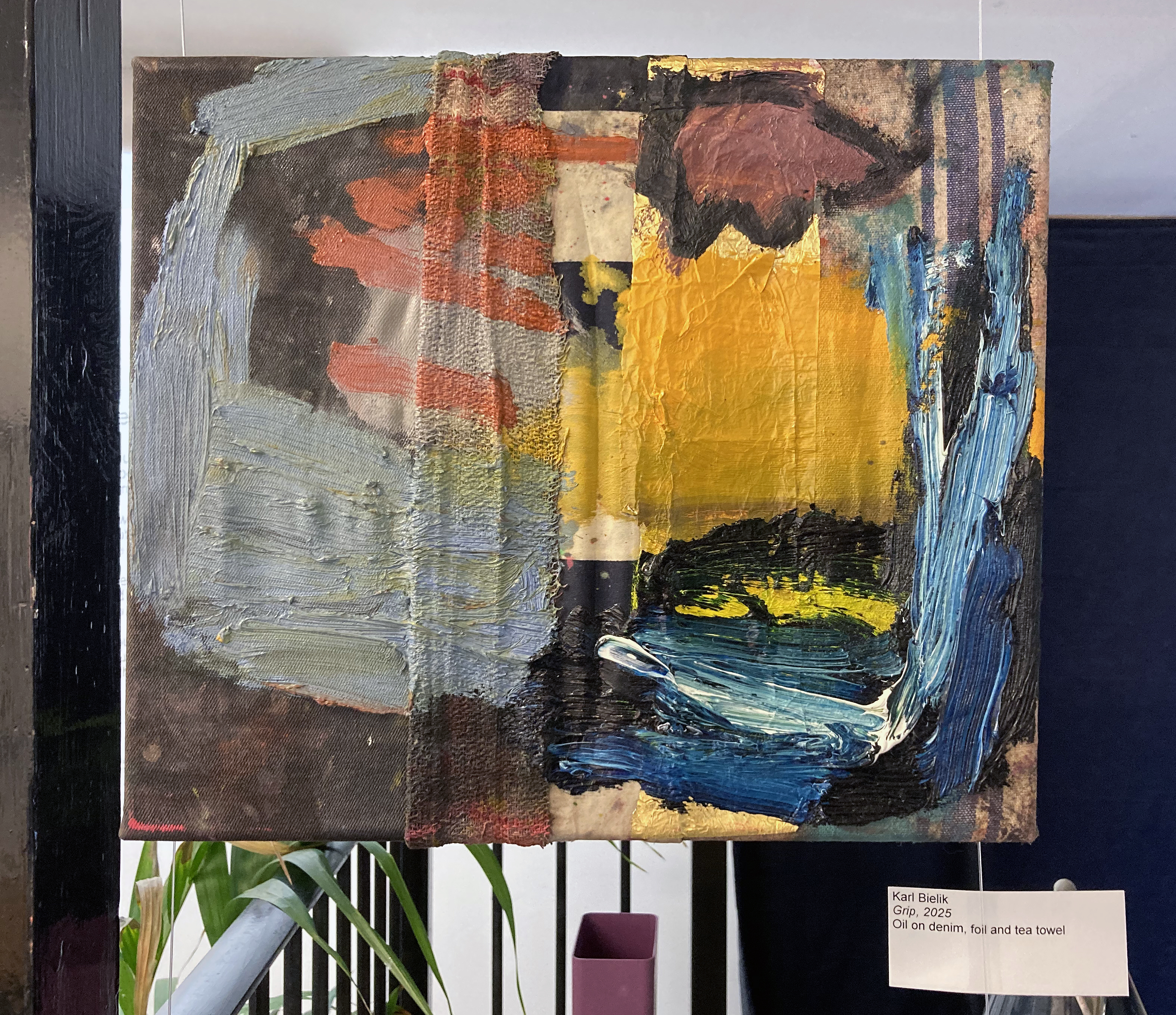
Karl Bielik – Grip 2025

CARRIE STANLEY: Benthic Blues

Brighton Art Space, Regent Street, Brighton

28 February to 2 March 2025

B:_:_:n|-hic[< B[u:_:_:s

“Ultramarine Blue is the language that unifies the artwork in this show… I use it for its energy, and its magical and infinite possibilities. It brings a sense of calm yet has huge vibrational energy.” (Carrie Stanley)

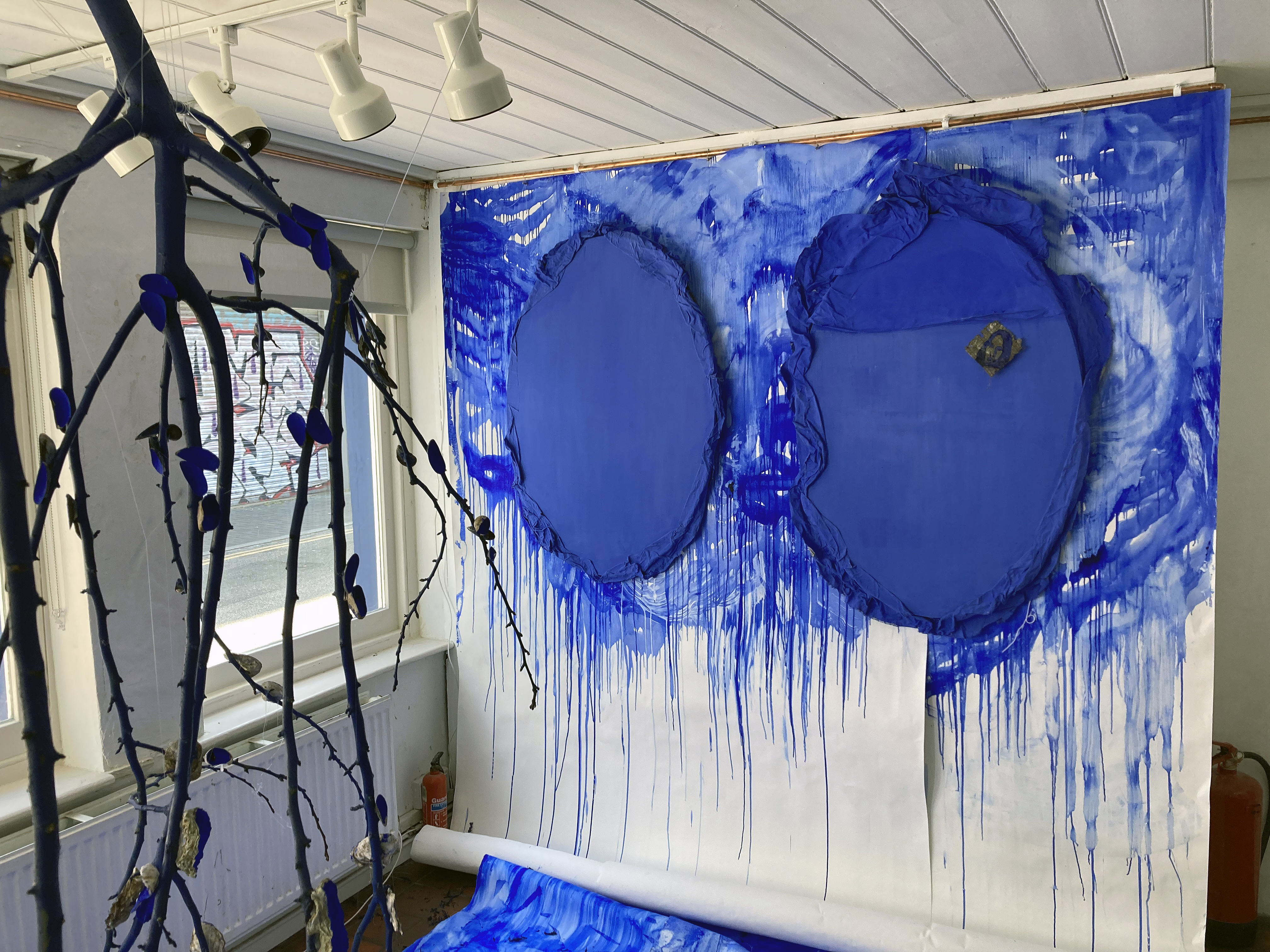
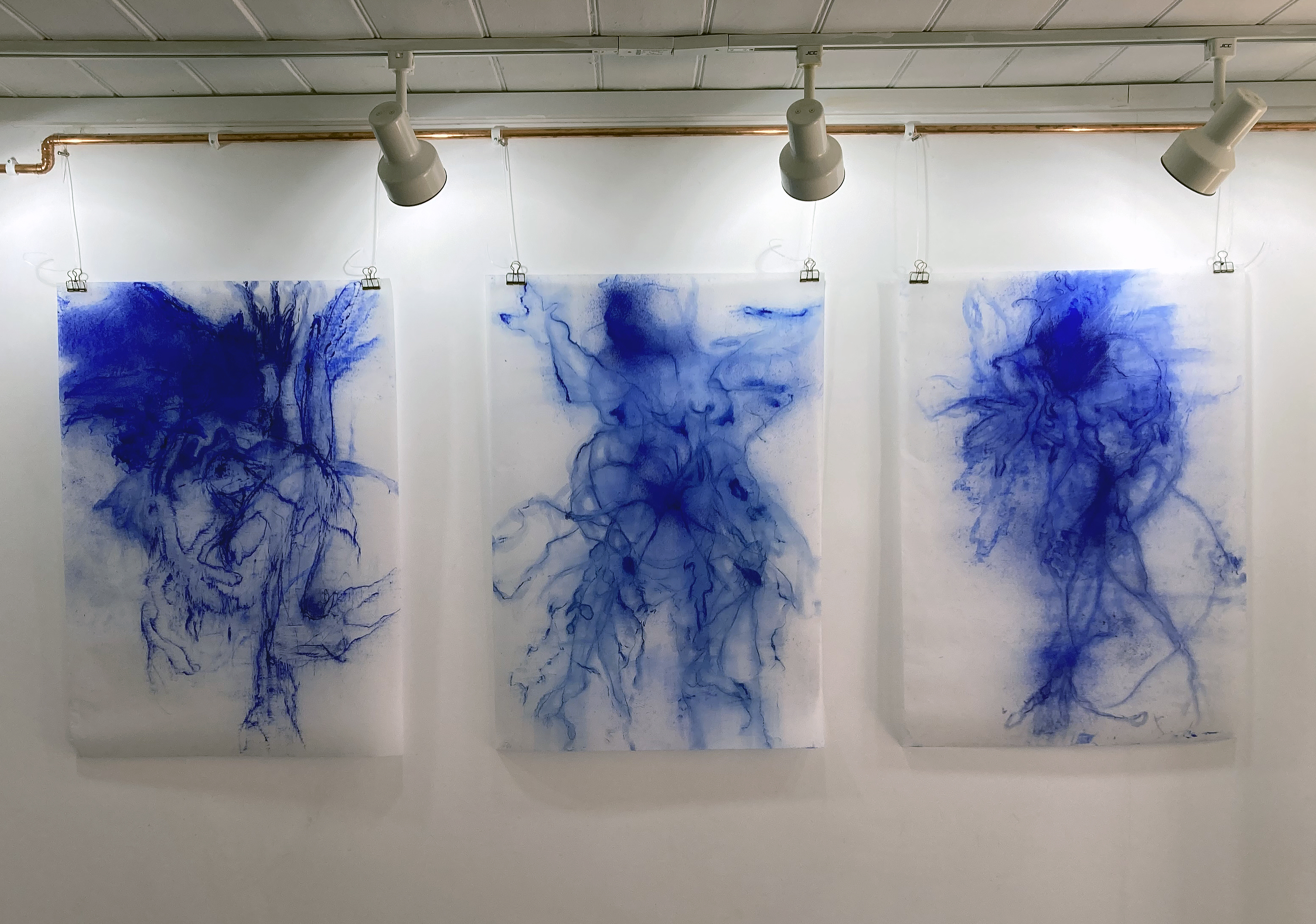
This impressive exhibition, Benthic Blues, is of just three days duration and I have arrived on the final day. I was compelled to visit a.s.a.p. as the Brighton Art Space is a fairly new venue in the city and I have already missed a couple of shows I wanted to see but had diary clashes. Via Carrie Stanley’s Instagram account I was intrigued by her seeming obsession with ultramarine blue and a shifting display from the gallery wall to the floor. As it happens, ultramarine blue is my favourite colour and the recent Turner Prize had rekindled an interest in the phenomenon of the installation. Other visitors may have visited knowing of the underlying theme relating to grief from suicide and that Arts Council England have supported the artist with a Developing your Creative Practice grant.

So much can depend on one’s own predilections when choosing to visit a show, but what we think we might like or dislike, of course, is too limited a reason for engaging with the general spectacle of the exhibition. We are all more or less experienced than others, so if an artist is presenting a celebratory theme (my interpretation of this exhibition) with a tragic, family related background it’s incumbent upon us to give that work time – and respect.

Carrie Stanley is a multidisciplinary artist and motivating her practice is a highly personal commitment to exploring mental health and trauma healing through the creative processes of painting, drawing and printmaking, re-presenting found objects and sound, and creative writing. Her interest in ultramarine goes beyond the visual aesthetics of colour. She links the colour to the sea, memory, the unconscious (e.g. dreams), ocean and land, the organic, materiality, play and potential healing.

There was a strong sense from the exhibition of the artist committing herself, against all the odds, to being positive, transformative and emotionally brave. By making, following a process and discovering something, or just knowing (or sensing) that she is in the right space at this time, permeates this body of work. Sharing the fruits of this journey amongst a community, known and unknown that may benefit many in some way is also akin to a celebration of sorts. Via the unfathomable depths of our emotions, the lowest region of despair, where light (as metaphor) cannot penetrate, the sometimes difficult to express or verbalise can be delivered through visual art. It reminds us that we are not alone, we are community. Stanley’s installation takes the viewer into the littoral zone, where light, and therefore colour, enables us to see – or at least begin to make something felt tangibly from the magical aspect of our world where messages await our readiness to receive them.

Considering the exhibition later that evening (before actually reading the exhibition statement), I sensed that the display was something of a showcase, intimating a larger, more realised, show in the future. The route forward might be towards an even more immersive viewer experience. The canvas/objects might reach out into the space even more. The suspended works might come further away from the walls. Works might be enlarged, like they want to shout out loud. Sound might be more dominant. Benthic Blues may in fact be a taster of more to come as I read that it forms part of a larger project, Together in Electric Dreams, which is in progress.

In visual art generally the artist’s personal background, wider societal issues, a political context or theme might be foregrounded as manifesto – or no more than subtlety implied in the artist’s offering. A strong or moving theme might be best kept a little sunken down to avoid the equivalent to the party political placard, which can trigger unreflective agreement or discord. It may be incumbent on the viewer to make some effort rather than rely on the artist to be too literal, as spelt out it becomes verbal language. Visual art is, well, visual and this aspect is a great strength in Benthic Blues as Stanley works with impressive skills, energy and commitment towards both herself, her family and a shared social community through an engaging body of work. She doesn’t shout. She allows us to cry with her.

Links:

Carrie Stanley on Instagram – @carrie_stanley_artist

ACE: Developing your Creative Practicehttps://www.artscouncil.org.uk/dycp

LYDIA STONEHOUSE: Taking Her Body With Her

ORGAN PROJECTS at One Church – Florence Road, Brighton

24 to 29 January 2025

Going to church can be so rewarding. Naturally it’s a Sunday and I find myself outside the One Church building in suburban Brighton, quite close to my home. I have been here on a couple of occasions before for the crafts market, but now I learn that there is a studio where Lydia Stonehouse produces her paintings and that a space has been commandeered for a gallery.

Lydia Stonehouse – ‘Arrangements’ (2024)
Oil on canvas (97x107cm)

Just the one small room, but highly suitable for looking at a carefully selected group of works. Eight paintings from last year are more than enough to give the visitor a good idea of what imagery Stonehouse is developing after graduating from The University of Brighton in 2022 and spending a year at the Phoenix studios as the receiver of the CASS Art X Phoenix Art Space Studio award that supports graduates in that potentially challenging year after completing their first degree.

Six of the paintings are seen at first glance, displayed on three of the walls. Two of these are ‘An ongoing birth’, with a strong landscape feel; which vies with ‘Arrangements’, transforming this sense of a distant view with (possibly) two figures dominating the foregrounded pictorial space. They initially dominate the immediate impression of the display. Four other smaller works, however, actually work well by alternating the various sizes of the works. The viewer must step forward or back to immerse the eye into the variously sized compositions.

Lydia Stonehouse – ‘An Ongoing Birth’ (117x127cm) and ‘Lotus Birth’ (26x21cm) both 2014
Lydia Stonehouse – ‘Book Scan’ (2024)
Oil and coloured crayon on canvas (35.5x51cm)

After tuning myself into looking at the works, being aware that first impressions can be misleading, I realised that I was attracted most to ‘Bookscan’, a relatively small canvas that was predominantly a subdued green mini-vista that actually felt quite expansive, way beyond the 35.5 X 51 centimeters of its physical reality. The floating linear and rectangular drawn shape within the confines of the canvas edges certainly suggests (is that a contradiction?) an opened book. The impression of a patchy rectangle of light close to the bottom left corner of the canvas brings a notion of time revealed through the light of day. What we perceive, what things are, where we are, are on a continuum. All is in flux, despite the painter’s foolish project to fix things as they are. Yet Stonehouse does not illustrate this; rather, she appears to be engaged on a mission of sorts. Her painting project is nakedly, vulnerably open and questioning. There is no sense of superficiality in these works. She knows when to stop and not to over reach the phenomenon of observation as a painting trope; of visual rhetoric as a too-certain reality.

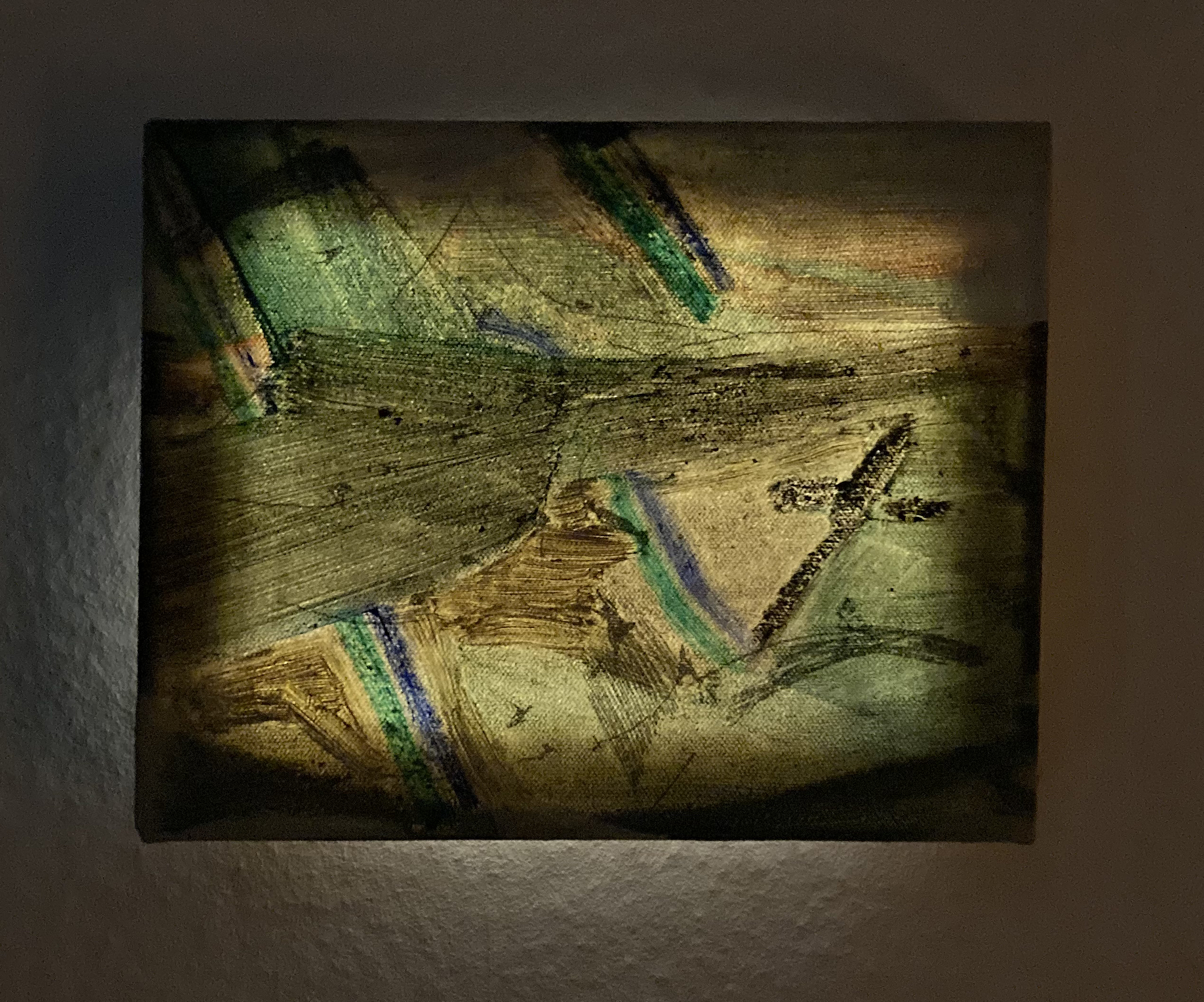
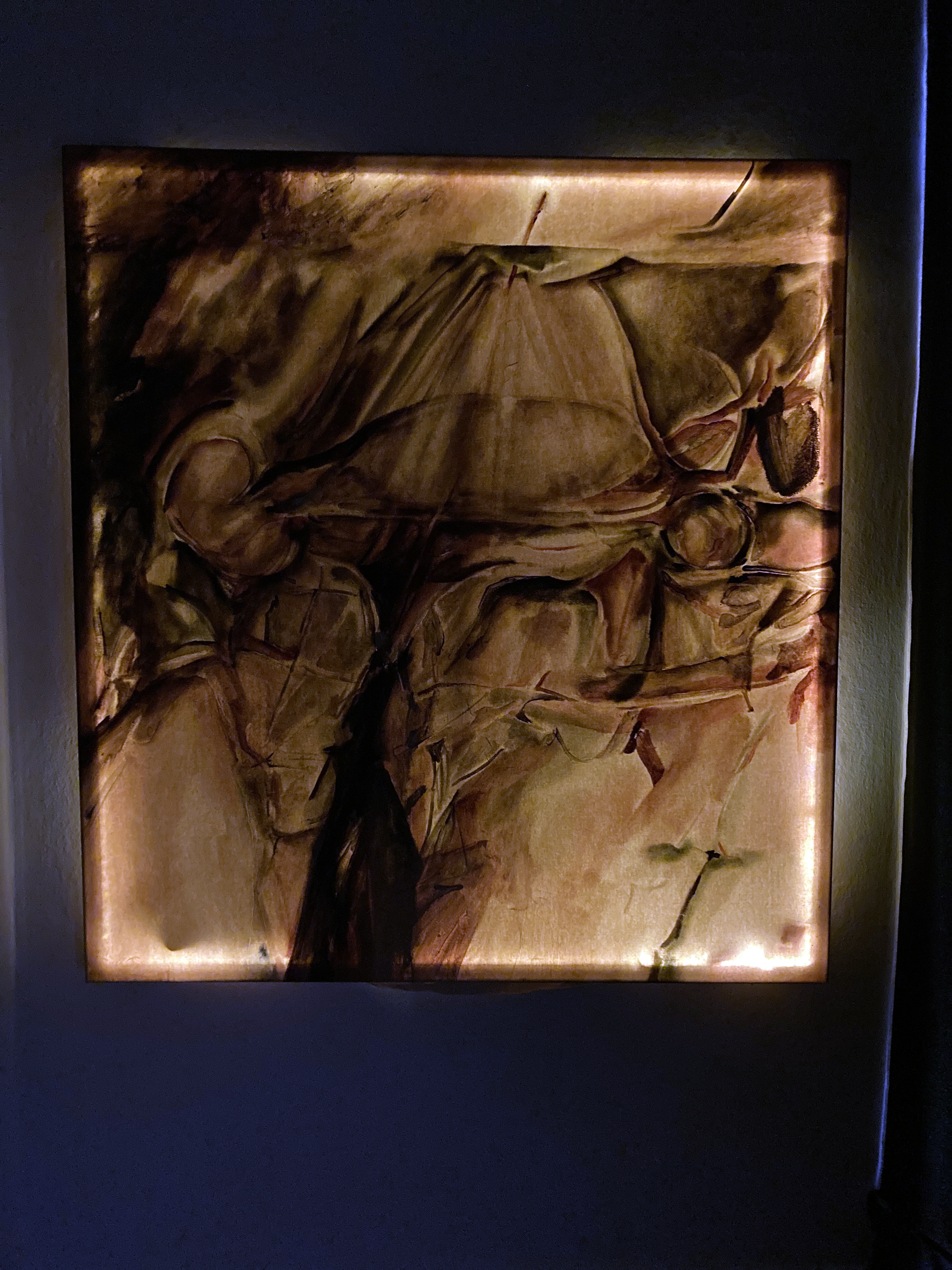
Then, I feel a little foolish. An arrow prominently marked on the floor points, most unequivocally, to the corner of a curtain. I have been in here for a good 30 minutes or so, totally absorbed by these engaging paintings, but where does this arrow lead? Parting the curtains I am welcomed into this intimate space by two (literally) glowing paintings. ‘Church State’, on my left, feels so small (21X26cm) compared to its equally lustrous ‘Not Even Trying’ (117x127cm) that might be exploding in slow motion. Each work has an embedded set of electric lights behind each canvas. I would like to sit here for a while. This feels like such a quite, meditative space.

Lydia Stonehouse – ‘Church State’ (2014)
Oil and carbon print on canvas. (21x26cm)

I need a chair. I can imagine one. Or perhaps my consciousness is the idea of a chair. Either way, the emanating light and colour creates a sense of the physical painting embodying a phenomenon engaging with me rather than simply being observed. The much smaller work, ‘Church State’ (maybe it’s a landscape) includes a small Christian cross that floats in pictorial space on the right hand side. The larger canvas, ‘Not Even Trying’ is suggestively bodily, physical, earthbound – yet amorphous. I am not sure.

Lydia Stonehouse – ‘Not Even Trying’ (2024)
Oil on canvas (117x127cm)

This uncertainty (if I am on the right track) is starkly honest I feel, in Stonehouse’s work. The work is explorative, which is healthy. The fatuous notion of the artist as unattached observer is dissolved. The reward for looking at this work is to know that our sometimes felt disconnection with the world out there is ultimately one, non-dual.

Notes:

Organ Projects is an artist-run space founded in January 2024 and is located within a small room in a church in Brighton. The space exists to bring together and show the work of visual artists both local to Brighton and further afield. They are committed to working with artists and curators to provide space for experimentation, share parts of their practice they don’t often get to show, test ideas, and encourage dialogue with one another.

One House, gallery entrance

Links:

Lydia Stonehouse

CASS

One Church

SEE EMILY PLAY

EMILY BALL: Walk with me

Atrium Gallery, Seawhite in Partridge Green

December 2024 to March 2025

Emily Ball – ‘Pulse’ – oil on canvas (120x170cm)

We play (mentally and physically) to learn, to discover, to realise. If this attitude diminishes nothing more will change and life will be mundane. It’s especially important for painters, or rather, it’s what I see in the painters who interest me. That’s my personal bias, but I am sure it’s a stance far from unique.

Emily Ball’s work has been on my adoration list for years, so making a fourteen-mile road trip in atrocious weather from Brighton was not a problem. Fortunately Storm Darragh had diminished significantly during the morning, which made the more scenic route north, via Henfield, possible. The countryside is fantastic along the meandering roads that gently rise and fall on the Sussex Weald. A feeling of being in the landscape is so strong, even if travelling in a car. Unknown to me, I was being mentally (and perhaps psychogeographically) tuned in for what was to be seen and experienced quite soon.

Installation including ‘Longing and Sweet Sadness’ – oil on canvas (120x170cm)

Many will know of Seawhites of Brighton (who moved to Partridge Green many years ago) as a great source of art materials, especially sketchbooks. But they have hosted exhibitions for several years too and with this show an expanded office space in an adjacent building to the one with the shop is perfect for a decent sized display that provides more than a taster of someone’s work. This is my first visit to the Atrium Gallery and first thoughts are assured and affirmative: wow, what a space, this is proper painting, everything is interesting (all 44 paintings and drawings). Then, unexpectedly: You don’t see this in the Turner Prize nowadays.

Indeed not. But initial impressions can change with reflection. So I walked around the ground floor for a while longer and was pleased to see that the floor above hosted many more works expertly arranged and hung. After a few minutes upstairs another visitor walked past talking to his partner, and I eavesdrop: “This isn’t kiss me quick or celebrity art”. He was referencing the nearby Brighton (but not so much Hove) art scene. It’s a little unfair, but I get what he means. There’s an abundance of excellent painters whose work is not seen enough down at the coast where the post/neo-Pop, street arty scene dominates. But I had to put that gripe aside for the afternoon and indulge in this engaging imagery from Emily Ball. After all, her work is unequivocally right here, right now whatever the trends might be.

Emily Ball – ‘Dig Deep’ – oil on canvas (120x170cm)

The work in Walk with me is totally absorbing. Many of the other visitors were either standing fully engaged with a particular work for several minutes or strolling around looking and looking again at the display. This is not so commonplace in the gallery environment where looks can be fleeting and it confirmed my sense of the high quality of the works displayed.

Emily Ball’s work in this show might simply be categorised as abstract landscape, but that would not be specific enough to account for a clear individuality of purpose in a lifelong project that engages with a searching, animated and exuberant understanding of the world as experienced. A being in the world, fully connected but including mystery. The works are full of implied movement, visually and physically expressed, by an observer fully engrossed in the act of drawing and painting. The imagery graciously pulls the observer’s gaze into a dynamic conglomeration of forms, coloured patchworks and passages through woodland spaces from the Algarve in Portugal (the Hot Hill collection) back to the artist’s home in Sussex (an ongoing series called Woodland Weave). The paint is applied skilfully with dexterity, self-confidence and years of practice – but healthily retains an aspect, or an edge, of testing out applications and combinations of sometimes raw but playful brush marks. There is a sense of a positive and intentional work in progress, or a springboard for future works yet to be realised. This animated feeling confirms that environments are never really still or are only observed with a rational eye. Nature’s spaces are in and around us, containing histories and yet moving on.

Emily Ball – ‘Shimmer 1’ – oil on canvas (16x24cm)

So, in the future, we can look forward to an expanded Woodland Weave exhibition that explores the woods at the rear of the artist’s childhood home, merging with her parents’ garden. As with any space that Emily Ball draws and paints this will be as much an emotional as a geographical space. It will be past, present and future. We might be reminded, or prompted, to recall our own equivalent spaces to conjure the psychogeographic nature of environments that are personal, familial and, ultimately, social. This is a distinctive potential for the age-old practice of painting and drawing.

First impressions can even improve, too. See Emily play.

Geoff Hands (December 2024)

Emily Ball – ‘Shimmering Jewel Study I to VI’ mixed media drawings

LINKS:

For high quality images of Emily Ball’s artwork visithttps://emilyball.net/

Instagram – @emilyballpainting

Viewing – ‘I smiled when I hear the cuckoo sing’ – oil on canvas (120x170cm)

ARTHUR LANYON: A Moon With A View

Anima Mundi, St Ives

19 July to 31 August 2024

Paintings are fascinating things. They have the potential to extend beyond imagery and the object hung on the wall as they provoke thought and, sometimes, a sense of common subjectivity, but with open-endedness and multiple yet authentic timelines. There can be a sense of not being finalised or prescriptive but suggest a more speculative, active domain of resolution. Arthur Lanyon’s exhibition at Anima Mundi in St Ives celebrates a three-year period of intensive work in the artist’s Penzance studio and these works have that sense of being both finished and in progress. It makes for a fascinating contradiction.

Whenever I visit Cornwall, thanks to the family holidays (close to thirty years now), a trip to St Ives is unquestioned. The first gallery visit is, almost certainly, to Anima Mundi. Way back when (the children were very young) it was the New Millennium and the Tate Gallery that drew us in to town. Anima Mundi has developed and matured and the quality of work displayed is consistently high and thoughtfully curated. Either way, this is the best independent gallery in St Ives. No contest. There really is no contest. This is a fact we should regret, as there are so many talented visual artists in, or linked, to Cornwall. There should be a dozen Anima Mundis in this non-London part of the British Isles.

This is my first post-Covid visit to the town. Too long, I know. I have my Tate membership ticket at the ready – but it’s the Arthur Lanyon show, A Moon With A View, that tops my list of desires. I was not disappointed. With no intention to write a review, my partner and I have a good look around. There are three floors of displayed works to investigate but we are engaged in conversation on the ground floor for quite a while. We are attuning. No kids with us this year (we are a little sad and despondent). The conversation was quite formalist: line, mark, gesture, shape, space, surface, process, choice of medium – all that (important) stuff. It’s the way in we always take. As for subject matter. Not so sure. Not necessarily concerned. Not yet anyhow. Inevitably, the pen comes out of the pocket and I start my scribbles on the exhibition handout that I always hesitate to read before viewing the works it lists and promotes. This is my choice not to be too primed, although in retrospect Lanyon’s own commentary was very useful. For example, the centrepiece of the exhibition is the large work entitled, A Moon With A View, which sets up a frame of reference in his use of the term ‘shapeshifting’ that can be born in mind for any of the works displayed:

“The problem and solution to a lot of paintings is in the shapeshifting between background and foreground. In ‘The Full Moon Over Water’ by Turner, the painted waterscape represents the finite and the moon – seemingly painted but actually bare background paper – is the infinite. The relationship between water and moon – and, in my son Rory’s drawing, between tree and owl hole – draws the viewer closer to the non-material, further into the mysteries.”

And his use of the term ‘unfamiliar knowing’ in another extract also attunes the viewer:

“A childhood drawing can filter through your system like ‘chinese whispers’ and come out as something new. Call it an unfamiliar knowing… It is strangely intimate because the nature of the mind seems to expand inwards to a place that cannot be found in the world of objects.”

Drawings are embedded in the paintings. Surfaces are physically loaded and layered as well as scraped, scratched or sanded back. The canvas is a place of work. A place of purposeful action. Improvised and adjusted as he goes along, I would imagine. These certainly are hard won images. Drawings are crucial ingredients in Lanyon’s practice, collage too. His work can be described as gestural, abstract and certainly speculative and (dare I say) ruminatory through active image/mark making. They acknowledge an inherently cubist sense of time and space in a sense. Very real and encapsulating a nurtured progress through sheer hard work and commitment. There is no irony intended either and some content is childlike, not childish. Given time in an exhibition, and patiently letting the imagery in, goes a long way towards shedding unnecessary luggage. Which is what happens fairly quickly with Lanyon’s work. This may be because the works, of whatever size, are visually very busy, mysterious and demand the viewer’s undivided attention. I feel a sense of the everyday/extraordinary too. His commentary also spoke of the ‘moodboard’, which might well be a useful model for the true nature of narratives concerning the everyday simultaneously affected by the past and present – including long hours spent in the studio.

Fortuitously, I have just read painter, Rebecca Partridge’s recent paper for the Journal of Contemporary Painting in which she explores the post ‘Modernism/Postmodernism’ of the metamodern, which can be characterised by “Simultaneity, depth, a ‘structure’ of feeling and a return to meta-narrative.” This term includes subjective experience, authenticity, romantic subject matter and multiple subjectivities. For his narratives (which, like ours, can be solidly clear, barely recountable or obscure), Lanyon appropriates the physical, material world of the here and now. But he also includes familial memories, sometimes of an historical nature across generations, in a painterly present in which personal iconography is embedded and emerges to make highly engaging imagery. Like a movie represented in its entirety by one still – which perhaps only painting, songwriting and poetry can do effectively.

An initial impression of the exhibition was that this is good stuff. It’s not immediately obvious or illustrative. Why? The work seems kind of honest. I am not sure what this might mean right now even as I type up my reactions almost a week later. That’s good, or at least promising. Looking and, subsequently writing, is a journey of sorts, though you can travel backwards and forwards through the text. The writer might fool the reader into thinking that this was all a first draft. That’s not so easy with a painting. Painting is often a more conspicuous struggle. Painting is vulnerable to scorn or indifference and misunderstanding. Painting is a statement often unchangeable. It certainly cannot hide whilst on display.

Painting is sometimes ‘metaphysical’. What does that even mean? Emotions are in there, for sure, and some sense of transcendence. Is the metaphysical universal (too Jungian a definition?) – for surely, one should not need to read about Metaphysics to experience it? Definition follows experience. Aspects of this evolving theory, the metamodern, are here in Lanyon’s work too. To take just three examples, or traits, from Partridge’s article:

“A pervasive ‘structure of feeling’, a return to affect, to multiple subjectivities”; “Construction as well as deconstruction, the expression of sincerity and depth as well as irony or critical remove”; and “Re-engagement with historicity and meta-narrative.”

Refreshingly, in his work something of the child remains and is addressed almost naively:

“A boy draws a tree for the first time. It’s tall, no branches, just a trunk shooting up to a leafy looking cloud (all simple cartoons are the same). But he forgets what lives in trees: owls. Looking at the skinny trunk he decides to put the owl hole out on the left – a free-floating circle. He thinks his drawing looks good. So he doesn’t screw it up. His dad blue-tacks it up on the wall by the light switch.”

This approach produces a visual poetry of emotion generated by the personal memory and the mark making activity. This set me thinking about the marks we all make and our human ingenuity for language in all its manifestations. When language first developed was it from a gesture (body language) or a sound (made from the body) – or from found objects reconfigured for use? Anyhow, in time, a mark of some kind was made that carried meaning. With some sort of tool – the finger, a stick – we shall never now. But Lanyon’s practice conjures a form of the metanarrative from the instinctive urge to make painterly and colourful marks and shapes that will literally surface in the studio-based activity.

Unexpectedly upon leaving the gallery I found myself looking at the exterior walls and the pavement as a continuation of the paintings – an experience my partner confirmed for herself. This has happened before, but not often. This emphasises to me that Lanyon’s paintings are in and of the physical, playful and creative world, which is all around us and at all times.

Back home in Brighton I check my notes: “Battle between abstraction and fig. Not only visually busy but also content/lyrically.” That was enough to start writing this Rumination. How can one appraise artwork from a one-off visit? It’s more impressions gained than a sustained ingestion and understanding. But how do you separate the art from the viewer anyway? Paintings need a viewer, often strangers, not just the artist. We turn up with our tastes, our troubles, our pre-conceptions, misconceptions, expectations and prejudices, but ripe to be transformed and refreshed. Yes, refreshed.

Geoff Hands, July 2024

LINKS:

Anima Mundi Gallery

Instagram – @animamundigallery

Arthur Lanyon

Instagram – @arthur.lanyon

Journal of Contemporary Painting (Rebecca Partridge)

Ten Basic Principles of Metamodernism

ARCHIE ROGERS: curb-bound

crafted material from an urban world

Gallery 19a, Brighton

20 to 31 July 2024

I am unable to make the Private View so have visited Gallery 19a the day before the initial gathering of friends and fans to have a sneak preview of Curb-Bound, a one-person show by Archie Rogers. The installation appears complete, unless any wall text or other information is yet to be introduced. As visitors we may well seek out some explanatory content but I am not so sure it’s needed.

Archie Rogers – ‘Copsewood’ Oilstick on two wooden panels (20x25cm)

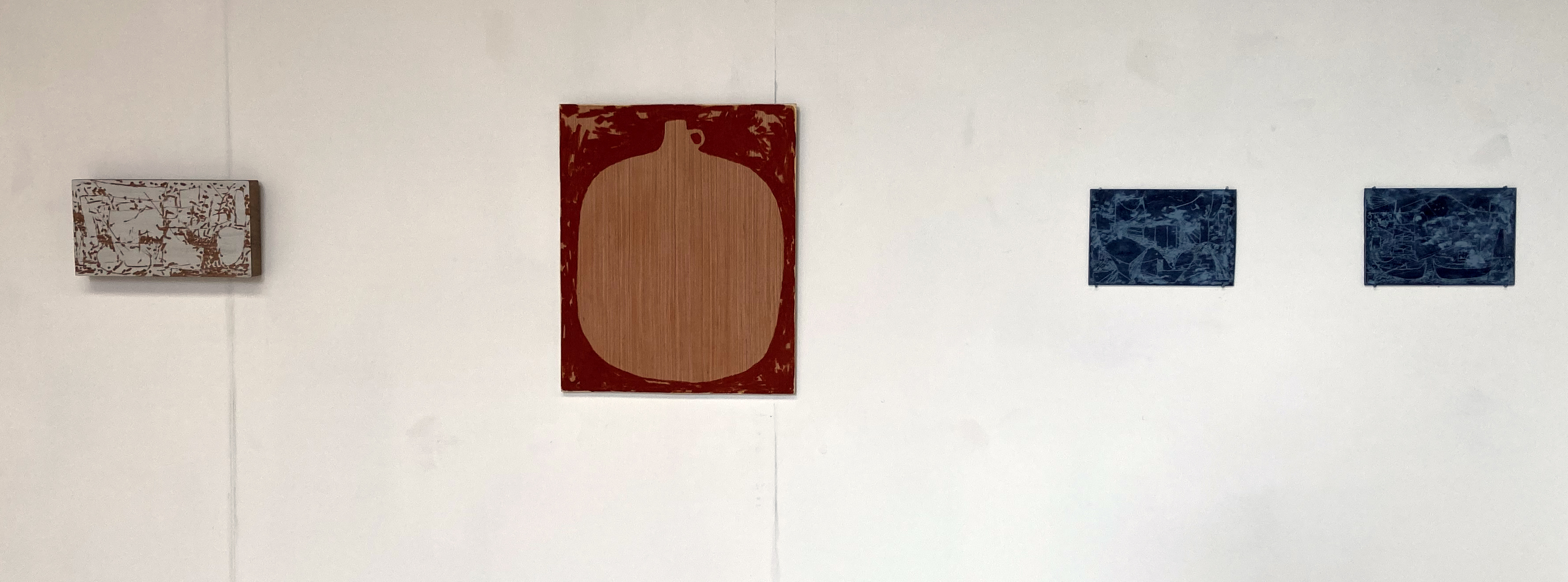
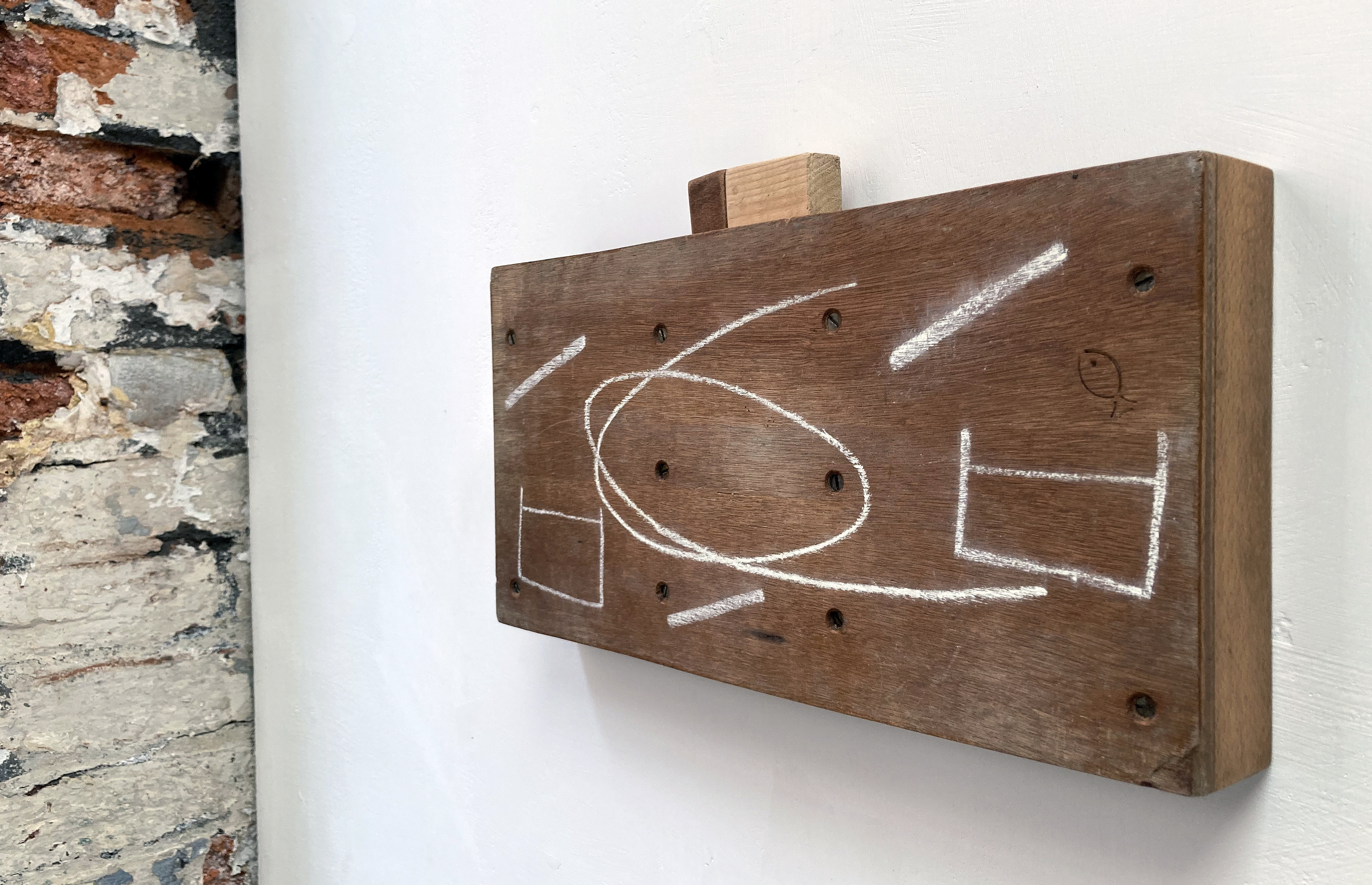
Titles usefully act as signage towards subject matter and, usually, enable a more informed or focussed reading. But without such prompts the emphasis is on the viewer’s imagination to make some sense of the creator’s intentions. I was not counting but there were close to twenty pieces hung on the walls and about a dozen other items arranged on the floor and on a long shelf. Sculptures might be the incorrect term for the various objects; I prefer the latter term, objects, as it acknowledges the ‘found’ nature of many of the pieces on display.

If the viewer knows of the Japanese term Wabi-Sabi, an appreciation of the found object, now defunct and showing evidence of natural aging, impermanence and transience, a context usefully envelops these works. But, interestingly, Rogers has continued any natural transformation with a carpentry and woodcraft type activity. In this sense the objects drift back towards some notion of the constructed and designed object. By collecting many wooden items (though not exclusively as chalk, oil, Bakelite and string make an appearance too) and sawing, drilling or carving up these materials, that could otherwise have been heading for the beach or home fire as kindling, are transformed by the simplest of means. This flotsam and jetsam from the street, and the beach, takes on a new purpose as art – and the hand is always present to make purposely-unsophisticated changes.

Archie Rogers

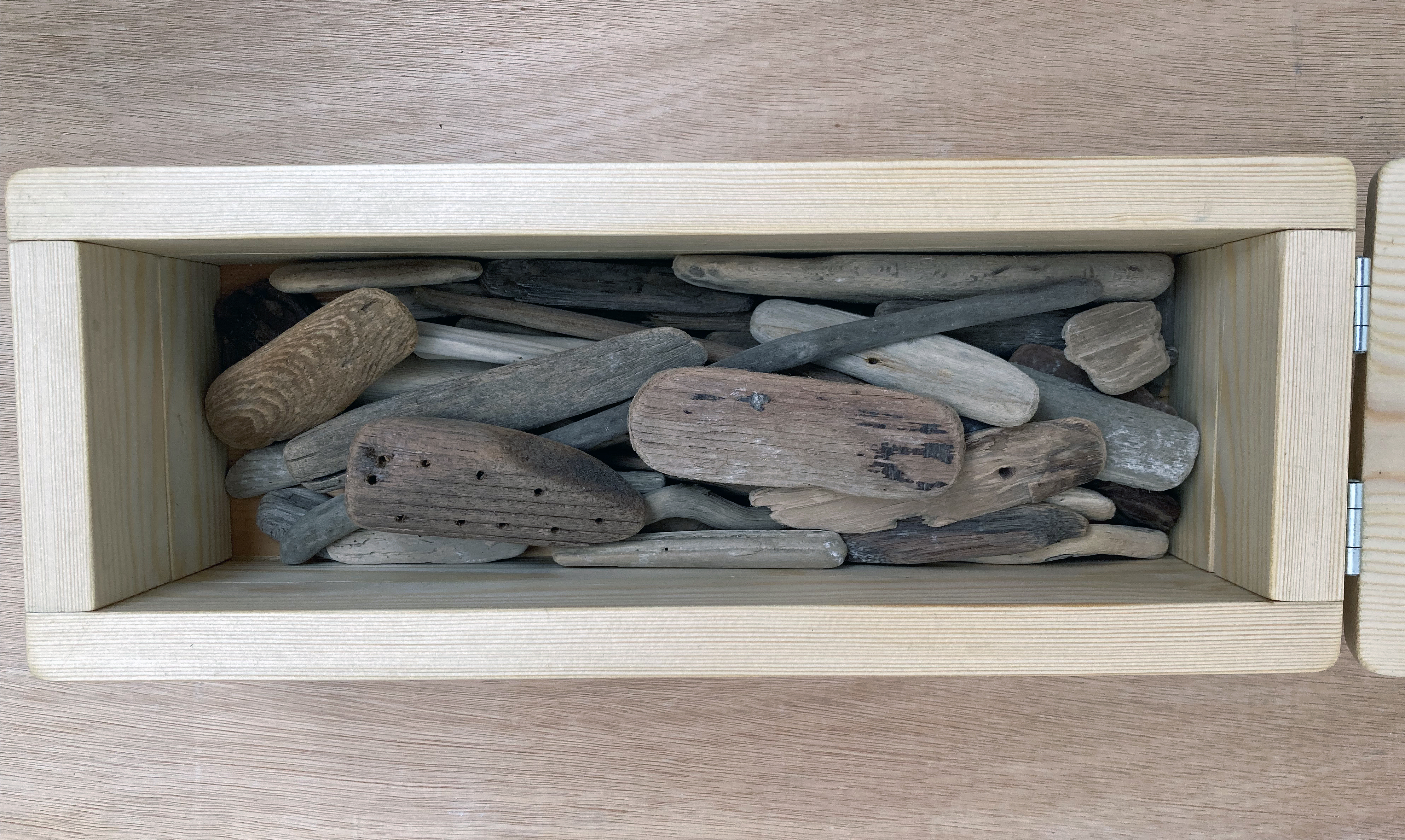
Some constructions are wall mounted and others are arranged on a long shelf or stored in a box. One such box held many pebble-like pieces of wood from the beach. A smooth little piece of wood had ten holes drilled in it that were surely added after being found. (I was reminded of Roger Ackling’s works that he embellished with burnt lines from the sun’s rays focussed through a magnifying glass and are currently on display in Norwich.) These holes suggest some semblance of transformation, perhaps from a primitive and seemingly unsophisticated starting point. Without obvious purpose the object remains abstract but is highly suggestive of human interaction

Another box held more cuboid and cylindrical forms that had clearly been carefully placed to enable all of the pieces to fit in. I thought of keepsakes, emotional treasure, something you might need one day, or just can’t bear to part with. The stuff found in parents’ lofts many years after the children have left home.

Archie Rogers – ‘Weaving’ String and wood

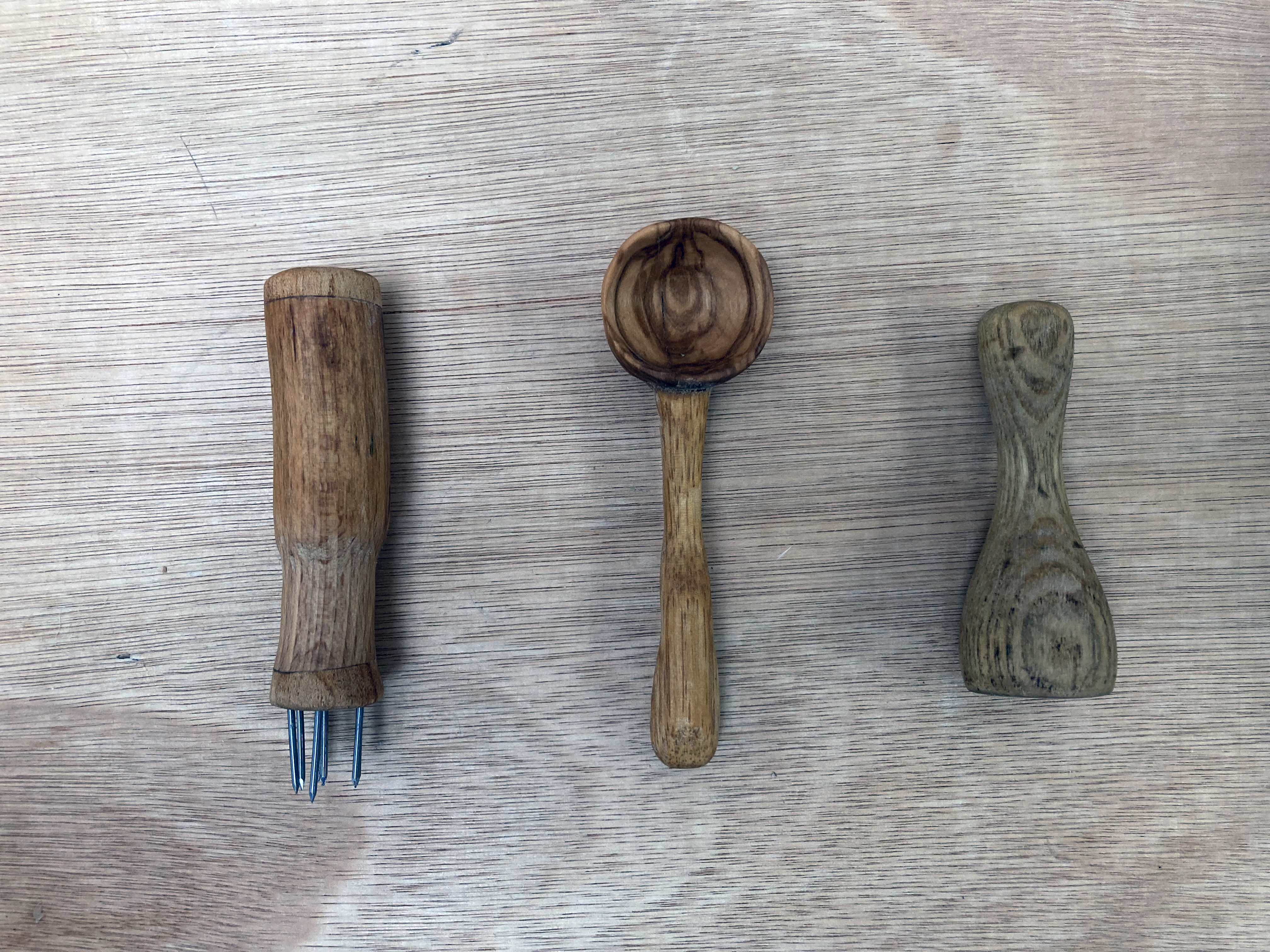
The standout item for me was a small weaving made from the artist’s very small hand made loom. In fact it was the second loom made, as the first, also on display, appeared flawed, broken or unfinished. The warp and weft item was suspended from a large wooden knitting needle. Although nearby, on the shelf, were three items, including a spoon, that equally drew my attention. Again, the subtle hint of earliest design and technology directed towards everyday needs, the real treasures of life, was refreshingly present. Wood, and associated materials have literally transformed our lives. Wood must be present in our creative and imaginative DNA.

Archie Rogers

Britain was once heavily forested, almost completely, 7000 years after the last ice age. Now we live in one of the most de-forested countries in Europe. With the Green revolution well underway our relationship to the natural world will surely rejuvenate. Archie Rogers appears to be discovering this material legacy in the curbsides and on the pebbly beach here in Brighton.

Geoff Hands (July 2024)

Archie Rogers – Wall installation

Note:

Archie Rogers is a co-founder and curator for Fresh Salad Art, a platform supporting emerging artists through the organisation of group art exhibitions around the UK and internationally through virtual gallery spaces. He is a University of Brighton graduate from 2022.

“My smaller works are predominantly made using found wood and other discarded materials, so surface takes on a whole new significance. An object which has been intensely used, worn, fixed, and abandoned bears evidence of its past life and can only become more beautiful as time passes. I enjoy reacting to these marks with the intention of complementing, not merely to conceal them. I believe in tactility and rejecting boldness in favour of subtlety, thoughts which are reflected also in my recent sculptural and functional pieces.” (UOB website, see link below)

Archie Rogers – Shelf installation

LINKS:

Instagram – @ar.chie.art

Gallery 19a

University of Brighton

Fresh Salad

Roger Ackling

Archie Rogers – ‘Oversounds (16-23 December)’– Found wood and chalk

RUPERT HARTLEY: Rising in the start of its arc

At Gallery 19a, Brighton

June 27 to July 6 2024

Entrance to Gallery 19a

I have this unexpected feeling that I have been outside for a walk. I am not so sure about the weather conditions, or where I have ventured. I may have been alone but I was definitely walking – probably at a leisurely pace. Rupert Hartley’s paintings presented at Gallery 19a in Brighton have this feeling of gentle serenity nuanced with a sense of fresh air and time flowing, though not fixed or too specific. The journey is the destination in itself, somewhere in between A and B. It is no surprise that psychogeography, a wandering multi-experiential activity, interests this artist. But the works are quite formalist too, with no requirement to read them figuratively.

Installation at Gallery 19a

In true ‘white cube’ tradition it has been a dominant convention not to display titles on the white gallery walls for many years now. Sometimes this purist ‘rule’ is annoying or occasionally quite helpful (maybe for figurative works?). In this show, however, it feels appropriate not to place wall labels that could distract from the works on display. The viewer, at least initially, is thrown in to the deep end of abstraction. The works might be described as minimalist or geometric in nature. The use of colour is paramount, with a predilection for the handcrafted, painterly approach. Though there are some signs of the use of masking tape making a tantalising approach towards the hard-edge.

After a general look around for about ten minutes, to tune in as it were, I take a look at the list of paintings in Rising in the start of its arc, quite possibly affected by how I have initially received the works. Echoing a moving gaze that shifted within each composition and from canvas to canvas, reading the titles randomly, not necessarily from the first to the last on the A4 sheets, was uncharacteristic of me. Many sequences are possible from just eight titles:

Totals; Leave here for large external world; Green lights both their smokes; Blue black on yellow smile; False dawn; Lights bathe you in red-blue-red; Afterlight; Totals…

Rupert Hartley – ‘Blue black on yellow smile’ 2023 (55x45cm) acrylic on canvas

How does the title of a painting function? In ‘Blue black on yellow smile’ we see the blue and black squares on a yellow background or surround (to avoid too spatial a reading), yet I am not sure about the smile. This is good. Let’s not get too literal or descriptive. The titles, perhaps they are best considered as sub-headings as the paintings are paramount as visual phenomena, from Hartley’s selection of paintings certainly have poetic potential as pure text. They could conjure an imaginative scenario of people and places or be presented as a form of Concrete poetry. In actual fact the titles are taken from Infinite Jest, a novel by the late American writer, David Foster Wallace. If these works are actually urbanscapes (and close to the seafront in Hove where the artist lives and has his studio) the notion of the literary arc is appropriate given a sense of place and some sentiment or hunch of the fictional nature of reality as it might be retold or represented in a literary or visually creative mode. But unlike a text rendered narrative a painting is usually manifested as a kind of one-off statement, even if part of a larger grouping. Such a form of ‘reading’ (if that is the right term to use) can be challenging, simple, or both.

Rupert Hartley – ‘Green lights both their smokes’ 2023 (55x45cm) acrylic on canvas

Hartley’s works are both objective and subjective. They are formalist and tantalisingly impressionistic. Light and colour are strong characteristics. Implied affects, from the paintings, include floating or an about to shift sensation. The process of the making of a painting could be sited as its essential subject, as a form of narrative, in this category of abstract painting. But that old-fashioned term needs a capital letter: Impressionistic, crops up as the works emulate moments of lived experience (a development of Realism in art history). Nowadays we might prefer the term environmental, as the works may well allude to the land/seascape and the constructed social space. Living on the south coast is an environment that local visitors to the exhibition might well recognise, even if indirectly or obliquely. The viewer could see or sense something in the work from the outside world they inhabit, as this is an aspect of traditional expectations too. The mind will often want to make sense of/from the abstract. But in Hartley’s works there is no illusionism. There is certainly a concrete feel, or sensation of space and structure, and some sense of figure and ground, whether intended or not. Viewpoints are potentially here too as one could be looking down on (an aerial view or map) or across to (a group of buildings or even a still life). The frame might even imply a window view, in pixelated fashion. There can be a sense of illusionism too, as in ‘Green lights both their smokes’ gives a hint of floating and shadow.

Rupert Hartley – ‘Afterlight 1’ 2023 (160x135cm) acrylic and flashe on canvas.

In all works, to slightly varying degrees, there are layers or just the one coat of paint, in a specific square or rectangle. The bottom section of each painting is either bare canvas or (mostly) painted with one colour for the whole width and might be read as an unintentional, though minimalist, predella. (The bottom section of a Gothic or Early Renaissance altarpiece that typically illustrates the life of a saint.) In all eight paintings the bottom section appears separate from the grid above, as if it could have been cut off before being stretched on to the supporting frame. Reading figuratively this strip/rectangle could be an urban, geographic pathway (and in ‘Leave here for large external world’ a blue stripe at the top, suggests the sky). Repeated greens in several of the works might suggest trees or bushes, but this literal reading that any viewer might have, though revealing a subconscious pictorial habit that is hard to suppress, is unnecessary.

Rupert Hartley – ‘Leave here for large external world’ 2023 (86×70.5cm) acrylic on canvas

There is a subtle predominance of blues and greys and a few reds and pinks in the selected works. Perhaps this made the earthy yellows stand out, particularly in ‘Leave here for large external world’. Colours are generally subdued, but retain vitality, from intermixing in most instances. Seldom does the acrylic appear squeezed directly from the tube or out of the manufacturer’s paint pot. The colours are key, not just individually but in relation to each other. The general square shapes and grid structures maintain an implied order and structure that holds it all together. The canvas surface is also part of the visual content. I frequently found myself stepping very close the works, especially ‘Green lights both their smokes’, to simply take in the woven texture. So too with various brushmarky laminations of colour in some of the squares. A handmade quality is retained in the painting process at all times. Nor do the works look pre-planned or overtly systematic, despite a studio-based system of some degree leading to these outcomes. In Hartley’s works we see infinite variety in a restricted, and sophisticated, practice.

Another reading might be of a form of deconstruction of the seen and experienced, leading to a constructed amalgamation of visually encountered environments to be realised as a work of art – something new in the world that we call a painting. On a more subject level I sensed a sort of breathing element too, as the imagery might be taken in to be exhaled. The visual becoming air as a calm softness of encounter accommodates a sense of changing viewpoints as well as general and specific identities. A kind of sense of place that is literally psychogeographic.

Before visiting Rising in the start of its arc, the last time I saw a painting of Hartley’s was in the memorable H_A_R_D_P_A_P_E_R exhibition at the Phoenix Art Space just four months ago. In my review of that show I avoided choosing a favourite, as there were so many works on display and my shortlist was too long anyhow. But I was tempted to choose Hartley’s contribution as my personal front-runner for the fictitious gold medal. I was not sure why though, and seeing this more comprehensive selection of his work helps me to realise that it might have been for the skills and ability to produce a work that appropriately requires a long look and a calm kind of gaze. The imagery sinks in rather than imposes itself upon the viewer. The colour range also adhered to this methodology of encouraging a mind-merging/thought process linking with the visual experience, rather than an all too obvious revealing of subject matter. In this new exhibition there is a purposive yet contradictory sense of the finished suggesting the unfinished in each work. There is also a sense of the process of becoming and of being made, with colour, shape and slightly imprecise or loose grids. But clearly being finished and resolved enough to merit the imaginative responses from the audience.

Geoff Hands, July 2024

Rupert Hartley – ‘Totals 3’ 2023 (120x120cm) acrylic on canvas

LINKS:

Rupert Hartley https://www.ruperthartley.com/

Nordic Art Agencyhttps://www.nordicartagency.com/rupert-hartley

Instagram – @ruperthartley

H_A_R_D_P_A_P_E_R review – https://fineartruminations.com/2024/03/07/h_a_r_d_p_a_p_e_r/

Gallery 19ahttps://19a.org/exhibitions

OLIVIA GUILLOT: Swallowed A Fly

At Phoenix Art Space, Brighton

26 June to 30 June 2024

Wow! Some paintings, some actual, real, “look at me I’m a painting”, paintings. Sometimes the best things happen when you least expect.

It has been a busy day and I am rushing around town. Dad’s taxi, paintings to collect from the framer’s, pick up a few things from Sainsbury’s, park at the studio (yes! there’s a space), say ‘hi’ to people in the corridor (make out all is well), pick up a notebook, water the plants and then, as I almost depart… there’s a new show just been installed in the Project Space at the Phoenix. But there’s no time to stop, but one has to.

Olivia Guillot, a recent graduate from the University of Brighton, has installed a display of seven paintings and a sketchbook in her first solo show, Swallowed A Fly. I am immediately drawn in by the painterliness and the strong colour hit. I might only have a few minutes, maybe 10 or 15 if I can dismiss the future awhile. Painting is so much more than the here and now, of course.

Olivia Guillot – Swallowed A Fly 2024 (120x150cm) oil on canvas

The works are lively and painterly, oh so painterly, and as fresh as the perennial daisy. This artist clearly has an almost unchecked love of paint and colour and image. I say ‘almost unchecked’ because there is a visual intelligence emanating from these canvases. There is a restraint too; revealing a painterly design sense that I suspect is intuitive. Whatever, these works are so refreshing to see with their vitality and energy. Paint and image are in transition, despite the fixed nature of the resolved canvas. What are these images peopled by? The figurative and the abstract meld. The act of painting, sucking something up from the imagination (whatever that is) makes new scenarios. Magic.

Olivia Guillot – Walkies 2024 (20x40cm) and Anteater 2024 (100x100cm) both oil on canvas

More joy: There’s a sketchbook (item no.3 on the exhibition plan, which gives an equal status with the paintings) that the visitor can leaf through. Why can’t artists show their sketchbooks more often? In some way this is an unusual, even a brave, decision. A document like this is such a personal document. Containing good and indifferent drawings and colour studies; notes from a tutorial; bare thoughts. But viewers should get the bigger picture (pun intended) and see some of the working and thinking process that determines the end result. That final canvas has a studio history. Discussions have taken place. Doubts work alongside discoveries and day to day planning. Ruminatory thoughts have floated by, sometimes recorded in scribbled notations. Perhaps there should be a clause that every painting exhibition includes a sketchbook or two.

Olivia Guillot – Sketchbook

Painters have to have confidence of course, a resolve to climb on board for the journey. It’s an attitude thing. Guillot has this in abundance.

For contemporary painters the gallery system is not always open enough. The Gatekeepers are not always into painting, after all. Painters have to raid the bank account and rent spaces. Painters have to be self-confident and brave. But, despite obsessions with alternative media, painting persists. Painting courses, such as the one at the University of Brighton, attract students of a highly visual persuasion. The medium encourages investigation and thought; self discovery and realisation. Out there in the ‘real world’ there are so many painters – and they are, for the most part, a national treasure.

The end result, like this small but expansive show, is akin to a music gig. The various parts are given extended strength by the grouping, the set list. See the show if you can, get the ‘hit’. Let the experience dissolve into your consciousness forever.

Geoff Hands, June 2024

Olivia Guillot – I Cant Stop Making Mush 2024 (100x100cm) oil on canvas

LINKS:

Olivia Guillot on Instagram@livguillot_

Update: Tracey Emin Foundation

HARRIETTE LLOYD: When The Dust Settles

Gallery 19a, Hollingdean, Brighton

7 to 19 June 2024

Harriette Lloyd – ‘After The Dust Settles’ 2024 Oil on canvas (67x112cm)

What are the painterly visual equivalents for the recollection of time and place? At a simple level we might think of the dark and the light, forms and space, the near and the far. Shapes, layers and geometric or organic forms, which despite the very clever invention and illusion of perspective, combine as an environment. Compositions from the visual field in the here and now, and potentially from memory (or become a version of memory), offer evidence. The future’s not so certain. There’s a sense of permanency unfolding into change of what is or was. Building, deteriorating or soon to be replaced scenarios are here or there. Surfaces reflecting or absorbing light enable differentiation in the visual field. Oh how we need light, and touch, of course.

Harriette Lloyd’s exhibitions of a dozen or so paintings at Gallery 19a in Hollingdean, Brighton conjure these notions of time and space as she makes these evidential documents. The painted memorials appear quite individual but make links from one to another and might be categorised as an extension of the traditional still-life, albeit expanded into architecturally interior spaces such as walls, floors and corners. The seventeenth century Dutch still-life painters of the vanitas recorded and presented objects as a sub-genre of the still-life that reflected a Protestant acknowledgment of the all too short duration of life and of the ultimately limited value of possessions. Lloyd’s project is also embedded in the everyday as a commemoration, but specific objects appear less important than the remarkable visuality of anything and everything around us – including the very process of painting which produces a kind of visual diary from actively engaging with a seeing in action. The application of and engagement with the stuff of painting is certainly endearing as I found myself imagining wanting to apply more of the medium, but Lloyd holds back. She does not get carried away or seduced by the oil paint. This is a promising sign of confidence and calmness in a demanding process. Graduating from the University of Brighton Fine Art Painting course she has clearly been well tutored.

Harriette Lloyd – ‘Grout’ 2024 Oil on canvas (138x82cm)

Lloyd’s visual vocabulary, including the inclusion and reference to of distortions or glitches in digital photography (a generationally related trope from a young painter?), of a near abstract style of painting appear wedded to a language of realism but allow for some degree of improvisation and, as she explains in her exhibition statement:

“The works individually are fragments that together archive fleeting beauty in melancholia.”

Melancholia implies depression or despondency but my take on this collection of paintings overturned any degree of personal dejection into a somewhat positive and celebratory frame of reference. These paintings might affect the viewer in a surprisingly positive and optimistic sense of being alive right now and of a consciousness of the here and now, even in apparent banality, as hugely wonderful. The viewer might leave the exhibition having been prompted to look around wherever they might be and to comprehend and value what’s here rather than some illusion of the elsewhere. This seeing does not have to be denoted as good or bad, or beautiful or ugly. These works might encourage us to accept what is, even if nostalgia, a sense of loss or even premonition creeps in. The paintings certainly stand up to a prolonged viewing as a quick glance was quickly developed into a compulsion to stay put. These paintings generously invite the viewer to stay calm and to carry on – and to deserve a place in your home.

Geoff Hands (June 2024)

Harriette Lloyd – ‘Hot and Cold’ 2022 (30x27cm) Oil on board

LINKS

Harriette Lloyd – https://www.harriettelloyd.co.uk/

Gallery 19a – https://19a.org/exhibitions

REMBRANDT: Paintings Must Be Seen For Real

Rembrandt in Brighton at Brighton Museum & Art Gallery

10 May to 4 August 2024

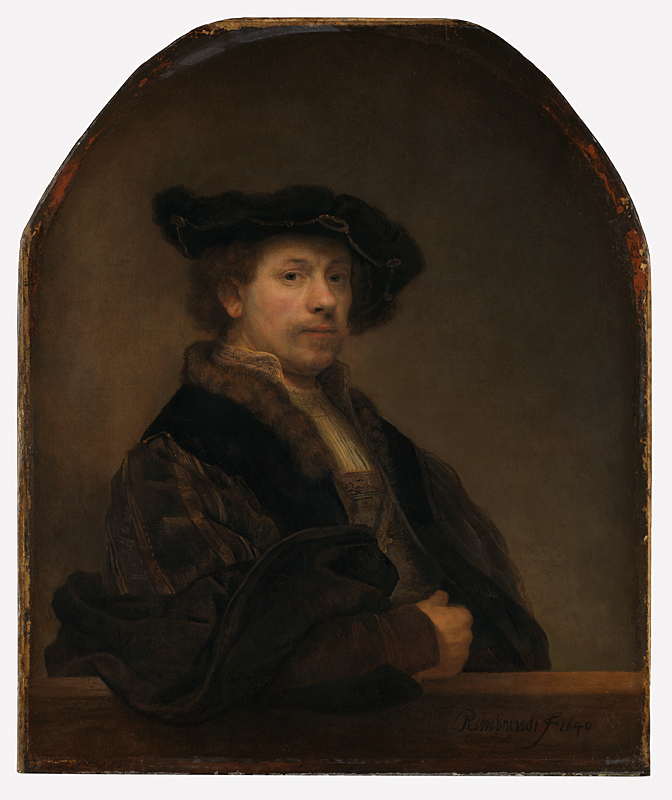
Rembrandt Self Portrait at the Age of 34 1640 Oil on canvas, 91 × 75 cm Bought, 1861 NG672 https://www.nationalgallery.org.uk/paintings/NG672

Earlier this year I posted the following advice to painters on my Painting Studio Strategies Instagram account: ‘Paintings must be seen for real’. Of course, it’s an obvious thing to say, but we all (not only painters) should see actual works whenever possible. The obvious reasons for looking at a painting are straightforward: the viewer sees the work without changes to its size, the colours and tones are not affected by a printed reproduction or the screen settings, the surface qualities are not smoothed out and you can get up close (within reason). But there’s another element, which is subjective and relies on the viewer giving ample time to experiencing the work.

In this instance I imagined the painter (myself included) in the studio surrounded by one’s own paintings with images of other artists’ work, especially our heroes, only being accessed through books or on our iPhone screens. There might be a few postcards on the wall too, although I suspect that card sales have plummeted since the advent of the mobile device and through being allowed to take photographs in most exhibitions for personal use.

When we do see a painting for real, by which I mean one from the greatest of all painters such as Rembrandt, there might be a degree of surprise or just a reminder that paint, most especially oil paint, is an astonishing medium. In the right hands a painted image can move into a region beyond what we might call ‘materiality’ today. The experience of looking might even go beyond ‘subject matter’ too. As I mentioned above, there is surely a subjective aspect to this point of view but I would advise a detractor to visit an institution, such as the National Gallery in London, to tune into the alluring charisma and sublimity of the paint medium. Or maybe just its ordinariness as an ingredient in a composition (I am thinking here of Piero della Francesca) will suffice.

So when a painting by your favourite Old Master is displayed in the local art gallery, just a ten-minute walk from the Phoenix Art Space studio for me, there is no excuse to not visit several times. In fact for the locals we just have to pay once and we can revisit the Brighton Museum and Art Gallery as often as we wish for twelve months. So I expect to pay homage to Rembrandt Harmenszoon van Rijn’s ‘Self Portrait at the age of 34’ (1640) quite a few times up until August this year. The painting is on loan from the National Gallery to celebrate the Bicentenary of one of the most important art galleries in the world. Twelve paintings from the collection are being lent to venues across the UK, which would be a great initiative to continue and to expand to even more galleries for many years to come.

If I try to define the impact of this astonishing self-portrait it’s difficult not to fall into well-worn cliché, particularly in relation to the gaze of the sitter connecting with the viewer, or the implied humanity of engaging with a fellow human being from so far back in time. Then there’s the art historical and cultural information that not unreasonably feeds into the experience of appreciating the painting (see the impressively curated NG website for a full explanation, link below). One could even make a connection, if contemporaneity is sought, to notions of the ‘selfie’ today, although the virtual instaneity of the self-portrait type image made with a smartphone will generally be quite superficial, even facile. Rembrandt’s heavily implied self-confidence and promoting of his painting skills are clearly on display. But this is certainly not a painting that celebrates selfhood or reveals the more modernistic sense of existentiality that questions the times one lives in. The painting is certainly a form of advertising as Rembrandt sought commissions from the wealthy Dutch collectors of the 1640s.

But there’s just something about the paint and its application, and about the control of colour and tonality that Rembrandt fuses so well with the subject beyond appearance. Does the face/head represents thought and ideas, whilst the hand on the parapet in the foreground represents the human hand that physically works in conjunction with the intelligence. Is this a manifesto of sorts that elevates the painter to the realm of the poet? Rembrandt, the painter, achieves a notion of image (visual art) with ideas (expressed through literature, most especially poetry) that we might consider ‘abstract’ – beyond but reliant upon the visual and the written or spoken word*. The indefinable ‘X factor’, to use modern parlance.

On my second visit another viewer commented to her partner, “The more you look the more you see. It’s the detail.” Yes, I thought, but it’s the aura too. This does not seem to be down to skill alone. It’s not purely about the painter’s choice of what to do and how to do it. It’s from a training, and a looking at other artists (Titian in particular) and of having some practical purpose in the subject matter. But more still.

You really have to see it to believe it. And, fellow painter, if you get the chance to visit buy a postcard for just 75p.

Geoff Hands (June 2024)

* This connection of painting with poetry was mentioned by Bart Cornelis, National Gallery Curator of Dutch and Flemish painting, in a public talk connected with the showing of the Rembrandt portrait.

LINKS:

Brighton Museum & Art Gallery

The National Gallery, London

https://www.nationalgallery.org.uk/paintings/rembrandt-self-portrait-at-the-age-of-34

Phoenix Art Space – https://phoenixartspace.org/

Instagram – @painting_studio_strategies

LYDIA GIFFORD: Low Anchored Cloud

At Alma Pearl, Hertford Road, London N1 5ET

15 March to 13 April 2024

Lydia Gifford – Fruiting Bodies 3 (2023) with viewer (270x200cm)

Painting is not only a physical endeavour for the artist, the maker, but is also a phenomenon for an audience to participate in an intriguing experience that the artist has recorded in their own unique way. This is partly what exhibitions are for. The artist is a gift maker. We should be appreciative and respond constructively.

Alma Pearl is a relatively new space, barely a year old. This was my first visit and I was enraptured by this display. There were just eight paintings plus half a dozen fabric/collage pieces (subtitled – sensitive fibres) that made for an exhibition within an exhibition. Despite generous expanses of white space between the paintings the walls felt full due to the visual impact of the works of various sizes. The curation, therefore, was just right.

I had not seen a Lydia Gifford painting in the flesh since 2015 when my eldest daughter took me along to the Laura Bartlett gallery. On that occasion I was impressed, though a little shocked, by the bareness and rawness of the mostly monochrome artefacts. The works were obviously paintings, but there was an element of sculpture, in the unmonumental sense, and of the expanded field aspect of contemporary painting. I felt primed for something even though I had only tasted a small selection from the artist’s oeuvre and I looked forward to seeing more. How time flies.

It was the final day of the exhibition at Alma Pearl and I had booked a place for Lydia Gifford’s interview with art critic, Tom Morton. My daughter’s here too. Before the discussion we had ample time to look at the work displayed on the walls. There were written notes to be made too as, inevitably, personal thoughts emerged from the looking. As viewers this is one way of participating. It’s not everyone’s practice but one legitimately connects to the visual and physical by recording reactions in this way. Others will talk excitedly with a fellow viewer (not my style) or will keep their thoughts to themselves. But there is undoubtedly a dialogue of some kind going on, which may well echo back to what transpired for the artist in her studio, out of doors in the countryside or in the urban environment. Either way, the experiences of the artworks are a form of an earthbound, quotidian transcendence for artist and viewer alike. The viewer must be as open minded as the artist and to make the experience of looking at artworks as active as possible.

I had not planned to write anything for wider dissemination than my own notebook, but here they are, amended a little and given the form of notes masquerading as free verse muddled with loose haiku. Part two includes quotations from Gifford’s responses to Morton’s questions, as well as my own notes that were very much prompted by what Gifford had to say.

Notes (1)

Materiality
The paint substance
Just as it is.

Read the mark
Realise the surface
Take it in.

Bound within a rectangle it’s difficult not to think ‘composition’
Movement
Active.

Scrim as underlying material structure but mobile, unsteady, loose
Or rather, in a slow state of flux
Finding and losing.

Images return as the mind’s eye attempts to make some visual sense out of what might be a form/instance of chaos
But the chaotic has structure too
(Do I really mean chaos?)

Does one ‘see’ a figure or a compositional structure?
A building or a scene of some sort
A isualised subject matter (such as landscape).

Then the substance of the paint brings one back to its smeary constituency
Stuff creating form
Or denying form and structure to emphasise its materiality.

Earth colours, including orangey brown and gentle greens
Straightforward marks and textures, as in not fussed about with
A sense of fingers and hands smearing and pushing/dragging the paint around, over, into.

The works stop/are resolved just in time
No nonsense or overstatement
Intuitively created, acts of play.

Risk becoming manifested as confidence
Or take it or leave it
But maybe give some time, some attention, for this may make sense in a certain frame of mind that is more intuitive, yet everyday.

Here is a painting
Chaos is only theory
Join me in what I see and experience.

Lydia Gifford – Untitled (earthing) 2023 (82x122x6 cm)

Interim

The title for the exhibition, Low Anchored Cloud, was taken from Mist, a poem by Henry David Thoreau from his Poems of Nature (1895).

Low-anchored cloud,
Newfoundland air,
Fountain-head and source of rivers,
Dew-cloth, dream-drapery,
And napkin spread by fays;
Drifting meadow of the air,
Where bloom the daisied banks and violets,
And in whose fenny labyrinth
The bittern booms and heron wades;
Spirit of lakes and seas and rivers,
Bear only perfumes and the scent
Of healing herbs to just men’s fields.

Lydia Gifford – Untitled (hypha) 2023 (56x26x4 cm)

Notes (2)

L.G. and T.M.
Spoke of a poem
A “real poem” (LG)

Grapple with.

Flowing nature of textile and body absorption
Psychedelic nature
The physicality of something transient.

“Unbelievable reality, I see all around me.” (LG)

Feel
Vaporous sense of self
But in this world, this moment.

Cultivate marks
Not a linear way of mark making
To open up a way of (mark) making.

Edit
Cover
Extract.

“Honour the consciousness of the moment.” (LG)

Time
Now, not fixed
Lived.

“I love drying time… cultivating.” (LG)

Refine the haphazard.

“There isn’t a finishing point – you can make another one.” (LG)

“I like awkward.” (LG)

Learning to sense
Entrap, to peel open
To ooze through the layers.

“Make a kind matter.” (LG)

Closeness.

“What are thoughts and how we hold consciousness together?” (LG)

Fluid, lost in time
Feel durational
Can’t quite capture.

“There’s no image.” (LG)

Terror
Wonderment
And awe.

“It’s being living.” (LG)

“Colour is embodied in textiles.” (LG)

Blood
Sweat, tears
Procedural.

“Textile is very time based.” (LG)

Re: Titles: “Not closing down.” (LG)

Not closed by a title
A nudge
To add.

Mushrooms build and connect
Ever spreading
Through or around obstacles.

‘Mycelium’

Construct of time
And thinking
Terrified.

At peace.

Lint holds
Makes things right
Balanced.

Classical
Imbalanced
Proportion.

“I try to unfamiliarise the marks.” (LG)

Lydia Gifford – Untitled (sensitive fibres) 2023

Text: © Geoff Hands (April 2024)

All images of paintings © Lydia Gifford

LINKS:

Alma Pearlhttps://almapearl.com/exhibitions/11-lydia-gifford-low-anchored-cloud/

Laura Bartletthttps://archive.laura-bartlett.com/lydia-gifford-2/

Henry David Thoreauhttps://poets.org/poem/mist

IN THE GARDEN

Michelle Cobbin interview with Geoff Hands

Gallery 19a, Brighton

March 21 to April 6 2024 (Closed Sundays / by appointment Wednedays)

Installation of In The Garden at Gallery 19a

Michelle Cobbin, a fellow painter at the Phoenix Art Space, interviewed Geoff Hands as he prepared to install his exhibition, In The Garden, at Gallery 19a in Brighton.

Install photographs by Rob Harris.

Michelle Cobbin – What was the first painting that had an impact on you?

Geoff Hands – A Camille Pissarro woodland landscape. I was 18 or 19 years old and on a Shrewsbury School of Art visit to Manchester City Art Gallery and The Whitworth. It was not a particularly large work, but the paint was quite thickly applied in that Impressionistic manner. It sounds naive, but I was so accustomed to looking at reproductions of paintings in books that I must have assumed that paintings were essentially ironed flat. Today we probably talk about ‘materiality’ but back then, in the 1970s, it was ‘surface touch’. A visual touching of course, which is one of those fascinating dualities of experiencing painting that might only truly be comprehended on a feeling level.

I should also mention two other paintings recalled on another art school trip a little later to Liverpool. These are Stephen Farthing’s ‘Louis XV Rigaud’ and John Walker’s ‘Juggernaut with Plume – for P Neruda’ that were selected for the John Moores exhibition in 1976. They employed a technique of employing collage within the canvas, which expanded the painting process. Collaging, in a sense, is more ‘hands on’ than painting with a brush.

MC – That is really interesting. Your recent work utilises unctuous and thick oil paint and collage plays a part in your studio practice. Would you say that the ‘materiality’ of making work is essential to your practice? 

GH– I have always felt that the physical medium is a crucial ingredient in the realisation of the artwork. It’s experiential too, both for maker and viewer.  There’s a symbiosis at work, which is material, physical and visual. Oil paint is a wonderful medium, just from a feeling point of view. If my painting is going well, on a subjective level, the oil painting process is still a challenging and discomforting experience. That’s the contradictory nature of painting for me, which has been appropriately labelled the ‘hard won image’. I’m sure that sounds rather old fashioned and romantic.

Oh, but the thick layers of oil could be thin too. And I love the term ‘studio practice’ as it implies a never-ending quest for something. The recent work being presented in ‘In The Garden’, particularly from 2019/20, really continues work from before but with an added realisation that there’s a singular pursuit to make a painting that was worth the effort. That’s why I called my show at the Phoenix Art Space in 2020, ‘It’s All One Song’, after a comment made by Neil Young to an audience member who wanted to hear a specific song but he launched into something else. My interpretation was adjusted to the notion of my own singular pursuit, engaged with as a painting student so long ago, that is still manifested in repetition of some kind of desire.

‘Garden (Pilgrimage) – After Watteau II (for PJ Harvey)’ 2020-21 (121x150cm) and
‘Garden (Pilgrimage) After Watteau I’ 2020-21 (121x150cm)

MC – That quote from Neil Young, ‘It’s All One Song’, you mention one way you apply that idea to your painting in that it is a repetition that forms part of your ‘studio practice’. Keeping with musical references I would suggest that you use a lyrical mark-making motif in many works that lead the eye from painting to painting in a rhythmic way. Are you conscious of that – is it deliberate or is it perhaps that you are listening to Shakey in the studio and the marks are spontaneous responses to the music?

GH – Well, I am conscious of a desire to create a feeling of movement and flow in the paintings. This starts with the looking and the observational drawing before the paintings are made back in the studio. This interest in rhythm, movement and atmosphere is concerned with consciousness, time and space. So there should be occlusion and fixed point too. This is everyday stuff, acknowledging the animism and agency of the here and now. The mark making can be described as ‘lyrical’ and I see it as an extension of the looking and the drawing but improvisation is key too, along with a journey into abstraction with colour.

I get the musical link too but I more often paint with some chilled ECM label jazz playing in the background. The occasional blast of Neil Young with Crazy Horse would be good to stop overthinking though!

It’s worth briefly mentioning that I am currently working with musician and composer, Tobias Wheal, on walking, drawing and painting with his music responding to my work and vice-versa. There’s a little poetry as well, but it’s still a little early to say much more as we are buried in the project at the moment.

Garden’ series, 2023 (25.5x31cm)
and ‘In The Garden (for V.M.)’ 2023 (51x26cm)

MC – The project with Tobias Wheal sounds like an interesting collaboration, I look forward to seeing how that develops. Recently your work has referenced paintings by historic landscape painters such as Watteau and Gainsborough. In particular I was drawn to the large painting inspired by ‘Mr and Mrs Andrews’. What drew you to riff off that particular Gainsborough painting?

GH – Between two of the lockdown periods I went to see the Titian show at the National Gallery and took a walk around the permanent collection. Gainsborough’s painting is one I know well from many visits there and it never fails to impress. I always expect it to be bigger than it is and his paint handling is astonishing. It’s a loaded image of course, not just from a feminist perspective concerned with the implied male ownership of the female partner, but it is also an unintended glorification of capitalism and land ownership from its early history of development in England. For anyone interested in the English Landscape tradition in painting it can’t be ignored either. All of these political frameworks are important and remain relevant today, but I think that we can look at paintings for what they are without having to add a societal context every time.

Anyway, at the time (during the pandemic) I was incorporating elements from paintings from the past into my own work. I was initially looking at a Ruben’s composition (‘Landscape with St George and the Dragon’ 1630-35) and adjusted a small series of my own paintings to include compositional references. This lead onto ‘appropriating’, the artist’s term for stealing, various elements from Titian, Watteau and Gainsborough to add to my own imagery. Some of the content from these painters has been intermixed, especially from Watteau’s, ‘The Embarkation for Cythera’  (the version in the Louvre) that has become a bit of an obsession. With the Gainsborough I have found that I can enjoy painting towards abstraction. The image just seems to lend itself to this painterly and colorful direction. All of this has been happening since about 2020 when I was becoming a little disillusioned with where my work was going, or rather, it was stuck in a groove that needed changing somehow. My forthcoming exhibition (In The Garden) at Gallery 19a will show a small selection from this quite large body of work and I shall have an opportunity to distance myself a little from the paintings so that I can see it from another perspective.

‘Andromeda’s Garden’ 2023 (145x200cm) oil on canvas

MC – As I think about you preparing to select paintings and curate your exhibition ‘In the Garden’ I wonder about titles of individual paintings and whether titles are important to you. As a whole you say the work is ‘all one song’, how does that effect how you title individual works?

GH – Well, there’s an obligation to title work but it’s useful. Just numbering works does not feel right for my works – although as I work in series there will be a roman numeral somewhere. A title is something of a portal, an entrance into the work for the viewer. With the works that reference another artist it seems ethically correct to add their name to the title. As for the importance on a personal level I often reference the source of the painting. This is often a particular location where I have typically visited with a sketchbook to draw in. The untitled option is always there though, and if I am looking at someone else’s paintings in an exhibition I generally avoid reading the wall label at first. The song reference is more of an acknowledgement of a lifetime’s quest or project.

The exhibition title for my show at Gallery 19a is deliberate reference to the feel of that particular song by Van Morrison. It’s quite personal, and perhaps only relevant to myself. The garden reference is also an allusion to the painting studio, especially during the pandemic lockdown periods, and an even more oblique reference to images of Mary in the Garden from the Gothic and Renaissance periods in art history. I like to think of this as a poetic decision, inviting the viewer to make whatever they wish from the references without any clear answers from me.

MC – I think that’s a good place to end.

Links:

Geoff Hands – https://www.geoffhands.co.uk/

Michelle Cobbin – https://www.michellecobbin.art/portfolio-abstract-paintings

Geoff Hands – ‘Emilia’s Garden’ 2023 (135×185.5cm) oil on canvas
‘Andromeda’s Garden’ 2023 (145×200) oil on canvas
Catalogues, included limited edition of 32 with original paintings.

H_A_R_D_P_A_P_E_R

At Phoenix Art Space, Brighton

2 March to 14 April 2024

Paper has been around for ages, maybe 5000 years, especially if we include papyrus from ancient Egypt. Artists love this material. Even digital images end up being printed on it. Just as there will never be a paperless office, there will never be a paperless art studio.

Abstract art may have been around even longer than paper – I am thinking of pattern-like marks made on the body with mud or blood, or in the sand with a stick – before any notion of symbolism or figuration advanced visual language. Today abstraction continues to interest many painters and in Brighton we have been fortunate enough to see a good range of the more geometric, non-objective formulations in the H_A_R_D_P_A_I_N_T_I_N_G shows at the Phoenix Art Space in recent years.

When I first heard about plans for the H_A_R_D_P_A_P_E_R exhibition a few weeks ago I was pleased that drawing and collage – maybe even 3D forms too – might get a look in alongside the painting that I assumed would dominate this project. I wasn’t wrong.

Paper can be passive or add agency – by way of an effect of literally underlying subtlety or more overtly pronounced and structural. In this exhibition there are examples of a suggestively drawing or print-based approach as well as monochrome or limited palette imagery. As expected from geometric abstraction, linear grid-type configurations, systems based structures through to colourful, almost (dangerously) painterly imagery is included. Just over fifty artists have contributed works that they selected themselves. Perhaps this was a risky decision not to completely control and steer the selection by the four H_A_R_D_C_U_R_A_T_O_R_S (my tongue-in-cheek term for Ian Boutell, Patrick O’Donnell, Philip Cole and Stig Evans) as they went for the light touch and allowed things to happen. Based on a first impression I felt that the decision had worked well enough and, as with the previous painting shows, the viewers are given a little taster to seek out more from these practitioners.

An alternative point-of-view, however, might demand a much tighter range and a smaller group of participants, with far more in common linking the cohort. This has certainly been my feeling after a third visit as, for if there is an argument being promulgated, it is possibly diluted through diversity. That desire to see more from several of the artists, and to make a tighter and less assorted grouping will not go away. Another personal quibble could be even more paper related in that the surface and structures of the medium could have come more to the forefront. Seeing works unframed or breaking free of the rectangle might also emphasize the paper aspect. At this more critical level, a viewer (or a selector) might well insist on an elevated role for the choice of paper as a support and/or main material feature in all of the works. Admittedly, some works, such as several of the paintings could have been applied to a smooth canvas and appeared much the same except for a paper edge or floated mount showing up. Several works adjust or undermine the expected rectangle and hint at an expanded, or extended, field arena for painting. The painting media are, understandably, wide ranging. Some works are closer to drawing, or employ gouache, ink or watercolour. The acrylic medium was present in eight works with some use of oil. Although the unifying factor is paper, even if subservient to the applied medium at times, there could be an argument that demands a less collegiate approach to the final selection in which participants from the second show invited an additional artist to contribute something.

There are so many works on display that I am reluctant to single out a favourite piece. There were three works that remained strongly in my memory after the first visit, but three others after the last. Some works exude expertise and decades of experience, whilst others suggest an experimental attitude or even a sense of humour or play. Three works could loosely be categorised as sculptures – and so I wanted more. For the curators I would like to think that this showing inspires another paper-based show in the future – or even a H_A_R_D_S_C_U_L_P_T_U_R_E survey. But it must not become gimmicky or too broad. They might return to the desires felt for the first exhibition in 2018, which produced a highly memorable show. On this occasion the press release explained that works on display would be: “Painting that is hard edged, non-figurative and abstract / Painting that endures / Painting that is a complex and esoteric distillation of ideas” 

On a very positive social note the Phoenix was jam-packed on the open evening with over 400 attendees and when I visited again over the first weekend there were many more visitors than usual. On my Thursday afternoon visit, often a very quiet time, a steady flow of people were turning up. If it’s a sign of the times, and of an interest in contemporary art, we need more artist lead shows at this primary Brighton venue.

The artists:

Mohammad Ali Talpur, Richard Bell, Biggs and Collings, Helen G Blake, Katrina Blannin, Isabelle Borges, Ian Boutell, John Bunker, Matthew Burrows, Belinda Cadbury, John Carter, Cedric Christie, Nina Chua, Philip Cole, Deb Covell, Gina Cross, Matt Dennis, EC, Henrik Eiben, Stig Evans, Catherine Ferguson, Martina Geccelli, Della Gooden, Richard Graville, Dom Gray, Charlotte Winifred Guerard, Alexis Harding, Rupert Hartley, Pete Hoida, Zarah Hussain, Ditty Ketting, Roman Lang, Jo McGonigal, Matthew Meadows, Johanna Melvin, Mali Morris, Morrissey and Hancock, Jost Münster, James William Murray, Patrick O’Donnell, Tim Renshaw, Giulia Ricci, Carol Robertson, Sonia Stanyard, Daniel Sturgis, Trevor Sutton, G R Thomson, David Webb, Lars Wolter, Eleanor Wood, Mary Yacoob, Jessie Yates.

LINKS:

HARDPAINTINGhttps://www.hardpainting.com/

Phoenix Art Spacehttps://phoenixartspace.org

Also see:

Sam Cornish on Saturation Pointhttps://www.saturationpoint.org.uk/Hard%20Paper.html

The first Hardpainting show reviewed for Abcrithttps://abcrit.org/2018/01/20/93-geoff-hands-writes-on-h_a_r_d_p_a_i_n_t_i_n_g-at-pheonix-brighton/

MICHAEL CLARENCE: Full Catastrophe Painting

At Phoenix Art Space, Brighton

21 February to 3 March 2024

Michael Clarence – ‘Devily Dyke‘ 2024. (30X21.3 cm)
Oil on board.

Don’t go looking for the punctum. It will find you, only you. Not just in photographs, as Roland Barthes explored in the now classic ‘Camera Lucida’ nearly fifty years ago, but in any visual situation.

I am expanding this compelling theory of Barthes’ beyond its intended scope within photography as I attempt to ascertain why one painting in a small exhibition made a connection that did not rely on it standing out from the other works as bigger, better or more beautiful. Its title is irrelevant (to me at least, for now…) and, for the record, it was possibly the second or third smallest work on display. Maybe there are eight works, or nine. There was ample space for double or triple the number. Overfilling a space is easy. Just getting it right is an impressive skill.

Mind you, if I could fully understand and explain why this one particular oil painting ‘hit the spot’ I would be venturing into the studium as not only the language and form of an explanation would betray the impact of the singular act of seeing something, but I would be obliged to discuss (in general terms) figuration and abstraction in painting. The present day, an aspect of the historical moment before it is truly placed in some kind of past, would oblige a discussion of identity politics too (in specific, contemporaneous terms, no doubt).

Sometimes we should allow ourselves the thrill of the extended moment and should, or at least can choose, to put aside the societally inflicted art appreciation straightjacket awhile. Such an act is difficult and might be achieved in some act of play or weariness. It may happen by chance, just once in a while. The cultural obligation to look at, and judge, ‘art’ with an overburdening requirement to apprehend a painting whilst looking through the lens of current ideology can be challenged. I admit a form of blasphemy here, but I do not regret such a stance, however brief I might be able to hang on to it. There is surely an elemental and unsophisticated rawness to seeing some phenomenal aspect of painting without a framework that might impair judgment that relies on the theory and the concept that the painting must necessarily serve. This painting did that for me (I say ‘did’ because I don’t know how it will greet me when I next see it, probably tomorrow) and I have some reluctance to stress over understanding why. I suspect it’s something to do with the use and application of the paint medium, the simplicity of the composition and the colour combinations. But I have said too much already.

The work in question has been selected from paintings made during 2023 in Michael Clarence’s role as the Freelands Foundation Studio Fellow at the University of Brighton. He explores themes surrounding identity and a sense of place, situated somewhere between figuration and abstraction. Full Catastrophe Painting at the Phoenix Art Space fulfills the culmination of this fellowship before the artist returns to his native Glasgow. Many people will see this exhibition when they turn up to see three other shows that are also open at the Phoenix. How fortunate we all are, sometimes.

Image © Michael Clarence

LINKS:

Michael Clarencehttps://www.michaelclarence.com/

Freelands Foundationhttps://freelandsfoundation.co.uk/artist/michaelclarence

Museum of Education (explanation of Barthes studium and punctum)

KARLA BLACK at Newhaven Art Space

Newhaven Art Space, 24 High Street, Newhaven, BN9 9PD

21 September to 2 December 2023

Sadly, the empty shop on the high street is a phenomenon exacerbated by the economic decline that characterises present-day Britain. It’s also hardly surprising now that we buy so many of our goodies online too. So an alternative reason to visit a town centre site might be to see and experience contemporary art. Why not? Newhaven Art Space is a gallery and community project venue supported by Arts Council England and the Newhaven Enterprise Zone and was set up by artists Helen Turner and Nicholas Marsh just over a year ago. They invited Glasgow based, Karla Black, a fan of such spaces, to install an exhibition of her work. It feels like a gift to the town and has hopefully brought in visitors from across the county.

I have arrived four weeks after the opening. I have to mention this fact, as I regret not attending sooner. ‘Karla Black’ is evidently a show that should, ideally, be revisited as the materials used to create many of the works have a life of their own. There is constant change going on, at a slow pace. If you are already a fan of Karla Black’s work you will be aware of her preference for the non-conventional, or just unexpected, type of art material. So perhaps you will expect to see Vaseline, lipsticks, bath bombs, blusher balls and helium balloons in addition to oil or powder paint. But the time aspect is crucial too, as the various materials will be smearing, melting or, in the case of helium filled balloons, degrading and deflating. Ideally it’s a show to visit day after day, or at least at the beginning, middle and end.

But my partner and I have arrived at long last and we enter the premises prepared only by a few images from social media. Good old Instagram. This point is made, as I am not aware of coverage from the mainstream media, which is a little surprising considering that the Turner Prize is currently being held at the Towner in Eastbourne. Plus various shows and activities are taking place in Charleston, Lewes and Hastings (though sadly very little in Brighton), which are frequently featured in Sussex media outlets. We did, however, meet a couple from London that had visited Karla Black’s recent exhibition at the New Art Gallery Walsall and so the awareness is out there.

When Karla Black has intervened, you know you’re in for some fun.  She has conjured a sculpture installation that has a pronounced impact on the viewer, even if it is initially one of surprise at the materials chosen to make the sculptures. Or it could be the ephemeral nature of most of the works displayed, for they have been made for the occasion and the space rather than the art collector’s vault. The front windows of the former shop have something pink and sticky looking smeared onto the glass alongside the Vaseline.  Hand written smudges revealing the artist’s name take on a watery, flowing presence on the glass surface. Here today, gone tomorrow might be the sub-theme. The window decoration must have looked neat and tidy on day one, but a month later transformation has set in. Soapy pink blocks and blusher balls hearts have melted down the inside surface of the glass in the early autumn sunlight, which invokes natural processes on artificial mediums. The glass façade is strangely alive, albeit in slow motion.

The premises have been treated as a ready-made space with the potentially monotone grey floor of the larger of two rooms covered in a sandy looking substance, light pink plaster powder, which creates a landscape of sorts for four Barbie-standard pink heart shaped balloons and a row of blusher balls – one of which has unexpectedly but gently exploded at some point. The balloons, attached to a polythene dustsheet, must have moved around more obviously when first placed on view. The very slow motion of this raft (of sorts) is affected by air movement, and I assume the vessel gently decelerates as the helium diffuses from the balloons. A passageway has been left to one side for the visitors to stand in then walk further to a small back room with more deflating sculptures. En route are half a dozen or so small configurations of Vaseline, paint, blusher balls, lipstick, metallic thread and eye shadow affixed to the wall surface, attached by their inherent viscous tackiness. Again, impermanence is on display in pink, slimy glory. But these small and intimately configured compositions engage the viewer nonetheless.

There are small works on the walls in both rooms. They look like something, a process, is being tried out or tested. But this application of materials is a mode of sampling that is intentional and purposeful. The exploration and configuration of materials with the hand and eye is primary. Think what you wish afterwards.

How might a viewer react to this exhibition? There is equal potential for joy or sadness. On a colourful surface level there’s a child-like playfulness on display. But things come to an end. What does one read into materials that have, for the most part, changed their purpose? Or perhaps the conventional or typical use of any one medium (such as a party balloon) is only a limited starting point. Karla Black applies imagination and invention to materials. The materials are the key, whatever they are made of. In an interview for the New Art Gallery Walsall she considers materials as pre-linguistic. Our very distant ancestors had to deal with materials and processes before names and concepts were made up through a language medium. We are still conditioned to material processes, with language being far more expendable.

This exhibition lingers long after returning home. Days later I am still pondering about that sense of change, of a kind of indefiniteness, of the nature of time and duration, which opens the door for thoughts, for wordy language I guess. But no materials: no thoughts. The human condition is forged by play with materials. As children still do.

Links:

Newhaven Art Spacehttps://www.newhavenprojects.co.uk/newhaven-art-space/

Karla Black – @karlablackstudio

New Art Gallery Walsallhttps://thenewartgallerywalsall.org.uk/exhibition/karla-black/

Karla Black talking about her practicehttps://www.youtube.com/watch?v=OYBi-dG0OCw

THE TURNER PRIZE 2023

Towner, Eastbourne

28 September 2023 to 14 April 2024

The Turner Prize 2023, the world’s leading prize for contemporary art, arrives in Eastbourne this year. It’s the centrepiece of Towner Eastbourne’s Centenary year. No doubt the Towner organisation, Eastbourne Borough Council and East Sussex County Council will be pleased with hosting such a thought provoking and exciting exhibition that aims to promote public debate around new developments in (contemporary) art. The Towner has been transformed, with an exhibition of work by Jesse Darling, Ghislaine Leung, Rory Pilgrim and Barbara Walker, that displays the broad nature and range of (contemporary) art. *

No, no, no. Don’t start in this predictable manner and beware of repetition. What’s the angle? What’s the thematic hook to grab the reader’s attention and to keep them reading until the end of your piece?

Angle #1

Towner, Eastbourne.

Note to self: Focus the first paragraph on Eastbourne, the brilliant Towner and the contemporaneous by extracting some lines of text from the website and the press release. (See above) *

It’s possible that other commentators who write about the exhibition will start in this way. Eastbourne, like so many other impoverished coastal towns in the UK, needs the media attention to encourage tourism to support employment and the local economy. But don’t mention party politics or the mismanagement of the UK economy in this context. (Note: Eastbourne has a Tory MP who probably won’t want a photo opp. with the Windrush imagery from Barbara Walker.) Maybe politics, broadly speaking, is implicit in the works on display anyway. I think I have quickly slipped into dangerous ground. But it would be an opportunity to use the term quagmire… and who reads this anyway…

Angle #2

Tradition and medium specificity?

As the annual Turner Prize (with thanks to J.M.W. Turner) comes round again to remind us that, despite the appropriation of the name of the famous English painter, painting (and to some extent sculpture), is now no longer the paramount art work medium. Installation and the ‘expanded field’ are still in vogue though, and there’s film, poetry and performance. How very Postmodern, with or without irony. But this might make me sound like a grumpy painter

Angle #3

Emphasise the shock of the new, (with thanks to Robert Hughes).

If there’s an opportunity for shock value in the visual arts, then the Turner Prize will often please the tabloid newspapers. Jesse Darling presents a fascinating sort of junkyard with many found materials, wherein dysfunction functions. And Ghislaine Leung requires the gallery organisation to create the artwork based on her simple instructions. Is this the advanced, aesthetically inclined gig economy at work? Actually, who’s shocked anymore? The shock of the old probable lurks somewhere.

Angle #4

We’re all in this together, (with thanks to David Cameron and George Osborne).

The contemporary artist is no longer required to be a troubled outsider or aloof in any way. It would not be difficult to identify with or understand the plight of the Windrush generation, represented by Barbara Walker. Ghislaine Leung works in an immediate kind of ‘here and now’ in terms of space, sound and labour. Jesse Darling appropriates, reconfigures and transforms objects we see we see regularly. Rory Pilgrim’s RAFTS film emphasizes the requirements of community and common humanity: dangerously socialist principles, perhaps – with a strong hint of Christian belief that is comforting on a humanist level.

Angle #5

Get with the program: Community. Identity. Inclusion. Socio-economics. Feminism etc.

These are the themes of the moment for so many arts organisations and how are they represented in the finalists’ work? Aesthetics have been out for decades, after all. No more art for art’s sake nonsense. Themes dominate just about all forms of contemporary art practice today, irrespective of the visual. That’s rather simplistic.

Angle #6

Get outside of the box (with thanks to Henry Ernest Dudeny).

The impact on the critic and/or the viewer is always implicit but what about the artwork’s point of view? The thinking, feeling, non-sentient being takes the stage. Could I explore notions of materiality taken to a higher level – encompassing hints of Artificial Intelligence? This would be a challenging exercise for a Creative Writing student, I’m sure. Been there but didn’t do it…

I don’t think angles are working for me, but, maybe:

Angle #7

Just blurt it out, then tweak for detail.

I arrived a day early, but returned for the press preview the next day. The staff greeted me kindly and someone gave me a goody bag of information and a stick of rock. She smiled as if to say, you’ve been here before, but I won’t embarrass you. The queue for coffee was so long, I went without. But that was good, as so many people have travelled to Eastbourne who may not have been here before. I already know the place quite well as I taught here for five years (in the 1980s), when the original Towner was in the Old Town area. It’s quite a different organisation now, but built on the same principles for offering art to the general public.

There was an interesting and informative introductory session with four speakers, including Joe Hill (Director and CEO of Towner Eastbourne); Heather Sturdy (Head of National Partnerships at Tate); and Gyr King from McGaw and King the sponsors. In the audience was one of my favourite contemporary poets, Sue Hubbard, and so was someone else I chose to avoid (not an interesting story), but the place was packed. Pen and notebook at the ready. The final speaker, Noelle Collins (Exhibitions & Offsite Curator, Towner Eastbourne) rounded off the formalities by preparing us for the four artists who presented “remarkably different practices” but who were all responding to the world around them. She stressed humanity and vulnerability.

First stop was the introductory ‘Welcome to Turner Prize 2023’ area on the ground floor with video monitors showing short introductory films about the artist. Fortunately they were subtitled, as two pairs of headphones were inadequate for so many visitors attending this space. Then into Ghislaine Leung’s display on the same floor. The main feature is a water fountain but I am drawn to a graphical, wall painting that is the same size as the artist’s home studio wall. It shows a grid representing 168 hours of the week with two blocks of seven hours filled in to represent her available studio hours. To be fair, I am not quite tuned in to the exhibition.  At this point introductory videos don’t do it for me so I decide to get around the whole show fairly swiftly as I normally choose to do and then return to individual sections.

Swiftly didn’t happen but for a positive reason. The next section on the first floor is about to show Rory Pilgrim’s film RAFTS. My usual experience of film/video in art exhibitions is for most of the coming and going audience to hang around for a couple of minutes and then to move on, irrespective of the length of time required for the whole screening. There are approximately fifty of us in attendance and 1 hour 6 minutes later virtually all of us are still there, plus half a dozen latecomers. We were transfixed, whether we were seated or standing. In the same room some paintings by the artist and three characters that appeared in the film are displayed. It was difficult to look at these works in the semi-darkness. They seemed to work as installation pieces that were secondary to the filmed performances encompassing the spoken word and commentary, dancing, song and a short prayer.

Next were the second floor galleries, the best space in the building, to see works from Jesse Darling and Barbara Walker. Darling’s sculptures had been almost crammed into this space but left enough room to walk around to inspect each piece. It is a brilliant installation feat, where the space is used to the max without going overboard. One of the sculptures, ‘Corpus (Fortress)’, is placed at the entrance to the section occupied by Barbara Walker. Here the visitor will see nine huge framed drawings illustrating three British citizens from the Windrush generation who had been denied their immigration status by the Home Office. Their portraits are integrated with drawn versions of documents, some official, that would surely be evidence enough for them to be welcomed to stay rather than harassed and hounded by officialdom. In the same space, a massive wall drawing depicts five people drawn directly onto the wall. They will be washed off at the close of the exhibition next April. I felt that some of the washing away could have started at the outset of the show to add impact, but the message of incredulity about Conservative government inspired Home Office actions was still there. I hope that the work celebrates these people.

Then it was time to go back to Ghislaine Leung’s display. I could focus on the installed ‘Fountain’ now. It’s sound ironically cancelling sound. Without understanding why, this was quite beautiful. I also read the wall painting as a minimalist-type grid (echoes of Agnes Martin). Whist the medium might be the message, in a certain frame of mind the message is the medium. That’s what makes all of this art and not mere propaganda or a secondary form for the ideas that have generated the practice.

Who will win the Turner Prize? Why not have four winners as there were in 2019? For what it’s worth I would choose Jesse Darling today, but tomorrow might select Ghislaine Leung. I would guess that the public would nominate Barbara Walker (for the subject matter, not the drawing). So, of course, it will be Rory Pilgrim – his works will cheer us all up. I really don’t think it matters.

Links

https://townereastbourne.org.uk

https://www.kingandmcgaw.com

JOSHUA UVIEGHARA: Sapele Neon Boy

KOOP Projects, Brighton

23 September to 14 October, 2023

Curated by Naomi Edobor

It’s Saturday evening and I have spent part of the afternoon in Kemptown, the eastern quarter of Brighton. Sapele Neon Boy is the first show I have visited since attending the Turner Prize press preview in Eastbourne a couple of weeks ago. My review of the Turner is written but I am not happy with it. The show or the writing. But this small selection of works by Joshua Uvieghara at KOOP Projects has woken me from my slumbers. I am going to write this in one draft, check the grammar and publish with a few of my iPhone snapshots. Be damned.

Painting. Thank goodness someone is still painting. I mean, making really good paintings. Producing paintings that grab you and demand your attention. It’s a tough ask these days as visual artists work in so many media. Maybe some ‘alternative media’ artists are really painters at heart, but trends and expectations have taken them off course. For a while, at any rate.

Joshua Uvieghara has been painting for many years. His work should be seen more. Much more. Why? You may well ask. As a fellow painter I am hopelessly biased towards painting. So I know about the relentless challenges and frustrations, including the dangers of repetition and lying in a safety net of satisfaction with what’s okay. And I know that painting is nothing new. It’s been around for so long, after all. But painting is inexhaustible even though it has had to assert itself from modernist decade to post-modernist decade. Painting involves the application of paint onto a surface, often canvas. Paintings never really work on the computer or iPhone screen. There’s no true texture, the size is wrong and the exhibition context is destroyed. The human sense of visual experience and reception is curtailed by digital technology, as technologically clever as it is. Uvieghara’s paintings, like many others of course, have to be seen in the flesh. They should also be seen more because they are, actually, more than visual imagery.
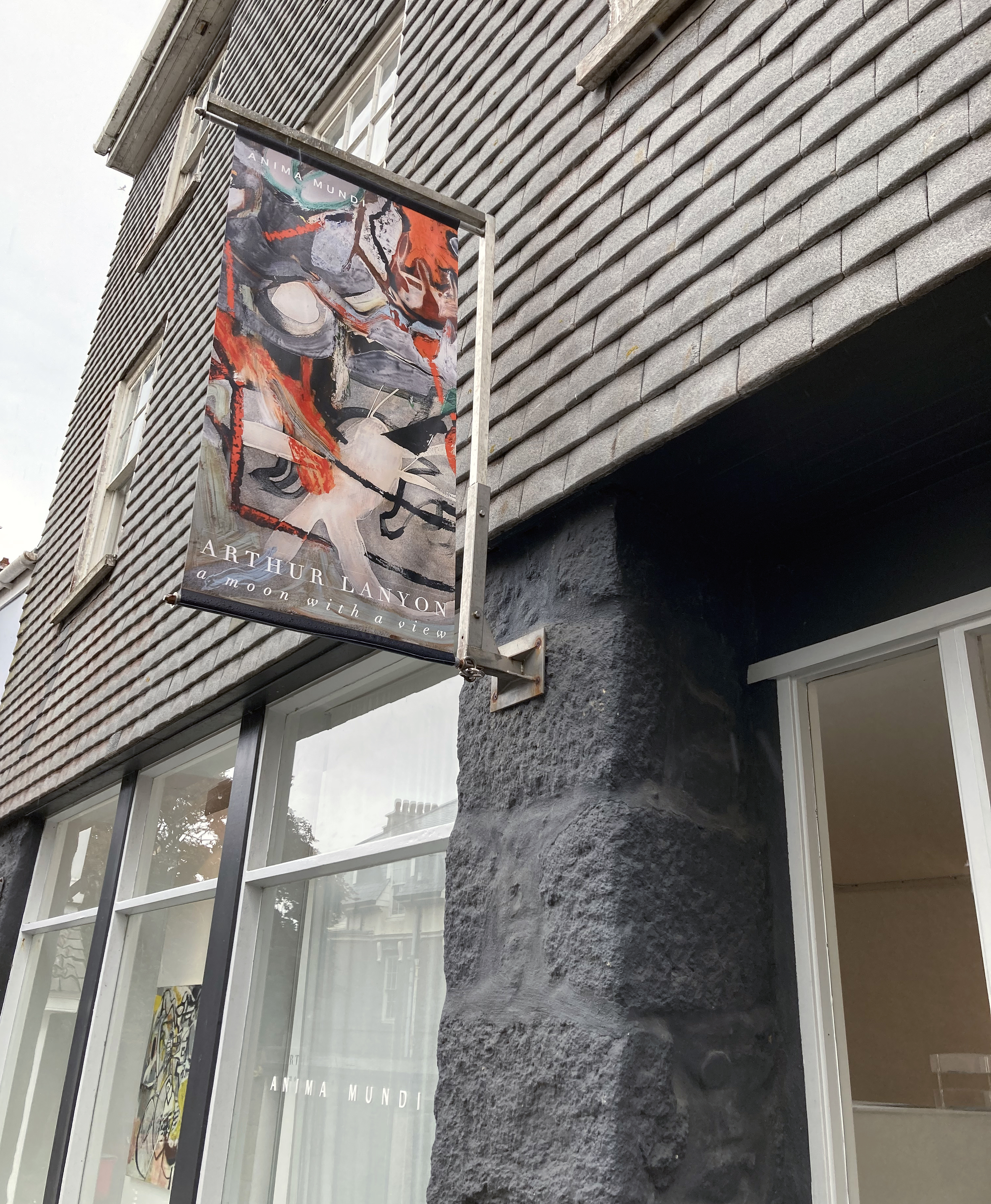
Joshua Uvieghara – ‘The Cascading Wall’ 2018

Uvieghara’s paintings often visually unsettle. His tactile combinations of out of the tube colour can appear crude and raw. He uses all six primary and secondary colours – often on the same canvas. Going crazy with colour can create one hell of a mess – but not in Uvieghara’s work. The viewer must hang on in there when first looking at one of his canvases – or fourteen or so at KOOP. Thank goodness there is still somewhere in Brighton that displays quality contemporary painting from time to time. The city is full of artists, but there are few places to show work. Hopefully the situation will change before too many people have left for pastures new. But I digress.

Joshua Uvieghara – ‘Magodo Gate’ 2018

In Sapele Neon Boy figurative imagery jostles with the expressionistic abstraction of the twentieth century. Indications of landscapes, places and people coexist with paint applied, sometimes, in a hurry. But always with hard won experience, and certainly with self-confidence. Colour clashes; paint is laid down and left as it is. Paint sometimes drips, but mostly just sits there. The colour combinations could be enough for pure abstraction, but there is subject matter of a highly personal nature too. If there was nothing personal there would be no reason to paint, I suspect.  This vicarious nature in/of painting is clearly intended. Taken into the illusionism of space and time, but soon (abruptly) brought into the present by the physical and visual qualities of the painting, Uvieghara’s paintings evoke a living body that is both coming into being and tragically disappearing into the past. Through incompleteness, or imagery taking hold of something concrete, there is a sense of searching too. The work is autobiographical yet universal. Identity is cultural and geopolitical as well as individual. The artist’s personal, familial history, linked to Nigerian and Dutch heritage, will encompass so many cultural and political facets – but there’s enough leeway for the viewer to consider their own sense of selfhood, individuality and identity. At least that was the effect the work had on me.

Joshua Uvieghara – ‘Head as Firmament’ 2022

I found some of the portraiture almost emotionally painful, despite the use of bright, gorgeous colour and even gold leaf in one work. Maybe ‘painful’ is too strong an expression. Mirrors and photographs reveal so much and so many people. Uvieghara’s portraits have this unfathomable quality. I was reminded that our pasts are present, even if not always across continents: even if remaining a mystery. The science of DNA has opened doors to the past. We are individuals who know that we are not totally so distinctive and unique. But so many stories are forgotten, secretly hidden or just too distant to recollect. Painting can reconstruct: even as simulacra, as substantive new territory as real as the forgotten or submerged real. Whatever that is.

Visit this exhibition if you can and watch out for any future shows from one of Brighton’s pre-eminent painters. Painting is alive and, well… available to conjure something for the restless imagination.

Joshua Uvieghara – ‘Fragments On a Riverine Ocean’ 2019

Links:

KOOP Projectshttps://www.koopprojects.com

Founded in 2022 and based in Kemptown, Brighton, Koop Projects is a neighbourhood gallery with an international outlook.

The gallery believes in Contemporary African art and artists as a dynamic source for learning and change, promoting sustainable art practices through an interrogation of materiality and the contexts in which artists across Africa make and show their work. 

We support our local art community through the gift of space. Opening doors for artists, curators and creative people with stories to tell, by providing them with space in which to realise their projects.

In the future, the gallery hopes to develop connections and conversations between creative communities in Africa, Brighton and beyond. 

Joshua Uviegharahttps://www.joshuauvieghara.co.uk

Joshua Uvieghara – ‘Sapele Neon Boy’ 2021

DENISE HARRISON: Seven Sacraments

Window Gallery, Phoenix Art Space, Brighton

2 to 24 September 2023

“Denise’s current body of work explores memory, loss and place using the rituals of the Seven Sacraments that marked the milestones of her family’s life-events and gatherings. These memories are then re-imagined with the additional knowledge that is acquired. This work is about exploring the loss of her mother to head and neck cancer. Each of the seven sacraments has a narrative, a memory. When exploring old photos and family memories, her relationship to these images change according to life experience, what was once a fleeting memory suddenly becomes a treasured and precious embrace that can now only be experienced in her thoughts and on her canvas.” (Phoenix Art Space website)

Entrance to Phoenix Art Space – Poster image ‘Baptism’

Why visit a painting exhibition? For pleasure, to be inspired, to engage in a sort of communion, to be challenged even? This is human behaviour best explained by an anthropologist, no doubt. I suspect we have performed this ritual in different ways and contexts for a wide variety of reasons, in many forms, since the era of the cave painting. Closer to home, and today, the introduction from the Phoenix web site (above) succinctly sets the visitor up for something more than a superficial aesthetic experience for Denise Harrison’s thought provoking exhibition, The Seven Sacraments.

I was able to initially see the seven paintings and two small mixed media works in advance of the official opening and before those last, final tweaks with wall labels and the switching on of a video player. This was usefully raw as the final polishing for display was still a day or two away. I had previously seen some of these works in progress in Harrison’s Phoenix studio over the past few months. But here they were, finally resolved and ready for viewing as a group rather than as singular items in various phases of completion. Perhaps the studio is the notional cave from which the work emerges, requiring a suitably lit and formal viewing context. There is no more disappearing into the depths of the earth to celebrate or ritualise through what we now call ‘art’. This is a truly powerful set of oil and acrylic paintings that carefully balance colour impact with emotional content. This is certainly not mere (contemporary) wall decoration made for interior design purposes; it’s a visual witness statement conjuring the moving, melancholic and sometimes distressing subject matter of religious expectations and obligations for the family – yet I believe reveals a thoughtful and affectionate reflection on the presence of love within a family across generations.

Denise Harrison – ‘First Communion’ – acrylic on canvas (120x90cm)

My first impressions were divided between a reading of the powerful narrative in the series of paintings, including a reconsideration of the notion of time, and the visual impact of the colour combinations and paint handling that pulled in the eye as well as the mind. The memorial content, based on individuals and familial groupings – from ten parents and children in ‘First Communion’, pairings in  ‘Baptism’ and ‘Wedding’, to a rather sad looking ‘St Bernadette’ displayed in the annex of the café – connected the works as forms of portraiture and stage settings. There are Shakespearian echoes here as we may well eventually realise that, “All the world’s a stage, And all the men and women merely players…” But the players here of course are set in a religious, Catholic context. As an outsider to this faith I cannot really comment knowingly on the lived experience of adhering to the Seven Sacraments or of being directly involved in what appears to be a range of disturbing experiences for one particular family. The priest in ‘Ordination: Fr. Shannon’, the centrepiece of the display, doesn’t seem to represent any spiritual joy for himself or for his flock of seven red-clad females. As a counterpoint to any notion of spiritual exultation another emotionally moving image is ‘Last Rites: Despair’ where the ailing mother/grandmother appears alone despite the presence of three younger but ghostly figures in the foreground. The content sounds harrowing, but its production ultimately feels strangely rapturous. This reading is, admittedly, personal and intuitive on my part, but I think it has something to do with the painting and this sense of love that I mentioned above.

Denise Harrison – ‘Ordination: Fr. Shannon’ – oil on canvas (90x152cm)

In a more general sense there is a sense of time as well. Of duration rather than moments, despite the imagery being derived from family snap shots, and the artist’s memory. This time aspect might be more strongly felt by the older viewer, although the younger visitor will ‘get it’ intellectually. The implied presence of the camera is here too as the imagery is akin to looking at a photograph, or a photo-album. There could be a desire to know who, where, when and why but art works on universal levels as well as with local, specific histories. Although it’s not the case here, one might have found the original photographic prints (not on display) in a house clearance but the treatment and editing of the information is clearly specific to the artist’s own history. A story now shared to expand from the individual and the familial to the communal. Paintings cannot escape this fate once they become public and face scrutiny.

Denise Harrison – ‘Last Rites: Despair’ and ‘Confession: Sinners’

Still ruminating on this sense of time it struck me that as we age, time and memories collapse in a sense. Some degree of linearity remains but as we can all look back at our own histories through time we also belong to a family, like or unlike the one recorded here. This may not necessarily be nostalgic in a truly celebratory sense – this sounds too rosy spectacled. But the filters are removed decades on, or perhaps replaced by something at least a little clearer. You have to be outside and beyond to look in, sometimes feeling like a stranger or third party. But you’re still in there, somehow, and this forms identity broadened beyond oneself. Paintings can present contradictions that we can allow ourselves to go with. Paintings are poems, not screen plays.

With regard to painting the viewer might be struck initially by Harrison’s use of glowing pinky reds and airy blues in addition to the strong figurative content representing facial features, especially the eyes and the expressions of the mouth. The various colour shapes morph with their surroundings producing a dream-like, visual connectedness that forces, or frees up, the figurative confines of the photographic content to flow and expand by use of the paint medium. With its various aspects of selection, composition, colour choice, painterly application and materiality the paintings somehow challenge the original photographs to attempt to say more than a superficial reading might offer. A painting, a good one, might read more like a poem that does not explain all. A straightforward story will need some openness for the viewer’s own interpretation and meaning to arise. Narrative is potentially unsteady, open to interpretation and unavoidably filtered and synthesised by the onlooker. Meanings might change from one gaze to the next. Or at the very least we might adapt the various scenarios to our own histories and experiences as a way of dealing with trauma that is beyond the individual, residing in the family and across generations. I am aware that I am probably getting carried away here, beyond the intentions of the artist, but a visitor could not walk through this space without exchanging a ‘look’ with the various individuals depicted and possibly find an echo in there.

An affirmation of painting is also powerfully and skilfully evoked by a suggestion of the purposely unsophisticated veering on apparent clumsiness. For example a limb such as a leg that is too straight, or a head too big or childishly bulbous. This somewhat unfair attribution emerges as there is clearly something of the lens-based / photographic record in the visual language that sparks an expectation for some category of the photo-realistic. But this combination somehow works. The apparent distortions and simplifications are deliberate. The colour is sometimes acidic and contrasts are crudely intentional. Detail, for example, is reserved for eyes and mouths, whereas bodies and surrounding forms and spaces tend towards a more abstract language as backdrops from the theatre of the everyday to make the imagery emotionally real. These people are us, vulnerable and loving, lost and found.

Visit this exhibit if you can. Support for artists is about engagement with their works and ideas. Be baffled and be sure. Participate and trust. We need to share our stories and painting does this so well.

Geoff Hands

Denise Harrison – ‘St. Bernadette’ – oil on canvas (66x46cm)

Links:

Instagram:

@deniseharrisonart

@phoenix_artspace

Shakespeare: “All the world’s a stage” speech from ‘As You Like It’ by William Shakespeare, spoken by Jaques. https://www.poetryfoundation.org/poems/56966/speech-all-the-worlds-a-stage