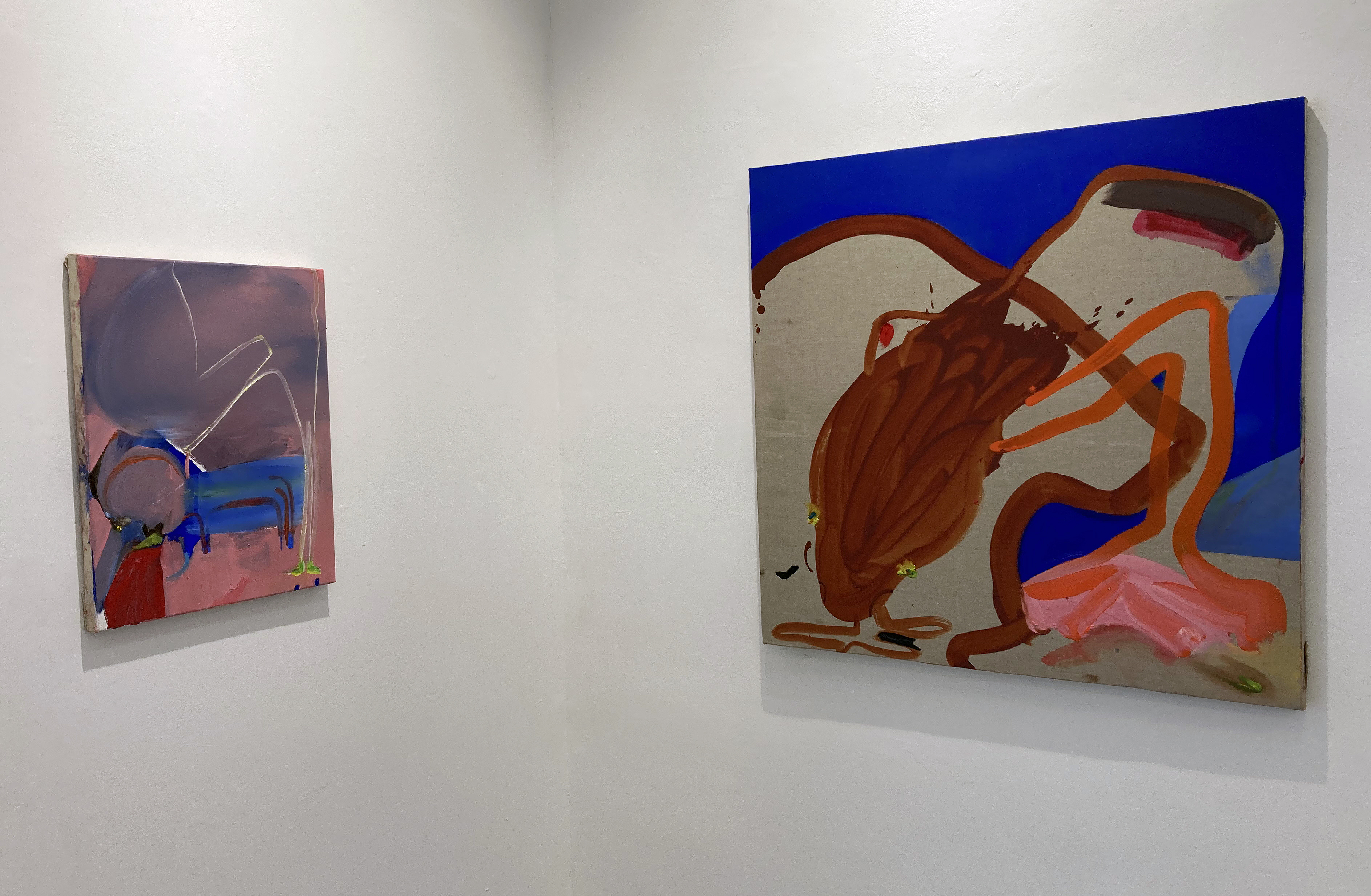
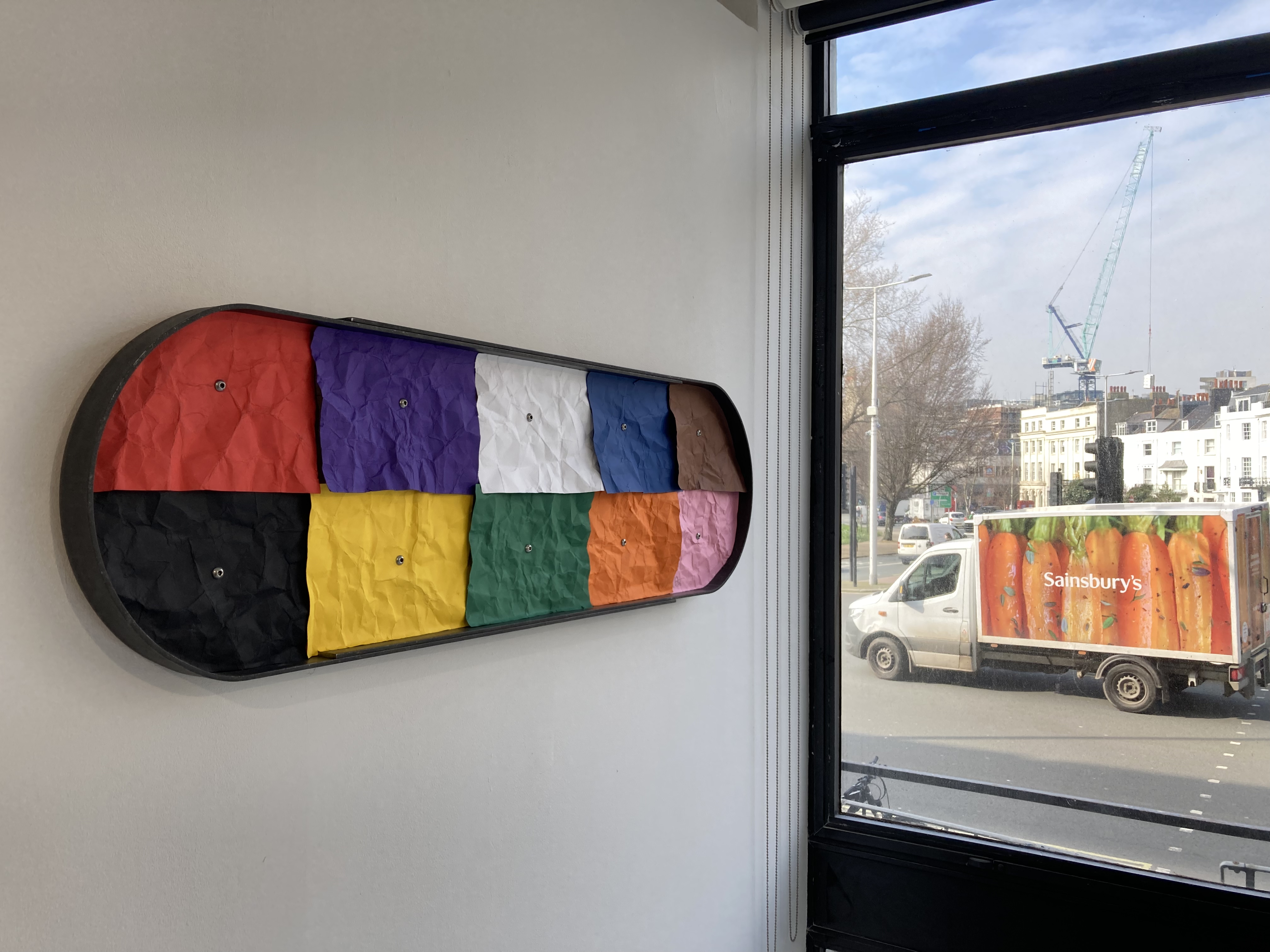
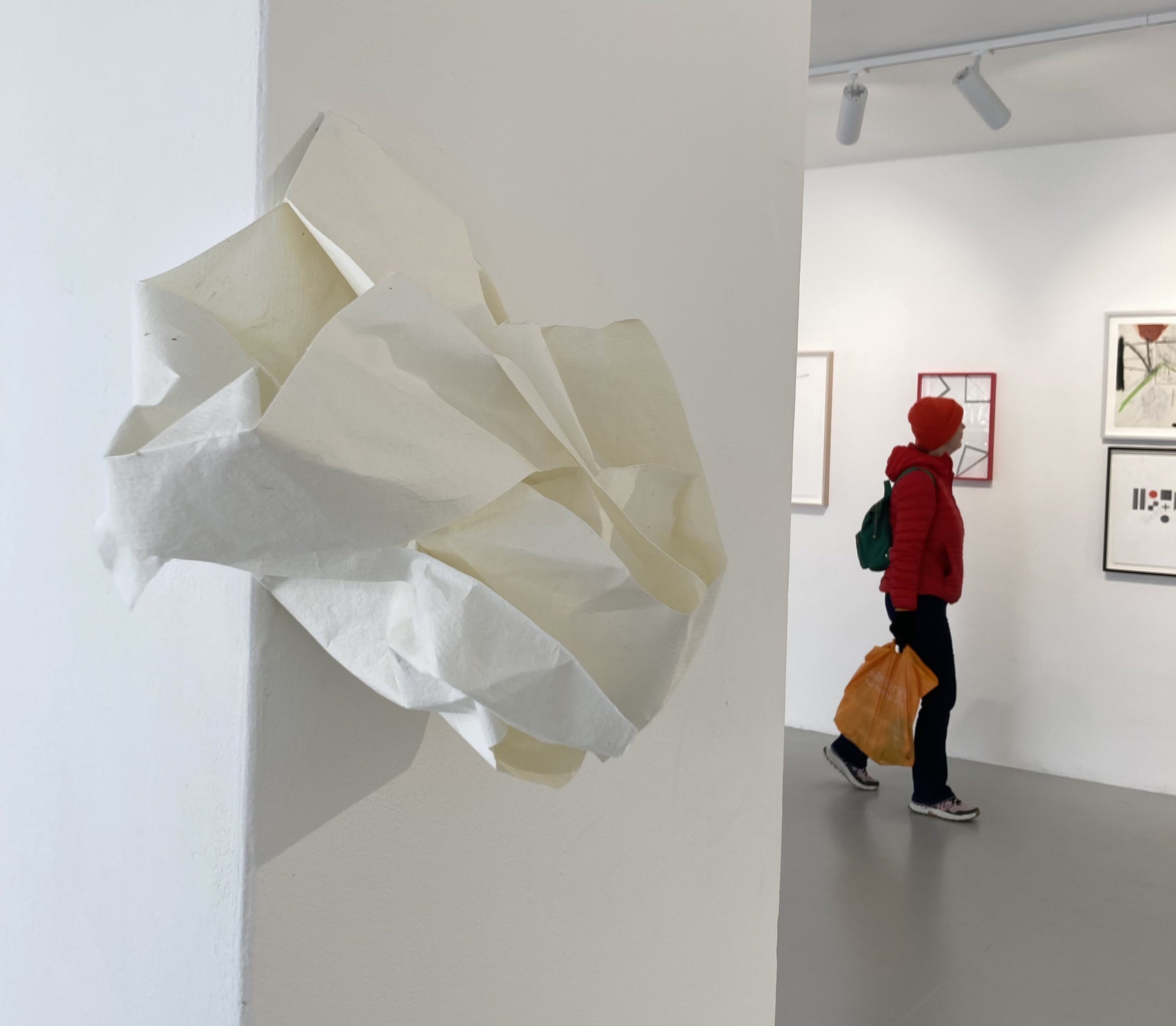
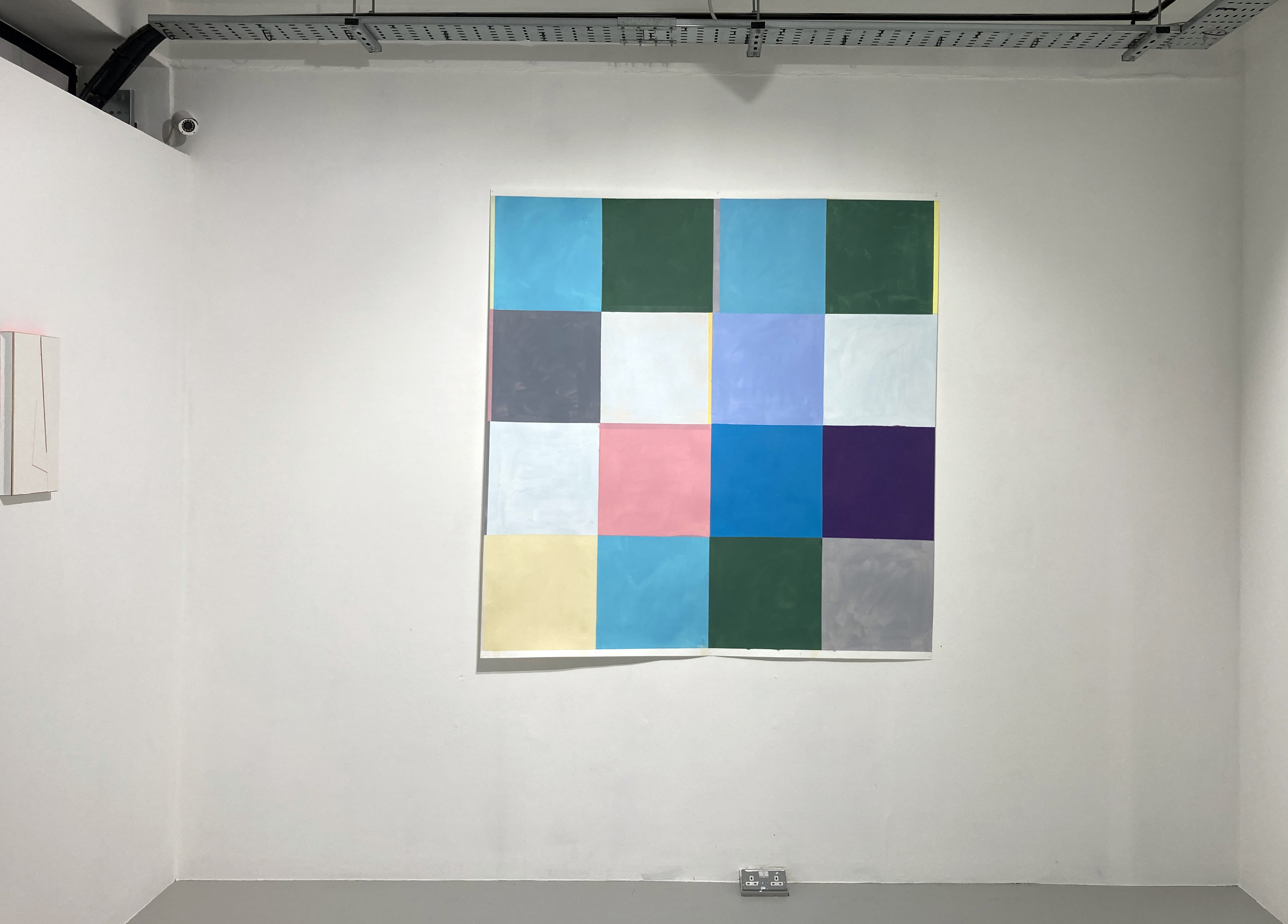
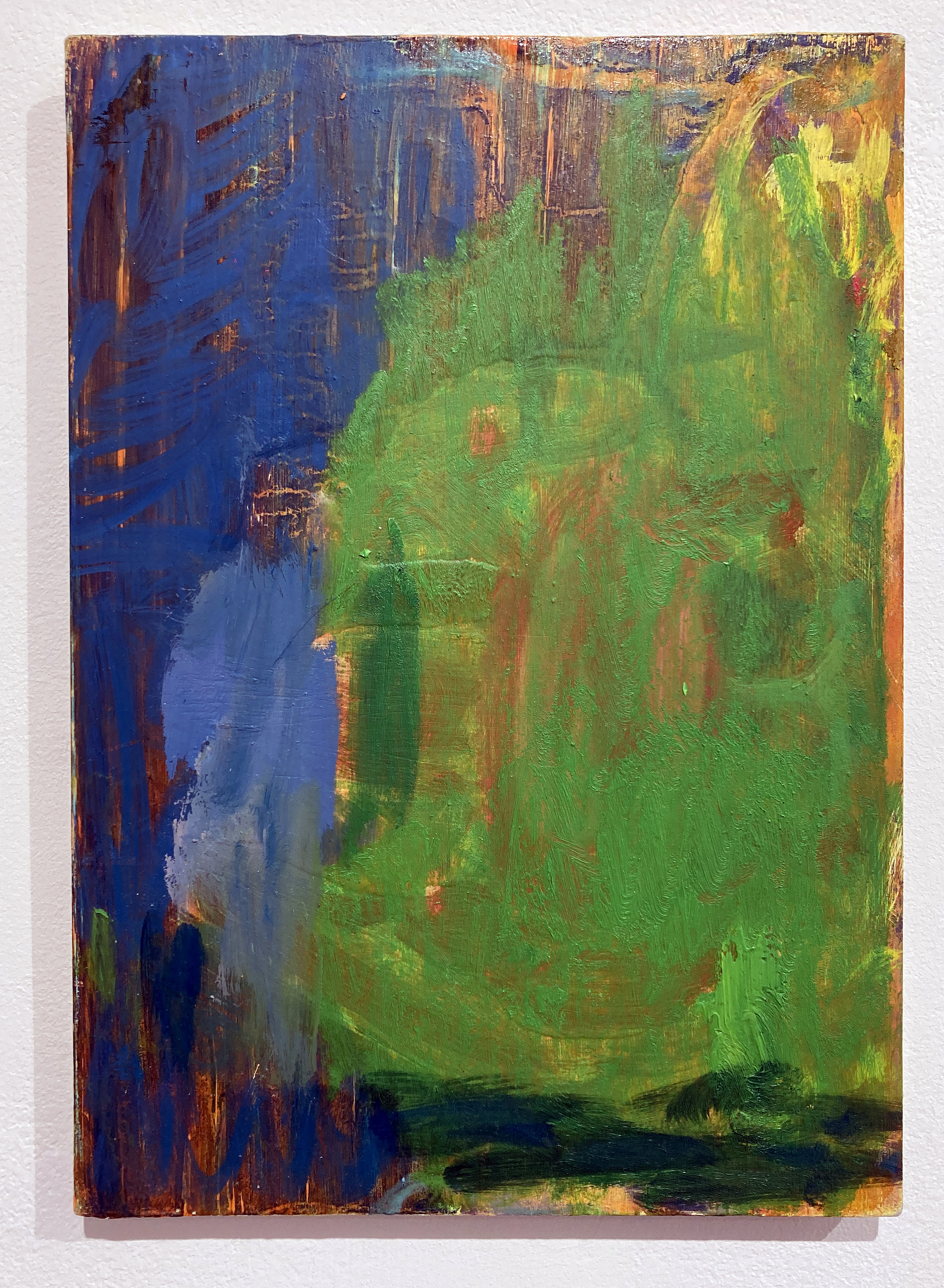
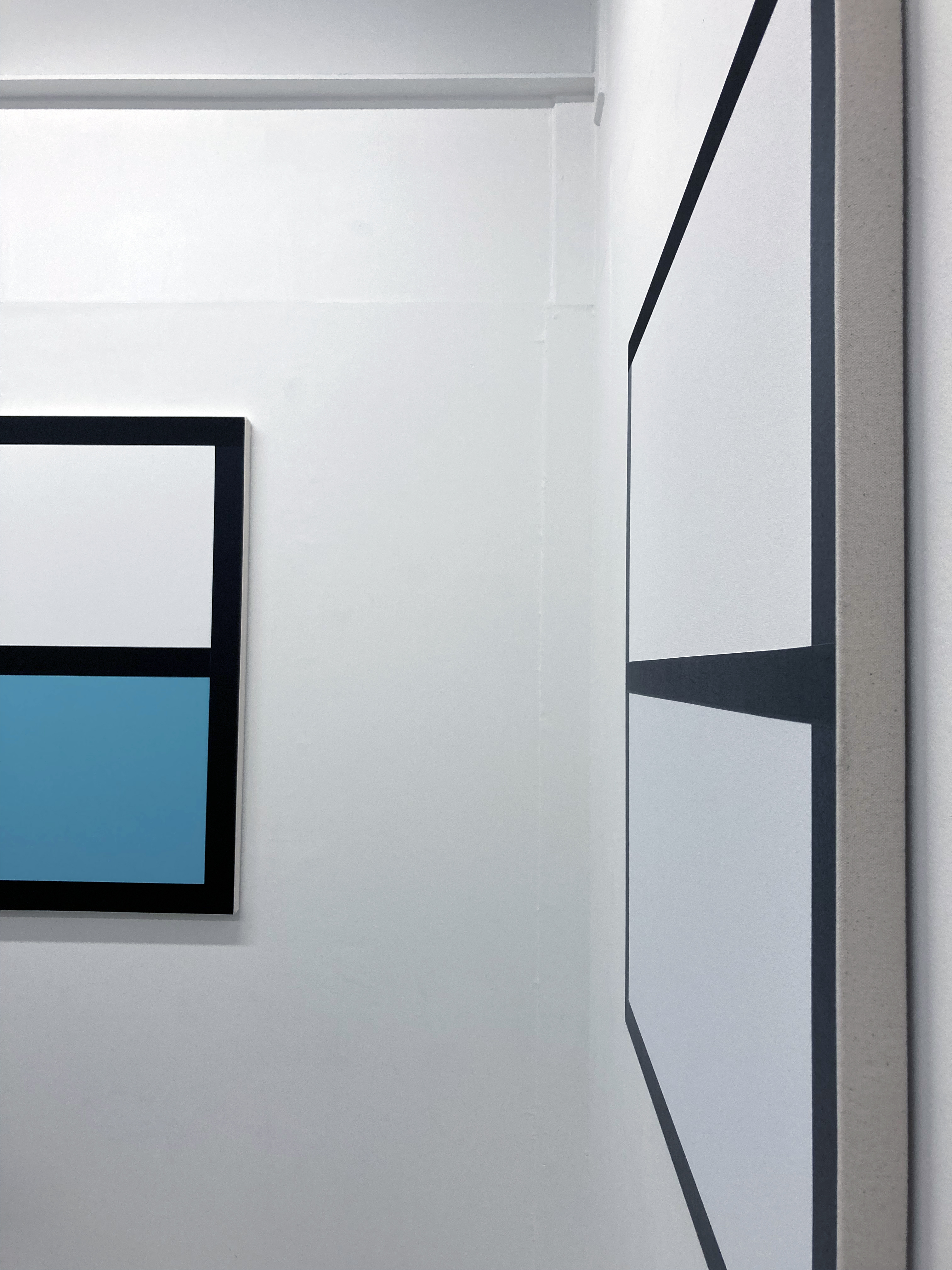
THINKING IN PAINT: Stubbs Turner Wakelin

At Tension, Maple Road, London SE20 8LP

18 October to 29 November 2025

I paint therefore I think…

AI Overview: Thinking is the mental process of manipulating information to form concepts, reason, and make decisions. It is a form of cognition that involves activities like problem solving, judgment, and memory retrieval, and it allows us to interpret, categorize, and make sense of the world around us. (From Google)

We surely do not know for sure what Michael Stubbs, Ken Turner and Julian Wakelin were thinking whilst making these works for Thinking In Paint. But we certainly have something to see, to experience and to think about ourselves now that their works have been selected and presented.

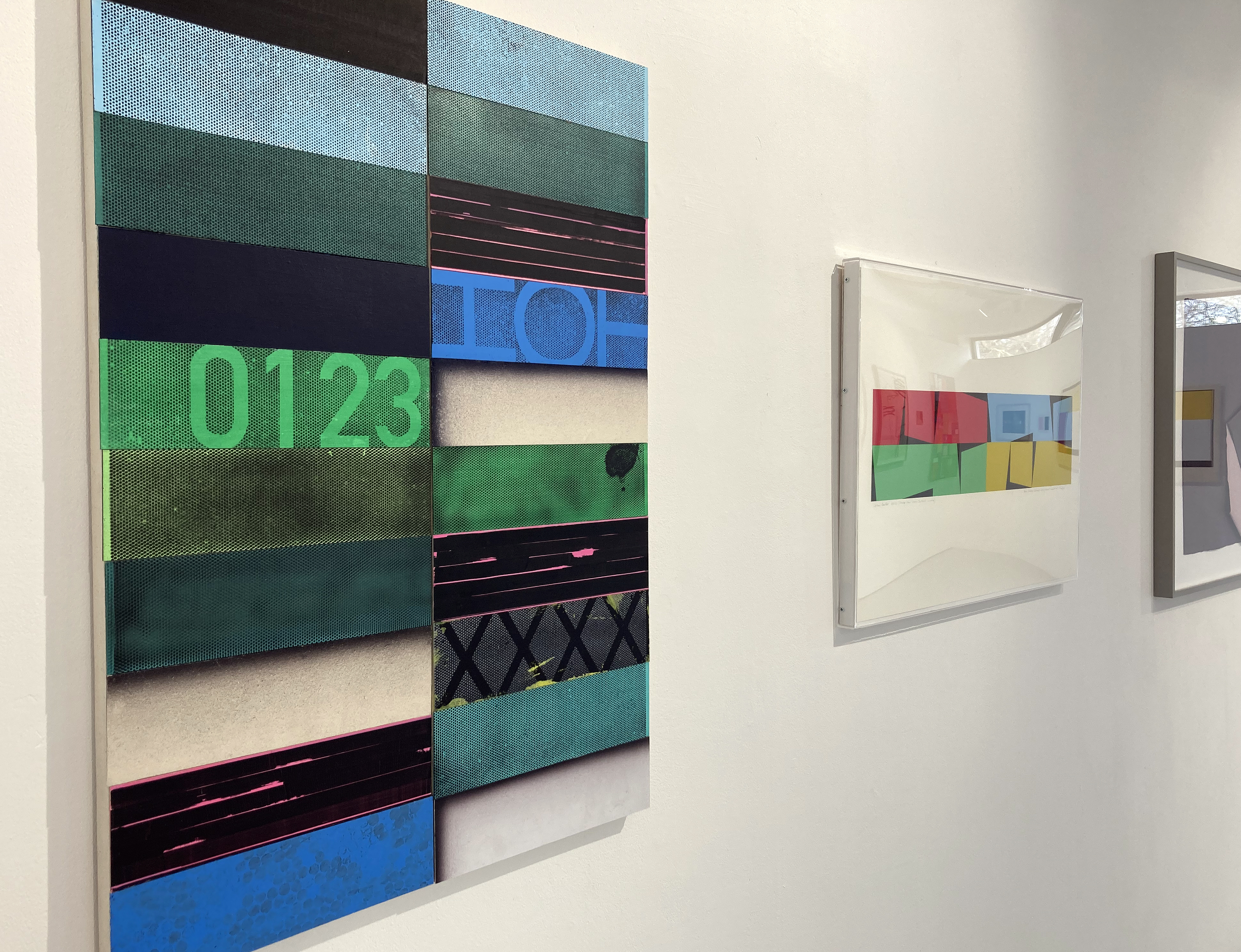
Michael Stubbs – Signal 502 [2024]

As an immediate reaction I prefer to avoid (for as long as I can) such sentiments as I like this or dislike that. Reactions can be direct and instantaneous, but ideally require a little time to ferment. Initial thinking, at least, can be characterised by simply taking various formal and material aspects in, such as colours, shapes, textures and the relationships between such features. This thinking might initially be described as feeling and perhaps usefully delays anything too conclusive. One can also see with the benefits of art historical knowledge – sometimes a prejudiced lense – and from personal experience of looking at paintings before, or from being painters ourselves. We may be susceptible to personal preference (I know what I like) and bias at times, but hopefully reasoning and rational judgement will enable an honest experience. Even uncertainty or ambiguity might take hold.

Ken Turner – Reformed [2025]

A group of paintings, whether by an individual or three individuals, sets up possible contrasts too. Yet I prefer to register works individually, even though my own practice invariably produces the series. Visual judgements can change of course, particularly as works sink in. Taking photographs of the works on the iPhone to view later is highly beneficial too, despite forming a bit of a contradiction as a real reproduction. For an exhibition called Thinking In Paint, that might eschew the digital in favour of the material object, it is imperative that the paintings are (ideally) viewed as they were created in their corporeal, material reality. Add sufficient time with the individual works in question to become accustomed, as it were, will also be a necessary factor. A lifetime might be ideal. But we generally only have our exhibition visits to provide such an experience.

At long last I had travelled up to London to visit Tension gallery. It’s a trip that has been on my arty bucket list for some time now and the promise of coinciding a visit with a live Instagram discussion between Ken Turner and Michael Stubbs – lead by John Bunker – was bound to add something special and noteworthy to the occasion. So, whilst the Instagramers on-line could see the exhibition content (ten paintings in all) on their computer or mobile screens I had the benefit of seeing the works for real. Gallery host, Alison Aye recorded the event for close to an hour as she smoothly and expertly moved from one painting to another with her iPhone guided by the conversation.

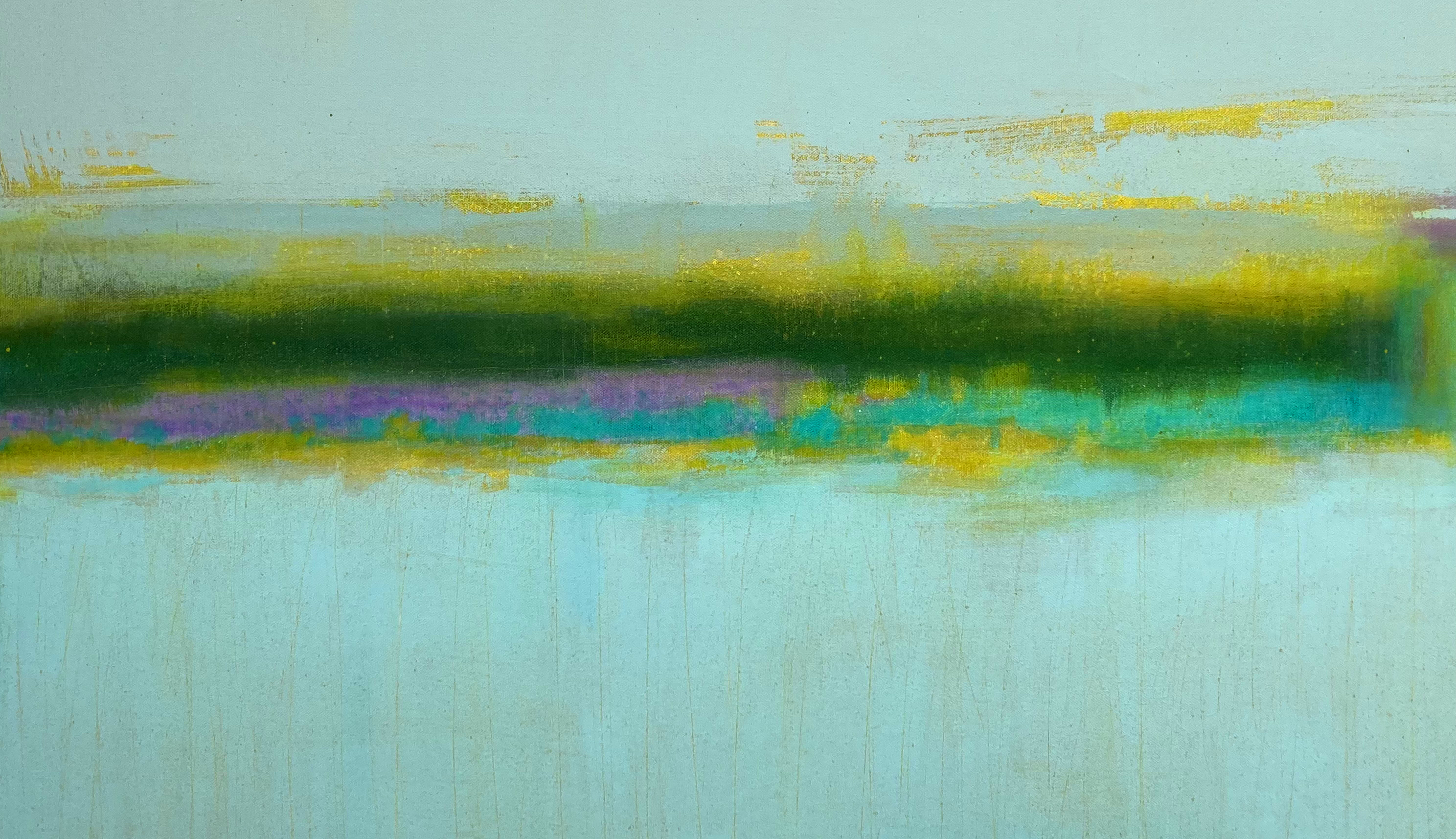
Michael Stubbs – Virus Bleed [2024]

It all felt a little like a contradiction in terms as the event was benefitting from digital technology by bringing us all together, despite not being in the same location as the paintings. Another distinctive and unique aspect for me was that, rather than having to generate my own thoughts and reactions as I looked at the works, I could jot down the commentary given to me in real time by the speakers. About this I have mixed feelings as focussing on one’s own thoughts whilst looking at the work on the walls is the usual – and most crucial – thing to do. I therefore had to suppress this activity somewhat and go with the contributions of the faces on the little screen held in my hand. I guess this is a little like being back at Uni making notes as the lecturer(s) speaks. One’s own thoughts, hopefully, emerge later.

Listening to three knowledgeable speakers, however, interweaving with each other verbally, and clearly being on the same wavelength turned out to be quite comfortable to deal with. In fact in some way I had been appropriately set up for this as I had spoken to John Bunker at his own exhibition called Antinomies at ASC Unit 3 gallery just the week before. As an abstract artist and an art writer himself he has that ability to distance himself into discussing works of abstraction in broad terms and then to apply his more intimate knowledge and experience as appropriate.
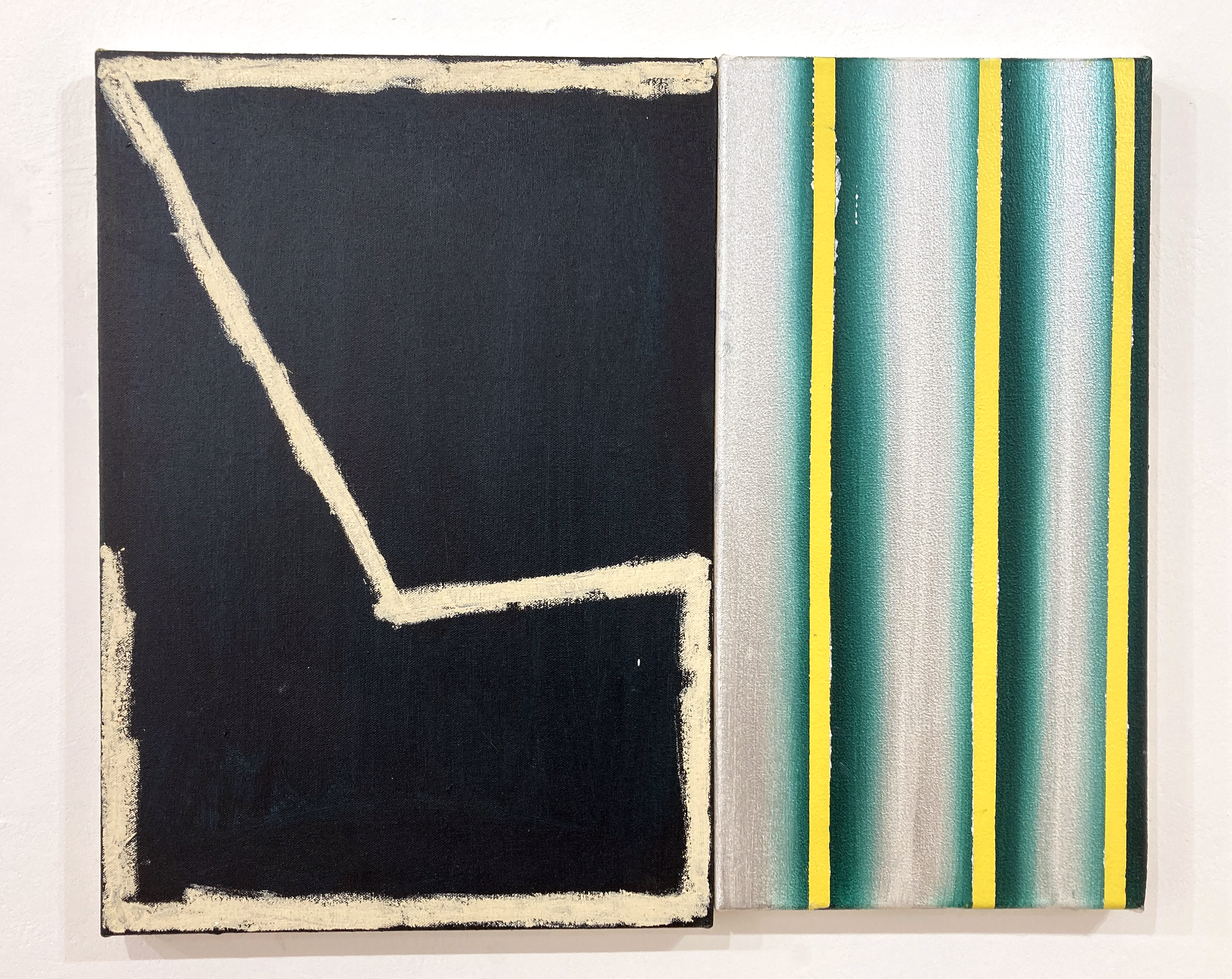
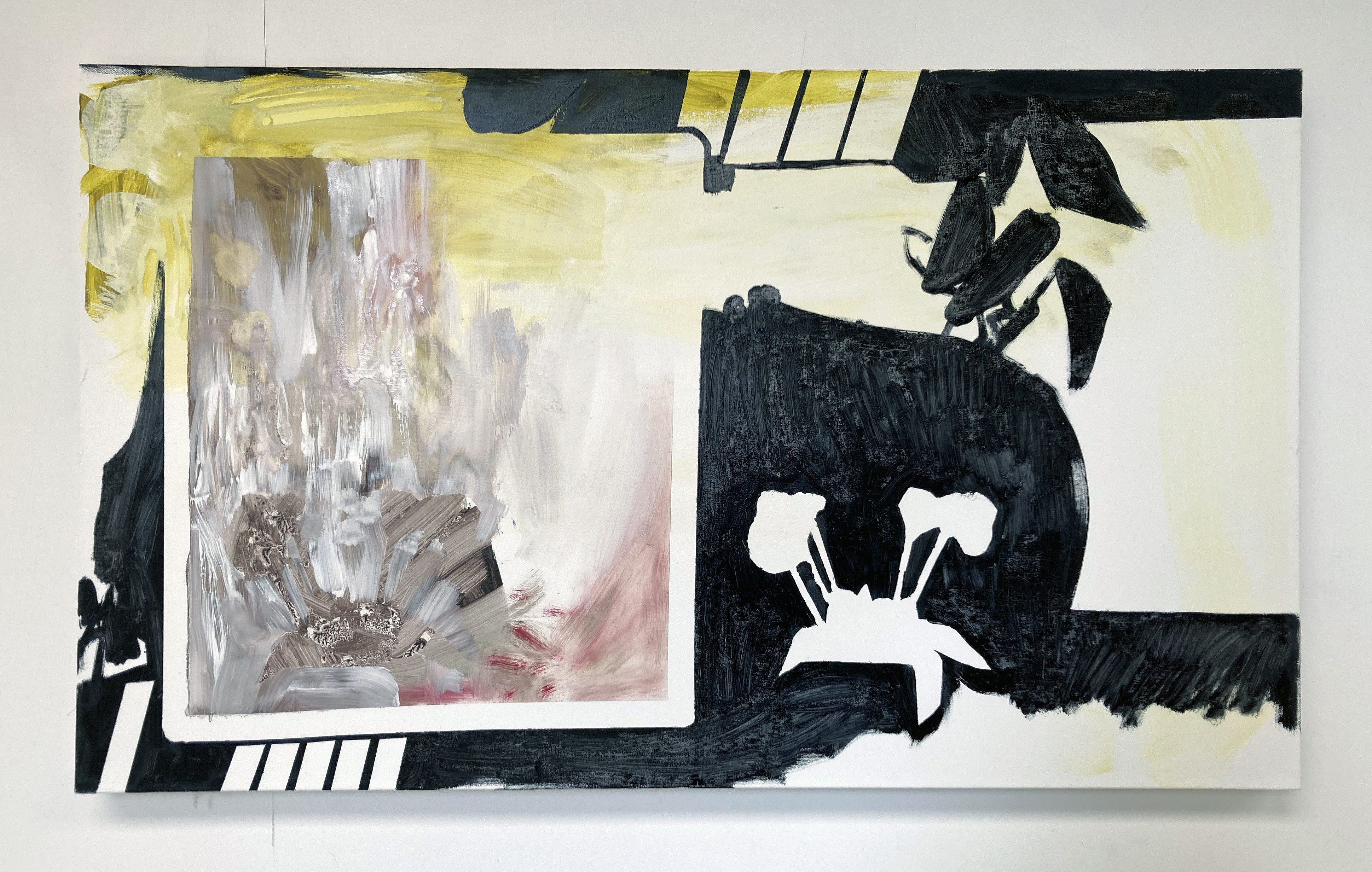
Julian Wakelin- Time (lag) [2025}

A few quotes follow in this paragraph, but they are not purely verbatim or chronological, so I shall not add quotation marks. The dominant theme that commanded the discussion was, as the title of the exhibition clearly states, thought (and its association with word related thinking) and the pure activity of painting that results in the abstract rather than the figurative. The notion of time, perhaps of a contemplative nature and being of a far longer duration than the immediacy of the digital culture that engulfs our visual experiences, was expressed by Bunker as thinking in paint, a slowing down form of looking and of contemplation. Stubbs added that when you are painting you are proceeding and that actions are made in advance of thought. Therefore thinking is contradictory and extends beyond itself. To this Turner added that thoughts and ideas couldn’t always be expressed in words, but by painting one is doing it (thinking) in different ways and that the activity of thinking is a long, drawn out process. There are overlaps too, an in-betweenness, a liminality in thought and painting, as there are things we feel but cannot say in words.

Julian Wakelin – Untitled [2025]

Bunker expanded the notion or understanding of thinking to the eye, mind and body – to which Stubbs referenced the studio and its literal, material content. The digital cropped up once more when Turner reminded us that subtle marks and textures in painting cannot be seen on a screen and that through painting we make some kind of sense of the world. This act of doing was crucial, he stated, between him and the canvas. To bring the absent Julian Wakelin in, Bunker remarked on the uncaniness about what Wakelin is doing and that in stillness there was that contradictory sense of paint moving. He pondered on whether the abstract painter might be hunting for stories and that by looking at the work (whilst in production) starts a dialogue with painting, giving a physical power to the work that cannot be underestimated.

In a broader context, and perhaps one that can separate painters from (superficially) opposing camps at times, Stubbs referenced the process based and the procedural – and perhaps the contradiction of the less saying more. The abstract painter might add or subtract things to rupture ideas of figurative painting. But the abstract painter, today, has the burden of the history of abstraction e.g. the expressive or American abstraction. But, to place his work in the digital present and the contemporary reality, he could bring the outside world in, juxtaposing signage with abstraction.
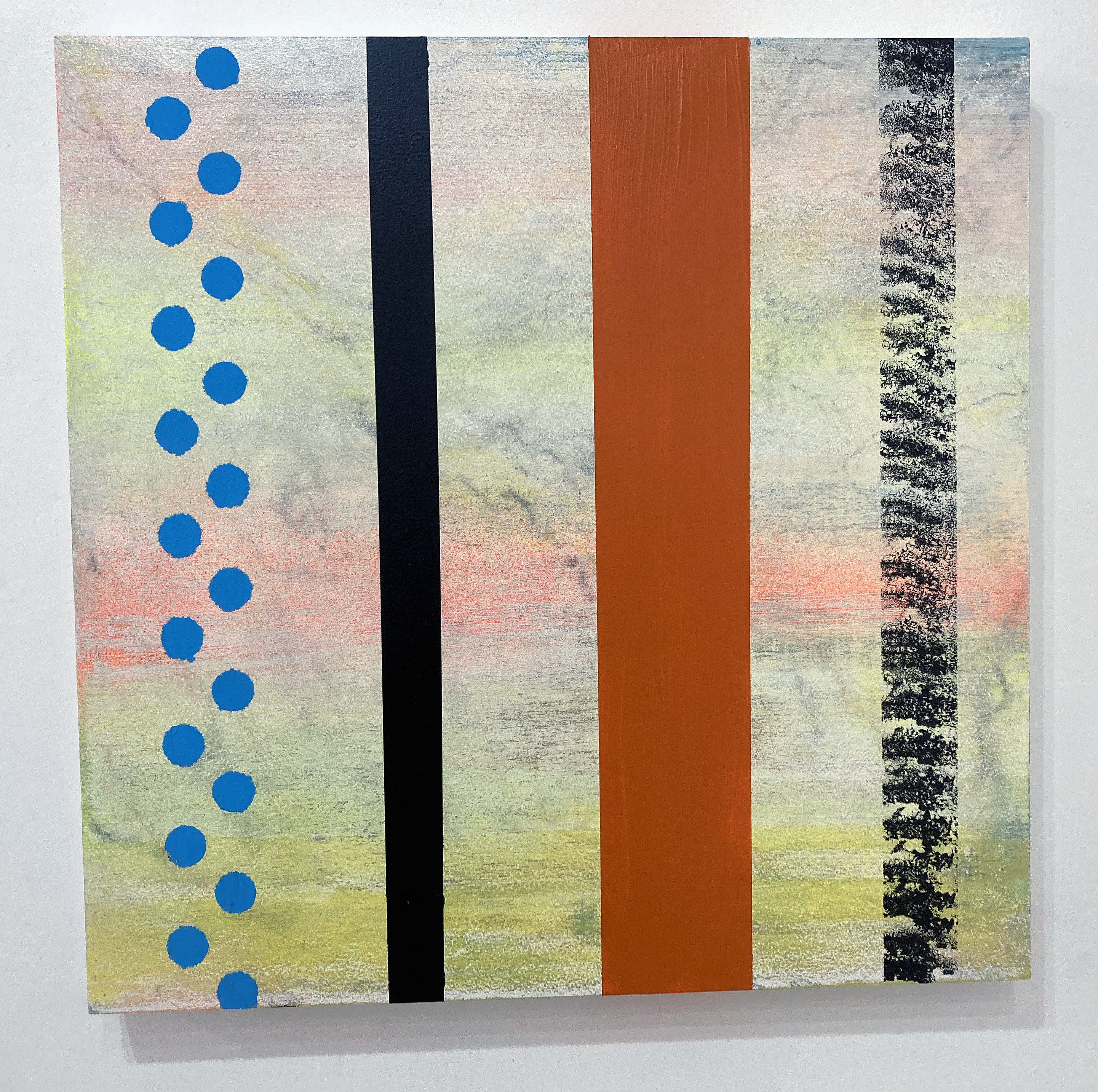
Ken Turner – Look into the distance [2025]

From this exhibition, not just the discussion, I was left with that welcome feeling of abstract paintings accommodating a real sense of place and space in the world – as concluded items. Finished and fixed so that the observer might concentrate on the paint and any additional media over the history of its painting. Works no longer in progress in the studio but here and now. Offering the promise of something maybe worth thinking or talking about. Or even reacting to, and accepting, in a pure mode or silence, just pure acceptance.

Geoff Hands – November 2025

Links:

Tension

We are an artist run gallery dedicated to showcasing the work and raising the profiles of emerging and mid career local, national and international artists. We show a mixture of contemporary & experimental art that questions what art is and what art could be.

Michael Stubbs

Ken Turner

Julian Wakelin

John Bunker / Instantloveland

John Bunker: Antinomies

SEE EMILY PLAY

EMILY BALL: Walk with me

Atrium Gallery, Seawhite in Partridge Green

December 2024 to March 2025

Emily Ball – ‘Pulse’ – oil on canvas (120x170cm)

We play (mentally and physically) to learn, to discover, to realise. If this attitude diminishes nothing more will change and life will be mundane. It’s especially important for painters, or rather, it’s what I see in the painters who interest me. That’s my personal bias, but I am sure it’s a stance far from unique.

Emily Ball’s work has been on my adoration list for years, so making a fourteen-mile road trip in atrocious weather from Brighton was not a problem. Fortunately Storm Darragh had diminished significantly during the morning, which made the more scenic route north, via Henfield, possible. The countryside is fantastic along the meandering roads that gently rise and fall on the Sussex Weald. A feeling of being in the landscape is so strong, even if travelling in a car. Unknown to me, I was being mentally (and perhaps psychogeographically) tuned in for what was to be seen and experienced quite soon.

Installation including ‘Longing and Sweet Sadness’ – oil on canvas (120x170cm)

Many will know of Seawhites of Brighton (who moved to Partridge Green many years ago) as a great source of art materials, especially sketchbooks. But they have hosted exhibitions for several years too and with this show an expanded office space in an adjacent building to the one with the shop is perfect for a decent sized display that provides more than a taster of someone’s work. This is my first visit to the Atrium Gallery and first thoughts are assured and affirmative: wow, what a space, this is proper painting, everything is interesting (all 44 paintings and drawings). Then, unexpectedly: You don’t see this in the Turner Prize nowadays.

Indeed not. But initial impressions can change with reflection. So I walked around the ground floor for a while longer and was pleased to see that the floor above hosted many more works expertly arranged and hung. After a few minutes upstairs another visitor walked past talking to his partner, and I eavesdrop: “This isn’t kiss me quick or celebrity art”. He was referencing the nearby Brighton (but not so much Hove) art scene. It’s a little unfair, but I get what he means. There’s an abundance of excellent painters whose work is not seen enough down at the coast where the post/neo-Pop, street arty scene dominates. But I had to put that gripe aside for the afternoon and indulge in this engaging imagery from Emily Ball. After all, her work is unequivocally right here, right now whatever the trends might be.
Emily Ball – ‘Dig Deep’ – oil on canvas (120x170cm)

The work in Walk with me is totally absorbing. Many of the other visitors were either standing fully engaged with a particular work for several minutes or strolling around looking and looking again at the display. This is not so commonplace in the gallery environment where looks can be fleeting and it confirmed my sense of the high quality of the works displayed.

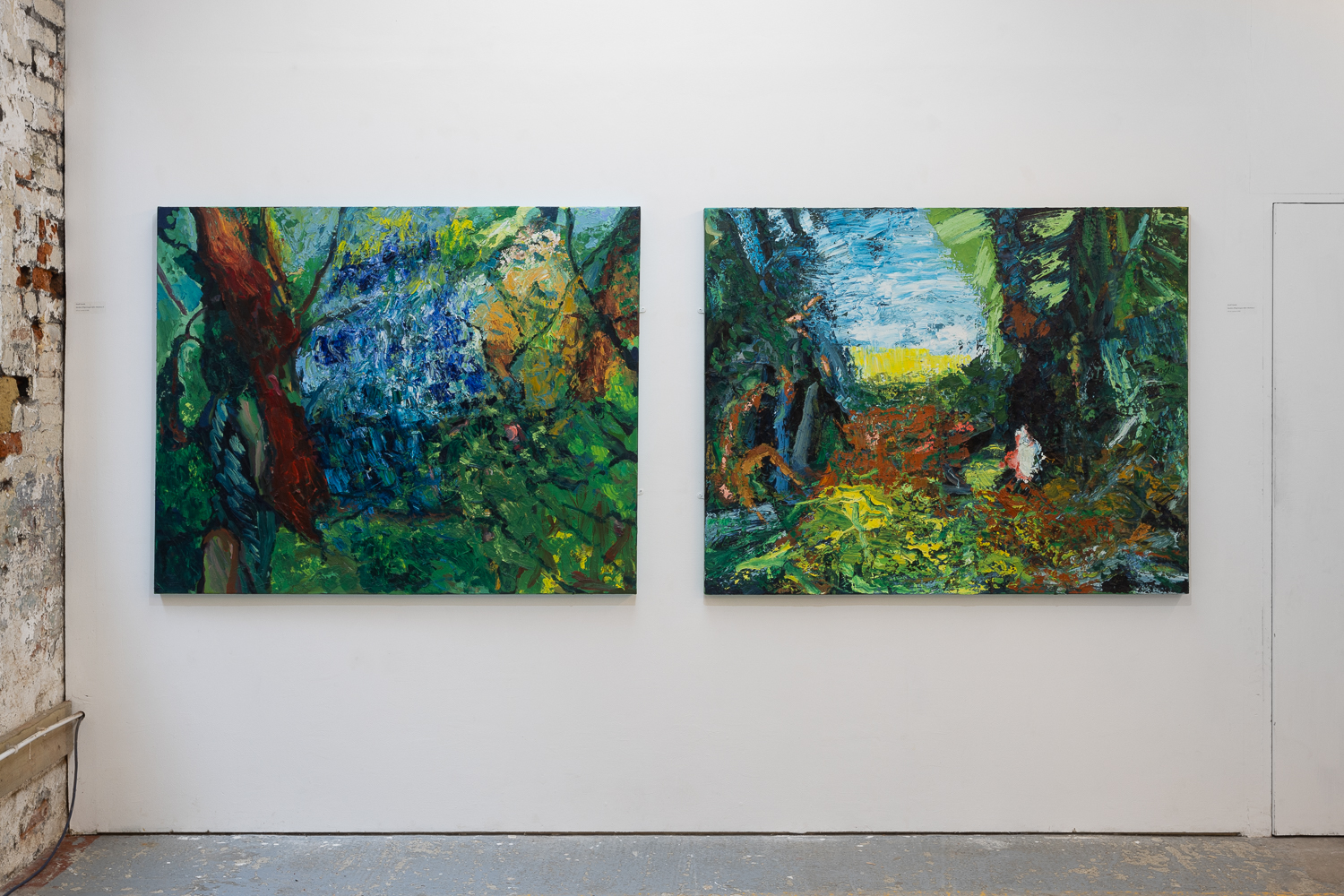
Emily Ball’s work in this show might simply be categorised as abstract landscape, but that would not be specific enough to account for a clear individuality of purpose in a lifelong project that engages with a searching, animated and exuberant understanding of the world as experienced. A being in the world, fully connected but including mystery. The works are full of implied movement, visually and physically expressed, by an observer fully engrossed in the act of drawing and painting. The imagery graciously pulls the observer’s gaze into a dynamic conglomeration of forms, coloured patchworks and passages through woodland spaces from the Algarve in Portugal (the Hot Hill collection) back to the artist’s home in Sussex (an ongoing series called Woodland Weave). The paint is applied skilfully with dexterity, self-confidence and years of practice – but healthily retains an aspect, or an edge, of testing out applications and combinations of sometimes raw but playful brush marks. There is a sense of a positive and intentional work in progress, or a springboard for future works yet to be realised. This animated feeling confirms that environments are never really still or are only observed with a rational eye. Nature’s spaces are in and around us, containing histories and yet moving on.

Emily Ball – ‘Shimmer 1’ – oil on canvas (16x24cm)

So, in the future, we can look forward to an expanded Woodland Weave exhibition that explores the woods at the rear of the artist’s childhood home, merging with her parents’ garden. As with any space that Emily Ball draws and paints this will be as much an emotional as a geographical space. It will be past, present and future. We might be reminded, or prompted, to recall our own equivalent spaces to conjure the psychogeographic nature of environments that are personal, familial and, ultimately, social. This is a distinctive potential for the age-old practice of painting and drawing.

First impressions can even improve, too. See Emily play.

Geoff Hands (December 2024)

Emily Ball – ‘Shimmering Jewel Study I to VI’ mixed media drawings

LINKS:

For high quality images of Emily Ball’s artwork visithttps://emilyball.net/

Instagram – @emilyballpainting

Viewing – ‘I smiled when I hear the cuckoo sing’ – oil on canvas (120x170cm)

OLIVIA GUILLOT: Swallowed A Fly

At Phoenix Art Space, Brighton

26 June to 30 June 2024

Wow! Some paintings, some actual, real, “look at me I’m a painting”, paintings. Sometimes the best things happen when you least expect.

It has been a busy day and I am rushing around town. Dad’s taxi, paintings to collect from the framer’s, pick up a few things from Sainsbury’s, park at the studio (yes! there’s a space), say ‘hi’ to people in the corridor (make out all is well), pick up a notebook, water the plants and then, as I almost depart… there’s a new show just been installed in the Project Space at the Phoenix. But there’s no time to stop, but one has to.

Olivia Guillot, a recent graduate from the University of Brighton, has installed a display of seven paintings and a sketchbook in her first solo show, Swallowed A Fly. I am immediately drawn in by the painterliness and the strong colour hit. I might only have a few minutes, maybe 10 or 15 if I can dismiss the future awhile. Painting is so much more than the here and now, of course.

Olivia Guillot – Swallowed A Fly 2024 (120x150cm) oil on canvas

The works are lively and painterly, oh so painterly, and as fresh as the perennial daisy. This artist clearly has an almost unchecked love of paint and colour and image. I say ‘almost unchecked’ because there is a visual intelligence emanating from these canvases. There is a restraint too; revealing a painterly design sense that I suspect is intuitive. Whatever, these works are so refreshing to see with their vitality and energy. Paint and image are in transition, despite the fixed nature of the resolved canvas. What are these images peopled by? The figurative and the abstract meld. The act of painting, sucking something up from the imagination (whatever that is) makes new scenarios. Magic.

Olivia Guillot – Walkies 2024 (20x40cm) and Anteater 2024 (100x100cm) both oil on canvas

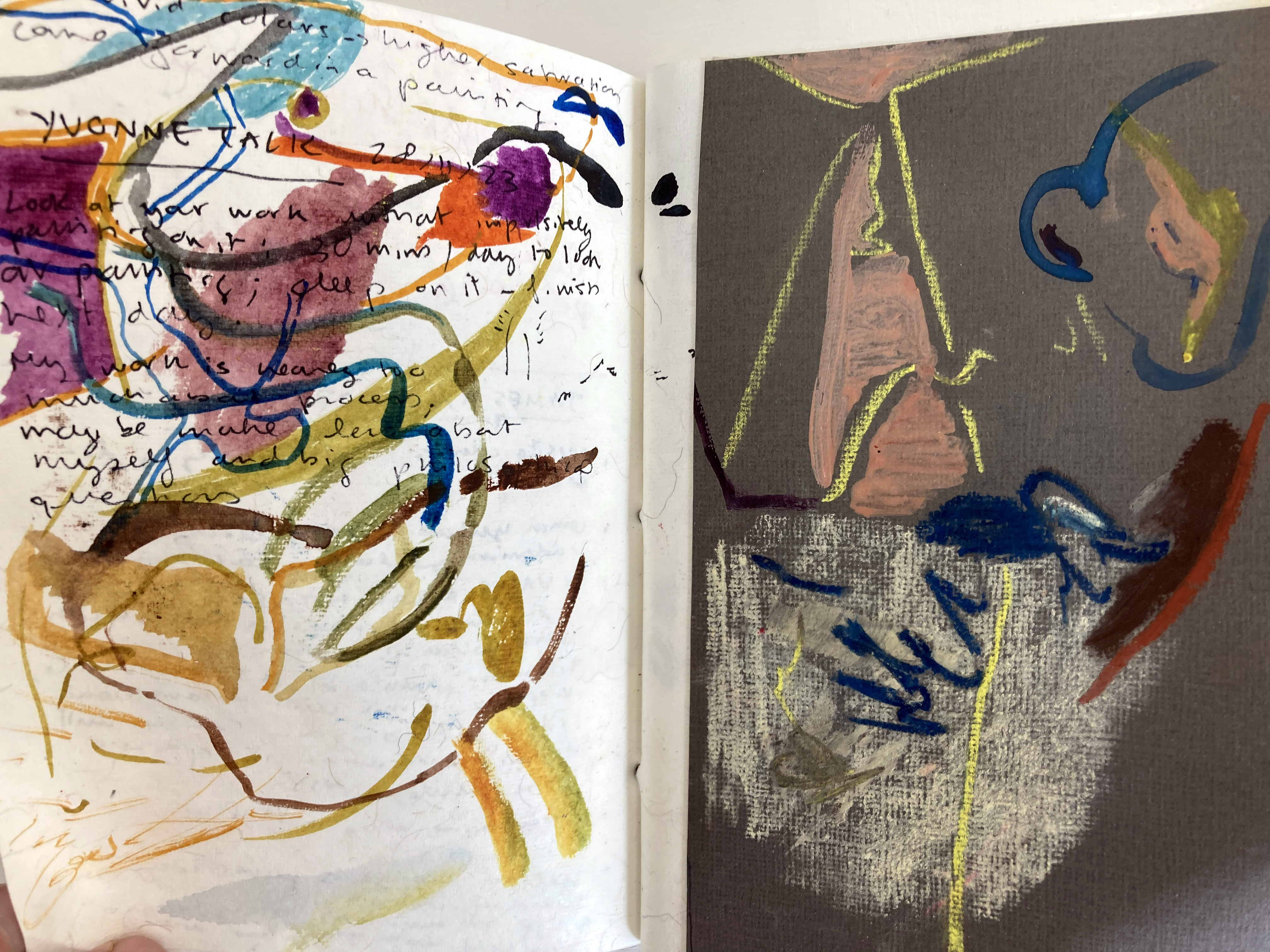
More joy: There’s a sketchbook (item no.3 on the exhibition plan, which gives an equal status with the paintings) that the visitor can leaf through. Why can’t artists show their sketchbooks more often? In some way this is an unusual, even a brave, decision. A document like this is such a personal document. Containing good and indifferent drawings and colour studies; notes from a tutorial; bare thoughts. But viewers should get the bigger picture (pun intended) and see some of the working and thinking process that determines the end result. That final canvas has a studio history. Discussions have taken place. Doubts work alongside discoveries and day to day planning. Ruminatory thoughts have floated by, sometimes recorded in scribbled notations. Perhaps there should be a clause that every painting exhibition includes a sketchbook or two.

Olivia Guillot – Sketchbook

Painters have to have confidence of course, a resolve to climb on board for the journey. It’s an attitude thing. Guillot has this in abundance.

For contemporary painters the gallery system is not always open enough. The Gatekeepers are not always into painting, after all. Painters have to raid the bank account and rent spaces. Painters have to be self-confident and brave. But, despite obsessions with alternative media, painting persists. Painting courses, such as the one at the University of Brighton, attract students of a highly visual persuasion. The medium encourages investigation and thought; self discovery and realisation. Out there in the ‘real world’ there are so many painters – and they are, for the most part, a national treasure.

The end result, like this small but expansive show, is akin to a music gig. The various parts are given extended strength by the grouping, the set list. See the show if you can, get the ‘hit’. Let the experience dissolve into your consciousness forever.

Geoff Hands, June 2024

Olivia Guillot – I Cant Stop Making Mush 2024 (100x100cm) oil on canvas

LINKS:

Olivia Guillot on Instagram@livguillot_

Update: Tracey Emin Foundation

HARRIETTE LLOYD: When The Dust Settles

Gallery 19a, Hollingdean, Brighton

7 to 19 June 2024

Harriette Lloyd – ‘After The Dust Settles’ 2024 Oil on canvas (67x112cm)

What are the painterly visual equivalents for the recollection of time and place? At a simple level we might think of the dark and the light, forms and space, the near and the far. Shapes, layers and geometric or organic forms, which despite the very clever invention and illusion of perspective, combine as an environment. Compositions from the visual field in the here and now, and potentially from memory (or become a version of memory), offer evidence. The future’s not so certain. There’s a sense of permanency unfolding into change of what is or was. Building, deteriorating or soon to be replaced scenarios are here or there. Surfaces reflecting or absorbing light enable differentiation in the visual field. Oh how we need light, and touch, of course.

Harriette Lloyd’s exhibitions of a dozen or so paintings at Gallery 19a in Hollingdean, Brighton conjure these notions of time and space as she makes these evidential documents. The painted memorials appear quite individual but make links from one to another and might be categorised as an extension of the traditional still-life, albeit expanded into architecturally interior spaces such as walls, floors and corners. The seventeenth century Dutch still-life painters of the vanitas recorded and presented objects as a sub-genre of the still-life that reflected a Protestant acknowledgment of the all too short duration of life and of the ultimately limited value of possessions. Lloyd’s project is also embedded in the everyday as a commemoration, but specific objects appear less important than the remarkable visuality of anything and everything around us – including the very process of painting which produces a kind of visual diary from actively engaging with a seeing in action. The application of and engagement with the stuff of painting is certainly endearing as I found myself imagining wanting to apply more of the medium, but Lloyd holds back. She does not get carried away or seduced by the oil paint. This is a promising sign of confidence and calmness in a demanding process. Graduating from the University of Brighton Fine Art Painting course she has clearly been well tutored.

Harriette Lloyd – ‘Grout’ 2024 Oil on canvas (138x82cm)

Lloyd’s visual vocabulary, including the inclusion and reference to of distortions or glitches in digital photography (a generationally related trope from a young painter?), of a near abstract style of painting appear wedded to a language of realism but allow for some degree of improvisation and, as she explains in her exhibition statement:

“The works individually are fragments that together archive fleeting beauty in melancholia.”

Melancholia implies depression or despondency but my take on this collection of paintings overturned any degree of personal dejection into a somewhat positive and celebratory frame of reference. These paintings might affect the viewer in a surprisingly positive and optimistic sense of being alive right now and of a consciousness of the here and now, even in apparent banality, as hugely wonderful. The viewer might leave the exhibition having been prompted to look around wherever they might be and to comprehend and value what’s here rather than some illusion of the elsewhere. This seeing does not have to be denoted as good or bad, or beautiful or ugly. These works might encourage us to accept what is, even if nostalgia, a sense of loss or even premonition creeps in. The paintings certainly stand up to a prolonged viewing as a quick glance was quickly developed into a compulsion to stay put. These paintings generously invite the viewer to stay calm and to carry on – and to deserve a place in your home.

Geoff Hands (June 2024)

Harriette Lloyd – ‘Hot and Cold’ 2022 (30x27cm) Oil on board

LINKS

Harriette Lloyd – https://www.harriettelloyd.co.uk/

Gallery 19a – https://19a.org/exhibitions

IN THE GARDEN

Michelle Cobbin interview with Geoff Hands

Gallery 19a, Brighton

March 21 to April 6 2024 (Closed Sundays / by appointment Wednedays)

Installation of In The Garden at Gallery 19a

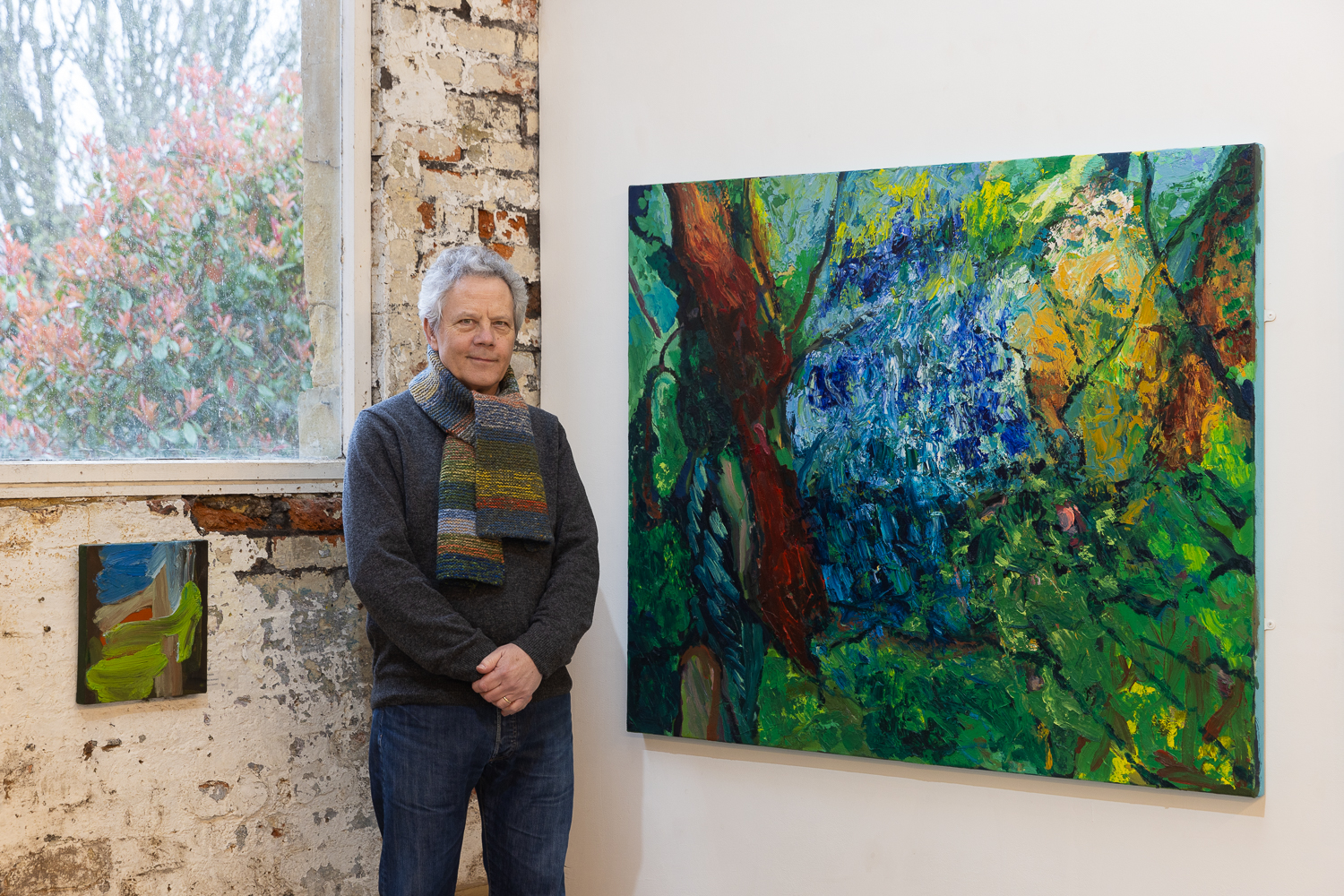
Michelle Cobbin, a fellow painter at the Phoenix Art Space, interviewed Geoff Hands as he prepared to install his exhibition, In The Garden, at Gallery 19a in Brighton.

Install photographs by Rob Harris.

Michelle Cobbin – What was the first painting that had an impact on you?

Geoff Hands – A Camille Pissarro woodland landscape. I was 18 or 19 years old and on a Shrewsbury School of Art visit to Manchester City Art Gallery and The Whitworth. It was not a particularly large work, but the paint was quite thickly applied in that Impressionistic manner. It sounds naive, but I was so accustomed to looking at reproductions of paintings in books that I must have assumed that paintings were essentially ironed flat. Today we probably talk about ‘materiality’ but back then, in the 1970s, it was ‘surface touch’. A visual touching of course, which is one of those fascinating dualities of experiencing painting that might only truly be comprehended on a feeling level.

I should also mention two other paintings recalled on another art school trip a little later to Liverpool. These are Stephen Farthing’s ‘Louis XV Rigaud’ and John Walker’s ‘Juggernaut with Plume – for P Neruda’ that were selected for the John Moores exhibition in 1976. They employed a technique of employing collage within the canvas, which expanded the painting process. Collaging, in a sense, is more ‘hands on’ than painting with a brush.

MC – That is really interesting. Your recent work utilises unctuous and thick oil paint and collage plays a part in your studio practice. Would you say that the ‘materiality’ of making work is essential to your practice? 

GH– I have always felt that the physical medium is a crucial ingredient in the realisation of the artwork. It’s experiential too, both for maker and viewer.  There’s a symbiosis at work, which is material, physical and visual. Oil paint is a wonderful medium, just from a feeling point of view. If my painting is going well, on a subjective level, the oil painting process is still a challenging and discomforting experience. That’s the contradictory nature of painting for me, which has been appropriately labelled the ‘hard won image’. I’m sure that sounds rather old fashioned and romantic.

Oh, but the thick layers of oil could be thin too. And I love the term ‘studio practice’ as it implies a never-ending quest for something. The recent work being presented in ‘In The Garden’, particularly from 2019/20, really continues work from before but with an added realisation that there’s a singular pursuit to make a painting that was worth the effort. That’s why I called my show at the Phoenix Art Space in 2020, ‘It’s All One Song’, after a comment made by Neil Young to an audience member who wanted to hear a specific song but he launched into something else. My interpretation was adjusted to the notion of my own singular pursuit, engaged with as a painting student so long ago, that is still manifested in repetition of some kind of desire.

‘Garden (Pilgrimage) – After Watteau II (for PJ Harvey)’ 2020-21 (121x150cm) and
‘Garden (Pilgrimage) After Watteau I’ 2020-21 (121x150cm)

MC – That quote from Neil Young, ‘It’s All One Song’, you mention one way you apply that idea to your painting in that it is a repetition that forms part of your ‘studio practice’. Keeping with musical references I would suggest that you use a lyrical mark-making motif in many works that lead the eye from painting to painting in a rhythmic way. Are you conscious of that – is it deliberate or is it perhaps that you are listening to Shakey in the studio and the marks are spontaneous responses to the music?

GH – Well, I am conscious of a desire to create a feeling of movement and flow in the paintings. This starts with the looking and the observational drawing before the paintings are made back in the studio. This interest in rhythm, movement and atmosphere is concerned with consciousness, time and space. So there should be occlusion and fixed point too. This is everyday stuff, acknowledging the animism and agency of the here and now. The mark making can be described as ‘lyrical’ and I see it as an extension of the looking and the drawing but improvisation is key too, along with a journey into abstraction with colour.

I get the musical link too but I more often paint with some chilled ECM label jazz playing in the background. The occasional blast of Neil Young with Crazy Horse would be good to stop overthinking though!

It’s worth briefly mentioning that I am currently working with musician and composer, Tobias Wheal, on walking, drawing and painting with his music responding to my work and vice-versa. There’s a little poetry as well, but it’s still a little early to say much more as we are buried in the project at the moment.

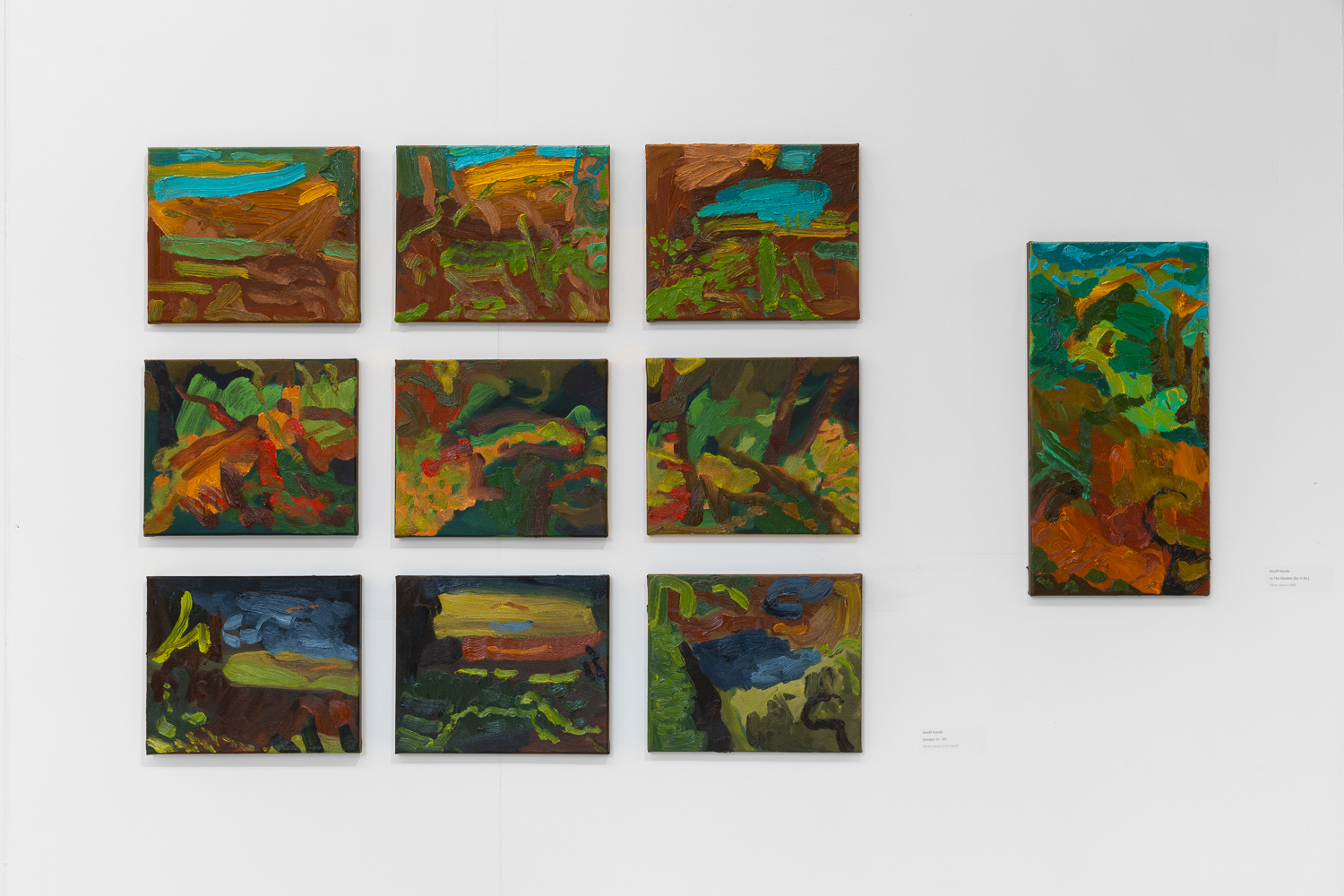
Garden’ series, 2023 (25.5x31cm)
and ‘In The Garden (for V.M.)’ 2023 (51x26cm)

MC – The project with Tobias Wheal sounds like an interesting collaboration, I look forward to seeing how that develops. Recently your work has referenced paintings by historic landscape painters such as Watteau and Gainsborough. In particular I was drawn to the large painting inspired by ‘Mr and Mrs Andrews’. What drew you to riff off that particular Gainsborough painting?

GH – Between two of the lockdown periods I went to see the Titian show at the National Gallery and took a walk around the permanent collection. Gainsborough’s painting is one I know well from many visits there and it never fails to impress. I always expect it to be bigger than it is and his paint handling is astonishing. It’s a loaded image of course, not just from a feminist perspective concerned with the implied male ownership of the female partner, but it is also an unintended glorification of capitalism and land ownership from its early history of development in England. For anyone interested in the English Landscape tradition in painting it can’t be ignored either. All of these political frameworks are important and remain relevant today, but I think that we can look at paintings for what they are without having to add a societal context every time.

Anyway, at the time (during the pandemic) I was incorporating elements from paintings from the past into my own work. I was initially looking at a Ruben’s composition (‘Landscape with St George and the Dragon’ 1630-35) and adjusted a small series of my own paintings to include compositional references. This lead onto ‘appropriating’, the artist’s term for stealing, various elements from Titian, Watteau and Gainsborough to add to my own imagery. Some of the content from these painters has been intermixed, especially from Watteau’s, ‘The Embarkation for Cythera’  (the version in the Louvre) that has become a bit of an obsession. With the Gainsborough I have found that I can enjoy painting towards abstraction. The image just seems to lend itself to this painterly and colorful direction. All of this has been happening since about 2020 when I was becoming a little disillusioned with where my work was going, or rather, it was stuck in a groove that needed changing somehow. My forthcoming exhibition (In The Garden) at Gallery 19a will show a small selection from this quite large body of work and I shall have an opportunity to distance myself a little from the paintings so that I can see it from another perspective.

‘Andromeda’s Garden’ 2023 (145x200cm) oil on canvas

MC – As I think about you preparing to select paintings and curate your exhibition ‘In the Garden’ I wonder about titles of individual paintings and whether titles are important to you. As a whole you say the work is ‘all one song’, how does that effect how you title individual works?

GH – Well, there’s an obligation to title work but it’s useful. Just numbering works does not feel right for my works – although as I work in series there will be a roman numeral somewhere. A title is something of a portal, an entrance into the work for the viewer. With the works that reference another artist it seems ethically correct to add their name to the title. As for the importance on a personal level I often reference the source of the painting. This is often a particular location where I have typically visited with a sketchbook to draw in. The untitled option is always there though, and if I am looking at someone else’s paintings in an exhibition I generally avoid reading the wall label at first. The song reference is more of an acknowledgement of a lifetime’s quest or project.

The exhibition title for my show at Gallery 19a is deliberate reference to the feel of that particular song by Van Morrison. It’s quite personal, and perhaps only relevant to myself. The garden reference is also an allusion to the painting studio, especially during the pandemic lockdown periods, and an even more oblique reference to images of Mary in the Garden from the Gothic and Renaissance periods in art history. I like to think of this as a poetic decision, inviting the viewer to make whatever they wish from the references without any clear answers from me.

MC – I think that’s a good place to end.

Links:

Geoff Hands – https://www.geoffhands.co.uk/

Michelle Cobbin – https://www.michellecobbin.art/portfolio-abstract-paintings

Geoff Hands – ‘Emilia’s Garden’ 2023 (135×185.5cm) oil on canvas
‘Andromeda’s Garden’ 2023 (145×200) oil on canvas
Catalogues, included limited edition of 32 with original paintings.

H_A_R_D_P_A_P_E_R

At Phoenix Art Space, Brighton

2 March to 14 April 2024

Paper has been around for ages, maybe 5000 years, especially if we include papyrus from ancient Egypt. Artists love this material. Even digital images end up being printed on it. Just as there will never be a paperless office, there will never be a paperless art studio.

Abstract art may have been around even longer than paper – I am thinking of pattern-like marks made on the body with mud or blood, or in the sand with a stick – before any notion of symbolism or figuration advanced visual language. Today abstraction continues to interest many painters and in Brighton we have been fortunate enough to see a good range of the more geometric, non-objective formulations in the H_A_R_D_P_A_I_N_T_I_N_G shows at the Phoenix Art Space in recent years.

When I first heard about plans for the H_A_R_D_P_A_P_E_R exhibition a few weeks ago I was pleased that drawing and collage – maybe even 3D forms too – might get a look in alongside the painting that I assumed would dominate this project. I wasn’t wrong.

Paper can be passive or add agency – by way of an effect of literally underlying subtlety or more overtly pronounced and structural. In this exhibition there are examples of a suggestively drawing or print-based approach as well as monochrome or limited palette imagery. As expected from geometric abstraction, linear grid-type configurations, systems based structures through to colourful, almost (dangerously) painterly imagery is included. Just over fifty artists have contributed works that they selected themselves. Perhaps this was a risky decision not to completely control and steer the selection by the four H_A_R_D_C_U_R_A_T_O_R_S (my tongue-in-cheek term for Ian Boutell, Patrick O’Donnell, Philip Cole and Stig Evans) as they went for the light touch and allowed things to happen. Based on a first impression I felt that the decision had worked well enough and, as with the previous painting shows, the viewers are given a little taster to seek out more from these practitioners.

An alternative point-of-view, however, might demand a much tighter range and a smaller group of participants, with far more in common linking the cohort. This has certainly been my feeling after a third visit as, for if there is an argument being promulgated, it is possibly diluted through diversity. That desire to see more from several of the artists, and to make a tighter and less assorted grouping will not go away. Another personal quibble could be even more paper related in that the surface and structures of the medium could have come more to the forefront. Seeing works unframed or breaking free of the rectangle might also emphasize the paper aspect. At this more critical level, a viewer (or a selector) might well insist on an elevated role for the choice of paper as a support and/or main material feature in all of the works. Admittedly, some works, such as several of the paintings could have been applied to a smooth canvas and appeared much the same except for a paper edge or floated mount showing up. Several works adjust or undermine the expected rectangle and hint at an expanded, or extended, field arena for painting. The painting media are, understandably, wide ranging. Some works are closer to drawing, or employ gouache, ink or watercolour. The acrylic medium was present in eight works with some use of oil. Although the unifying factor is paper, even if subservient to the applied medium at times, there could be an argument that demands a less collegiate approach to the final selection in which participants from the second show invited an additional artist to contribute something.

There are so many works on display that I am reluctant to single out a favourite piece. There were three works that remained strongly in my memory after the first visit, but three others after the last. Some works exude expertise and decades of experience, whilst others suggest an experimental attitude or even a sense of humour or play. Three works could loosely be categorised as sculptures – and so I wanted more. For the curators I would like to think that this showing inspires another paper-based show in the future – or even a H_A_R_D_S_C_U_L_P_T_U_R_E survey. But it must not become gimmicky or too broad. They might return to the desires felt for the first exhibition in 2018, which produced a highly memorable show. On this occasion the press release explained that works on display would be: “Painting that is hard edged, non-figurative and abstract / Painting that endures / Painting that is a complex and esoteric distillation of ideas” 

On a very positive social note the Phoenix was jam-packed on the open evening with over 400 attendees and when I visited again over the first weekend there were many more visitors than usual. On my Thursday afternoon visit, often a very quiet time, a steady flow of people were turning up. If it’s a sign of the times, and of an interest in contemporary art, we need more artist lead shows at this primary Brighton venue.

The artists:

Mohammad Ali Talpur, Richard Bell, Biggs and Collings, Helen G Blake, Katrina Blannin, Isabelle Borges, Ian Boutell, John Bunker, Matthew Burrows, Belinda Cadbury, John Carter, Cedric Christie, Nina Chua, Philip Cole, Deb Covell, Gina Cross, Matt Dennis, EC, Henrik Eiben, Stig Evans, Catherine Ferguson, Martina Geccelli, Della Gooden, Richard Graville, Dom Gray, Charlotte Winifred Guerard, Alexis Harding, Rupert Hartley, Pete Hoida, Zarah Hussain, Ditty Ketting, Roman Lang, Jo McGonigal, Matthew Meadows, Johanna Melvin, Mali Morris, Morrissey and Hancock, Jost Münster, James William Murray, Patrick O’Donnell, Tim Renshaw, Giulia Ricci, Carol Robertson, Sonia Stanyard, Daniel Sturgis, Trevor Sutton, G R Thomson, David Webb, Lars Wolter, Eleanor Wood, Mary Yacoob, Jessie Yates.

LINKS:

HARDPAINTINGhttps://www.hardpainting.com/

Phoenix Art Spacehttps://phoenixartspace.org

Also see:

Sam Cornish on Saturation Pointhttps://www.saturationpoint.org.uk/Hard%20Paper.html

The first Hardpainting show reviewed for Abcrithttps://abcrit.org/2018/01/20/93-geoff-hands-writes-on-h_a_r_d_p_a_i_n_t_i_n_g-at-pheonix-brighton/

MICHAEL CLARENCE: Full Catastrophe Painting

At Phoenix Art Space, Brighton

21 February to 3 March 2024

Michael Clarence – ‘Devily Dyke‘ 2024. (30X21.3 cm)
Oil on board.

Don’t go looking for the punctum. It will find you, only you. Not just in photographs, as Roland Barthes explored in the now classic ‘Camera Lucida’ nearly fifty years ago, but in any visual situation.

I am expanding this compelling theory of Barthes’ beyond its intended scope within photography as I attempt to ascertain why one painting in a small exhibition made a connection that did not rely on it standing out from the other works as bigger, better or more beautiful. Its title is irrelevant (to me at least, for now…) and, for the record, it was possibly the second or third smallest work on display. Maybe there are eight works, or nine. There was ample space for double or triple the number. Overfilling a space is easy. Just getting it right is an impressive skill.

Mind you, if I could fully understand and explain why this one particular oil painting ‘hit the spot’ I would be venturing into the studium as not only the language and form of an explanation would betray the impact of the singular act of seeing something, but I would be obliged to discuss (in general terms) figuration and abstraction in painting. The present day, an aspect of the historical moment before it is truly placed in some kind of past, would oblige a discussion of identity politics too (in specific, contemporaneous terms, no doubt).

Sometimes we should allow ourselves the thrill of the extended moment and should, or at least can choose, to put aside the societally inflicted art appreciation straightjacket awhile. Such an act is difficult and might be achieved in some act of play or weariness. It may happen by chance, just once in a while. The cultural obligation to look at, and judge, ‘art’ with an overburdening requirement to apprehend a painting whilst looking through the lens of current ideology can be challenged. I admit a form of blasphemy here, but I do not regret such a stance, however brief I might be able to hang on to it. There is surely an elemental and unsophisticated rawness to seeing some phenomenal aspect of painting without a framework that might impair judgment that relies on the theory and the concept that the painting must necessarily serve. This painting did that for me (I say ‘did’ because I don’t know how it will greet me when I next see it, probably tomorrow) and I have some reluctance to stress over understanding why. I suspect it’s something to do with the use and application of the paint medium, the simplicity of the composition and the colour combinations. But I have said too much already.

The work in question has been selected from paintings made during 2023 in Michael Clarence’s role as the Freelands Foundation Studio Fellow at the University of Brighton. He explores themes surrounding identity and a sense of place, situated somewhere between figuration and abstraction. Full Catastrophe Painting at the Phoenix Art Space fulfills the culmination of this fellowship before the artist returns to his native Glasgow. Many people will see this exhibition when they turn up to see three other shows that are also open at the Phoenix. How fortunate we all are, sometimes.

Image © Michael Clarence

LINKS:

Michael Clarencehttps://www.michaelclarence.com/

Freelands Foundationhttps://freelandsfoundation.co.uk/artist/michaelclarence

Museum of Education (explanation of Barthes studium and punctum)

RICHARD GRAVILLE: New Paintings

WE LIKE THE TASTE OF CERTAIN POISONS

At NoHawkers Gallery, Rodhus Studios, Brighton

1st to 2nd October, 2022

Returning home from the Private View for ‘We Like The Taste of Certain Poisons’, I am compelled to write something immediately about this small but compelling exhibition of Richard Graville’s paintings at NoHawkers Gallery, which is situated in the Rodhus complex of studios and workshops in Brighton.

Richard Graville- ‘WIDE’ 2022 (60x120cm) Flashe & acrylic on canvas

Some sense of urgency (including the use of my iPhone photographs – so apologies to the artist) is due to the fact that the show is only open for two days and that if someone were to read this hurried review in time they might make it to see the exhibition. But another aspect of this impulse is due to my having spent a large proportion of the day preparing a teaching session, in which I shall ask my students to consider our shared human history of the landscape environment and might consider why this is still an interest for contemporary painters.

I had been re-reading Timothy Morton’s, ‘Being Ecological’, in which he posits the notion that:

“Picture postcards are descendents of what came before Romanticism in art, namely the picturesque. In the picturesque, the world is designed to look like a picture – like it’s already been interpreted and packaged by a human. You can easily see what’s what: there’s a mountain over there, a lake, maybe there’s a tree in the foreground…  this is pretty much what humans saw in the savannah millions of years ago. Having a body of water nearby and some shade (those trees), encircled safely by mountains where you know there is water descending to feed the lake (for instance), is pretty handy if you’re some kind of ancient human. The picturesque is keyed to a fundamental human-centred way looking at things: it is anthropocentric.”

This seems strangely fortuitous, for although Graville’s paintings would certainly not be identified as landscapes as such (though they hold that possibility for a viewer who might be so inclined to wear their landscape-tinted spectacles), some kind of deep psychological and ‘pre-historical’ possibilities are pertinent to Graville’s project within a minimalist, systems/coding kind of approach to hard-edged abstract painting.

Richard Graville – ‘SOLUTION’ 2022 (100x100cm) and ‘CLEAR’ 2022 (80x80cm) both Flashe and acrylic on canvas

The last time I saw a Richard Graville painting (in the flesh, as opposed to on Instagam) was in H_A_R_D_P_A_I_N_T_I_N_G_x2 (Part 1) at the Phoenix Art Space in Brighton at the beginning of 2020. I wrote then that:

“Even Richard Graville’s pair of canvases, ‘Blushing Phantom’ and ‘Red Banded’, that come the closest to accruing accusations of painterly abstraction, have an aura of careful, premeditated control. That they echo the similar stripes on the workforce vans outside the building is either unfortunate or reminds us that abstract art is everywhere.”

This was my personal, uninformed but simplistically and naively honest response to two rather satisfying paintings. We search for meaning, some allusion, illusion or just good old subject matter in paintings. It’s habitual. That the red and yellow stripes on the Highway Maintenance vans had any connection with the natural world, as in animal colouration and patterning, I must admit was beyond me at the time.

Richard Graville – Studio view

From this solo show of ten new works by the artist (plus several more in his studio on-site) an information sheet presents this comment:

“Humans were once able to navigate and track subtle clues in nature. Now flat signs in primary colours tell us which way to go and what to do. I continue down that path to see where it leads.” (Richard Graville)

Hence my connection with Morton’s view on the picturesque, in that we humans create systems of understanding to navigate and understand the environments we live in – as do the other animals. Morton’s observations reference a perception of the world from a clearly human viewpoint (the anthropocentric), although also in the book he makes it clear that a worm’s experience of an apple is somewhat different to a human’s. Nevertheless, on all sorts of levels, data is interpreted, via various access modes, to be acted upon.

A wall mounted information display adjacent to the exhibition room tells the viewer that animal colouration systems, categorized as aposematism, inform potential predators that an animal is poisonous, venomous, or otherwise dangerous. All animals (which include us humans), to some extent, live (and die) by preventing attack (or not). Data requires interpretation, which is a form of code, taking us back to the work of the artist.

Not that Graville’s works could be categorized as ‘landscape’, but various painted arenas (canvases) are presented for interpretation and contemplation. Sensory input, from the simple act of looking, enables the mind to process information that we categorise typically as colour, size, shape, texture and finish or sheen. Each composition is relatively simple and geometrical and often references (purposely or not) windows and road signs. The colour palette is always limited (sometimes monochrome), though sophisticated and astute enough to prompt some reaction from the viewer. Every work is immaculately and carefully composed, painted and visually constructed. I suspect that the paintings might feel different depending on one’s mood and known or unknown frame of reference at different times. If you can accept a minimalist type of simplicity, aligned to a deep interest in colour (for its own sake, never mind any aposematic coding or sign) try to see this show – or look out for the next opportunity.

Geoff Hands (October 2022)

Richard Graville – Studio view

Notes:

‘Being Ecological’ by Timothy Morton (quotation from pp.24/25 Pelican, 2018)

Links:

Guardian review –

https://www.theguardian.com/books/2018/jan/20/being-ecological-timothy-morton-review

Richard Graville – https://richardgraville.net/shop (see good quality photographs of the works)

H_A_R_D_P_A_I_N_T_I_N_G exhibition review – fineartruminations.com/2020/01/30/hardpaintingx2-part-1/

Social media: Instagram – @nohawkers @richard_graville Hashtags: #certainpoisons

Also – The teaching session I was planning – https://hampshireart.studio/abstract-approaches-to-using-colour-acrylic-painting/

“STRANGE ATTRACTORS” – Paintings by EC

AbCrit.org gallery, London

5 June to 3 July 2022

abcrit.org gallery

“This work does not conduct itself with grand gestures. The best of these paintings make themselves felt intuitively and structurally by measures quite human. They progress carefully, in challenging jumps and starts. They are full of free and varied thought, without self-importance, working towards new and distinct states of abstract reality.” (Robin Greenwood, AbCrit website)

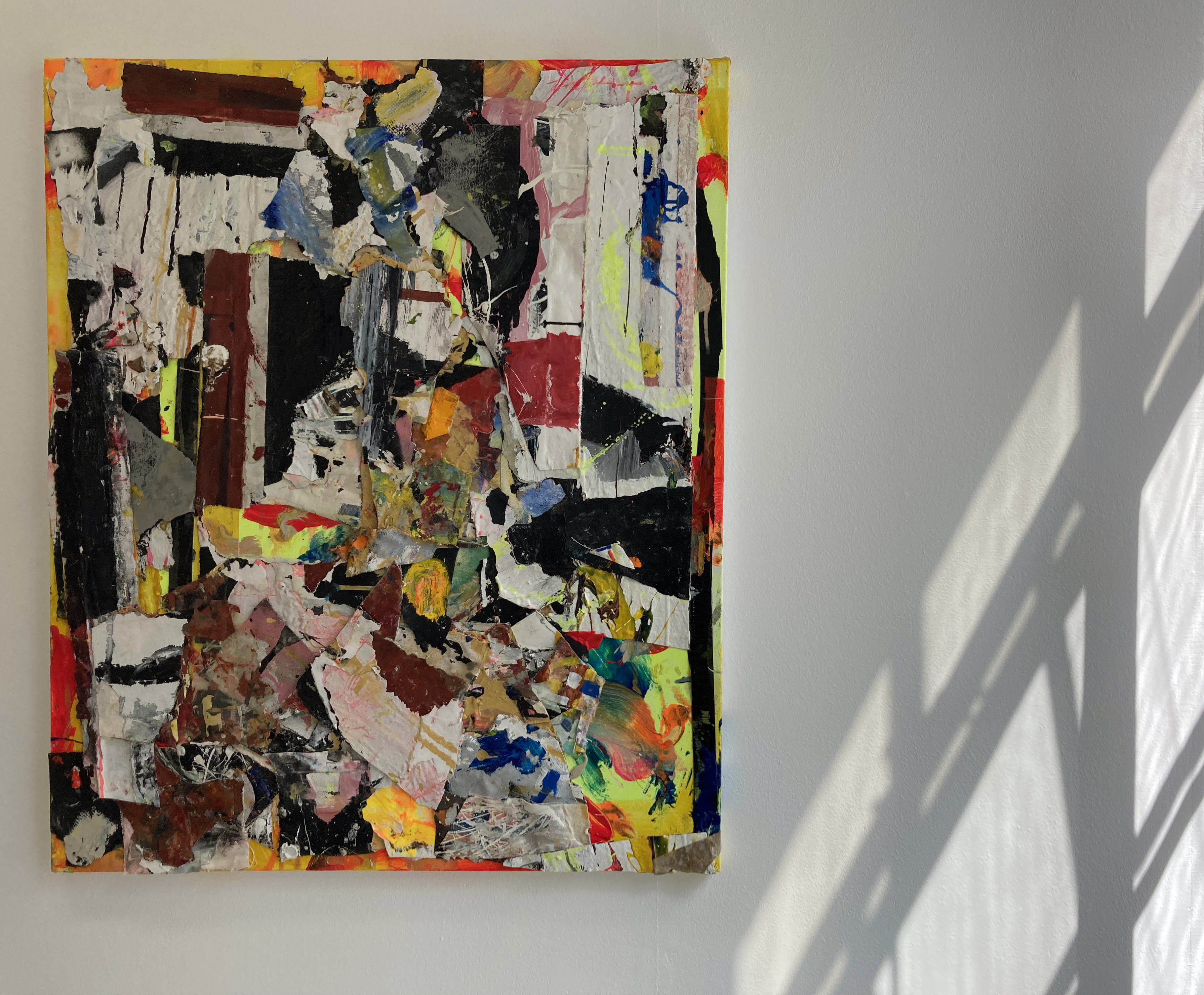
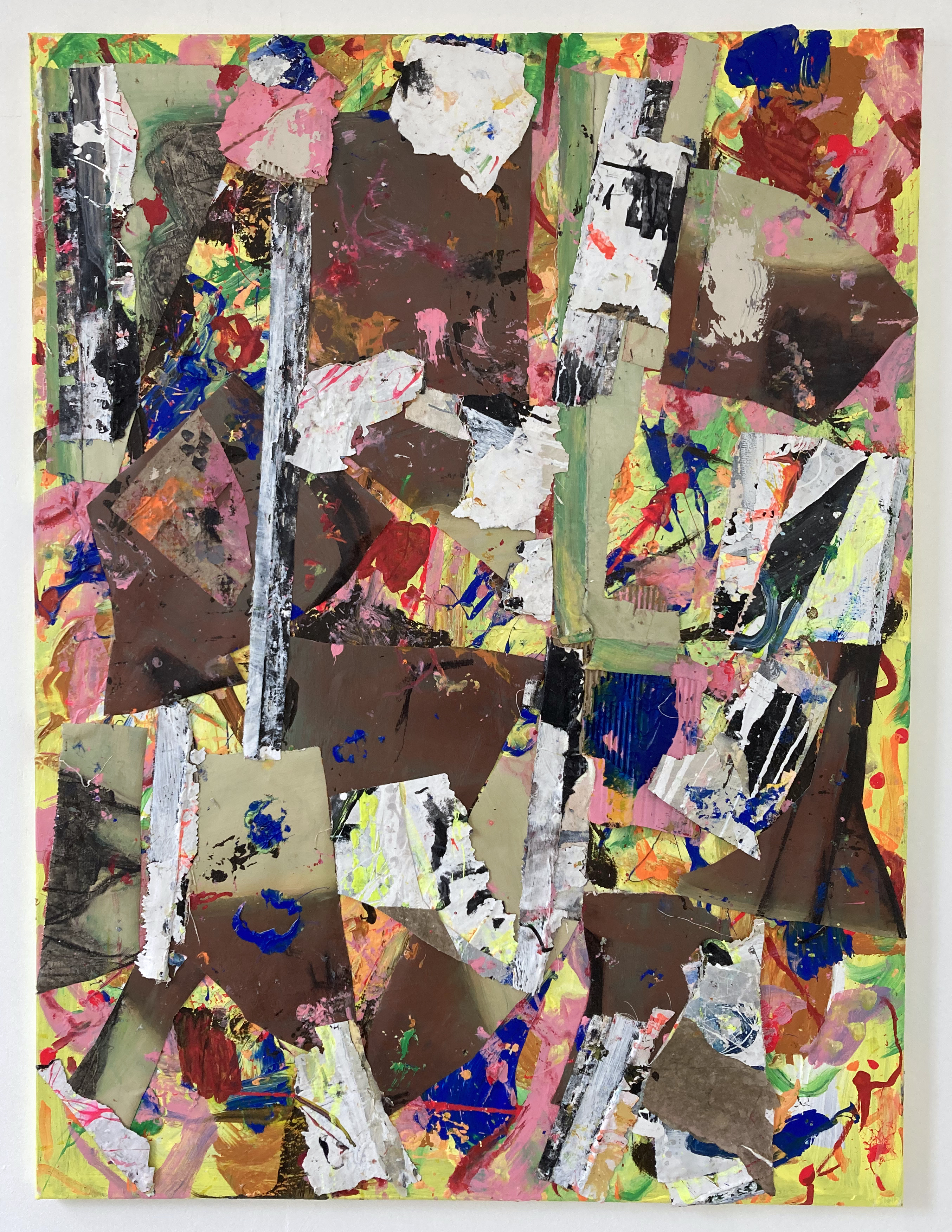
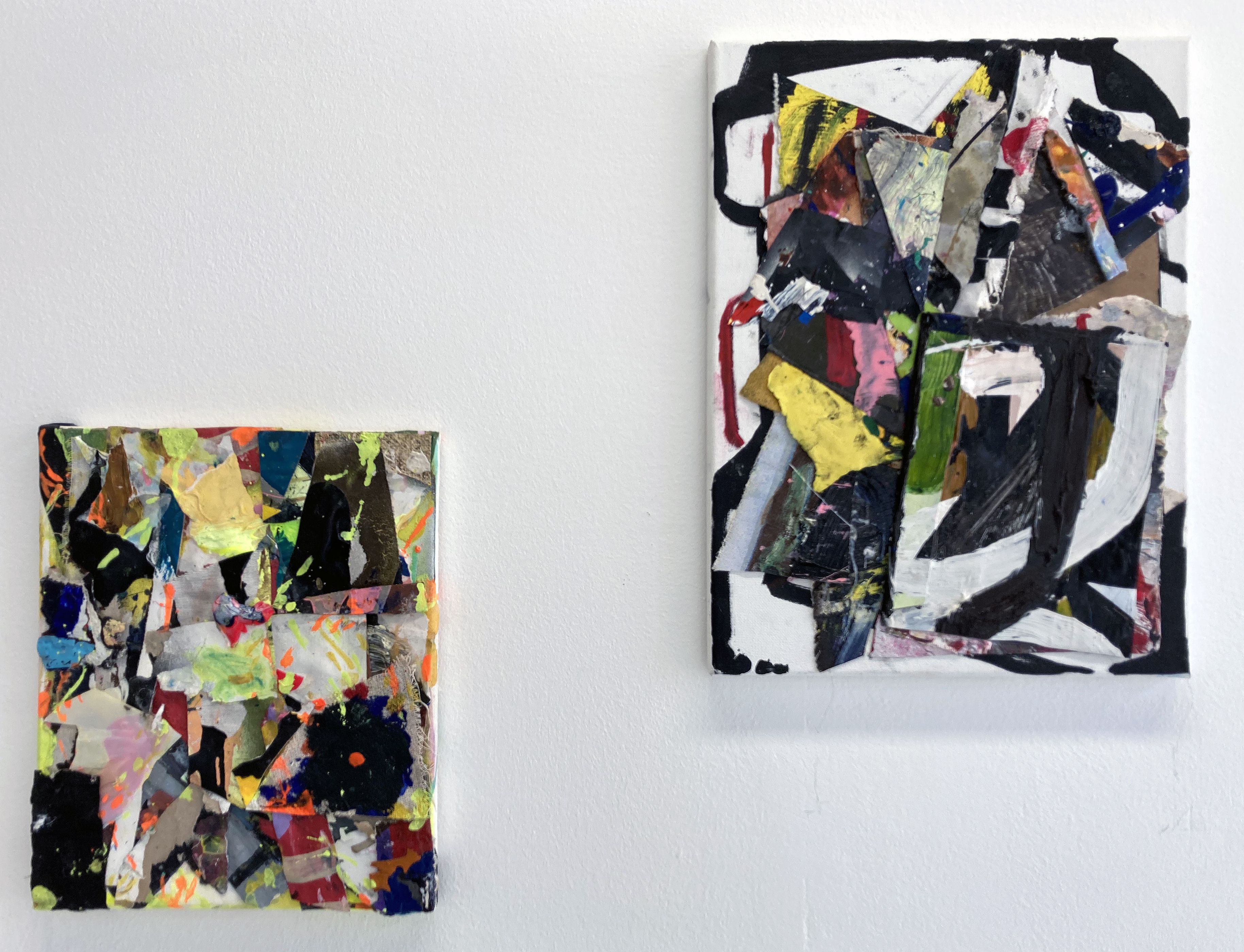
After seven previous shows this is the first exhibition in the newly extended abcrit.org gallery in Bell Yard Mews near the White Cube gallery, showing paintings by EC. There are 24 works on display ranging in size from 30x20cm to 122x92cm, with various permutations in between. Five are square and others portrait or landscape format. For such a range of disparity in dimension this collection literally hangs together in unison. There is a sense of the ‘series’ about the selection, yet every work has an independent status and can be viewed as a discrete piece.

The various titles are intriguing too. They read like a list of poems. For example:“Your Exquisite Manners (Frankly)”; “Unforbidden Pleasure Seeker”; “It Takes Patience to Make a Disaster”; “Yellow Swing Yellow Swing”; and “All Trajectories are Unstable”. Although “PUNK JAZZ”, the only work titled in capital letters, pays homage to a Weather Report track from ‘Mr Gone’ (1978) in which, at the start of the composition, Jaco Pastorius launches his bass guitar expertly into an unforgettable percussive jazz fusion frenzy that is, nonetheless, totally controlled. Rather like EC’s works.

EC – ‘Strange Attractors’ (90x75cm) 2014-22

These mixed media collages, that we can call paintings, are typically busy, boldly delivering overlapping patchworks of fragmented physical elements, purposefully destroyed then re-worked, but never distraught. Painterly fragments (as if) from the studio floor or bin, or from managed intentions to destroy previously made compositions, are sensuously positioned over the surface of supporting canvases. There is a visceral sense of chaos controlled, or rather, accommodated as the natural order of things prevails. Asymmetric balances and compositional nous bring these paintings into the current period of abstraction as a breath of fresh air. For this is serious stuff. Not content with employing pretty colours, punchy but vacuous vistas or harmonious and undemanding safe passages of expressive playfulness arranged for decorating an interior space, EC’s project engages with hard-earned visuality and an inherent depth of thought. The works truly engage and demand attention so honestly that you can detect joy and frustration combined. EC is one of those artists who are not distracted by the whims of fashion, socio-political issues, political correctness or commercial endeavour. This makes her work all the more engaging, as it constitutes a somewhat precarious road to travel upon that does not seek a ready-formed market position for safety.

EC – ‘Bias Interruptor’ 2022 (122x92cm)

Is EC’s project Dada-esque in spirit? Not so much anti-art (which Dada never was, of course) but anti-comfort: deploying the punk impulse to rock the boat (before it was integrated into the mainstream) when challenges are required to wake us from our stupor. From a first impression the viewer might wonder if this is a chaotic mess – though even chaos has a hidden pattern and logic. After all, why not explore and present ‘mess’? Chaos eventually controlled or simply halted at a stage of completion that is subjectively felt, has lead to these captivating and provocative works in “Strange Attractors”. Yet in a painting such as ‘Bias Interruptor’, or ‘Sanity Project (Radical Will)’, by giving some time for the paint smears and splatters seemingly applied by chance some careful looking, the open distribution in the former or the painterly concentration in the latter, actually read as carefully placed and subtly balanced compositions that reveal an expert eye and an adeptness for composure. There’s the punk irony, which hooks the viewer with clattering surprise but cares passionately after all.

EC – ‘Yellow Swing Yellow Swing’ (31x25cm) 2018-22
and ‘Swelter’ (40x30cm) 2019-21

Notably, the colour black appears in all of these works, holding things together akin to the lead scaffolding in stained glass windows. A disparate framework unevenly dispensed at times gives structure to hold the roving eye. Amalgamated into and alongside relief patchworks, dynamic structures, colour-as-paint (and vice-versa), these seemingly accidental and fortuitous juxtapositions make for engaging visual judgements that are anything but flaccid or disorganised. In the previously mentioned ‘Sanity Project (‘Radical Will’)’, a fragment of black (ink) text appears unexpectedly. Maybe it is an oblique clue of sorts. The title page from an edition of ‘Styles of Radical Will’, a collection of essays by Susan Sontag has possibly been torn up, discarded and disclaimed. I want to doubt it somehow (show some respect!): but here it is, peeping through the collaged detritus close to the centre of the composition as a potential manifesto statement.

EC – ‘Sanity Project (Radical Will)’ detail

In Sontag’s essay, ‘The Aesthetics of Silence’ she writes:

“… art comes to be considered something to be overthrown. A new element enters the individual artwork and becomes constitutive of it: the appeal (tacit or overt) for its own abolition – and, ultimately, for the abolition of art itself.”

The text and the concept have taken visual arts aside far too much and must be subsumed within the work itself, not held part in judgement. I wonder if EC’s mission is to toy with this radical notion that favours a changing resolution of “the human situation” (Sontag) as a form or manifestation of “spirituality” (Sontag, again) as an ironically playful project in itself, creating (or finding) some sort of order in chaos. Do these works employ the abstract absurdity of consciousness and self; notions of reality and worth vis-à-vis the creative impulse – and the concrete materiality that is abstract art? It all adds up to everything and nothing. But it’s something most refreshing and attractive.

EC – ‘Unforbidden Pleasure Seeker’ (30x30cm) 2019-21

Notes:

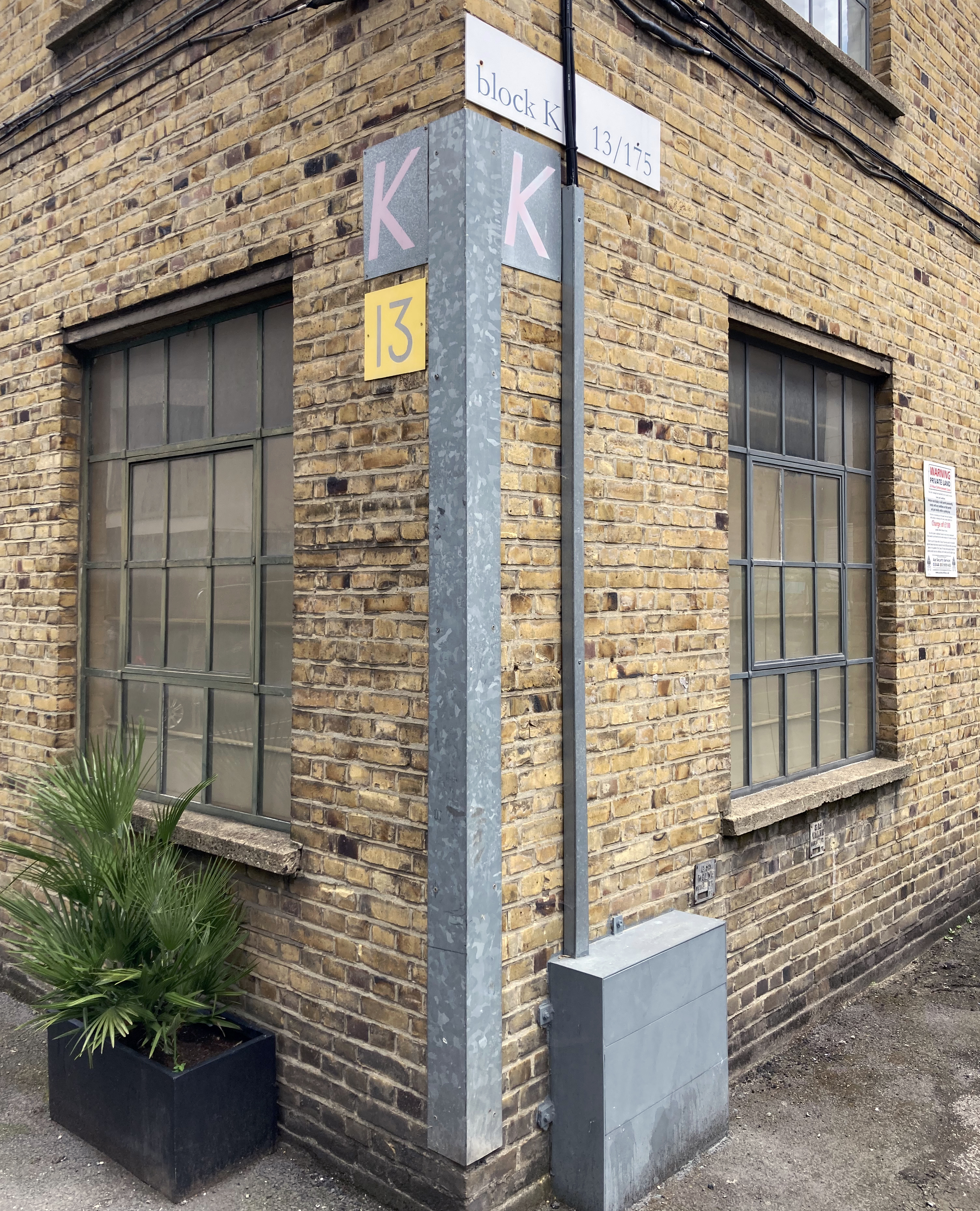
abcrit.org – Block K, 13 Bell Yard Mews, 175 Bermondsey Street, London SE1 3UW

Visit by prior appointment. Text your name and requested date and time to 07866 583629, for return. The entrance to Bell Yard Mews is opposite White Cube.
Links:

Instagram: @ec_ismyname and @abcritgallery

Susan Sontag – Styles of Radical Will

http://www.susansontag.com/SusanSontag/books/stylesOfRadicalWillExerpt.shtml

MICHELLE COBBIN: ‘I’d Be Enlightened Now If It Wasn’t For You’

Window Gallery, Phoenix Art Space

2 to 24 April 2022

Phoenix Art Space, Brighton

The Window Gallery at Phoenix Art Space in Brighton offers studio members an exhibition opportunity close to home and the latest show celebrates the abstract paintings of Michelle Cobbin. After an email exchange of questions and answers in anticipation of the exhibition I had the pleasure of helping her to hang the show and so literally saw the work very close up. I mention this, as a viewer would normally step back to view the larger works. But despite the apparent visual simplicity of many of her canvases the colourfield experience really does pull the viewer up to the surface and into an atmospheric, non-objective, realm. The weave of the canvas, however, reminded me that I was not floating in some sort of meditative dreamland but was experiencing concrete reality.

Michelle Cobbin – ‘Atmosphere’ acrylic on canvas (130 x 130cm)

I have often thought that abstraction in painting without overt reference to a particular narrative, scenario or specific space lends itself to a notion of timelessness, or of historical time collapsed into simply the experience of looking at and experiencing a work of art – something one might unashamedly describe as the aesthetic experience. This notion of the material here and now counterpoised by a more expanded sense of place is philosophically, as well as artistically, intriguing. Such an experience is not exclusive to abstract painting of course, as might paradoxically be seen in still-life painting (I am thinking of works by Giorgio Morandi and Peter Dreher) that both acknowledges a social reality and a particular time and place yet exudes a sense of ongoing visual engagement irrespective of the date on the back of the canvas. A kind of meta-reality embedded in paint and its various qualities.
Michelle Cobbin – ‘Atmosphere’ (detail)

In Cobbin’s oeuvre you will find that the landscape is implicit but not essential to identify and in this selection of six works the viewer will travel across the colour spectrum and from dark to light. The titles are generally broad and non-specific, although ‘Bridge’ and ‘In The Top Field’ keep our feet on the ground alongside ‘Atmosphere’, ‘Lament’, ‘Phosphorescence’ and ‘Hidden’.

To start the discussion with Michelle Cobbin I borrowed John Bunker’s first question for Peter Lamb from the new series of ‘Abstraction in the Now’ interviews from Instantloveland“Can you remember the first abstract painting to make a real impression on you?” is a brilliantly simple gambit to open up a deeper conversation that delves into the past to relate to the present, and implicitly the future, in one’s practice.

Michelle Cobbin – ‘Hidden’

Interview with Michelle Cobbin (February/March) 2022

Geoff Hands – Can you remember the first abstract painting to make a real impression on you?

Michelle Cobbin – The first would be Tibetan Mandalas and Thankas that I saw whilst travelling in Nepal in the early 1990s.  If you want a western fine art example it would be the Rothko room of Seagram murals at what we now call Tate Britain in the mid 1990s. I was struck by how much presence they had, how they made me feel melancholic and introspective.

GH – That’s interesting. I recall looking at reproductions of Mandalas in my studio on my degree course (late ‘70s) and being dissuaded by my tutor from doing so as I could not possibly relate to them. He would have been okay with Rothko of course. Your paintings invite a long slow look. A meditative state may not be necessary but I assume that you would like the viewer to take time to contemplate the imagery.

MC – I am interested in how people respond to colour and abstract imagery – I’m interested in how it makes them feel. So this could be an instant instinctual response. But yes, with contemplation the viewer may drop into their body and feel their response more fully. 

Aside from contemplating an image in a meditative way I’m also interested in how abstract imagery and colour has been used to divine insight. For example Rorschach’s Inkblot tests, the Lüscher Colour Test and the Aura Soma system. 

I title my paintings which may lead the viewer to see them in a particular way, but people read images based on their own experiences, likes and dislikes, which goes back to sensory responses again.

GH – You have made and continue to develop several series of paintings, which is a fairly common way of grouping paintings for artists today. Your website is well illustrated with examples from these various series where a viewer can see ‘Transitions’, ‘Gaia’ and ‘Terra Verde’ which relate to landscape experiences, or ‘The Breath’, ‘Semblance’ and ‘Sumptuous Contentment’ which are more specifically yoga and meditation related. I am particularly fascinated, but for different reasons, by the ‘Inscape’ series that summons up memories from East Anglia, with a minimalist Zen Haiku guiding principle, and ‘Kenshō’ which is more programmatically ‘abstract’, with a clear reference to Zen calligraphy. The sense of family history and landscape related impressions from childhood in the former and a more formalist expression of abstract mark making in the latter gives rise to quite stark imagery.

But I wonder if the notion that, if I can reference Neil Young, these “are all one song”, by which I mean that the series titles and subjects might fall away to reveal a process of expression and communication that ties everything together as a record of one voice – in your case a visual and intuitive, feeling sensibility that manifests itself as abstract painting?

MC – Yes, of course my work is ‘all one song’ in some respects. I am interested in keeping things simple both in how the work looks and in making things clear. I know that abstract painting can be difficult to relate to and I think by working in series and titling paintings it goes some way to bridging that difficulty. 

Working in series also gives me boundaries to work within – that might be a particular palette, mood, or conceptual idea. It helps me to focus, but no I’m not suddenly going to start painting people or objects as that would deviate from the message or ‘song’ that I want to convey.  

As you mentioned, I grew up in East Anglia, near the Fens. The ‘Inscape’ series was my internalised and perhaps nostalgic impression of that landscape. It was the first series where I began using a horizon line in my work. I was hesitant about this – blocky colours with a straight-ish line, I was concerned it would scream “Rothko!” Of course his work has been hugely influential upon me. I included lots of little scribbles in the ‘Inscape’ series to begin with, to make the paintings less ‘empty’. It took me a while to have the confidence and to find my way into accepting I’m influenced by but not deriving my work from anyone else.

My forthcoming show, ‘I’d Be Enlightened Now If It Wasn’t For You’, at the Window Gallery, Phoenix Art Space is, if we keep with your musical reference, going to be a Greatest Hits show. I will be selecting works from various series. The criteria will be size. It is such a great window – literally – into Phoenix, and out into Brighton. Personally, I want to use this opportunity to survey how my large canvases sit together and show how, to quote Bob Dylan, I “keep on keeping on…”

GH – I expect that such a selection would work well in a linear type space that necessitates hanging most of the works in a straight line. Not necessarily in a chronological sense but in taking the viewer on a short but visually loaded journey from period to period.

The experiential link to a particular landscape is, to some degree, an historically “English’ trait too. Perhaps, for many painters and viewers the landscape is a way into abstraction?

MC – Yes the show could be a short visual journey. That could be an inward journey provoking an emotional response. I like the idea of colour bathing: standing close to large swathes of colour and noticing what you feel. The arts are a gateway to our emotional life and a way of connecting to other humans. In my case, I do this through paint. I hope viewers are drawn in, intrigued, and perhaps, as you say, the landscape nature of some of the paintings might be a way into abstraction. 

I think that being linked to a landscape experientially is universal. I took a course with psychologist Sharon Blackie on finding and creating myths in one’s contemporary and ancestral landscapes. It has certainly helped me to relate differently to the little bit of downland near to where I live as well as to draw comparisons with the chalk land of East Anglia where I have traced my roots as far back as 1600. None of my ancestors moved outside of a 30-mile radius. This research will underpin my next series of paintings.

GH – Thank you Michelle, there is clearly so much more to contemplate from your broad body of work and I look forward to seeing and experiencing your mini-retrospective at the Phoenix in April, and, at some future date, the following series.

Michelle Cobbin – ‘In the Top Field’ exhibition installation shot (early evening)

Michele Cobbin – ‘Phosphorescence’ in the Canvas Coffee Co. bar at Phoenix Art Space

Links:

Michelle Cobbin – https://www.michellecobbin.art/about-my-work

Instantloveland – https://instantloveland.com/wp/2022/02/10/4891/

Phoenix Art Space –

Peter Dreher – https://fineartruminations.com/2017/04/14/ce-nest-pas-un-verre/

Sharon Blackie – https://sharonblackie.net