DANA AWARTANI: Standing by the Ruins

View Post↗

Towner, Eastbourne

29 November 2025 to 25 January 2026

Dana Awartani – Standing by the Ruins III

Visual art is never totally a form of escapism, even if a gallery visit takes us out of our ordinary, everyday for a while. In the UK we inherit a long-standing interest in the represented landscape and the people and places therein. Stepping into the temporary exhibition space on the ground floor of the Towner the visitor, like me, who essentially was there to see the J.M.W. Turner watercolours on display in Impressions in Watercolour, might already have felt more than satisfied with their visit having viewed a multitude of landscapes either aesthetically breathtaking or superbly sublime.

But an organisation such as the Towner pursues a positive remit to celebrate both the past and the present for a broad range of visitors. Thus, the Towner Emerging Artist Fund has supported a slightly reduced version of Dana Awartani’s exhibition, Standing by the Ruins, originally shown at the Arnolfini in Bristol earlier this year. Awartani, a Palestinian-Saudi artist now based in New York, references the craft, history and traditions of the Middle East in her broad ranging practice and applies her universal themes to the present day. This is a highly thought provoking exhibition – and I cannot see Awartani being designated as emerging for too long. She has also been chosen to show her work in the National Pavilion of Saudi Arabia in the Venice Biennale in 2026 and if you Google her name there’s much to read on-line already and this makes it unnecessary for me to echo what other writers have already written about this work.

Dana Awartani – Standing by the Ruins III

I do not really know what others will have thought of the Towner display, particularly as I was there on the opening night before I have had an opportunity to talk to friends who have seen it for themselves. Not all exhibitions linger in the mind for too long either – but I suspect that this one will. At least it should do, even if for lamentable and distressing reasons. Sadly, but necessarily, we are aware to some degree of the religiously and politically inspired cultural and economic destruction that is going on in the wider world right now. We may well be shouting at our TV screens most nights, but I doubt we regret the choice available to switch off both literally and mentally before retiring for the evening. There might be a sense of the elsewhere that protects us emotionally. Meanwhile we can have a good old gripe about the potholes the local Council fails to fix, the frequently poor performance of our various water companies, or that yet another public library is closing due to lack of funds. If we do still manage to follow the TV news without depression and/or anger setting in too overwhelmingly (choose your own issues to be frustrated by) we can always counter this by getting out and securing an aesthetic fix from visiting an art gallery. Oddly, though positively, in Standing by the Ruins both positive and negative emotions can organically combine.
Dans Awartani – Standing by the Ruins III

In Awartani’s work that element of visual delight, dexterity and excellence is certainly foremost, particularly in an applied design sense. The drawings and paintings for her Standing by the Ruins series in 2D and 3D outcomes, reveals an impressive level of skill in applying a traditional, age-old geometric system of drawing and pattern making employing a compass and ruler (not a digital program) into architectural references. Something that looks good draws us in. Form and content interweave.

Dana Awartani – Study Drawing 3 2025

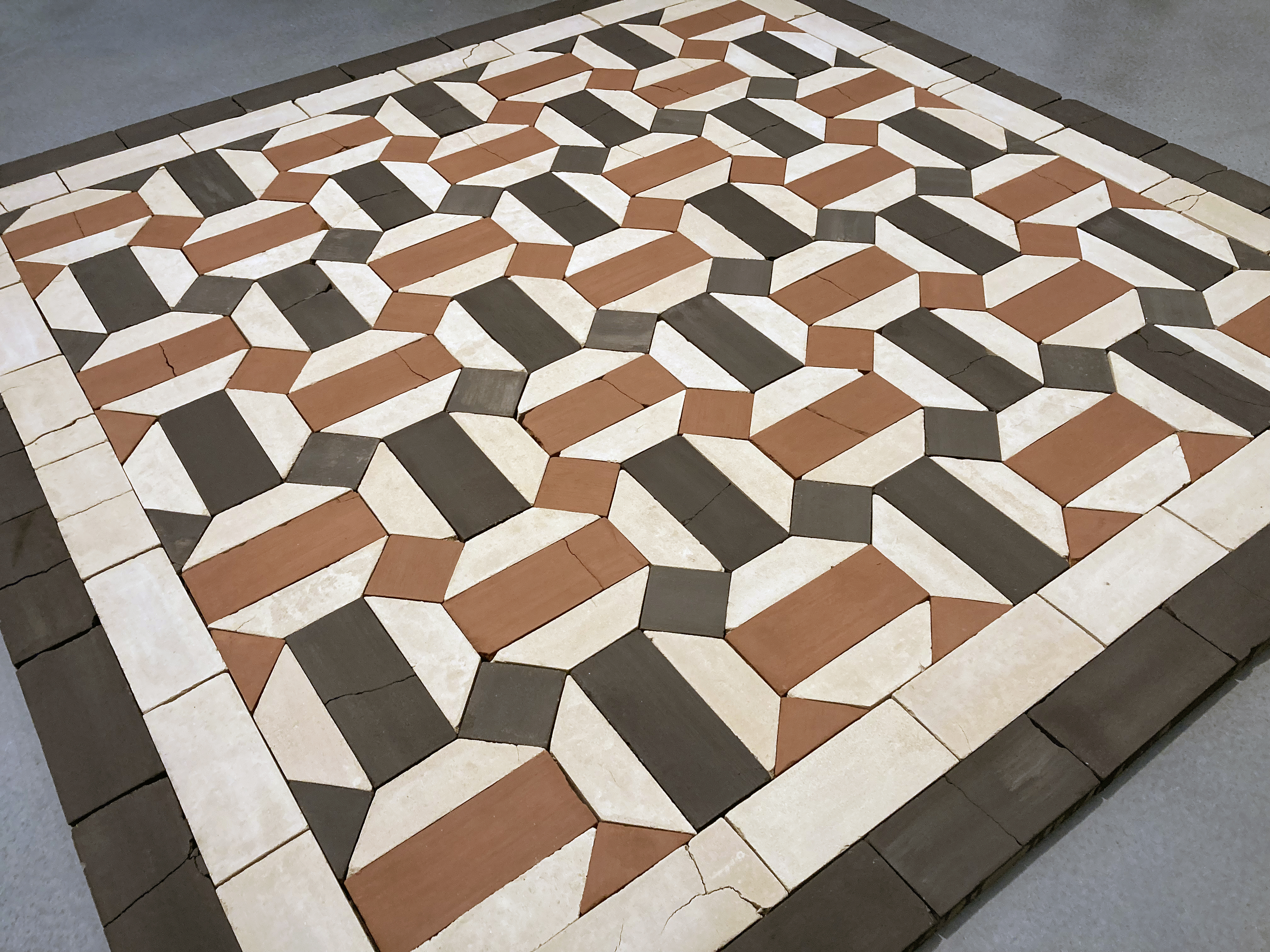
But before being drawn to the works displayed on the walls the works that the visitor will probably notice first are three floor-based arrangements of coloured bricks that the designs on the wall back up. These are the ruins that the exhibition title references – recreated sections of the floor of the Hammam al-Samara in Gaza, one of the oldest bathhouses in the region, but which has now probably been destroyed. To enhance the notion of destruction and obliteration the bricks are cracked and well on the way to further decimation. The artist worked with a collective of adobe brick makers (craftspeople of Syrian, Afghan and Pakistani origin) and deliberately left out the binding agent (hay) so the works are purposely intended to break up.

Whilst these would-be floors are adequately placed for the visitor to walk around there is a slight sense of the possibility of tripping, though no one does. The works are clearly installed rather than functioning as sculptures. Quite soon college tutor mode kicks in for me and, if I was questioning the young maker in an end of project tutorial, I may have commented that I want to see people walk on these floor coverings. Get on trend – employ the audience as active participants. In fact, I imagine being one of them myself. I visualise seeing the piece(s) destroyed, not because I dislike the work, but because the volume of the heavily implied message might, metaphorically, be turned up. If we accept that somewhere down the line we, and the governments we elect, are all complicit to some degree in the endless tragedies of the world, we are, by implication, the destroyers too, so lets be more physically involved here. Thereafter, more bricks could be made to replace the sculpture anyway, for a never-ending sequence of works to be installed elsewhere. But this is a male response. And that’s the problem.

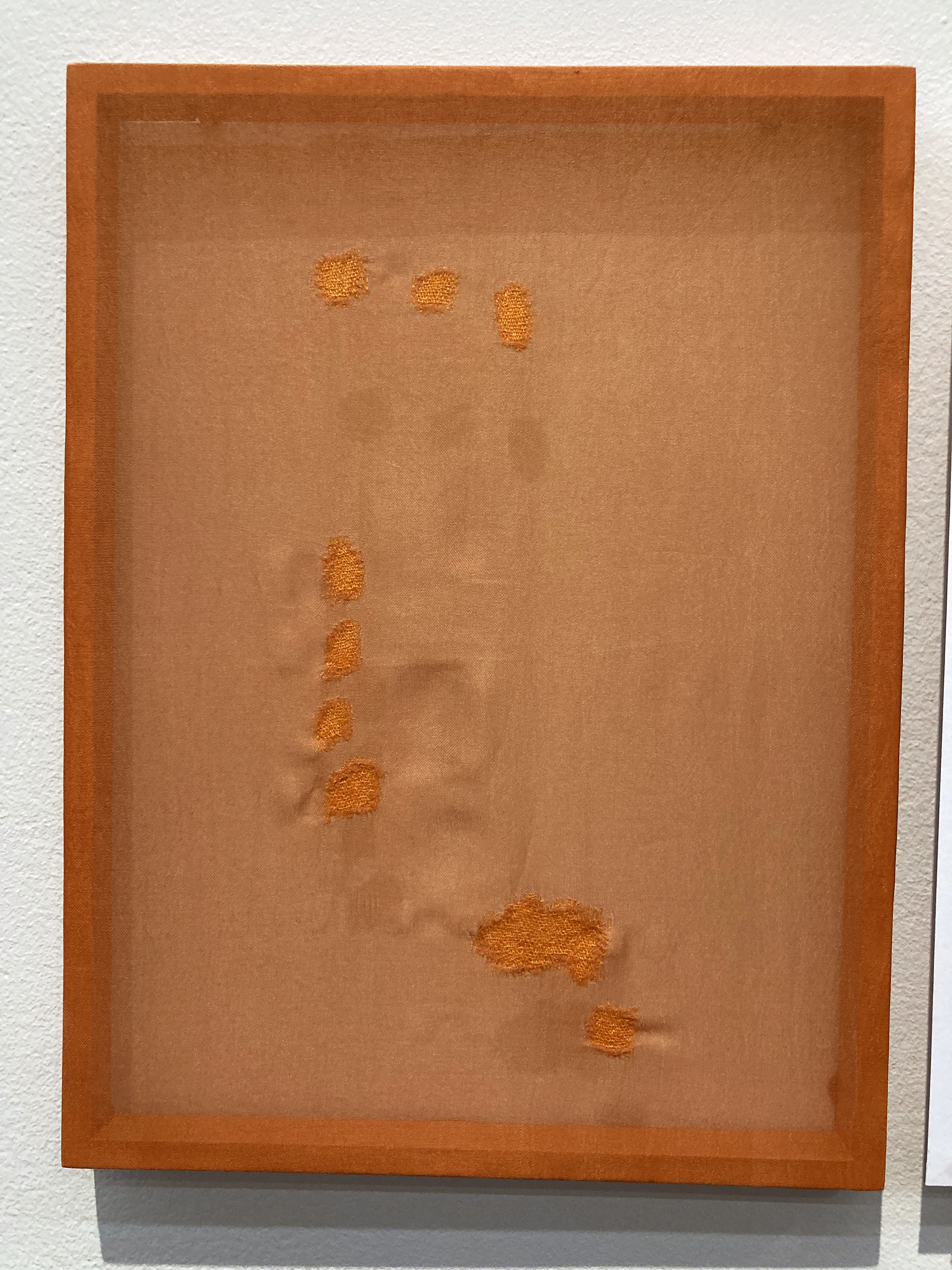
To reflect on this initial reaction, a quick summarising that has its routes in a previous modus operandi in fine art education, I was possibly thrown by that term emerging. I had too soon adopted an attitude that wanted to question and to advise this young artist. Arrogance, I know, but bear with me. My imaginary student might next have advised me to consider a set of other works displayed on the wall. These are from the Let me mend your broken bones series. In these works she has employed others to participate. Not in destroying but in making and mending by darning on medicinally dyed silk and implying a more positive attitude to life of preserving rather than wrecking. A female response – albeit embodied in hard reality.
Dana Awartani – Let me Mend Your Broken Bones

Initially the colour range might draw the observer to them, with attractive dyes of orange, red yellow and green. But get up close and we see a previously, a purposely, distressed surface that is fixed but permanently scarred. Paired paper panels display a text that records the scene’s recent history. The where, when, by whom, incident type and cause – listed methodically. Cold black text on a white background. Record keeping. Factual. Cultural cleansing is a term that terrifies and is certainly not confined to the Middle East. The interests, cultural background and broader context of an individual – such as an artist or any of the visitors to this exhibition – are always part of a much larger whole. This, of course, is stating the obvious. What may not always be so apparent or impactful is the fact that what might initially be considered as happening elsewhere, instigated by others, relates to our own history too. In a postcolonial age we now might think it’s in the past. Seeing this exhibition and letting it sink in for days after is sobering.

Dana Awartani – Let me Mend Your Broken Bones (text)

Standing by the Ruins is how Awartani operates. It constitutes an active positioning. Her work responds a little more quietly and contemplatively than a reactive, impulsive temperament might. The work acknowledges creation as a response to death and ruination; counters destruction with gentleness, positive even if piecemeal, literally re-making and mending. A slow and time-consuming process that is appropriate, for lives and lands are precious, and the relationship between each other and others can be far more accommodating of perceived differences. Hence the importance of landscape related themes in art from any era and of what is, and was, witnessed in various locations. So, if I might cheekily paraphrase a short statement from an essay in the catalogue* from the Impressions in Watercolour exhibition by Ian Warrell: “Turner had… contributed substantially to the transformation of perceptions of landscape subject matter…”

Dana Awartani changes our perception and understanding too.

Dana Awartani – Let me Mend Your Broken Bones

Geoff Hands, Brighton (December 2025)

* Essay: Nature raw or cooked: Approaches to Sketching in British Landscape Watercolours by Ian Warrell, published in Impressions In Watercolour: Turner and his Contemporaries. (Holburne Museum, Bath, 2025)

Links:

Dana Awartani

Towner

Arnolfini

Lisson Gallery

Goodwood Art Foundation

Verbier Art Summit (Youtube)

The elephant in the room?

Forms of postcolonial destruction continues today, aided and abetted by super powers to the east and west – even here in Brighton where L3Harris (the sixth largest defence contractor in the USA – and the world’s largest manufacturer of precision weapons) produces parts for the F-35 fighter jets used by the Israeli government to help destroy Gaza and the Palestinians living there.

Campaign Against Arms Trade

THE STOLEN ORANGE

At Bond Street Gallery, Brighton

15 November to 14 December 2025

“Poetry helps us understand what we’ve forgotten to remember. It reminds us of things that are important to us when the world overtakes us emotionally.” (Brian Patten)

Georgie Beach – Talisman 2025 and Brian Patten – The stolen orange

What might bring artists together for an exhibition? Well, a suitable space, a curator or three (who can contact artists already known to them) and of course, our Instagram community ready and waiting for a call up. Sarah Shaw, Hal Maughan and Anthony de Brissac present The Stolen Orange, inspired by the well-known Brian Patten poem, at a central Brighton studio space that has been turned into a gallery for the duration of this show. It’s a great initiative, particularly when suitable spaces are few and far between considering the significantly large community of artists and craftspeople who live here. Galleries are generally in short supply – although there is positive traction in the development of high quality exhibition spaces in the city with The Adelaide Salon, Kellie Miller Arts and Indelible Fine Art (amongst others) developing apace.

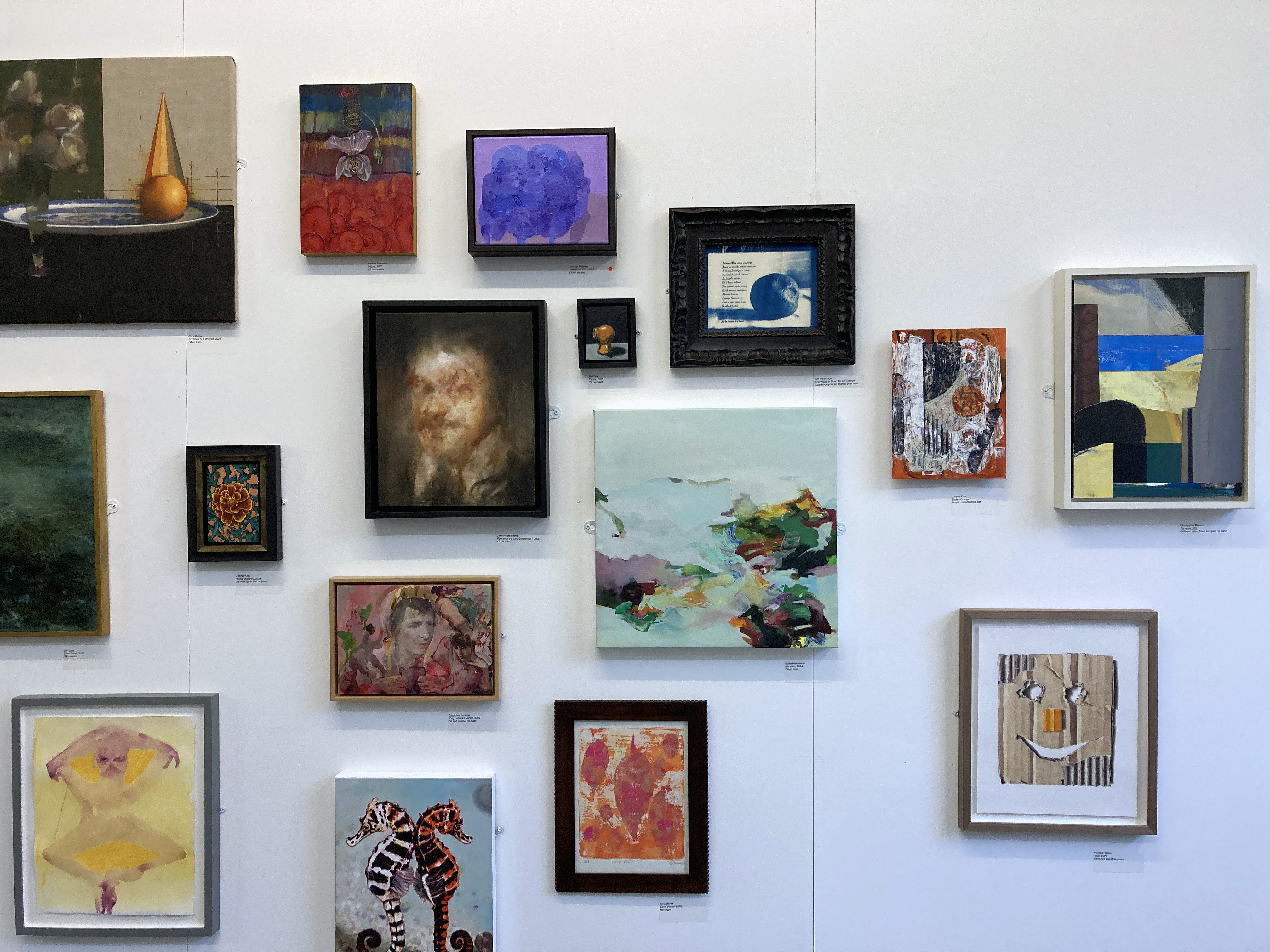
With the opening of The Stolen Orange clashing with the Anna Phoebe concert at the Hope And Ruin venue last week I was unable to attend the opening (Brighton is a great place for live gigs, by the way). In retrospect this wasn’t so bad as the event was fully booked and looking at the works on display – eighty or so – must have been challenging. So on a very sunny Monday lunchtime I took a break away from my Phoenix Art Space studio to recharge the visual batteries. This was a trip well worth making, not only for seeing several works by friends from the region, but for being introduced to some new names from near and afar. The installation was also very impressive. Poorly arranged displays can highlight the proverbial sore thumb(s) – but in this exhibition nothing looked out of place or clashed with unsuitable wall-partners. Figurative and more abstract works hung well together, and simple or more complicated and elaborate paintings (especially) commanded their own respective spaces. This was partly due to sizes not being too far apart with dimensions within 20 to 50cm in height or width, plus a handful a little larger or smaller. I also counted over a dozen 3-D pieces and a couple of videos – and the catalogue gave us two poems to take away, as well as the original poem from Brian Patten.

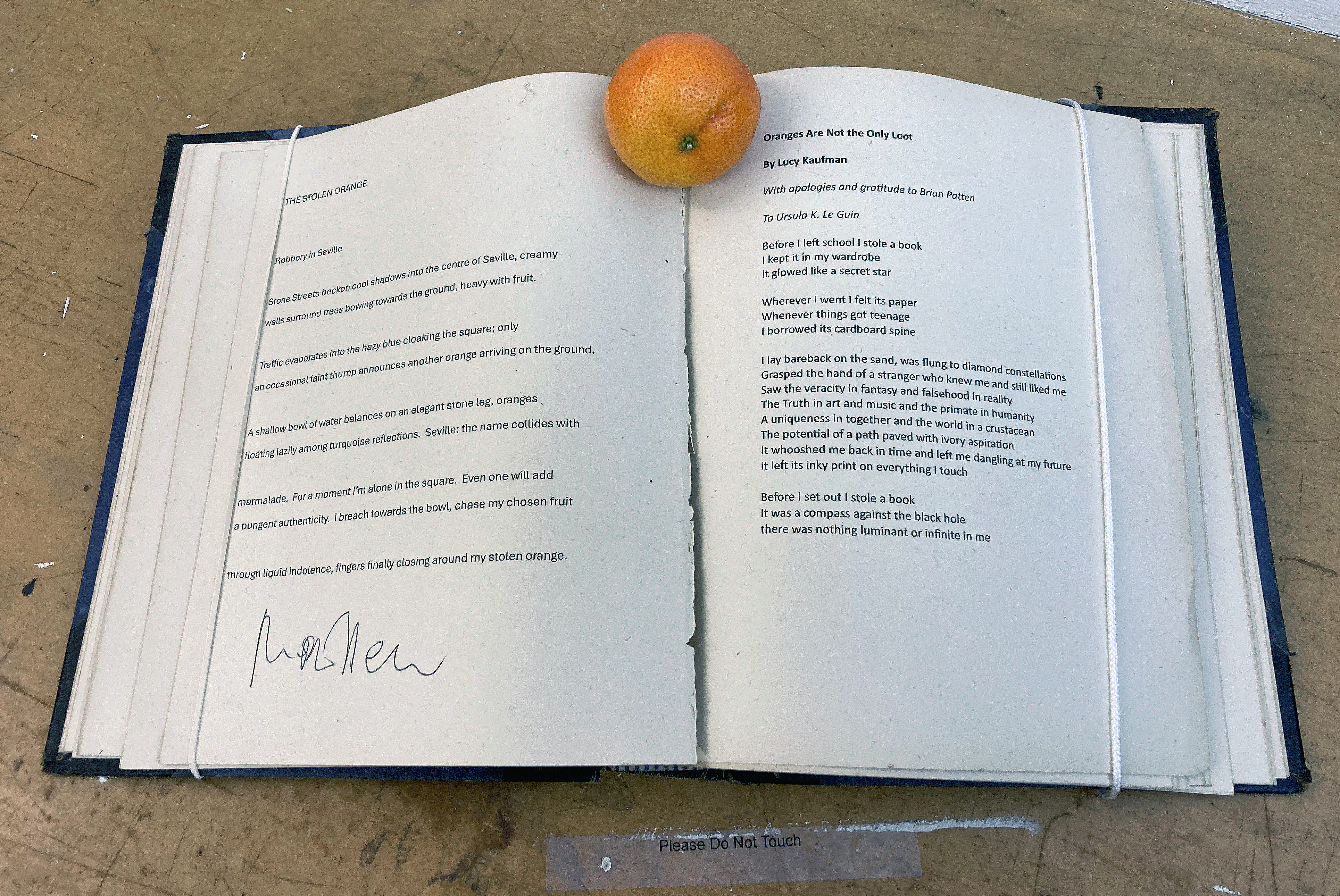
Mary Allen and Lucy Kaufman poems

Of course, the show was also held together in an organic aura rather than straightjacketed by any polemic. As stated in the catalogue the much-needed themes of joy and hope were intended as a positive theme to encourage a communion of spirit:

“Over the past few months, we have heard people talk of their stolen oranges as metaphors for something hopeful and totemic; something to hold onto.” (Hal Maughan)

The notion of joy as a positive and obligatory strength for the individual (artist or not) was also insisted upon for social cohesion:

“The exhibition reflects on how creativity can sustain optimism, humour, and connection in uncertain times, standing firm in insisting that joy isn’t optional, it’s necessary. Joy as an act of resistance. Joy as friction; a way to keep going, both with each other and for each other.” (The curators)

Carrie Stanley – I see the crescent 2025

Whilst walking back to the studio I pondered on the notion that a purist view of the visual arts (I plead guilty at times) to sustain a completely aesthetic independence for one’s work – unadulterated by ephemeral themes of the day – is nonsense. The content of this exhibition celebrates our many diversities and disparate interests. It’s what we share in common. It also keeps the memory of the amazing poem by Brian Patten alive. There is so much that is bright and special in the world.

Geoff Hands

Julia Williams – Türkis ist mein orange 2025 Diary

Note:

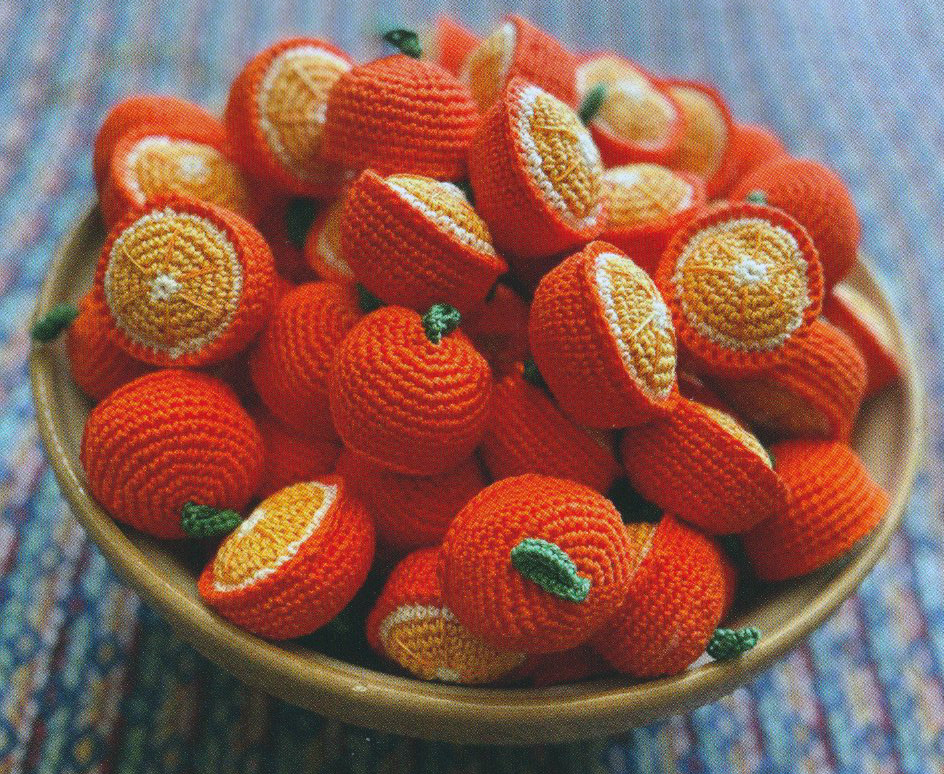
I have purposely not focussed on or highlighted any individuals from the exhibition, as there are just too many. I cannot feature all of the work here either, so please treat my choice of installation and specific artwork photographs as random. Although a special mention might be permitted for Phyl Callaghan’s fantastic cotton, silk and terylene oranges that are readymade for the pocket at just a fiver each – I bought a few for Father Christmas to distribute next month. I must add that there is a very well produced catalogue available from the gallery that features all of the participants’ work – and visit the website too.

Phyl Callahan – The Gifted Orange 2025

Links:

Bond Street Gallery

Brian Patten

Katya Adler and her daughter reading The stolen orange (BBC Radio 4)

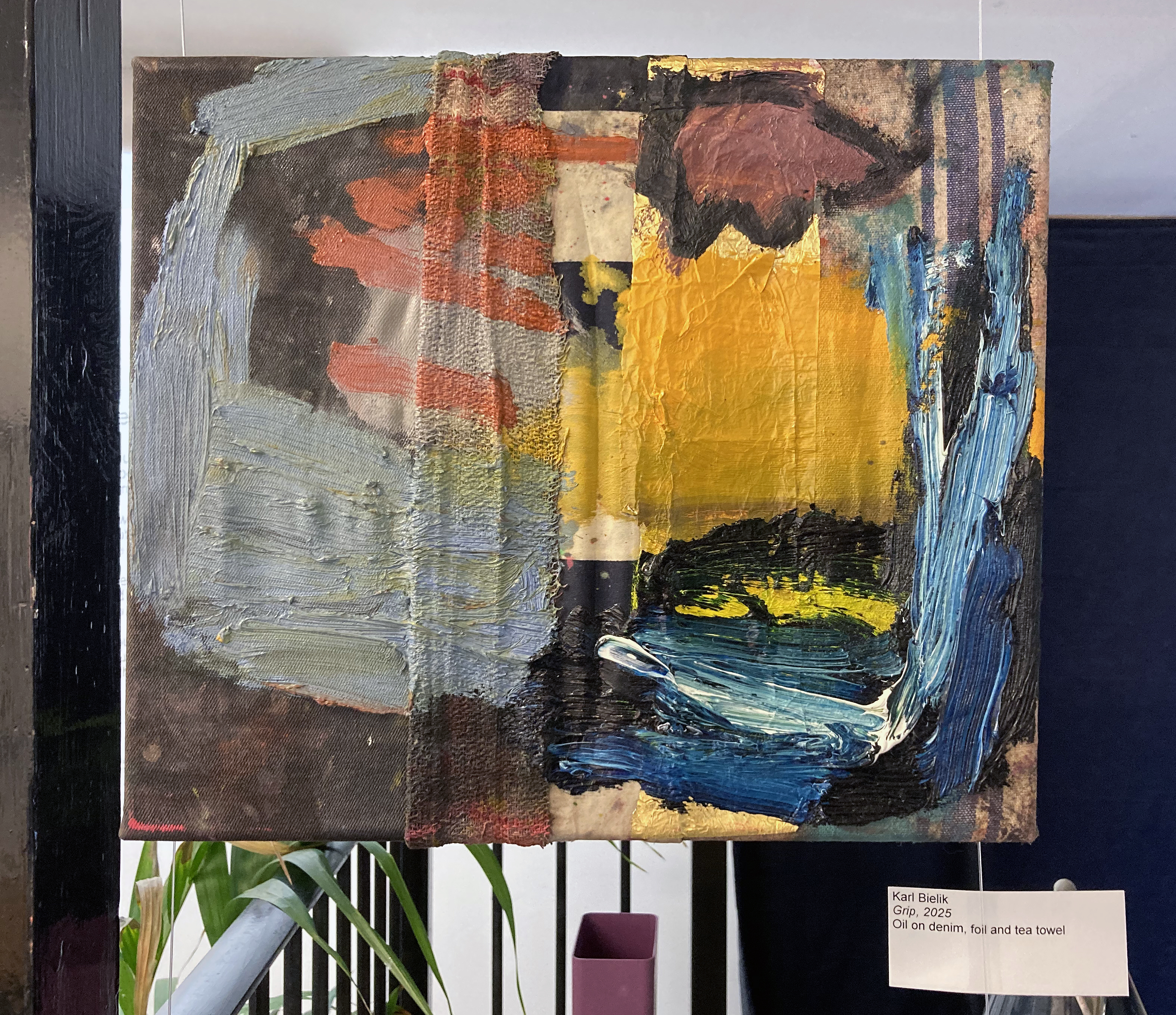
Karl Bielik – Grip 2025

ANTINOMIES: John Bunker: New Work

At ASC Unit 3 Gallery

15 to 24 November 2025

CRISIS, WHAT CRISIS?

John Bunker – Vampire Survivor 2025

Taking eight completed pieces out of the studio and re-seeing them, experiencing them afresh and re-contextualised in a carefully considered arrangement might be considered a luxury for some artists. But a room reserved for this purpose at ASC Unit 3 Gallery, a short walk from Bromley-By-Bow underground station, provides such an opportunity.

In turn, John Bunker has invited visitors to come and see the selection, thus creating an exhibition. Add the opportunity to visit his studio, just along the corridor, to see numerous works not displayed alongside works in progress is a real treat. But it’s quite informal and apart from stacking some chairs out of the way later on it’s ready for use. A stock of materials stored in readiness for creative activity over the coming months adds a little more depth to the whole experience of the visit.

Assorted works in the studio

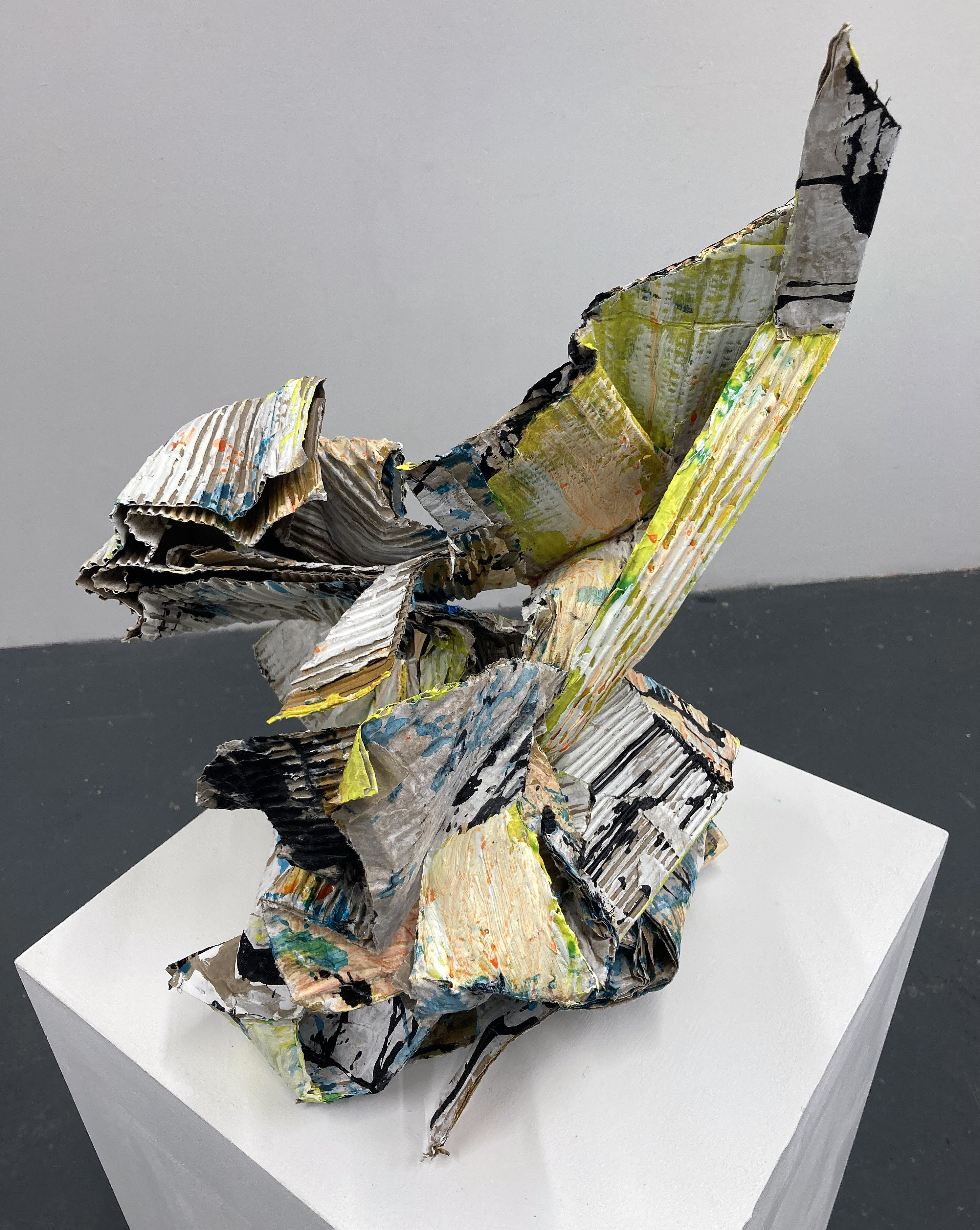
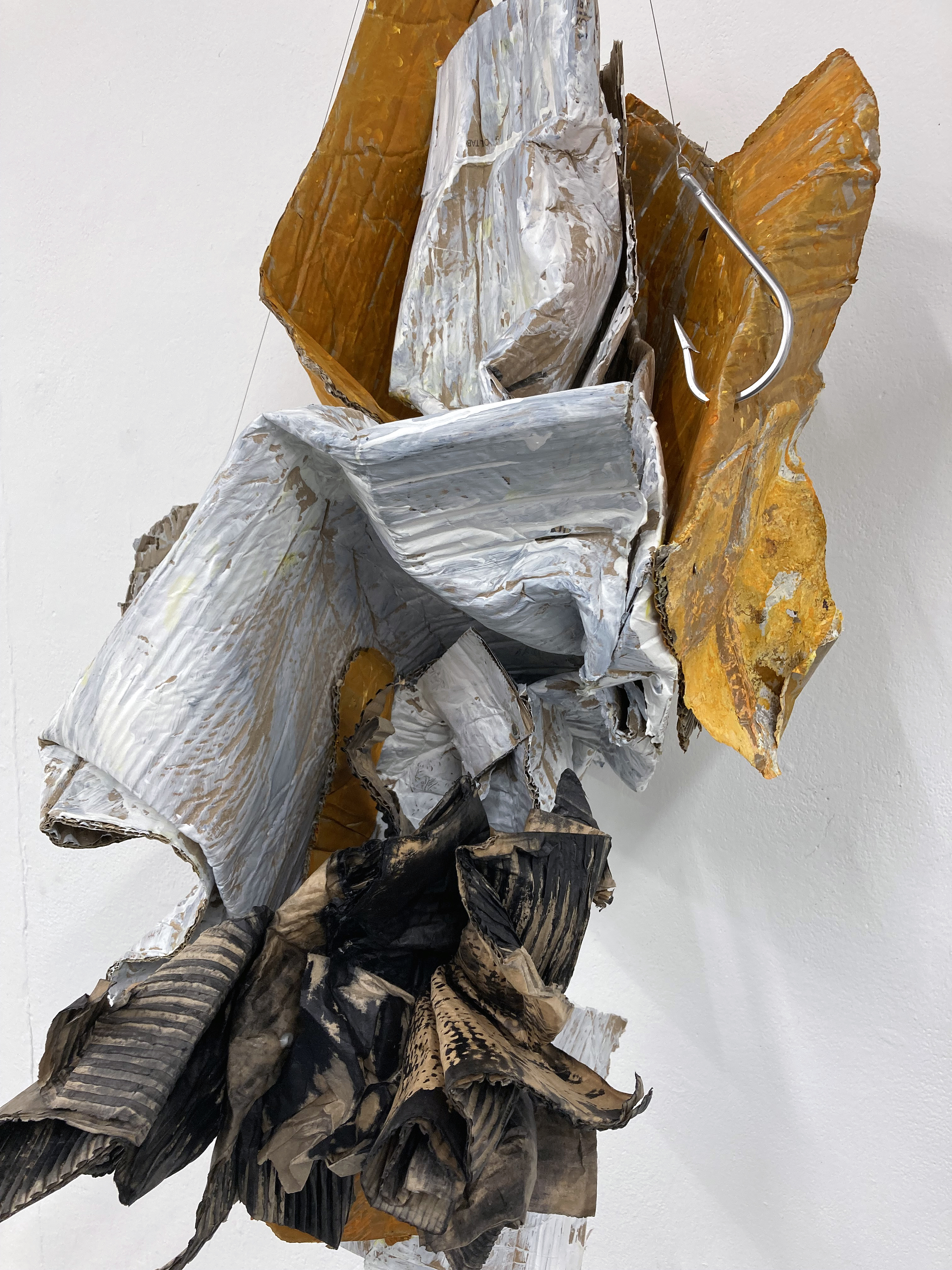
In both spaces the visitors can chat socially and also engage in responding to the works displayed. There is certainly an atmosphere of excitement and respect. Everyone seems well acquainted with Bunker’s oeuvre and it’s a compliment that they continue to come back for more. In current artspeak this is surely an interrelational situation. But it’s the actual works on formal display that truly matters today and if there’s a hint or nuance of hierarchy I get it from the four wall-hung sculptures that may turn out to be the precursors of what comes next.

John Bunker – Mithras 2025

I have been fascinated by Bunker’s work for the best part of a decade after writing about TRIBE. New & recent collages by John Bunker at Westminster Reference Library in 2016 for Robin Greenwood’s much missed AbCrit. A significant number of artists, particularly painters and sculptors, continue the exploration and development of abstraction in the UK. In Bunker’s case, he plays (seriously, that is) in both camps, as the exhibition leaflet explains:

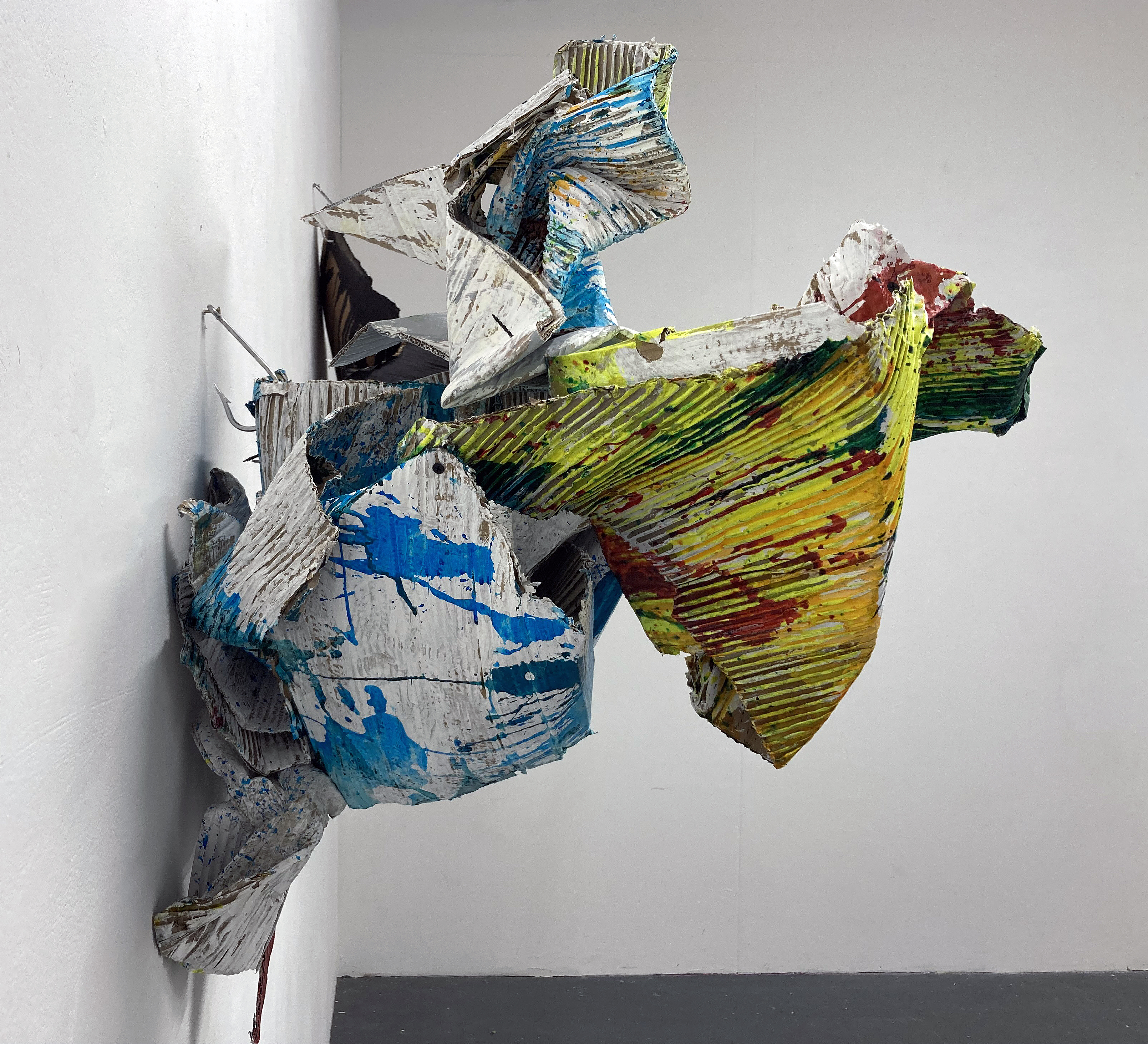
“Bunker’s abstractions are born of eccentric and paradoxical spaces that he has opened up between painting and sculpture. Known for his materially diverse approach to both disciplines, ‘Antinomies’ focuses down on cardboard. Bunker uses and abuses this ubiquitous everyday material by loading paint on its highly absorbent layered surfaces and, at the same time, engaging with it as a highly expressive sculptural material in its own right.”

This appeal, captivation, enchantment and enthralment with the phenomenon of a materially and visually based production of a cultural phenomenon we conveniently call ‘abstract art’ continues – despite the current expectation of a political correctness, a politicised demand from various quarters (including Higher Education), to engage with certain external convictions might blind the viewer to what the actual work contains, attains and demands of the viewer. Which, I guess, is my too wordy way of saying just look at the work! It is kind of purist, sure, but this is the real thing, in front of you – which maybe there is not enough of as we visually consume the (constructed and ready-made) world via the screen.

John Bunker – Rausch II 2025

Fellow painter, E.C. made an impassioned comment on her Instagram account after visiting Antinomies as:

“An antidote to the absurd, bloated gluttony, to the slick gallery shops and to the often frantic, frenzied and disinterested ambitions that can try to batter the life out of making… The kind of making that is about (to my mind) necessary and unfurling change and movement and not an efficiently quantifiable, capitalist product. Than goodness for this.” (EC 2025)

And added:

“I was thinking about the relationship to the wall and painting with some of these works and how they seem to occupy a cusp… slipping in and out of categories… imagining some sliding off the walls onto plinths or the floor. Where do things belong? Category crisis? Excellent!” (EC 2025)

In consciously looking at these works, most especially the wall hung sculptures and the two works on plinths I was captivated too. Comments from fellow viewers enforced this individual and collective sense of how engaging the new sculptures are. The eye/mind submerges into small spaces, pulled along by subdivisions of form and mass. Little distances, ins and outs, that pertains to the actual environment always in and around us. The paint is as much part of, as well as added to, the cardboard structures. The application is deliberately unfussy, hinting at the unpainterly but suggesting a conglomeration of parts or identities within the sculptural forms through the colour changes. There are dimensions that appear solid and still, but if you are in the zone, generate a sense of implied movement to quicken and invigorate. Are these works dedicated to physicality and consciousness? This is joyous and I wonder why. Is there not enough time? Get on with it, Bunker appears to be saying. Let’s make, share, manipulate and engage with materials in the world before we leave. So, yes joy, utter joy.

Geoff Hands

John Bunker – Sculpture FUR/FLA/FLE/BIS 2025

Artwork images © John Bunker

Studio

Links:

John Bunker on Instagram

AbCrit

E.C.

Flowers Gallery Artist of the Day

LOUISE BRISTOW/RUSSELL WEBB: and other trivial matters

Gallery Dodo, Phoenix Art Space

26 April to 8 June 2025

THE PERSONAL AND THE POLITICAL

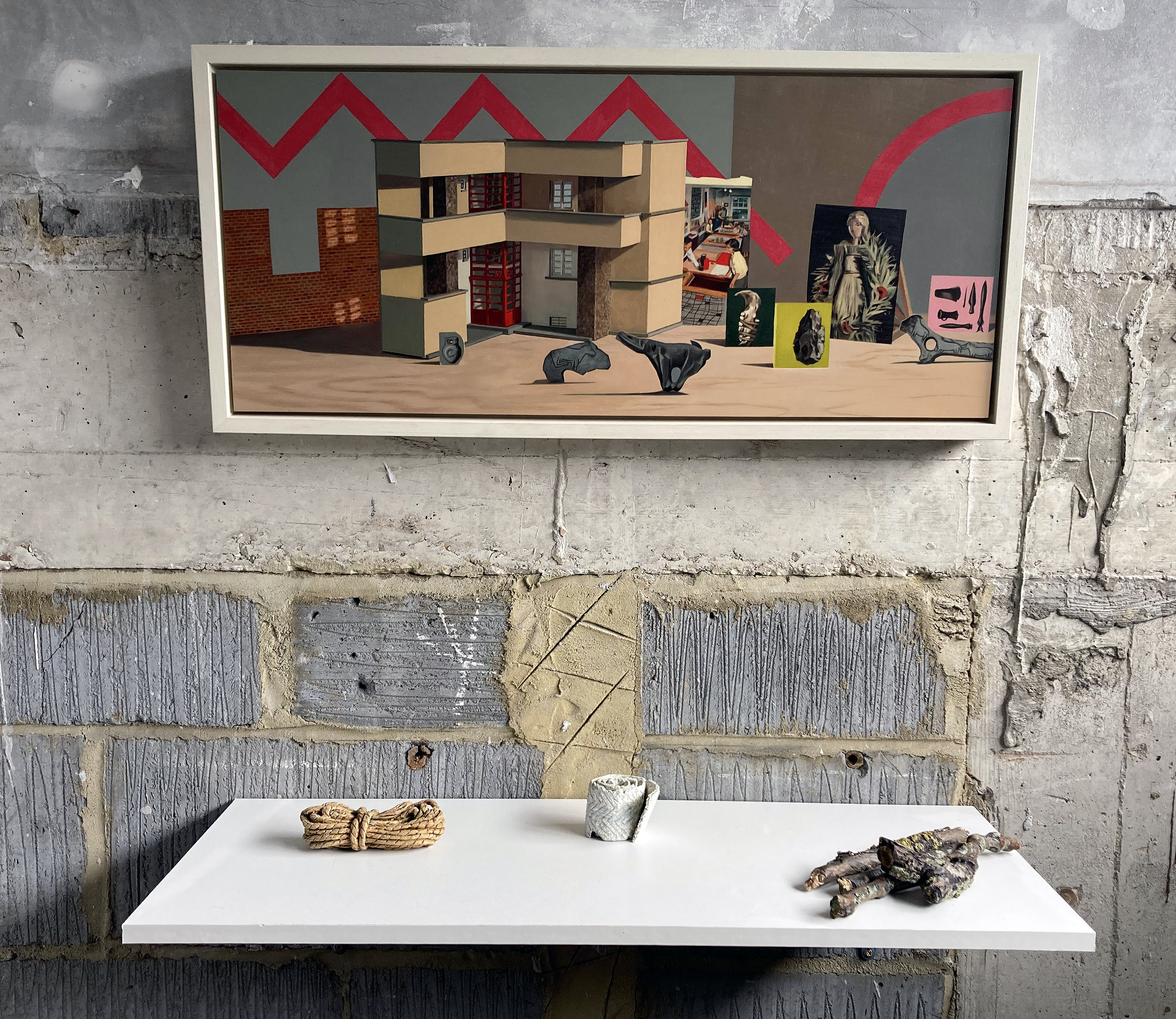
If you are already familiar with the artwork of Louise Bristow and Russell Webb you will know how fastidious they both are in the craft of their art making. Their respective and uncompromising working practices demand scrupulous attention to detail and full command of their chosen materials, processes and subject matters. I had not previously considered their work being shown together, but here they are in and other trivial matters at the Gallery Dodo in Phoenix Art Space. The results are impressive, not least because they have installed their work in complimentary fashion without either dominating the other and with a careful juxtaposition of contrasting imagery and objects. The works link under a broad still-life categorisation with the small (life size) sculptures sitting comfortably with the reduced scale of painted objects depicted in the paintings. As is typical of the still-life genre the imagery can be as straightforward, or as loaded, as the artist intends and the viewer is able to interpret.

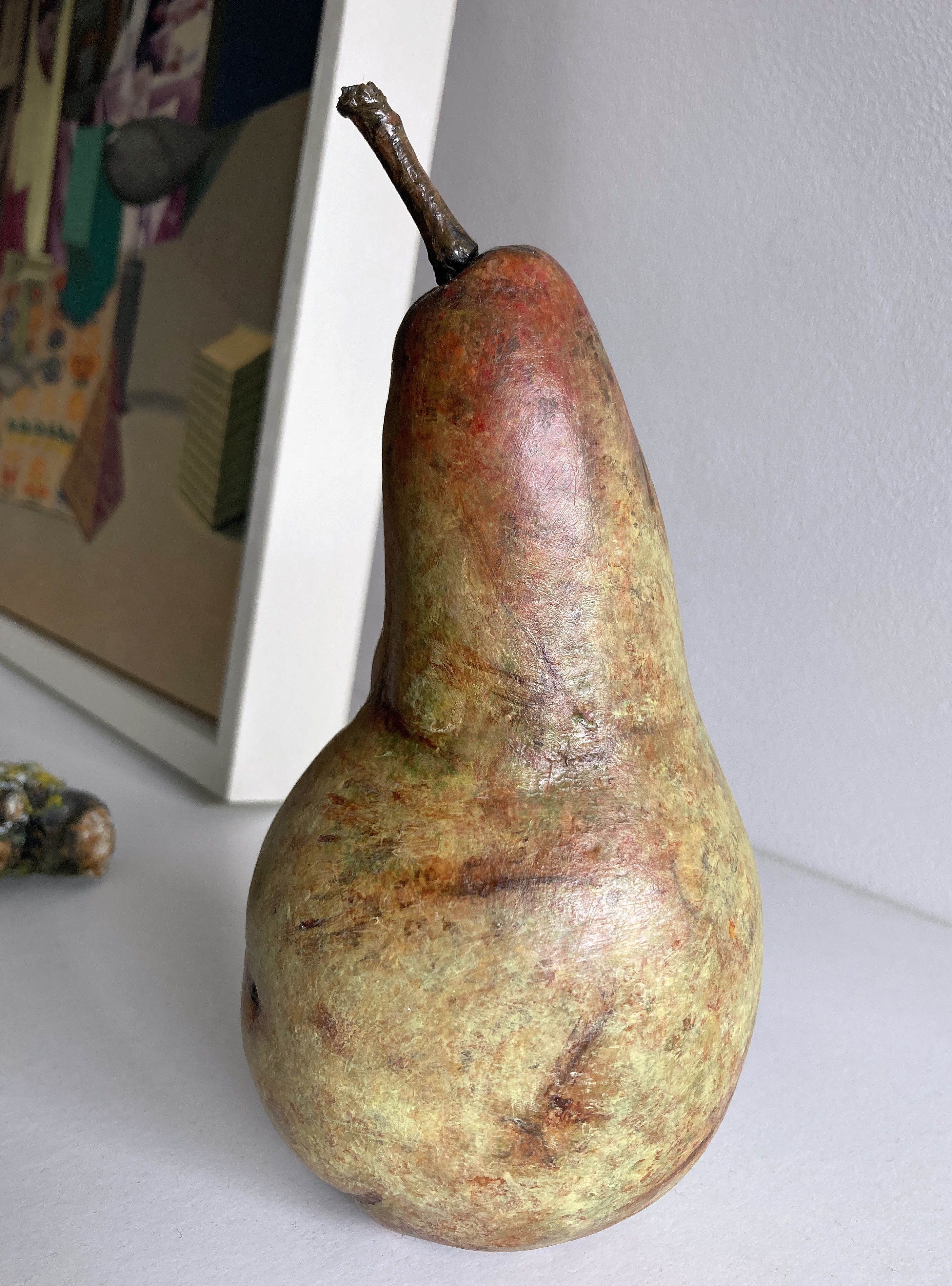
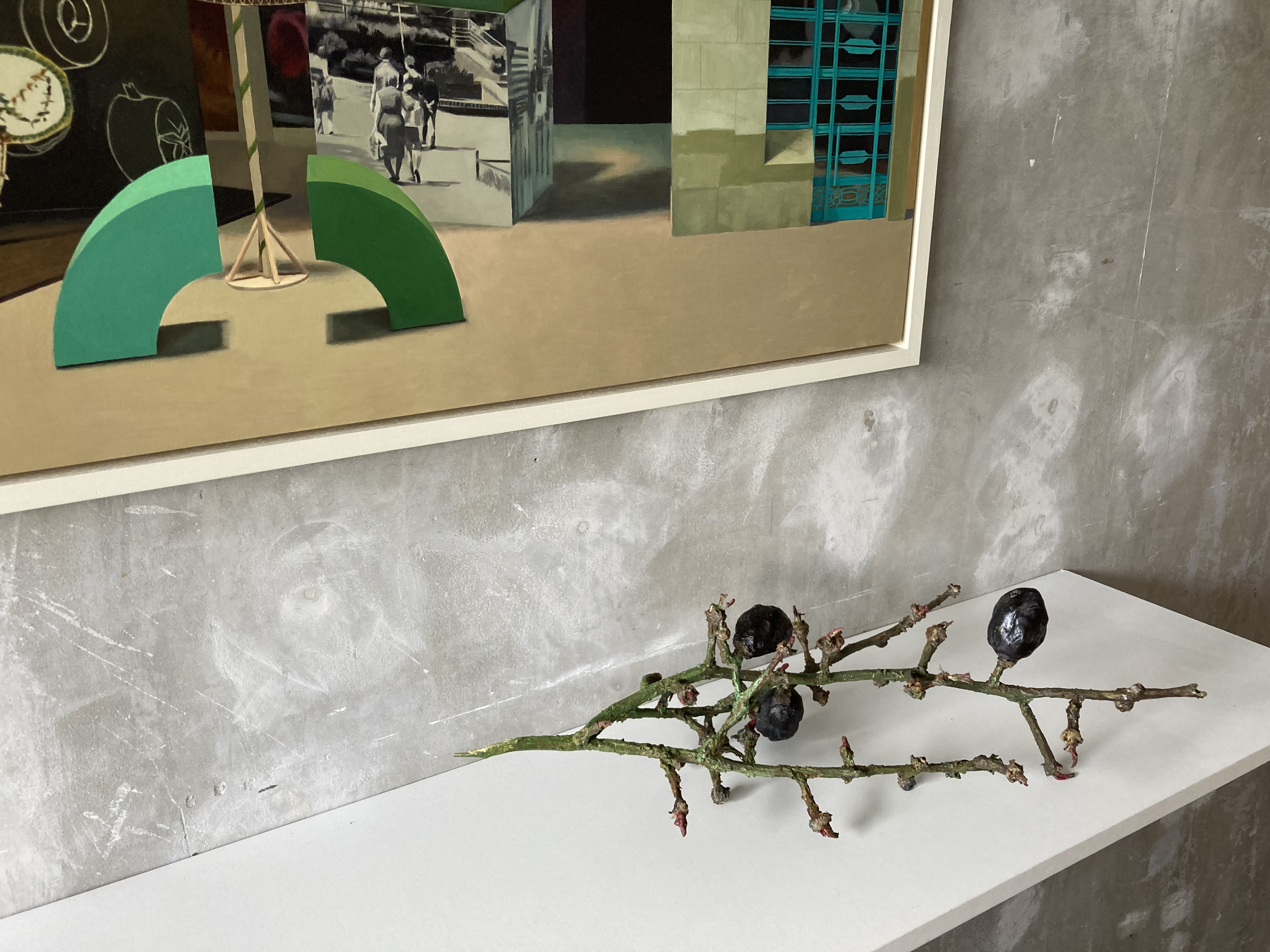
My initial visit to the exhibition was hurried and fleeting as I had my own studio to get to at the recent Phoenix Open Studios weekend for the Brighton Festival. A few days later I was able to return to the space and to peruse the contents for as long as was necessary. But that first fleeting visit was surprisingly useful, for a stick had stuck in my mind. This was Russell Webb’s Stick Surgery (viii) to be precise. For when is a stick not a stick? When it’s a (found) curtain pole, with sawdust and acrylic paint applied, of course. But when this combination of materials is transformed, or re-naturalised, into an object/ornament that you might display on your mantelpiece at home you must remember not to be deceived and put it on the open fire – or you will have lost a sculpture. Why the mantelpiece? Well that’s where one might typically display a found object from a countryside walk. An objet trouvé become perdu (holding aesthetic value) – maybe with a hint of the wabi-sabi aesthetic. But it’s not a found object; it’s a sculpture, I dare say, of the unmonumental category. So whilst it references the natural and the everyday, the quotidian in contemporary artspeak, as a designed or constructed object it may have a different sense of value to the found object. At which point I am getting confused between any old stick and the one that the artist has made. Is this his intention?

A mental fixation on just one piece of artwork encountered at the start of an exhibition is rare in my experience, as I have a habit to scan for an initial impression and to have a walk around to acclimatise myself. But as the Gallery Dodo space is relatively small, and I was pushed for time, this particular example of Webb’s selected pieces caught my attention first. Of course, in contrast to noticing this one individual item, I was also aware that, in a sense, the whole room was full of objects. In addition to the thirteen three-dimensional objects displayed on four shelves there were over forty still-life items represented in the four paintings. A return was clearly required.

Sitting in the Dodo space on my own for a private viewing a few days later was immediately quite calming. My inclination was to just relax and look, scribble a few notes as preparation for this review, and try to dismiss personal expectations. Simply respond to the physical content before me. Whenever I look at Louise Bristow’s paintings I slip into a state of calm anyway. They are so quiet, not even a hum emanates even if the imagery, a painting of a photograph perhaps, suggests a particular soundtrack from the contextual content. But this is not a display to sit and look at from a distance. It is imperative to stand up and move closer to each of the four groupings of an individual painting with various sculptural forms arranged on a shelf beneath the image. Both sets of work invoke an admiration of how they have been painted. In a sense, they are super-realist – though certainly not photo-realist. Webb’s sculptures might be termed as object-realist. They are utterly convincing as being the real thing, such as the orange peel or the piece of string. There is a common factor of the discarded, damaged or moving beyond some notion of a perfect state (e.g. Venus Figure – a slightly over ripe pear that appears to be tottering in terms of balance and tastiness) in his selection of reproduced items. They might typically be found in the kitchen, the garden shed, on the street or from that aforementioned woodland walk.

His titles are fundamentally important too: Lost Memory (a knotted length of material), Little Victories (two successfully removed orange peels that each remain as one piece of skin), or Family Tree, a broken off twig with three shrivelling berries remaining and the slightly spiky and pointed receptacle bases of the original flower where the missing berries developed. The titles can be nostalgic, jokey or deep. Aspiration (Manet) might reveal the aspiration of the young art student or the long-standing ideal of the older painter. His titles certainly guide the viewer towards a particular thought or interpretation.

Bristow’s titles are also loaded with possibilities of analysis and exposition. There is also an element of nostalgia in the mid and eastern European and Soviet imagery where (for example) education, high-art, architectural design and social housing meet political idealism. On a formal level, the figurative-realist visual language of Bristow’s paintings appears to invoke that notion of apparent ‘reality’ that might align with objectivity. The People’s Forum, Red Vienna, Common Market and Playground are titles that certainly suggest further reading and investigation. But here, as paintings, and as objects, they invoke speculation and demand time for thought, probably over a long period of time. By implication, as observers of ‘art’ in a gallery, we might by extension question our own society today and critically consider our received political and social ideals and inspirations. But let’s not go down that rabbit hole now.

If one of Webb’s sticks remains in my memory, the image from Bristow’s paintings that stays with me is a section in the top left quarter from The People’s Forum that is a torn out page from a book or magazine. It re-presents a black and white photograph of a small group of young school children. Three of the four kids hold up their paintings for others to see and admire. The child (a girl?) in the top left corner of the composition looks at the photographer, and by extension us the viewers, so many years later. We might wonder who this person and the other young people were. What did they go on to achieve later in life, where did they live and what society were they were a part of. An objectively painted image (a reproduction) of a non-digital, black and white photographic print earlier reproduced in a physical publication might, semantically, become very subjective of course. It would also be a mistake to distance this image from the rest of the composition, visually engineered by the artist.  What are we to make of another image of older (but maybe relatively young) people holding up small books? A few figures in the foreground are in focus with an out of focus background suggesting another photographic source, albeit in colour (maybe suggesting a later historical date than the aforementioned black and white photograph). Is that a sheet of wrapping paper on the tabletop? Does it introduce an element of nostalgia? What are those three-dimensional, architectural or modernistic objects doing there? Is that an ‘abstract’ type sculpture placed in the centre of the composition? None of Bristow’s compositions look random, in terms of content or compositional spacing. From the history of art, Piero della Francesca, Clara Peeters or the multi-talented El Lissitsky could well have inspired and guided her development as a painter – but she creates a voice of her own in the context of a politically complex world.

Physical objects (material culture in Semiotic theory) are inevitably reconstructed and interpreted by the artist and the observer, in this instance via the still-life repertoire and the notional gallery space that Louise Bristow and Russell Webb have all too briefly occupied. A sense of the personal and the political shifts between and within these works. As an audience we might question what visual artists do, and how they do it – especially the painters in a digital age. Biased as I surely am, seeing 2-D and 3-D paintings as impressively skilful as these, I sense an argument for the continued relevance of painting that both references a deep history and provokes or coaxes the imagination of the viewer. There may be more to this show than meets the eye. Where’s Duchamp, when you need him…

Geoff Hands

Links:

Louise Bristow

Louise Bristow on Instagram

Russell Webb on Instagram

Gallery Dodo on Instagram

Phoenix Art Space

Homework/further reading Daniel Chandler: Semiotic for Beginners

GRANT FOSTER: Home To My Teenage Bedroom

At Phoenix Art Space, Brighton

1 March to 13 April 2025

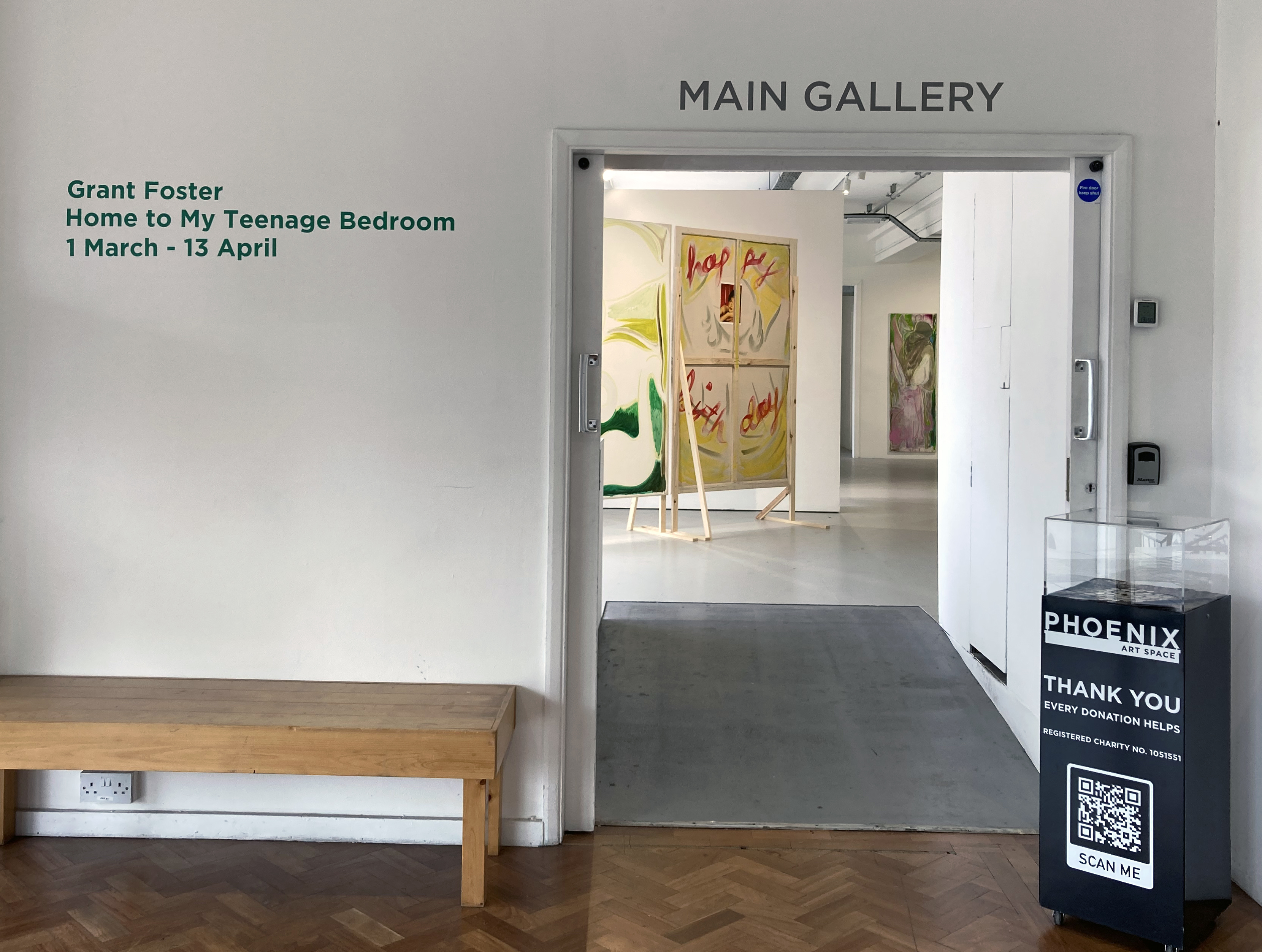
Often the best paintings, literature, music etc. take time to come through. The first impression may well be the one to not give too much credence to. A degree of complexity in any art form deserves a period of further thought. After five or six visits to Grant Foster’s exhibition at the Phoenix Art Space I know that I need to look again and again. This is good.

Q. What do you think about when you are looking at an exhibition of paintings?

What is the mind of any onlooker doing? Searching for something recognisable? Prepared and preconditioned by our shared culture we might be expecting something general or commonplace, such as a human figure, a landscape or objects constructing a narrative as a way into the work. What, potentially, could these visual references add up to? What might the storyline be, if there is one? And if the narrator/artist is describing something, making a serious statement or spinning a yarn, can you relate to the theme? Alternatively you might be more of a formalist with an eye for the aesthetic hit. The purely visual, via systems or improvisation, might be your thing. Either way, so-called content can be very complex or minimal. Of course, if the exhibition has a title you are already geared up with some expectations. Home To My Teenage Bedroom sounds perilously loaded.

There may be some idealised notion of preparing to see an exhibition as objectively as possible with the mind emptied. Ideally the extraneous thoughts of those other aspects of one’s life are put aside, at least for a while. It may be an artificial approach, but imagine entering a show with a mental blank slate. No preconceptions or expectations. What is experienced afresh? Nope. This is just not possible, or even desirable. Our various histories create our personalities (however flawed or enlightened) and enable a personal take on what we see and understand. In the case of this show we might consider that that teenage past was an under investigated portal that might throw some light onto who we became in adulthood. Grant Foster acknowledges this potentially rich period of life in a wall statement:

“It’s often said that our teenage years are the most decisive – our interests, obsessions, and passions are innocently formed and planted like seeds, taking root over time.”

But without any foreknowledge beyond the title of the show, visiting Foster’s exhibition at the Phoenix Art Space initially left me more impressed with the thoughtfully and dynamically prepared arrangement of works by the artist with the new Phoenix Art Space curator Laurence Hill, than with the paintings. I made no connection with the content, despite knowing the title of the show. I was surprised and sensed that this was a body of work requiring more viewings. In retrospect I guess I was a little overawed by the presentation. But I sensed that a few visits might be necessary, if only because my thoughts were probably too elsewhere – especially at an opening event that was extremely well attended as the crowds flooded in for three painting exhibitions under one roof.

Grant Foster – Nature V. Nurture (2024) Help (2023) back and Psychiatric Hospitals, Full, No. 3 (2020)

Back home at the computer keyboard I recalled my first visit, and an all too brief second pop-in the next day, by describing, albeit generally, those initial impressions. The earliest typed out observations prompted the following text:

The visitor very much walks into this exhibition. Into a structured, planned space – but not forced, obliged or coerced to travel in a particular way. This installation invites a weaving, walking, stopping and starting, slow dance in, around and even through the works. In the large main gallery the majority of the fifteen paintings are free standing, fixed on wooden structures that are equivalent to the human scale. Some have vertical poles, like spines, attached from floor to ceiling to prompt the visitor to actually touch the work of art and to carefully turn it around, thereby opening a door of sorts and changing the arrangement where, in two instances, accompanying canvases are set up next to each other as a triptych…

Grant Foster – St Francis (To the Stars) (Matter without Hierarchy) (2024)

But I was clearly missing so much more. On my third visit I found myself tuning in to the echoes of the art historical that, generally, permeates all contemporary painting. Plus, the painterly visual language and the way that Foster generally draws with the paint media – perhaps as an expression of his personality – was immersing me into the imagery. For example, in the four St. Francis paintings, representing statuesque Giotto-type figures that are placed as two separate implied diptychs on the walls, the paint application is fluid and almost shorthand. The figures have turned away from the viewer. Are we to follow – through some kind of portal? Then there is evidence, no more than implied, of other figurative content. A cat in one composition and a swan in another. There may be some wings too and a building type passageway where there might otherwise be legs. Is there a rural environment too, with a little taste of landscape beyond? The uncertainty must be deliberate.

Grant Foster – Nature v Nurture (2024) rear

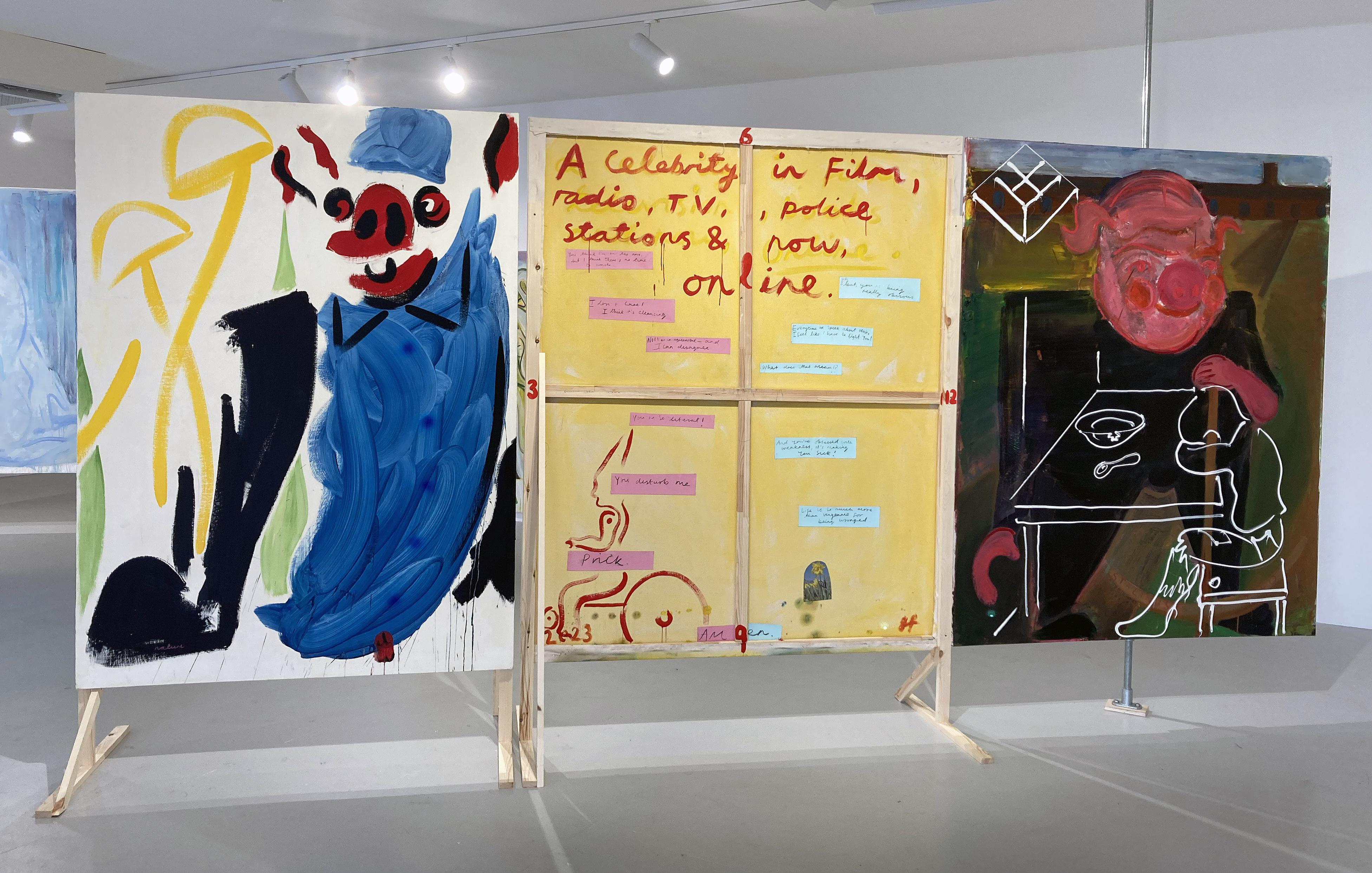
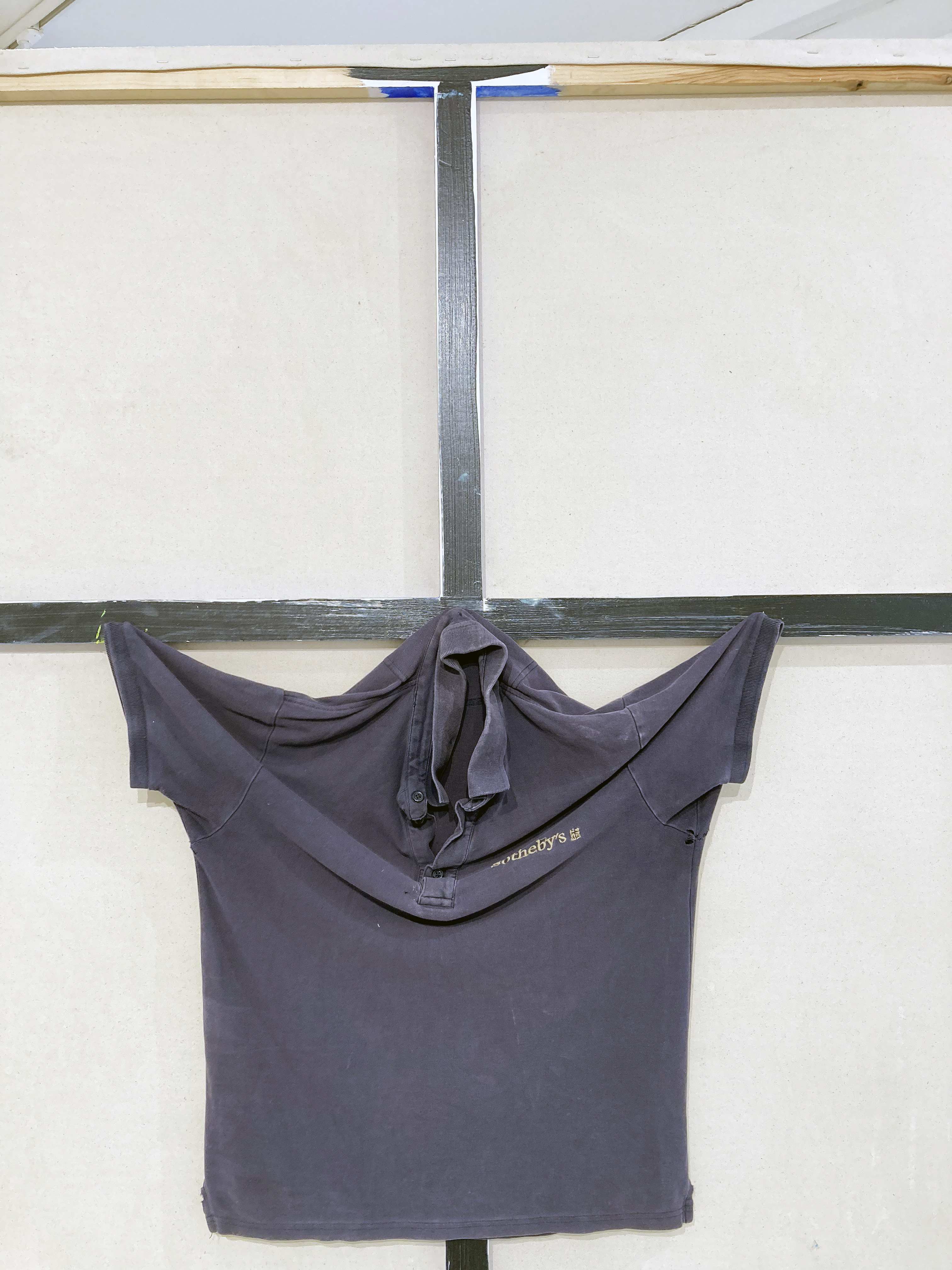
Another art historical reference might be the Sotheby’s work shirt fixed to the reverse of one of the freestanding canvases, Nature V Nurture, to suggest the Crucifixion. Perhaps I am reading too much into this, but others have made the same conclusion. On the front of this canvas a cartoon-like figure dressed in blue, but with red and black facial features appears animated by what might be two large yellow (psilocybin) mushrooms. This could be a retrospective self-portrait. It may not matter. Already, external contexts (facts or fictions) are expanding the reading of the works, even if I am mistaken. I am thinking again about the almost sketchy way that Foster applies the paint. In some of the works, many of them in fact, there’s a slightly underworked feel to the painterly execution, as if too much effort is to be avoided. This equates to a notebook-type intention, a formal device, which I interpret as a reference to a way of thinking and to the nature of mental recall. Events of the past, however strongly remembered or not, become a form of visual shorthand. Yet two canvases in particular stand out as comparatively overworked (even if they are not). These are Psychiatric Hospitals, Full, No 3 and Queendom which are each a part of two different floor-based triptychs.

Grant Foster – Nature v Nurture (2024) front

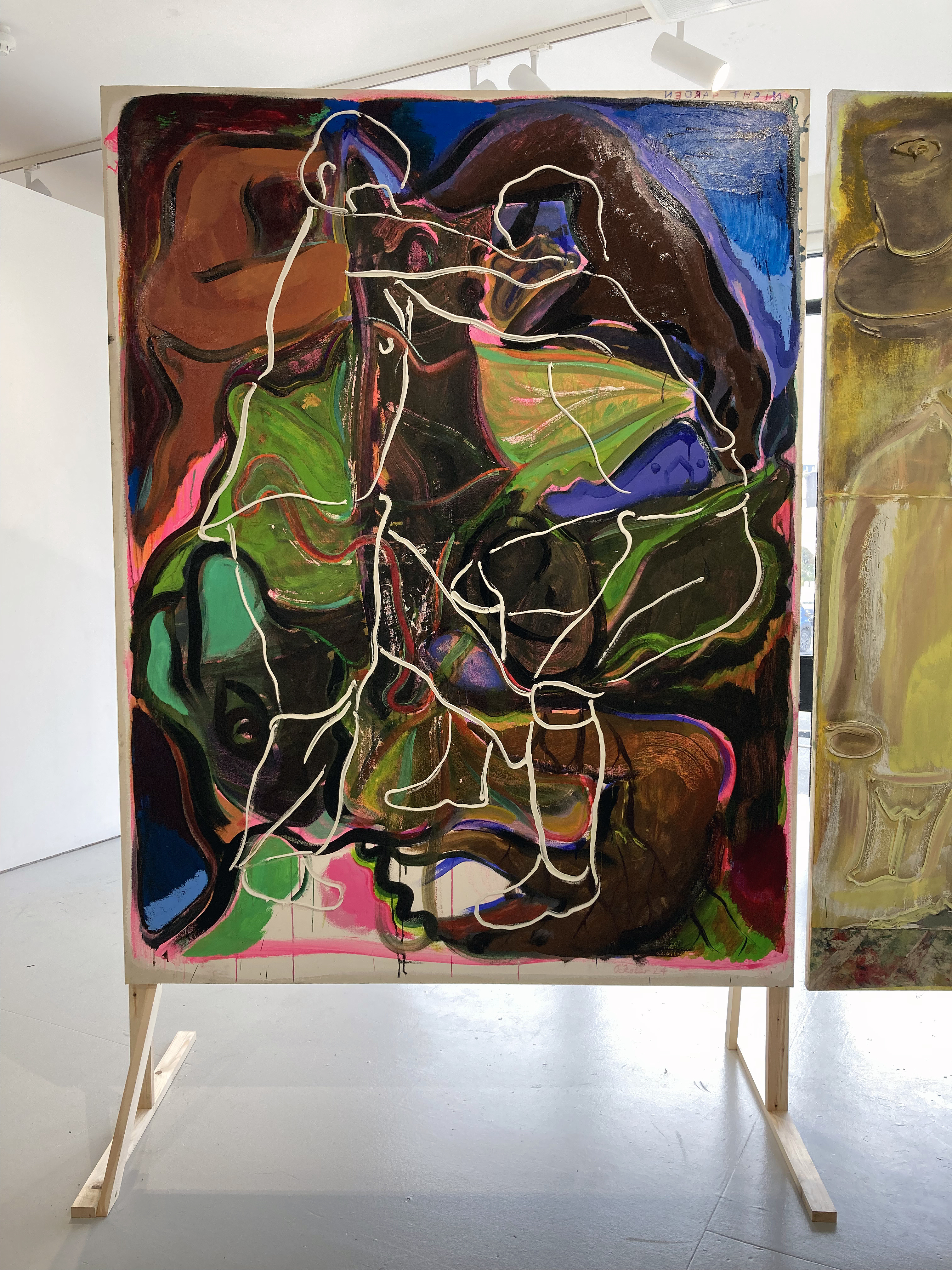
Each of these compositions appears quite different in subject and imagery. The former depicts a building (the hospital?) in mid-distance with a bloated pig-like character in the foreground, stood behind a table where a sad child sits with a discarded spoon and an empty bowl. In the latter, foregrounded figures appear to be involved in a judo move. Like the boy and table in the other painting these grappling forms are created with a squeezing out of white paint straight from the tube. Despite the two contrasting painting styles this incongruity works.

Grant Foster – Queendom (2024) front

Queendom is the more complex, visually loaded image. Over time the observer will make out other forms including a naked figure in the top left corner (which reminds me of figures from both Titian and Matisse); two animal forms (formerly cartoon characters from a childhood comic book?) and even a flat smiley face symbol, albeit with a nose, just below the centre of the composition but in shadow. I am sure that there is more here to emerge from a ghostly, shroud like confusion that threads throughout the composition. The looking experience is truly durational, suggesting that more could well emerge.

Grant Foster – Rat King (1576) (2024)

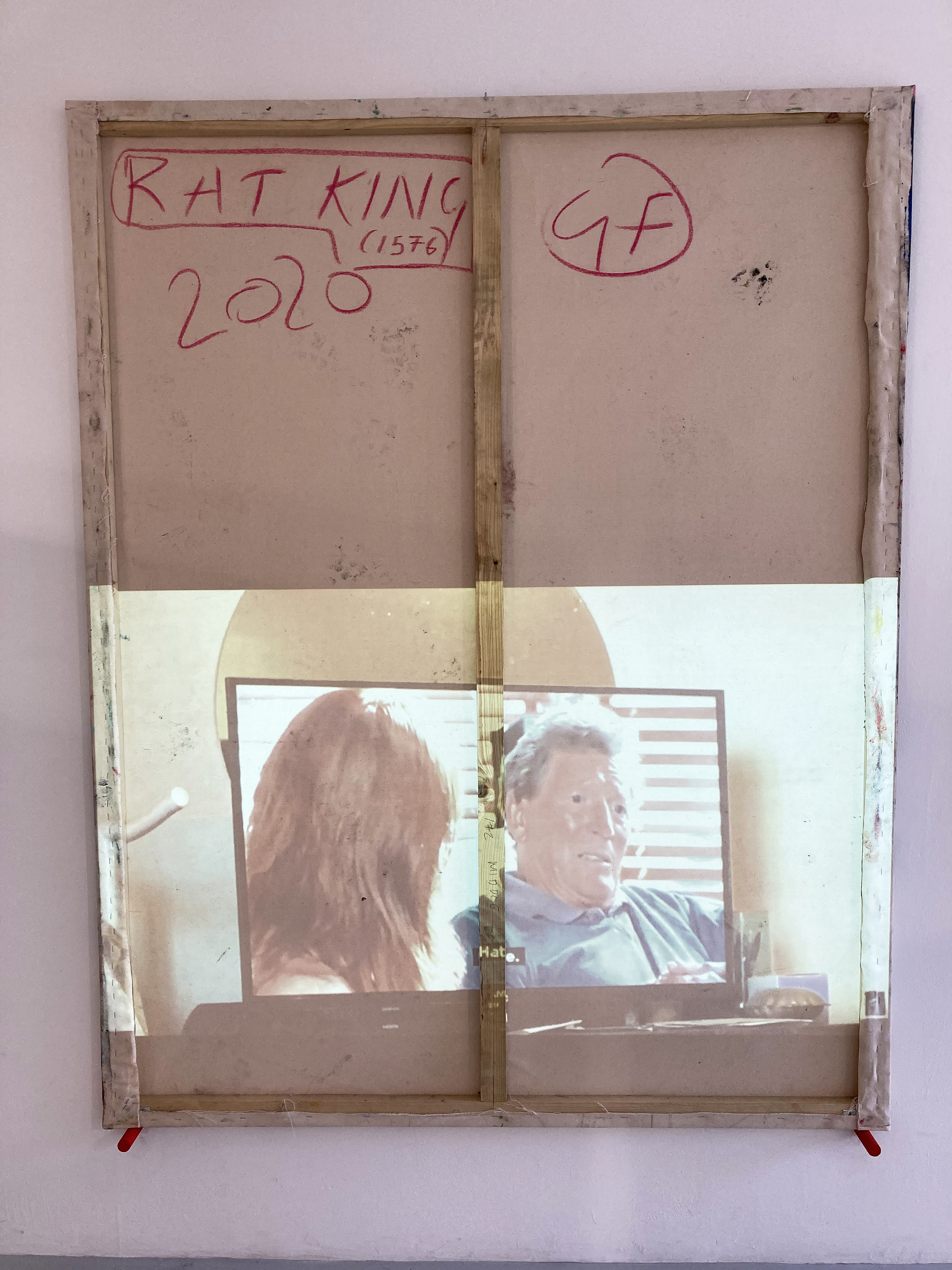
On this time-base note Rat King (1576), which has the de facto front pressed to the wall, adds a digital layer provided by the projection of the Telly with Mum video repeating every 43 seconds. This small element of the digital might be a pointer to future developments in Foster’s work – or a remnant of a past engagement with the once trendy art college digital projections that can be somewhat passé. But the projected content does provide a moving image element of collage that references watching television, which was the precursor to the computer screen and now the mobile devices that cling to our hands like an extra organ, back when Foster was a teenager.

Which brings us to a literal emergence: the backs of the paintings. The majority of the works have backs to be viewed as additional fronts, which will be an interesting challenge for collectors of Foster’s works. The convention of writing a title and adding a signature on the reverse of the canvas is developed from what might be seen as the private space (like a sketchbook or a notebook) that actually wants to be quite public. With the further addition of painted imagery, photographs and extended text, they are clearly beyond being auxiliary or supplemental to the conventionally expected paintings made on the front of the canvases. The stand out rear view to me was on Help, which included a small printed image of a daffodil, a painted pixie-type figure riding a bicycle, a possibly alternative title (‘A celebrity in film, radio, TV, police stations & now online’) and a conversational collage of hand written text that was a recalling of a conversation between the artist and his partner. Foster’s jokiness feels deadly serious.

Grant Foster – Help (2023) reverse

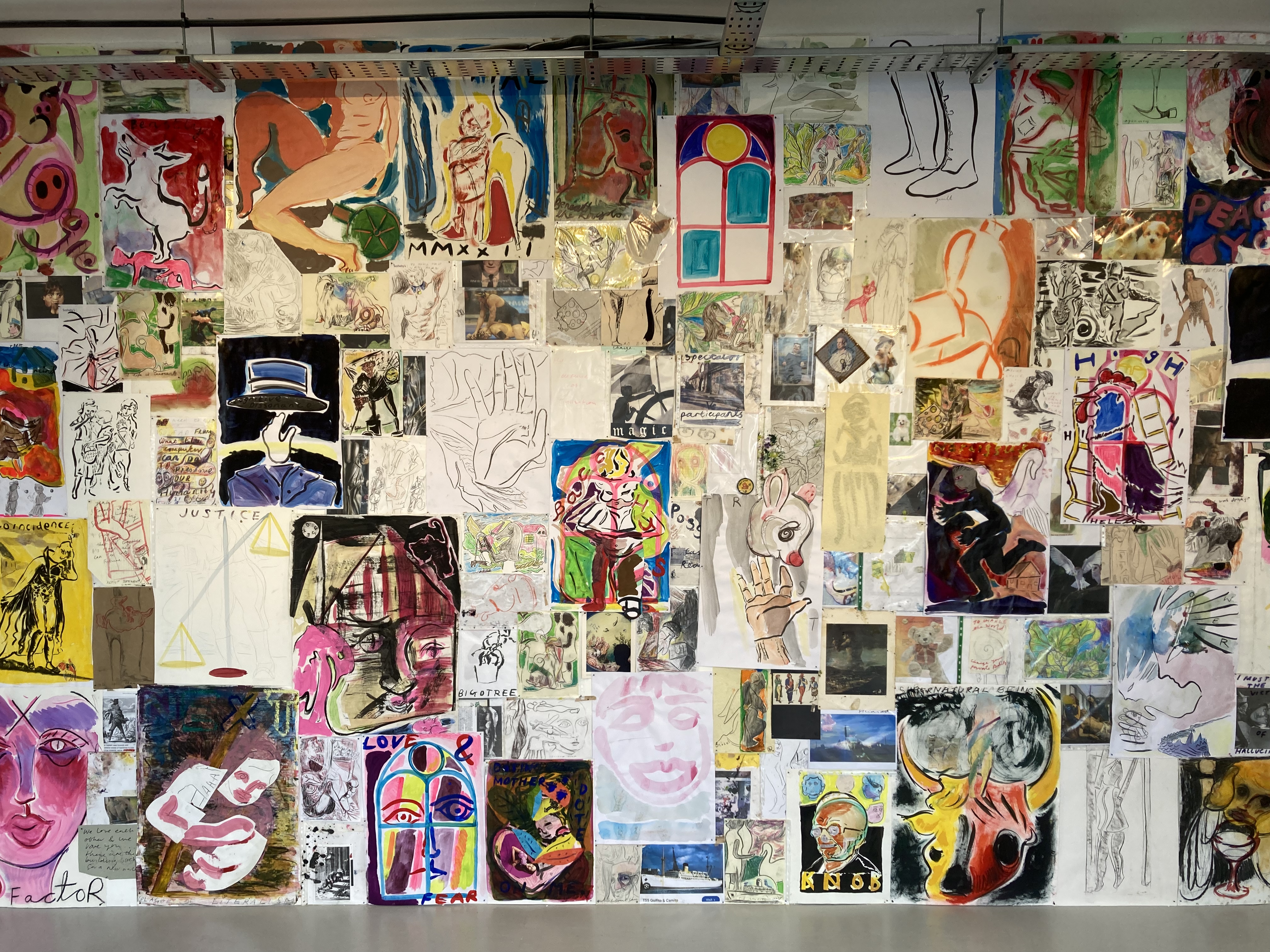
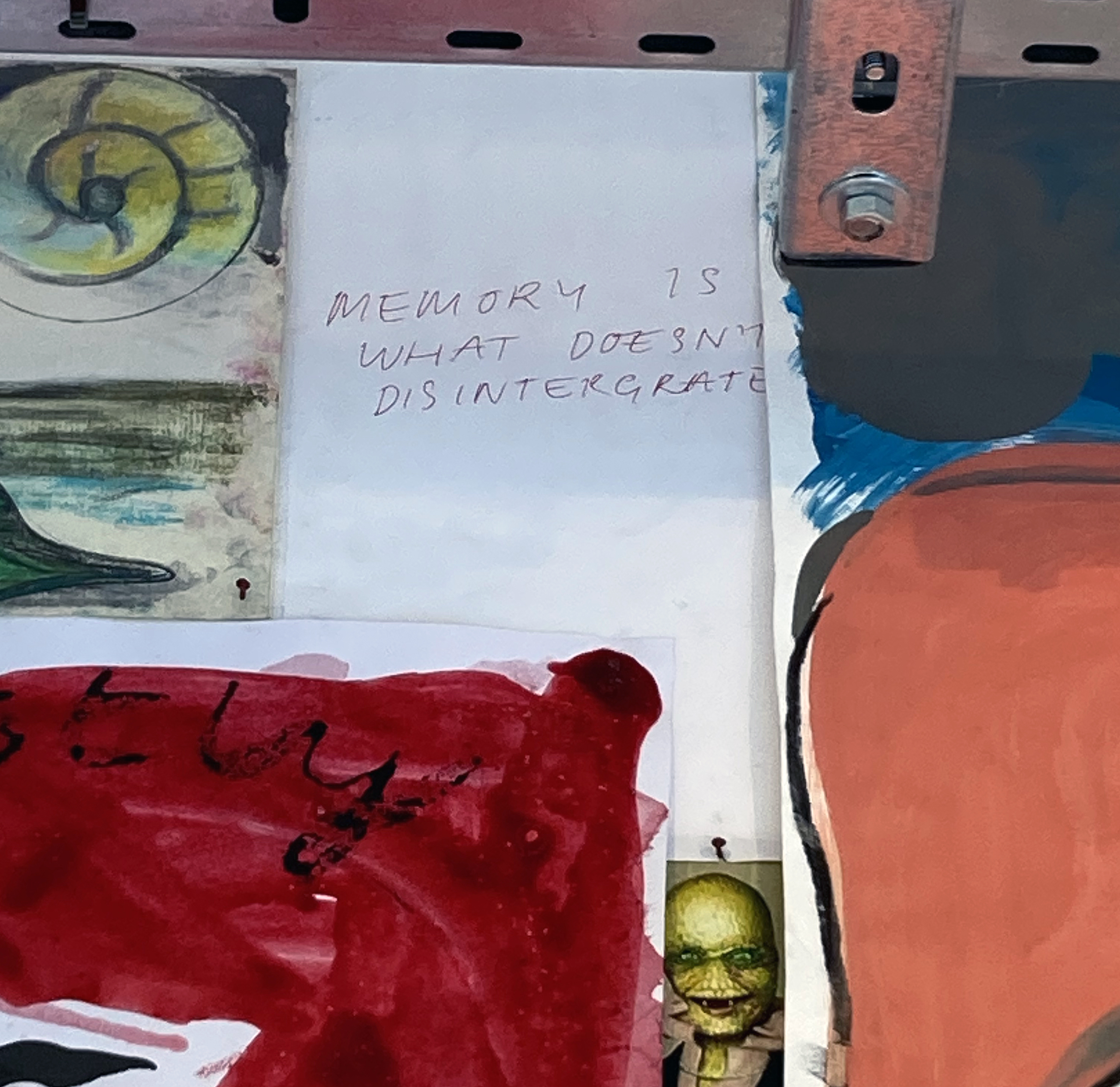
But delve further. Beyond this environment of paintings on the floor and walls the visitor, as a possible means of escape, enters what (in retrospect) may have been the implied bedroom of the artist’s youth. An annex off the main gallery with a large wall displays at least two hundred (I wasn’t counting) drawings, paintings, written notes and printed reproductions on paper. I jotted down a few of the phrases: Love and fear, All life is innocent, I must be the victim of a Hallucination, Innocence, Be Good People, and my favourite: MEMORY IS WHAT DOESN’T DISINTERGRATE (sic). Pictures (from books, art, TV, newspapers, magazines and the Internet) are so important to us all – and virtually unavoidable, then and now. Imagery from all and any context feed the imagination. There’s a sense of being inside an image-based thought process in Foster’s work that is constantly nourishing the potential of what the formative and the now fully realised artist continues to imbibe and assimilate. It’s the magical ordinary extracted from an image and text obsessed world – that was surely first started back in the caves of pre-historic humankind when the fundamental technology of mark making and visual language was really no different to now.

Grant Foster – Wall of works on paper installation

Foster’s wall text at the entrance explains more about the accumulation and assemblage of text and imagery:

“My studio is a haptic, experimental environment, where I continue to collect images, organising through free association: drawings, phone-screen grabs, newspaper clippings, children’s book illustrations, advertisements, and fragments of text.”

So, if the teenage bedroom was a place of seclusion that conversely expanded the imagination, then the adult studio clearly continues this function. Connected to thoughts and memories a touchy-feely collage type process, aided and abetted by literal touch as imagery that can be moved around, has expanded to and created the paintings in this show. On a more universal level we, as viewers, can surely connect with this phenomenon of the imagination, which runs alongside the everyday. Like the artist, we are always reconstructing and re-remembering: memories of memories, whether it was earlier today or decades ago, the happy and sad places, the images we made/make and those that we receive voluntarily or not. Narratives may not always be trusted as truth but new meaning or continuing misunderstanding may be of greater value and emotional impact as we age.

Grant Foster – Panspermia (2024)

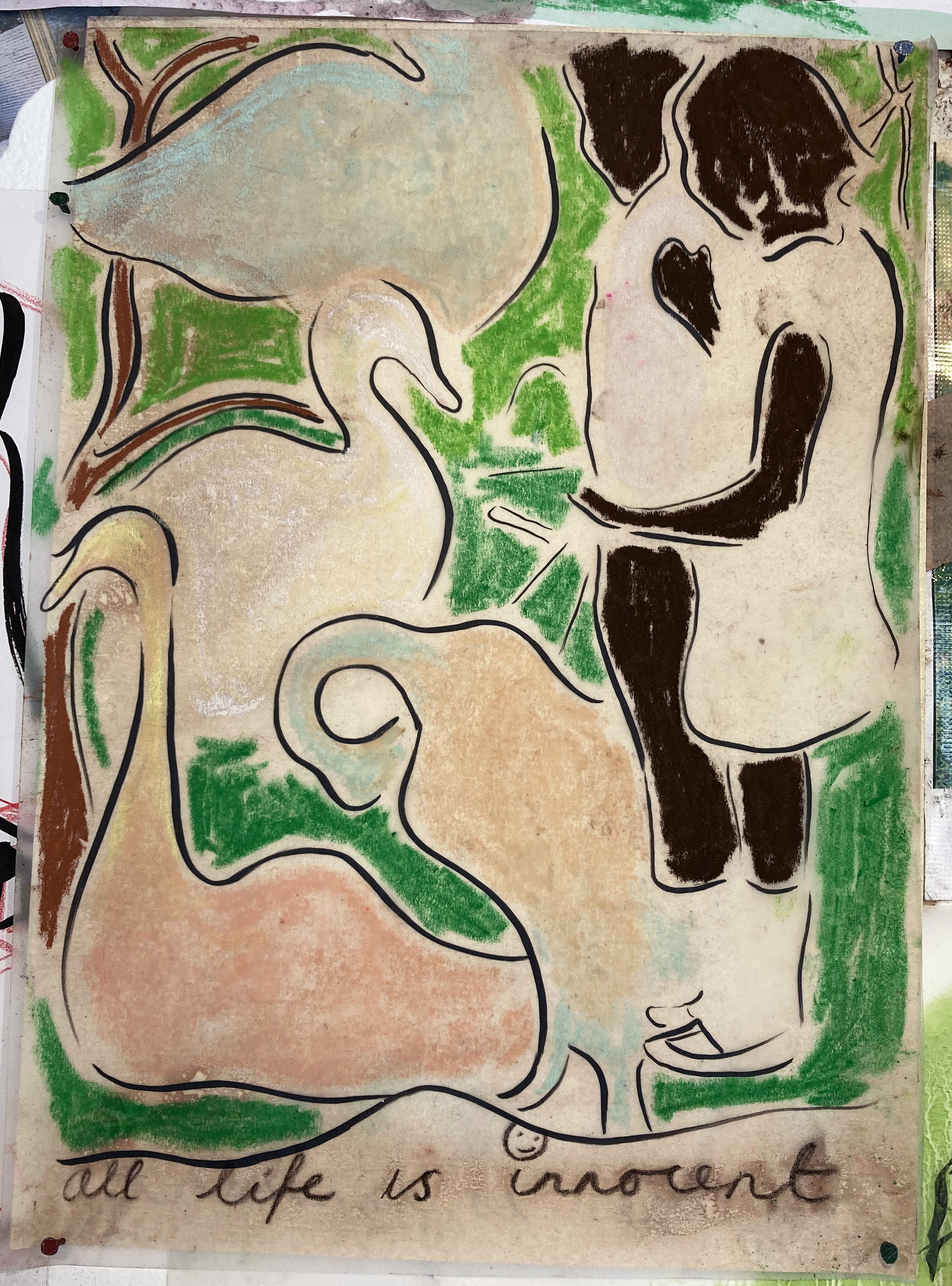
At this point as I consider wrapping up this review I recall a reoccurring image from the exhibition. There is just one photograph reproduced in the publication, A Year of Kindness that Foster has published and presented as the first listed work in Home to My Teenage Bedroom. It shows (I believe) the artist’s mother and uncle standing close to water where a swan has approached. The image is first encountered in the exhibition in the painting entitled ‘Panspermia’ (which Wikipedia informs us “is the hypothesis that life exists throughout the Universe, distributed by space dust, meteoroids, asteroids, comets, and planetoids…The theory argues that life did not originate on Earth, but instead evolved somewhere else and seeded life as we know it.”). The image crops up again on the amazing collage wall of imagery in what must be a preliminary drawing for the painting later on.  Now there are four swans, curvaceously morphing into organic shapes. The drawing could easily have been missed amongst so many images, but may have stood out for its line of handwriting at the bottom of the page: “all life is innocent”.

Grant Foster – Drawing for Panspermia

Returning to the painting, Panspermia, one sees that the swans could be read as decorative visual elements and that the black lines in the earlier drawing are now changed to a more yellowish green hue that visually suggests an organic environment. The branch of a tree fills the head shape of one of the two figures. Is that a wind farm sail in the top left hand corner that hints at the environmental concerns of today? It makes for a somewhat dreamy image whereby the unconscious is given as much credit as anything rational.

Near the start of my response to this exhibition I posed the question: What do you think about when you are looking at an exhibition? Perhaps, what you and I think about after seeing an exhibition is more pertinent. Our memories of previous experiences, times and places are embedded in our imaginations as we engage in recall. There might be hidden treasure in a photograph album too. Timelessly it’s all a here and now that, for some, becomes stronger as we get older. Foster provides much for the viewer to consider. Nothing is necessarily too clear to merely illustrate. This project sets us up. The viewer has work to do.

Geoff Hands (March 2025)

Grant Foster – From the works on paper installation

LINKS:

Grant Foster

Instagram

ExeterPhoenixGallery talk on Soundcloud

Phoenix Art Space

CALUM LOUIS ADAMS: an elephant, a room

At Gallery Dodo, Phoenix Art Space, Brighton

24 January to 9 March 2025

Friday 22 November, the original date for an elephant, a room at Gallery Dodo in Phoenix Art Space, came and went. Then a poster displayed on a window next to the front door of the main entrance announced that the exhibition had been postponed. Expectation supplanted by disappointment. But this was to be an exhibition presented by a conceptual artist, Calum Louis Adams. So, that’s it – wait with Godot. Brilliant I thought – the anti-climax palpably real. No show (yet) constituted a show. Or at least the idea of a show, which happened imaginatively in real time and space, constructed in my mind. The potential object of an exhibition that was fabricated by a poster (a form of text) to manifest itself as an illusion of sorts. But no.

Then a new poster appeared in the window just a couple of weeks ago. There is an exhibition after all. I was disappointed initially, as the joke was on me. But hang on; I am getting two shows for the price of one here so long as I visit the exhibition.

During the afternoon of Friday 24 January I got a sneak preview of an elephant, a room that Jon Carritt, Dodo organiser, has installed. You really have to see this space, a former toilet and washroom, to appreciate how unique and rather special it is. How fitting, therefore, it was to hear the soundtrack of a woman urinating, recorded on a single channel looped video, from a screen placed on the back wall floor. Or at least the phenomenon of a common sound from this electronic device would convince the perceiver of the actuality of a necessary kind of daily performance: now become art in this physical and conceptual context.

The door entrance (it’s just one room) was wedged open with a carefully folded up sheet of the single page A4 gallery handout that had to be the right thickness to hold the door in place. This was the second of the three works presented. The third was the text and digital image printed on the reverse of the handout, though the stack of handouts were placed on top of a wooden plinth, which might be counted as part of the installation. Extrapolating from this of course, the floor, ceiling and walls are the exhibition too. As is any visitor. I found myself taking some photographs of the partly renovated walls, wondering if an elephant might lurk somewhere.

This interestingly rambling/stream of consciousness text, written by Adams (I assume), consists of three paragraphs that link stories of a “startled crow”; the notion of a “Brood”, a collective spirit, a small car parking on the nut that the aforementioned crow has previously been eating, an abandoned house, smashed windows, a previous exhibition of the artist’s during which, on hearing a line from a song by the singer Clairo, changes their thoughts about a moment during which a window changes its functional self identity. Next there is a reference to a woman who drinks her own urine (from the American TV series My Strange Addiction) – which may or may not link to the urination soundtrack mentioned above. The final section of writing summarises these various parts as personal thoughts about choice and the possibilities of the crow’s possible awareness of the observer and the car having some sense of the crushed nut under its tyre. It is quite possible that the visitor who picks up the printed sheet will not read the text until later. A common habit (of which I am guilty) is to read the text handout on the journey home or even later. I would now guess that Adams wants the text read whilst in the show as it is listed as one of the exhibits. Although it is possible that this does not matter as the text read later, elsewhere, extends the exhibition and enables the reader to possess one of the artworks and to create something through the act of reading.

So where’s the elephant from the exhibition’s title? Well, to be literal, there is a minimalistic linear sketch of an elephant printed on the front of the handout. A visual representation, alongside the word elephant itself, which only makes cognitive sense if such a word (a label or name) is already in the viewer’s cognitive lexicon. Alternatively, the creature may actually reside in the mind of the viewer as the imaginative synonym of the elephant in the room – which may or not be in the room at all but perhaps appeals to an art practice that explores arty aesthetic ideas and objects. I wonder if there is a self-deprecating aspect here too, including a possible negation of the artist (a form of identity and an idea as well as a career choice for an actual human being, an object of sorts) as being worthy of explanation.

I was told that the artist would not be attending the opening evening due to rail travel difficulties during inclement weather conditions in Wales, where they live. Or perhaps this was fortuitous, as perhaps the physical presence of the artist is not so relevant as it could detract from the show, the physical work and the non-physical ideas or potential concepts. How suitably anti-climactic.

LINKS:

Calum Louis Adams

Gallery Dodo

Phoenix Art Space

BREAKING LINES

Futurism and the Origins of Experimental Poetry / Dom Sylvester Houédard and Concrete Poetry in Post-war Britain

Estorick Collection of Modern Italian Art
15 January to 11 May 2025

These two exhibitions, historically related but decades apart, make for a fascinating visual experience at the Estorick Collection. Housed in the two rooms reserved for temporary exhibitions, usefully on the same floor, there is a palpable excitement about the graphical form of text and the (early) expanded field form of print that links poetry to the visual arts. The display as a whole has the feel of a contemporary installation work with texts enlarged to cover significant expanses of wall. Framed text works dominate, as one might expect, but video screens enable the page turning of books that are otherwise displayed in glass cabinets.

On the walls in both spaces there is much to read and/or to observe purely visually. Usefully, the expository texts are reproduced in the newspaper-type catalogue that further expands the exhibition to wherever the visitor might take it. In fact to miss the catalogue, designed by Studio Bergini, the visitor would be missing part of the exhibition.

Along with the other visitors at the Press preview I turned right into the Futurism and the Origins of Experimental Poetry display. Carlo Carrà’s ‘Atmospheric Swirls – A Bursting Shell’ (1914) from the Estorick Collection, stands out immediately. TUMB, ZANG, TUUUM, ZANG and EEE, onomatopoeia – sound words – are integrated with painterly applied ink, charcoal and collage on paper. In these present times (well, maybe all times) such as aesthetic celebration of the sounds of missiles seems somewhat absurd and in poor taste. But the potential elephant in the room, the Italian Futurist links with Fascism (in particular the poet Filippo Tommaso Marinetti who founded Futurism), was not ignored as the wall texts and the catalogue acknowledge this disturbing context.

Carlo Carra – ‘Atmospheric Swirls – A Burning Shell’, 1914 Courtesy Estorick Collection

Christopher Adams and other members of the Estorick’s curatorial team have, in effect, stood back to allow the visitor to make what they will of this discomforting aspect in the exhibition. But they have not downplayed the sheer visual exuberance of how poets and visual artists freed the conventions of text display in publications such as ‘L’Italia Futurista’ (published from 1916 to 1918) through to Carlo Belloli’s ‘Texts-Poems for Walls’ (1944) that predicted the very public space of walls (and now the digital screen) as the common space for readers/viewers to be impacted and affected by the word. The show also includes rare original editions of works including Fortunato Depero’s famous book, ‘Depero futurista’ (1927) which is now more commonly known as the ‘Bolted Book’ with two aluminium bolts binding the pages together.

Transferring to the second display, Dom Sylvester Houédard and Concrete Poetry in Post-war Britain celebrates the work of Dom Sylvester Houédard (aka dsh), a Benedictine monk who is a contender for godfather of Concrete Poetry up to the present day. As the visitor would expect, dsh’s work is well represented here with works loaned from the Lisson Gallery. There is also material from Edition Hansjorg Mayer via the Chelsea College of the Arts Library (UAL) including Carlo Belloli’s ‘sole solo’ (futura14, 1966).

As with any exhibition holding works in cabinets you just want to get in there, although all six concrete poems from the Brighton Festival of 1967 are laid out for all to see. There are also works by several other British exponents of concrete poetry, including Ian Hamilton Finlay, John Furnival and Bob Cobbing. A signed copy of Cobbing’s ‘chamber music’ (futura19, 1967) adds a human dimension to the strongly graphical ingredients of the show. I mention this as a bombardment of the graphical might get wearisome if your main interest is in painting – the Estorick is full of paintings, of course.

I was also wondering whom the audience might include over the next few months. In addition to the loyal Estorick crowd I would hope that poets, graphic designers and art and design students from all disciplines, new cohorts perhaps, will see the show. For the fine artist with an involvement with text and collage the exhibition will not disappoint either. If anyone is unsure, just go along and support this organisation. The bookshop is full of goodies too – including that highly collectable catalogue.

Oh, and get that old typewriter out of the attic.

Edition Hansjorg Mayer display (1966)

LINKS:

Estorick Collection

Catalogue design by Studio Bergini

Lisson Gallery

Edition Hansjorg Meyer

Jonathan Jones in the Guardian

Vintage typewriters at George Blackman

SEE EMILY PLAY

EMILY BALL: Walk with me

Atrium Gallery, Seawhite in Partridge Green

December 2024 to March 2025

Emily Ball – ‘Pulse’ – oil on canvas (120x170cm)

We play (mentally and physically) to learn, to discover, to realise. If this attitude diminishes nothing more will change and life will be mundane. It’s especially important for painters, or rather, it’s what I see in the painters who interest me. That’s my personal bias, but I am sure it’s a stance far from unique.

Emily Ball’s work has been on my adoration list for years, so making a fourteen-mile road trip in atrocious weather from Brighton was not a problem. Fortunately Storm Darragh had diminished significantly during the morning, which made the more scenic route north, via Henfield, possible. The countryside is fantastic along the meandering roads that gently rise and fall on the Sussex Weald. A feeling of being in the landscape is so strong, even if travelling in a car. Unknown to me, I was being mentally (and perhaps psychogeographically) tuned in for what was to be seen and experienced quite soon.

Installation including ‘Longing and Sweet Sadness’ – oil on canvas (120x170cm)

Many will know of Seawhites of Brighton (who moved to Partridge Green many years ago) as a great source of art materials, especially sketchbooks. But they have hosted exhibitions for several years too and with this show an expanded office space in an adjacent building to the one with the shop is perfect for a decent sized display that provides more than a taster of someone’s work. This is my first visit to the Atrium Gallery and first thoughts are assured and affirmative: wow, what a space, this is proper painting, everything is interesting (all 44 paintings and drawings). Then, unexpectedly: You don’t see this in the Turner Prize nowadays.

Indeed not. But initial impressions can change with reflection. So I walked around the ground floor for a while longer and was pleased to see that the floor above hosted many more works expertly arranged and hung. After a few minutes upstairs another visitor walked past talking to his partner, and I eavesdrop: “This isn’t kiss me quick or celebrity art”. He was referencing the nearby Brighton (but not so much Hove) art scene. It’s a little unfair, but I get what he means. There’s an abundance of excellent painters whose work is not seen enough down at the coast where the post/neo-Pop, street arty scene dominates. But I had to put that gripe aside for the afternoon and indulge in this engaging imagery from Emily Ball. After all, her work is unequivocally right here, right now whatever the trends might be.

Emily Ball – ‘Dig Deep’ – oil on canvas (120x170cm)

The work in Walk with me is totally absorbing. Many of the other visitors were either standing fully engaged with a particular work for several minutes or strolling around looking and looking again at the display. This is not so commonplace in the gallery environment where looks can be fleeting and it confirmed my sense of the high quality of the works displayed.

Emily Ball’s work in this show might simply be categorised as abstract landscape, but that would not be specific enough to account for a clear individuality of purpose in a lifelong project that engages with a searching, animated and exuberant understanding of the world as experienced. A being in the world, fully connected but including mystery. The works are full of implied movement, visually and physically expressed, by an observer fully engrossed in the act of drawing and painting. The imagery graciously pulls the observer’s gaze into a dynamic conglomeration of forms, coloured patchworks and passages through woodland spaces from the Algarve in Portugal (the Hot Hill collection) back to the artist’s home in Sussex (an ongoing series called Woodland Weave). The paint is applied skilfully with dexterity, self-confidence and years of practice – but healthily retains an aspect, or an edge, of testing out applications and combinations of sometimes raw but playful brush marks. There is a sense of a positive and intentional work in progress, or a springboard for future works yet to be realised. This animated feeling confirms that environments are never really still or are only observed with a rational eye. Nature’s spaces are in and around us, containing histories and yet moving on.

Emily Ball – ‘Shimmer 1’ – oil on canvas (16x24cm)

So, in the future, we can look forward to an expanded Woodland Weave exhibition that explores the woods at the rear of the artist’s childhood home, merging with her parents’ garden. As with any space that Emily Ball draws and paints this will be as much an emotional as a geographical space. It will be past, present and future. We might be reminded, or prompted, to recall our own equivalent spaces to conjure the psychogeographic nature of environments that are personal, familial and, ultimately, social. This is a distinctive potential for the age-old practice of painting and drawing.

First impressions can even improve, too. See Emily play.

Geoff Hands (December 2024)

Emily Ball – ‘Shimmering Jewel Study I to VI’ mixed media drawings

LINKS:

For high quality images of Emily Ball’s artwork visithttps://emilyball.net/

Instagram – @emilyballpainting

Viewing – ‘I smiled when I hear the cuckoo sing’ – oil on canvas (120x170cm)