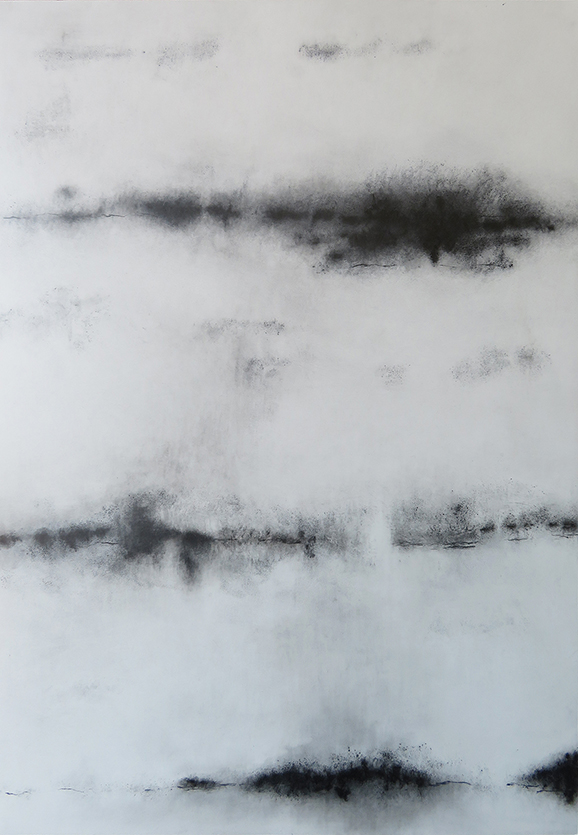
AFTER-IMAGE

AFTER-IMAGE: Works inspired by the Brighton Museum & Art Gallery Collection

Window Gallery, Phoenix Art Space, Brighton

1 to 30 November 2025

A few years ago, as a break from the painting studio, I had visited the nearby Brighton Museum & Art Gallery to view the Prof. Paul Heyer bequest that includes works by Jules Olitski, Frank Stella and Larry Poons. Just before leaving, whilst still in front of the Olitski, I noticed a lonely painting from an adjoining gallery that I imagined waving at me, perhaps exclaiming, “Hey, look at me – I’m a modern painting too!”

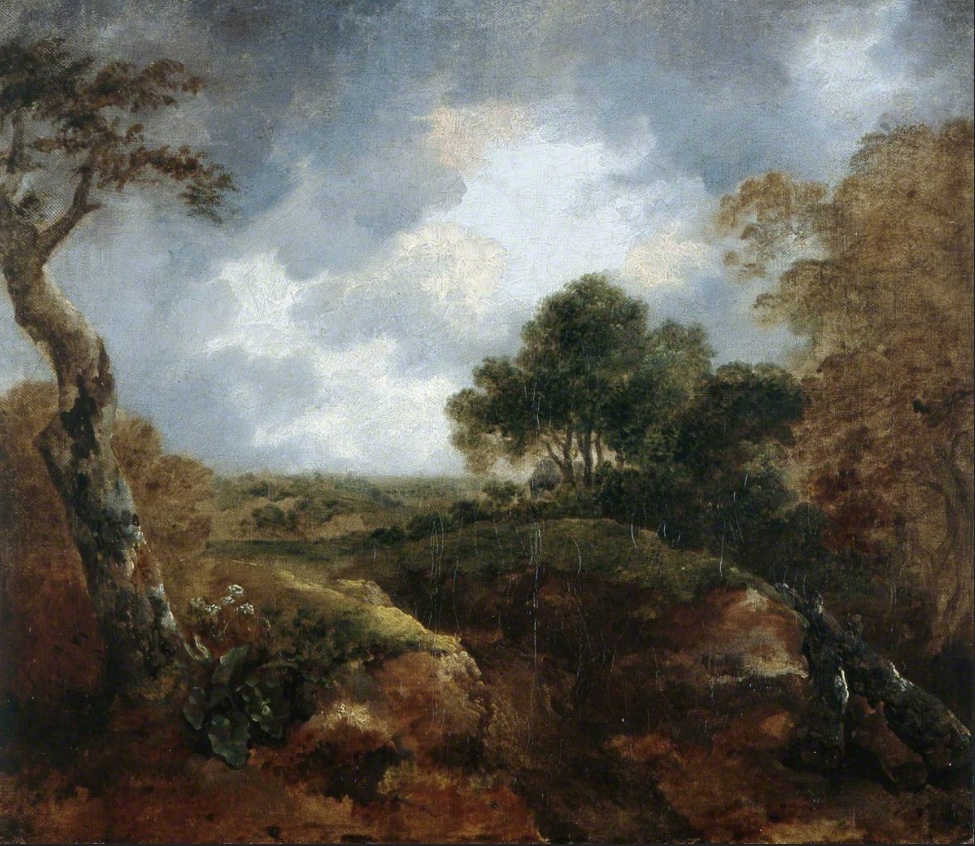
I went straight over to this relatively small oil painting, encased in a dominating gold leafed frame, already sensing something special. It was a landscape by Thomas Gainsborough. The experience reinforced a belief I have that all paintings have a potential to remain vital and relevant today – for painters and viewers alike. So its production date during the 1740s when he was still developing his skills was not an issue. This is a somewhat intuitive notion – but Gainsborough sets the bar for painting (not only landscape imagery) way back in the 18th century. He may well have his technical equals today, but there’s none better. Nor do visually powerful paintings have to be as big as the painters of the New York School often produced.

My first photograph of Gainsborough’s Open Landscape at the Edge of a Wood 1744-45
Brighton Museum & Art Gallery collection

This intriguing painting by Gainsborough, Open Landscape at the Edge of a Wood, lacks the presence of human figures (referencing the Classical Antique tradition that earlier generations of painters indulged in, or including the so-called peasants or the wealthy landowners of the day, such as Mr. and Mrs. Andrews), sometimes seen in his works. Though it has that constructed feel so typical of the European tradition of landscape imagery (post-Claude), an informal sense of place prevails. The viewer is invited to gaze upon the corner of a field, some local Suffolk woodland I assume, and the typically cloudy English sky. The implied narrative might be concerned with the everyday, as the artist invites the viewer to appreciate the countryside. I took a photograph with my new iPhone that usefully recorded the date as October 20, 2017 at 15:38.

I decided to revisit my photograph of the painting in 2024 after I received the go ahead to curate the AFTER-IMAGE exhibition for the Window Gallery at the Phoenix Art Space with the inclusion of other studio members.  (An earlier proposal in 2022 had been rejected, perhaps because I was eying up the larger Main Gallery and lacked the funds to rent the space.) The prompt to my Phoenix contemporaries was for them to visit the Museum and to choose anything to react to in whatever way they wished.

One of the benefits of having a studio at the Phoenix is its close vicinity to the Museum and Art Gallery, where a publically owned collection of artworks are available to see all year round, subject to curatorial changes and re-hangs. I decided to stick with my choice of the Gainsborough landscape despite temptations to respond to other works that also drew my attention. The fact that it has not been on display for a while was not an issue as I had my photograph and the memory of that encounter eight years ago. In fact, a kind offer by Laurie Bassam (Curator of Decorative & Fine Art) from the museum was not taken up to get the painting out of storage, as I preferred not to see the Gainsborough in the flesh quite yet. I had my photograph and my visual recollection. Yet I would, of course, maintain that it is always necessary for artists to see and experience original artworks ‘in the flesh’, rather than only in print and/or online. Painters, and photographers, are typically well aware of the history behind their respective practices and engage with displays of original works in a way that others may not. Any reaction can be to emulate, to be inspired by, or to creatively adjust and re-present or re-order subject matter for one’s own purposes.  Imagery and objects from the past will therefore be linked to the present either directly or more obliquely, depending on the inclination of the invested observer. The remit gave this small group from the Phoenix the opportunity to produce whatever they wished. I expected a wide range of responses, and have not been disappointed. I asked each in the group to write a brief (or not so brief) statement to explain their respective choices of works to respond to. With some respectful editing, and starting with the photographers, here is what they had to say:

Statements from the exhibitors:

Murray BallardBlack Rock, Brighton. C type print.

Murray BallardBlack Rock, Brighton
Jacques-Émile BlancheBlack Rock, Brighton, East Sussex (1938)
Image credit: Brighton & Hove Museums

Jacques-Émile Blanche’s painting of Black Rock, Brighton presents a composed summer scene, its figures formally dressed, children at play, artists at work along the shoreline. Returning to the same site with a large-format field camera, I was struck by the extent of its transformation. Once considered the eastern edge of Brighton, Black Rock has shifted through many identities: from coal-landing beach, to lido, and a gateway to the Marina. Today the space is often empty, yet on this occasion it served as the end point of a long-distance trail race. My photograph reflects on this layered history and the changing uses of place.

Fergus HeronShip Street Gardens, Brighton, England, 2016/2025. C type print.

Fergus Heron – Ship Street Gardens, Brighton, England, 2016/2025
George Dodgson CallowThe Chain Pier, Brighton (1856) Image credit: Brighton & Hove Museums

I am interested in how the places of the studio and museum offer different but related ways to imagine Brighton as an urban landscape through pictures. I was initially interested in the pictures of the chain pier by George Callow and another by John Fraser. 

The connections with my works being relations of land and water, distance, scale, looking at structures from which looking is practiced and that change perspective on place.

Ship Street Gardens, Brighton is a colour photograph on paper showing a view to the west over rooftops in the Lanes area of Brighton. The image describes the appearance of relations between buildings and natural features in soft overcast light with a high degree of detail. A dialogue with George Callow’s painting Chain Pier, Brighton is offered by the photograph with contrasts including direction and viewpoint, plus the presence of the i360 as a modern ‘vertical pier’ and the absence of the beach. My photograph forms a landscape that brings coastal, urban, and new and old aspects of place into relation.

Perdita Sinclair How the Whale Got His Throat and Gen 9. Both oil on canvas.

Perdita SinclairHow the Whale Got His Throat
Ice Age Black Rock AI fictitious digital animation in The Elaine Evans Archaeology Gallery
by Grant Cox of Artasmedia (2019) Image credit: Grant Cox and Brighton & Hove Museums
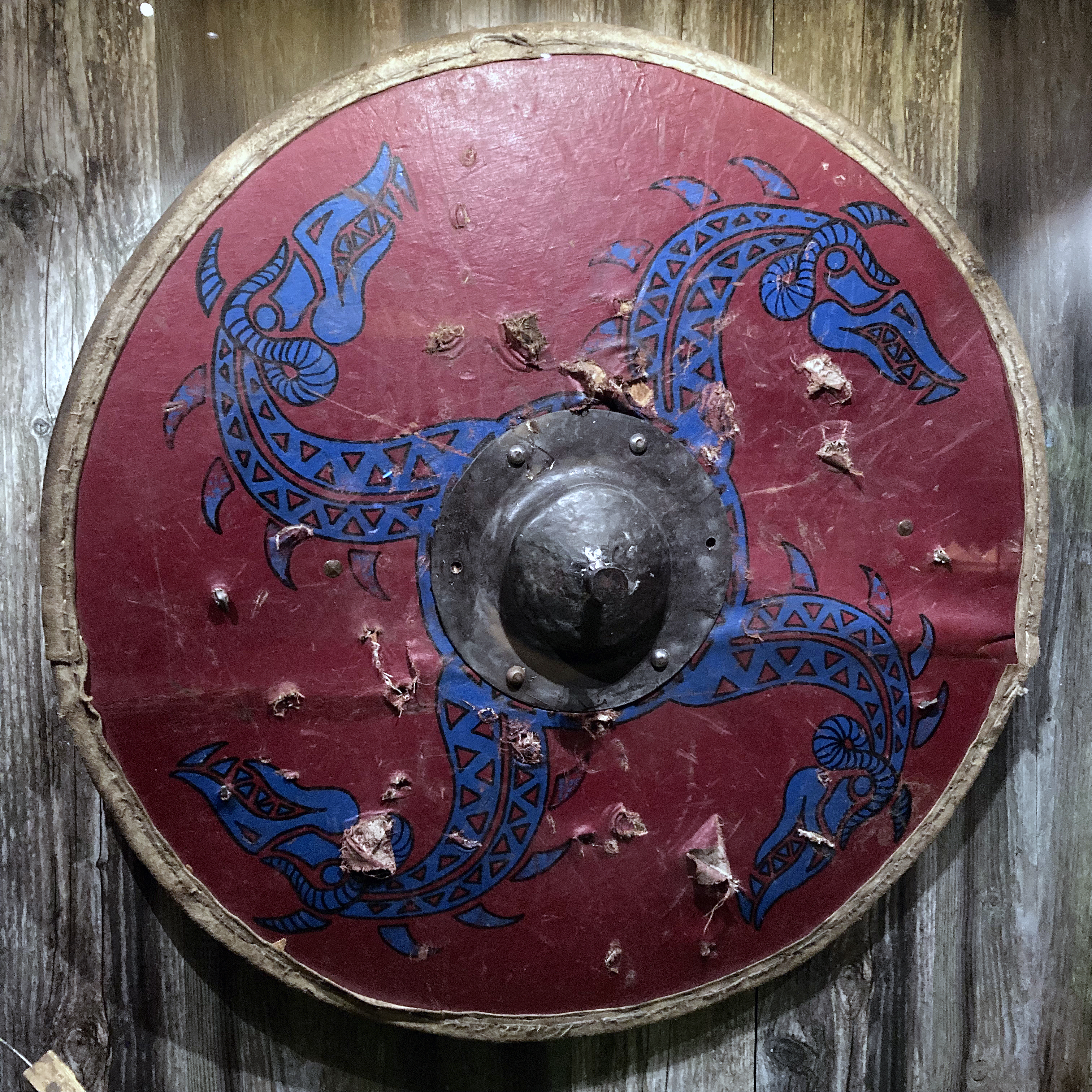
Joe Tyler – Replica Saxon shield (2018) Image credit: Joe Tyler and Brighton & Hove Museums

Both the animation and the shield influenced both of my paintings, How the Whale Got His Throat and Gen 9. They made me think about how animals and landscapes are captured and recreated by humans using tools. The tool being something practical, like a shield or information animation, but the symbols of animals representing something psychological or spiritual, like a connection to deep time. The paintings that I have in After-Image use the tool of AI to generate imagery and my own physical and psychological connection to Brighton and my home.

Perdita Sinclair – Gen 9

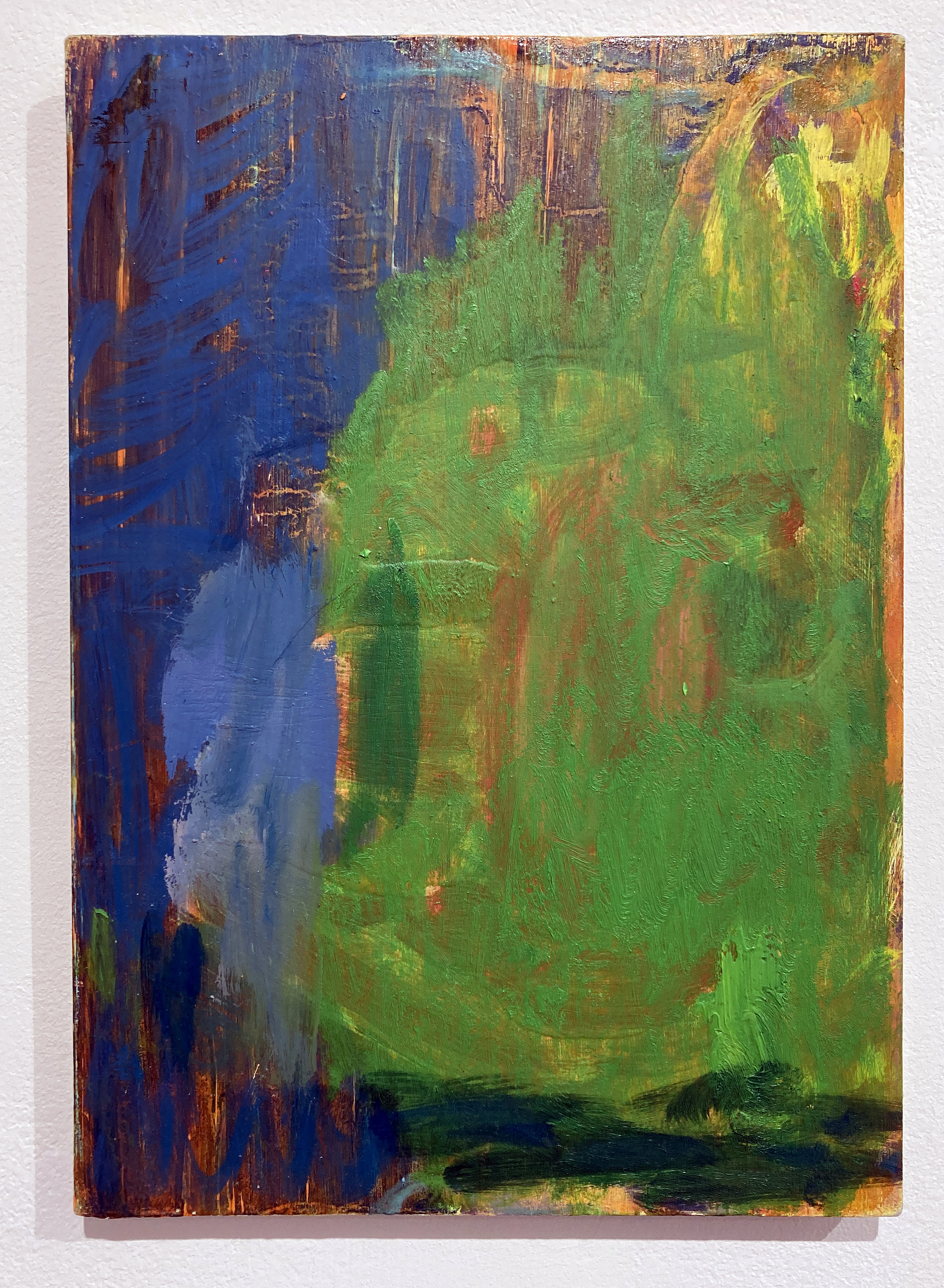
Denise HarrisonWater of Leith: Flow / Pause / Return. Acrylic on wood.

Denise HarrisonWaters of Leith: Flow / Pause / Return
Ivon HitchensForest (c.1940) © DACS Image credit: Brighton & Hove Museums

In July, after the death of my sister, I spent three weeks alone by the Water of Leith in Edinburgh. This place, connected to my past, became somewhere I could be quiet and reflect.  Each day I walked along the river or sat still in one spot, taking in the sounds, movement and atmosphere of the landscape. In my paintings, I translate sensations as well as views.

I was inspired by Ivon Hitchens’ painting, Forest and the way he immersed himself in his surroundings. I used acrylic paint on blocks of wood, adopting the panoramic format to reflect how the landscape is seen as a continuous space, without edges. Through gesture and colour, my paintings capture the feeling of being fully present in the landscape, where memory, grief and nature come together.

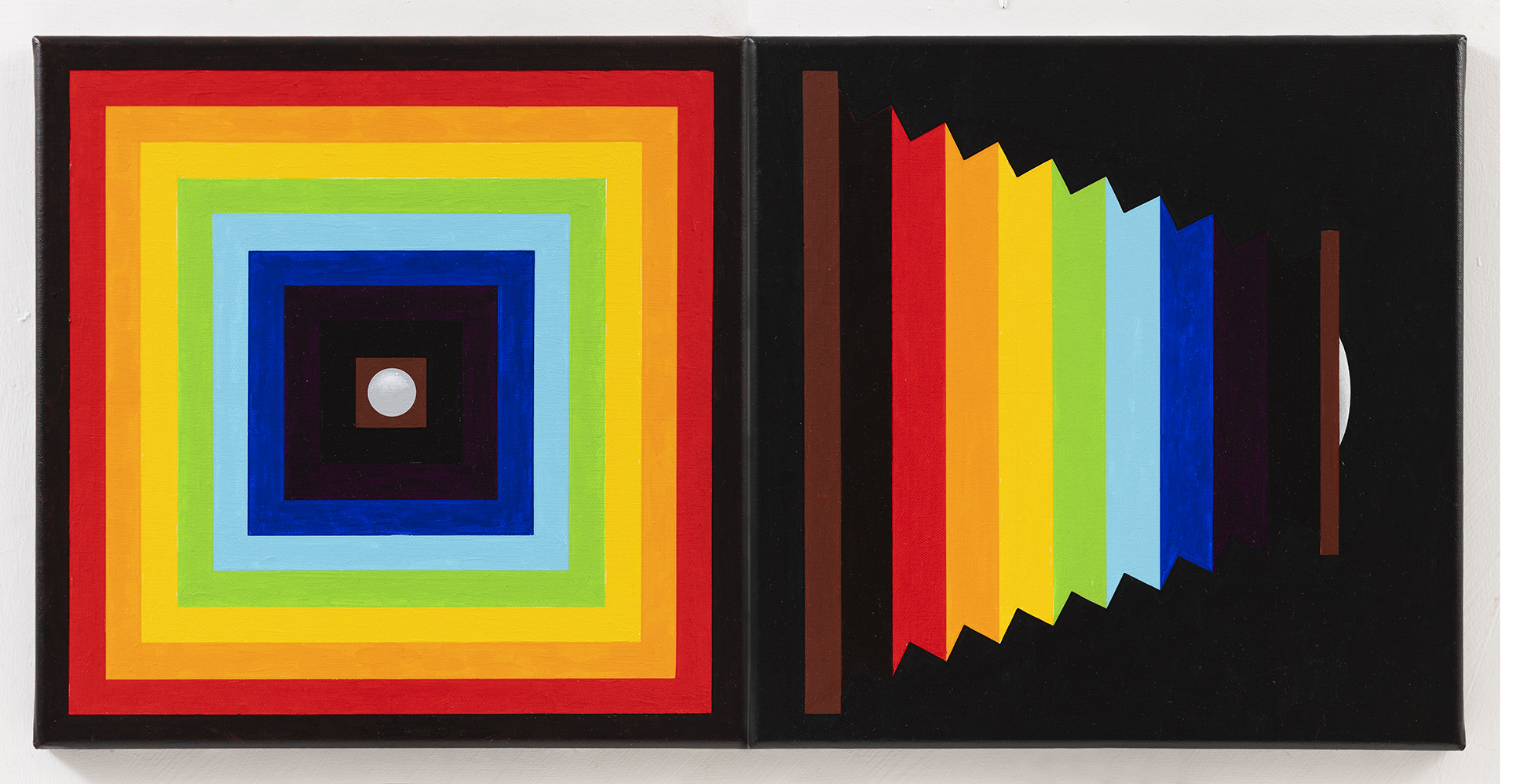
Bernard G. MillsBellows. Liquitex on canvas (diptych).

Bernard G. MillsBellows
Frank StellaRed Scramble (1977)
Image credit: © ARS, NY and DACS, London 2025
and Brighton & Hove Museums

When viewing the work on a visit to the gallery and a talk about their twentieth century collection I was struck, not so much by the design, physical execution or colours in Red Scramble, but by the resemblance of Frank Stella’s painting’s concentric squares to the folds in a camera’s bellows. As I was (and am) engaged in producing a series of paintings that I call Photographic Paintings – paintings that relate to aspects of photography, I decided to incorporate the response to Stella’s piece with a diptych entitled Bellows.

I had originally decided to include twenty-four painting in the series (one has to draw a line somewhere) – either twenty-four or thirty-six (referring to the number of frames in a 35mm film cassette). With the Stella being a diptych, I decided to extend it to twenty-five because, in the interest of economy, if one loaded a 35mm film into a camera judiciously, one could squeeze in an extra exposure at the end of the film.

June NelsonFire Spotting, Where All Ladders Start and Every Rung Shone Strangely. All oil on canvas.

June Nelson – Fire Spotting (t/l), Where All Ladders Start (b/l) and Every Rung Shone Strangely (r)
Toyokuni KunisadaFiremen performing acrobatic feats at New Year (1840)
Image credit: Brighton & Hove Museums

My initial response to a Japanese woodcut depicting firemen performing acrobatic feats took the form of a few small paintings – direct transcriptions of the image. After a long break working on another series of paintings, I returned to the ladder motif. Evoking ideas of balance, emergence, precarity, and triumph, the ladder has become the starting point for a new body of work, comprising paintings and sculpture. These works extend threads from earlier explorations of “impossible objects”: mirrors that refuse to reflect, faces that cannot be fully seen and shadow ladders that offer no passage. Together they forge a shifting vocabulary that hovers between the literal and the illusory, the structural and the dreamlike.

Mike StoakesThe Tyger, Tony the Tiger and Sporting Tigers. Mixed media.
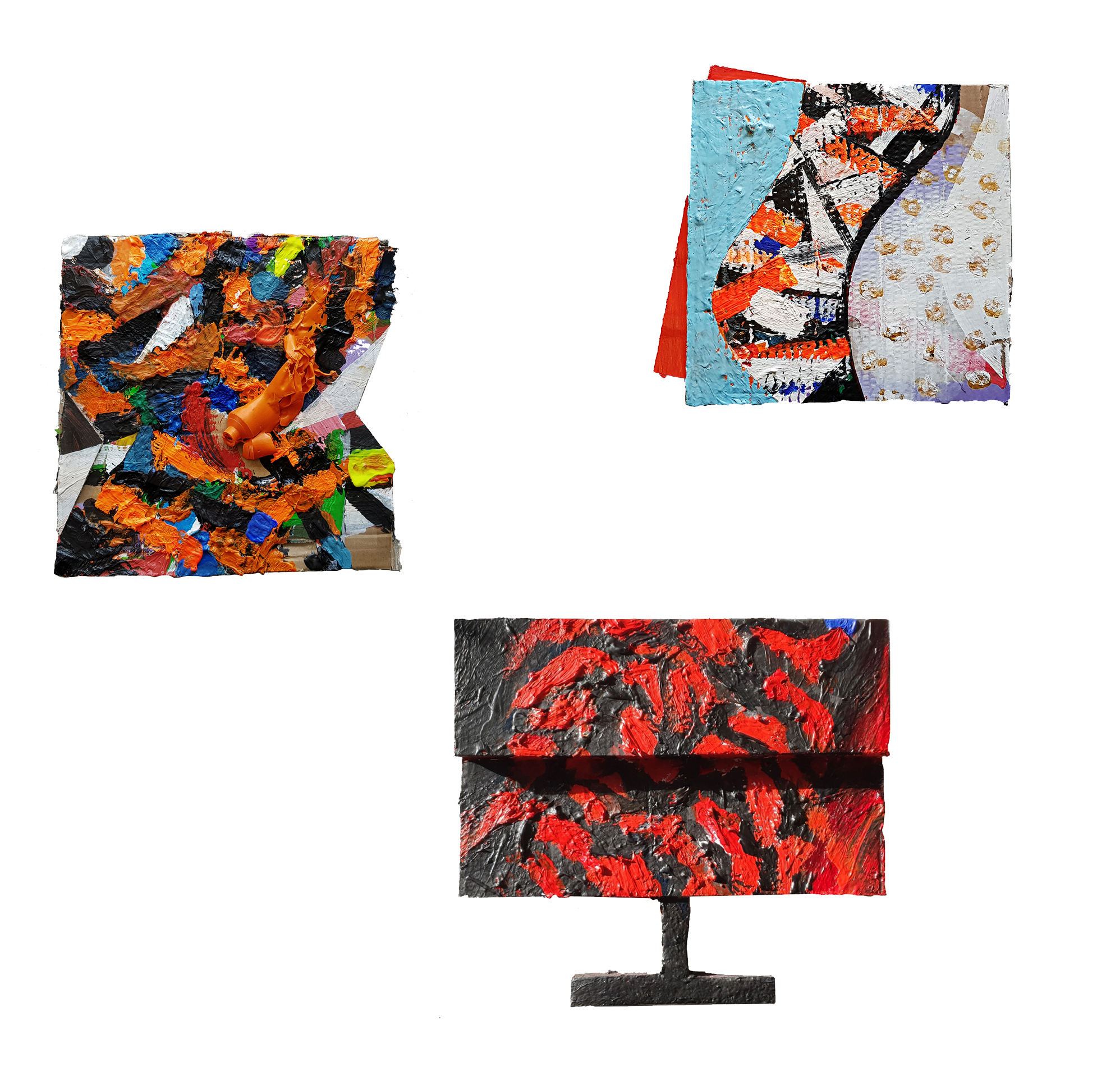
Mike StoakesThe Tyger, Tony the Tiger and Sporting Tigers. Mixed media.
Munro and the Hungry Tiger from the Willett Collection of Popular Pottery (c.1825)
Image credit: Brighton & Hove Museums

Though I’ve recently been working on the subject of my colonial past I have chosen this work for After Image out of pure interest. It represents an actual event where Hector/Hugh Sutherland Munro serving as a cadet for the East India Company was seized by the head and dragged away by a tiger, succumbing to his injuries even after the tiger was shot. The event was widely reported and subsequently (1820s) became the subject of a series of Staffordshire ceramic figures and more recently foreign fakes.

Not long after Munro’s death, Tipu Sultan of Mysore, who loathed the British, commissioned an automata of the incident that produced movement and wailing and growling noises activated by a crank. The body of the tiger also contained an organ. The styling of the piece draws on South Indian traditions of sculpture and is one example of many images Tipu caused to be made of British meeting their demise, with the tiger being a significant repeated personal motif. Uncannily the iconography of the tiger mauling a soldier had been used by him prior to the Munro tragedy. Tipu was killed by the British in a siege and his tiger brought to Britain as plunder and is now in the V&A. The style was likely the basis for the Staffordshire figures and the subject for William Blake’s poem The Tyger.

The work I have made uses the tiger image to explore human projection onto nature through various media representations. Three paintings each about 35cm square are titled The Tyger, Tony the Tiger and Sporting Tigers. The Tyger is from Blake’s poem in all likelihood inspired by the Munro story. Tony the Tiger is the Frosties breakfast cereal mascot who was animated with a Brooklyn accent – which gives him a name and location link to Tony Manera from Saturday Night Fever. Tony and the Esso tiger (in your tank) had cordial relations until Esso used it was to promote foodstuffs at which point the relationship became frosty. sporting tigers refers to a scene from if…. where Malcolm McDowell and Christine Noonan wrestle naked on the floor of a transport cafe impersonating tigers.

Julian VilarrubiStudy for Moonrise on the Rape of Hastings. Oil on board.

And Studies for Moonrise I and II. Oil on paper.
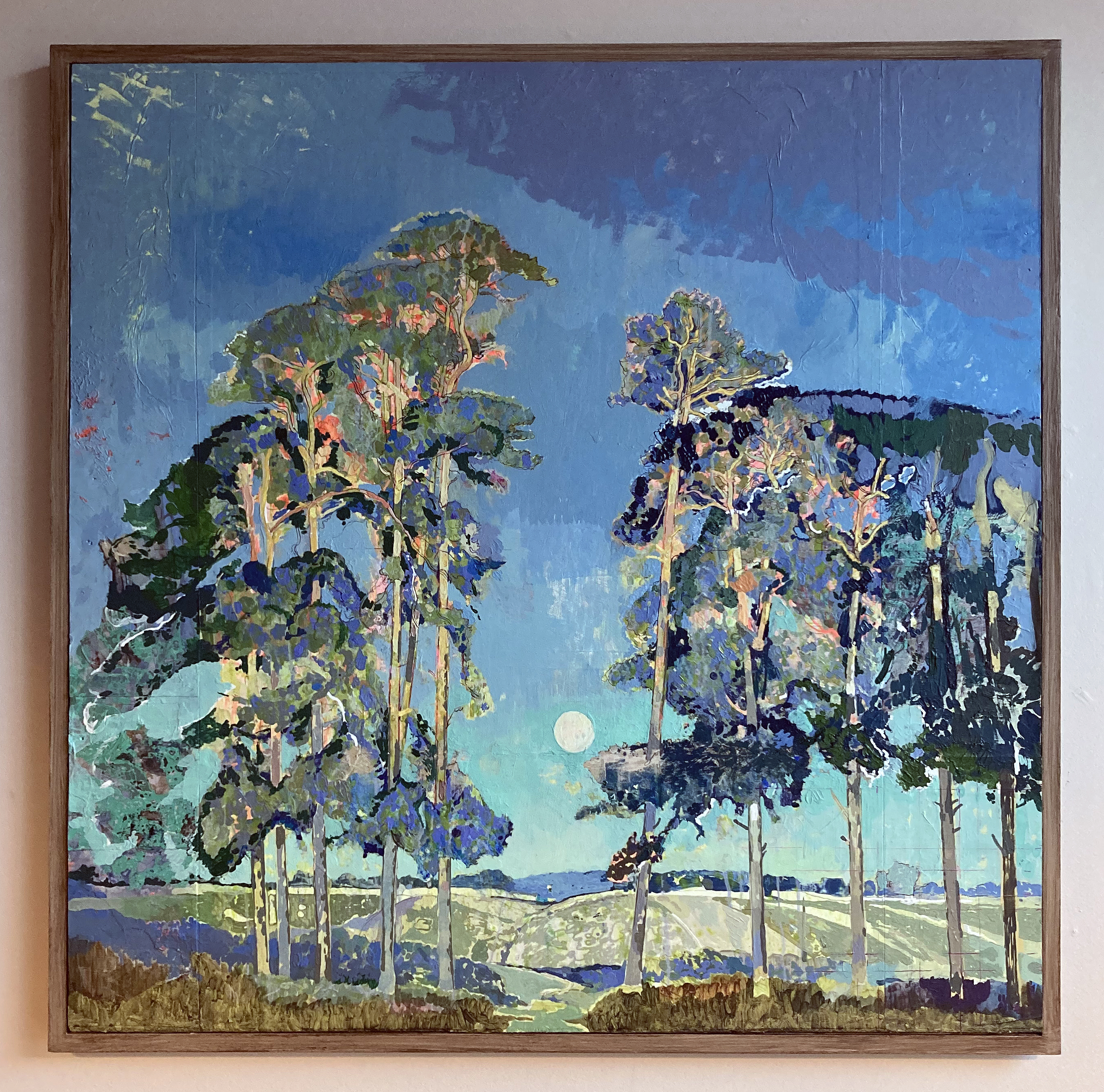
Julian Vilarrubi – Study for Moonrise on the Rape of Hastings
Edward Louis LawrensonMoonrise on the Rape of Hastings, East Sussex (c.1920)
Image credit: Brighton & Hove Museums

Caught in the liminal transition between day and night, the full moon ascends in direct opposition to the setting sun. The scene evokes an early evening in late September, sometime in the 1920s. The final warm, golden rays illuminate the treetops – light that is soon to yield to the cooler chromatic palette dominating the remainder of the composition. This fleeting equilibrium between sunlight and moonlight – the gradual succession of one form of illumination by another – imbues the image with a poetic transience. It captures the precise moment when day recedes and night begins its quiet ascent. The viewer becomes aware of the inevitable passing of time, as the low sun behind us slips beneath the horizon, signaling the arrival of autumn light and the encroaching darkness of the months ahead.

I first encountered this painting on 13 August 2023 at the Brighton Museum and Art Gallery. That single viewing has remained vividly imprinted in my memory. The work’s compositional and atmospheric qualities exerted such a profound influence on my painterly sensibility that I have since felt compelled to reproduce it, not as an act of imitation, but as an analytical engagement intended to uncover aspects of its making.

This undertaking is not an interpretation or a personal reimagining of the original. Rather, it represents a dialogue between my own practice and that of another painter. Through this process, I seek to concentrate on specific technical concerns allowing the act of reproduction to function as a form of enquiry. It is an attempt to locate, through practice, the intersections where two artistic methodologies might converge.

The objective is to study, replicate, and thereby understand how and why certain images resonate with such lasting intensity. Art museums provide a unique pedagogical context for such investigations: they preserve not only the works themselves but also the potential for experiential learning embedded within them. In this instance Lawrenson has already resolved many compositional decisions and I am thus liberated from considerations of subject or framing and can direct my attention entirely toward process, structure, and surface.

In total, my direct encounter with the painting amounted to less than ten minutes. My subsequent work has relied exclusively on photographic reproductions – an approach far from ideal. Reproductions inevitably introduce distortions of colour, scale, facture, and detail, yet they remain my only means of sustained engagement. As a student of historical painting practice, this project constitutes a deliberate methodological exercise: a means of interrogating pictorial construction, tonal balance, and chromatic harmony. By attempting to reconstruct the processes underpinning this work, I aim to absorb and internalise its lessons, thereby extending my own understanding of painting as both material practice and visual language.

Stig EvansUnveil. Graphite and acrylic on canvas + curtain.

Stig Evans Unveil
Philippe de ChampaigneSt Veronica’s Veil (c.1640)
Image credit: Brighton & Hove Museums

To “draw a curtain” can mean two apparently contradictory things: to pull it aside to reveal what it had concealed, and to pull it in front of an object, in order to hide it. To draw, and to paint, a curtain is thus both to cover and discover.

Geoff HandsAfter Gainsborough I and II. Oil on canvas.

And Open Landscape (Oval). Oil on board/frame

Geoff HandsAfter Gainsborough I
Thomas GainsboroughOpen Landscape at the Edge of a Wood (1744-45)
Image credit: Brighton & Hove Museums

Gainsborough’s painting chose me, in a sense. As I explained in the AFTER-IMAGE essay (above), I was looking at works by Olitski, Stella and Poons from the Prof. Paul Heyer bequest and the almost unnoticed small oil painting beckoned me from afar. As a contemporary painter I am always on the lookout for paintings to excite me, irrespective of when they were produced. So I love visiting the National Gallery in London as much as visiting displays of new paintings in the contemporary and independent galleries. My focus on painters from the past increased during the Covid pandemic, perhaps because I was usefully confined to my Phoenix studio and a packed bookshelf of artist’s monographs kept in there. So I was looking at painters such as Caravaggio, Rubens, Watteau, Gainsborough and Gillian Ayers, particularly intrigued by pictorial composition. As much as content and historical readings are essential in understanding paintings from any era, I was particularly focused on the more formal aspects of painting. Not only in composition, but also in internal shapes, passages of light and dark, and just how the paint medium has been applied onto the surface. Looking with a fellow painter’s eye I guess, though not as an equal of course.

When the NG re-opened I visited the Titian: Love, Desire, Death exhibition and was also pleased to see Gainsborough’s Mr and Mrs Andrews for real in the general display. Later on, a postcard of Titian’s Perseus and Andromeda, bought from the NG shop, influenced my painting back in the studio. This attention to the image followed great discontent with a landscape painting made the day before, to which I now added the appropriated figures. Around this time, the experience of seeing the Gainsborough painting in the Brighton Museum in 2017 came back to me. So when the opportunity to make AFTER-IMAGE happen it felt appropriate to transcribe Open Landscape at the Edge of a Wood rather than another work from the Museum collection (I was also tempted by Ruskin Spear’s Brighton Beach and Gillian Ayres’ Sappho – and may yet produce something from either of these).

In addition to making three main transcriptions from the Gainsborough, a study entitled Open Landscape (Oval) integrated the frame that referenced seeing the Gainsborough in its historical gold frame, although I went with a more Hodgkinesque connection of the frame into the painting. In the AFTER-IMAGE exhibition I have hung this work slightly away from the main display as I am hoping that it is not immediately seen by visitors, but has that opportunity to say “Hey, look at me!

Geoff Hands (October 2025)

Julian VilarrubiStudies for Moonrise I and II

Thanks:

Laurie Bassam and Lucy Faithful from Brighton Museum & Art Gallery

Laurence Hill and Ainoa Burgos Gonzalez from Phoenix Art Space

Installation assistance – Bernard G. Mills from Phoenix Art Space

Poster design – Jiating Yang

Links:

Brighton Museum & Art Gallery

Phoenix Art Space

Exhibitors’ Websites –

Murray Ballard

Denise Harrison

Geoff Hands

Fergus Heron

Bernard G. Mills

June Nelson

Perdita Sinclair

Mike Stoakes

Julian Vilarrubi

Instagram –
Stig Evans

Bernard G. Mills

Geoff Hands – Open Landscape (Oval)

LOUISE BRISTOW/RUSSELL WEBB: and other trivial matters

Gallery Dodo, Phoenix Art Space

26 April to 8 June 2025

THE PERSONAL AND THE POLITICAL

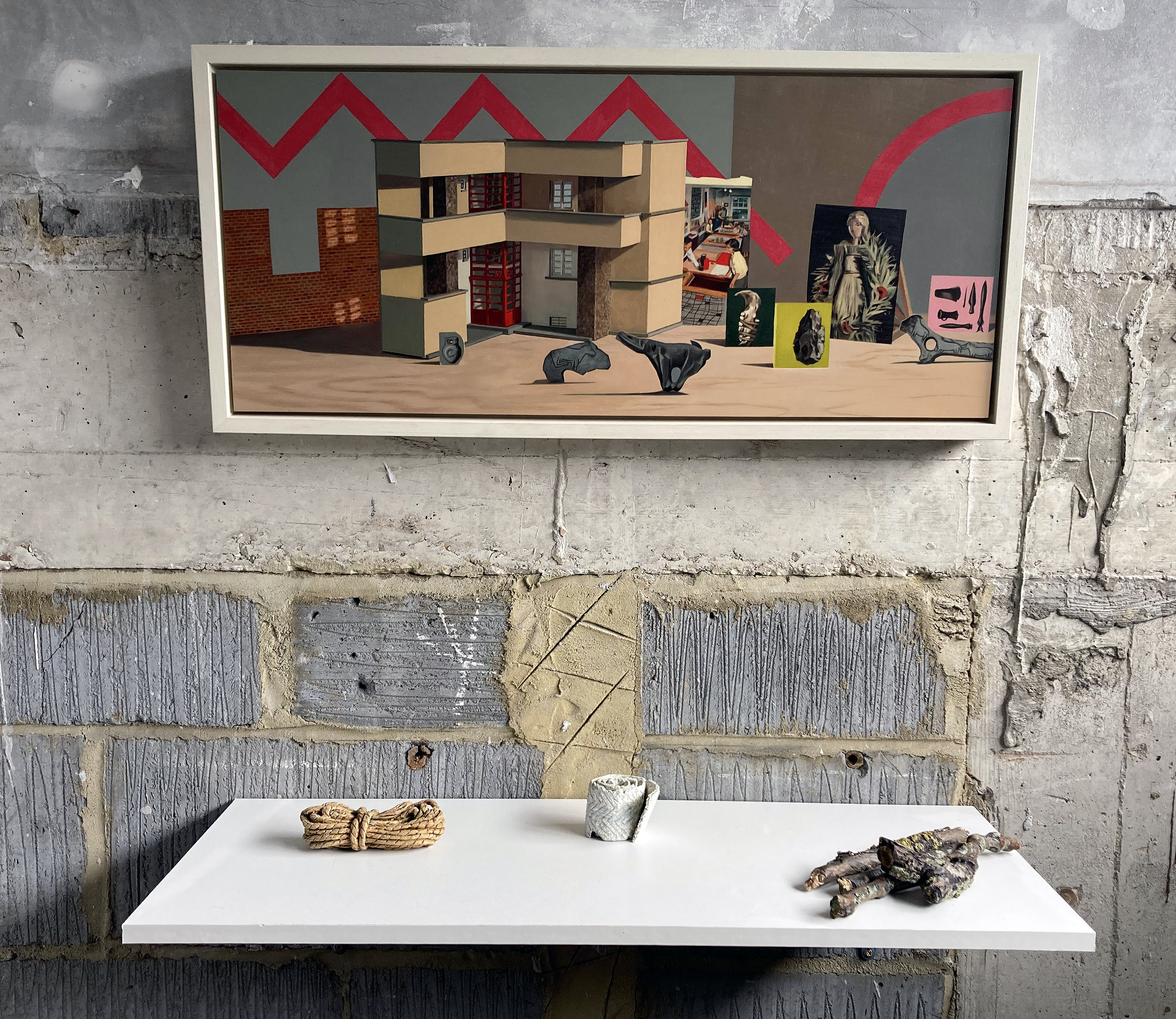
If you are already familiar with the artwork of Louise Bristow and Russell Webb you will know how fastidious they both are in the craft of their art making. Their respective and uncompromising working practices demand scrupulous attention to detail and full command of their chosen materials, processes and subject matters. I had not previously considered their work being shown together, but here they are in and other trivial matters at the Gallery Dodo in Phoenix Art Space. The results are impressive, not least because they have installed their work in complimentary fashion without either dominating the other and with a careful juxtaposition of contrasting imagery and objects. The works link under a broad still-life categorisation with the small (life size) sculptures sitting comfortably with the reduced scale of painted objects depicted in the paintings. As is typical of the still-life genre the imagery can be as straightforward, or as loaded, as the artist intends and the viewer is able to interpret.

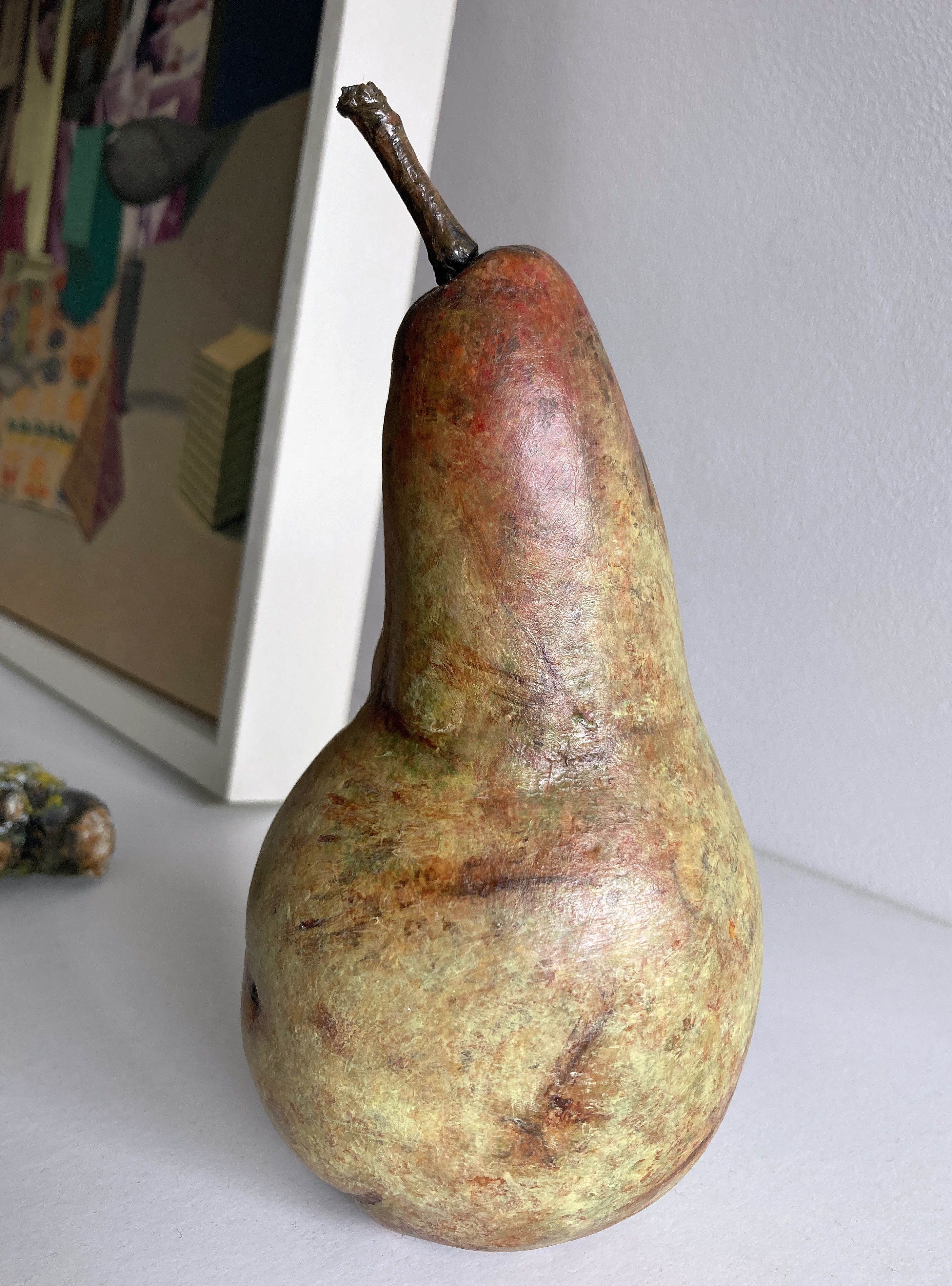
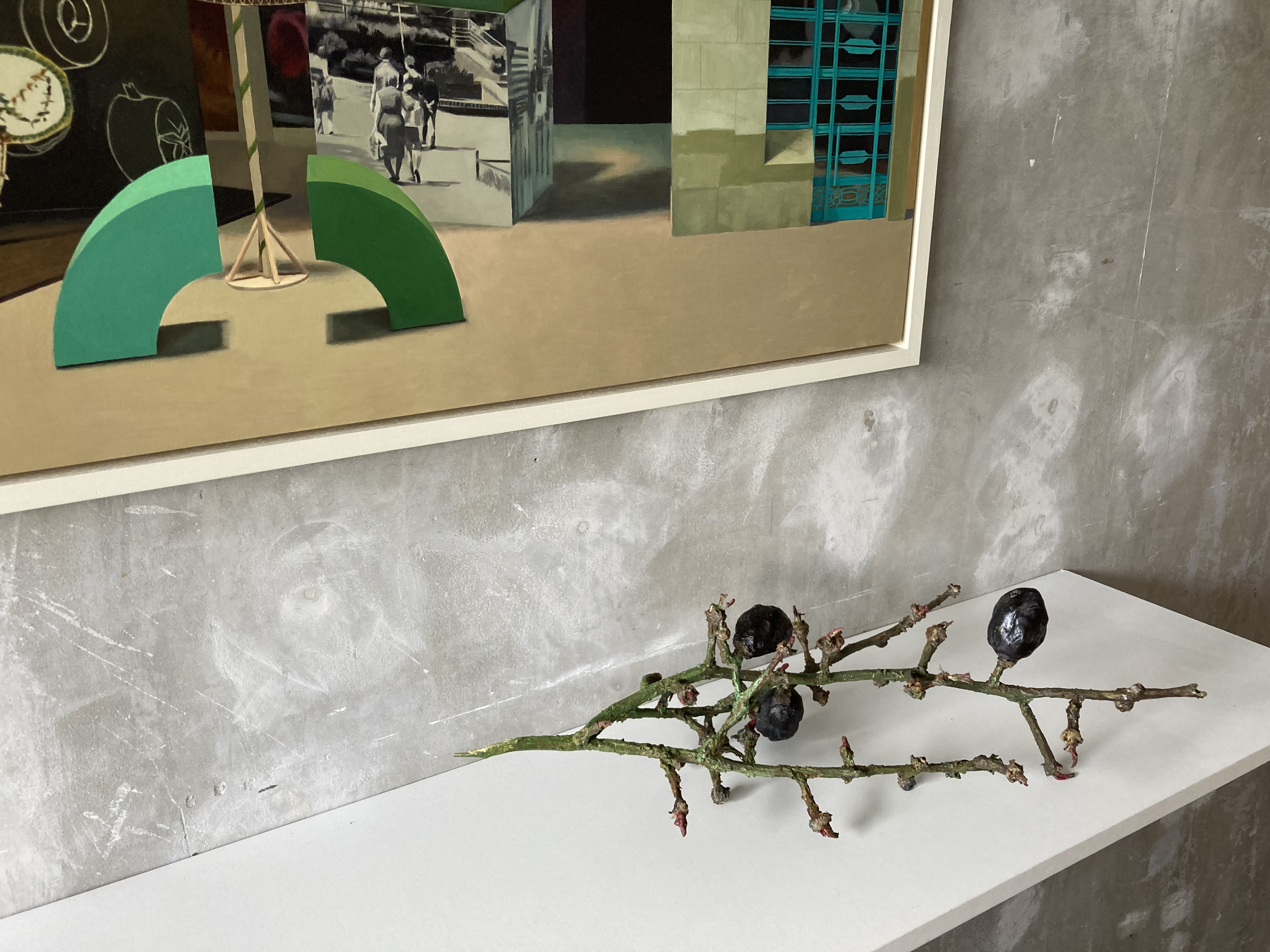
My initial visit to the exhibition was hurried and fleeting as I had my own studio to get to at the recent Phoenix Open Studios weekend for the Brighton Festival. A few days later I was able to return to the space and to peruse the contents for as long as was necessary. But that first fleeting visit was surprisingly useful, for a stick had stuck in my mind. This was Russell Webb’s Stick Surgery (viii) to be precise. For when is a stick not a stick? When it’s a (found) curtain pole, with sawdust and acrylic paint applied, of course. But when this combination of materials is transformed, or re-naturalised, into an object/ornament that you might display on your mantelpiece at home you must remember not to be deceived and put it on the open fire – or you will have lost a sculpture. Why the mantelpiece? Well that’s where one might typically display a found object from a countryside walk. An objet trouvé become perdu (holding aesthetic value) – maybe with a hint of the wabi-sabi aesthetic. But it’s not a found object; it’s a sculpture, I dare say, of the unmonumental category. So whilst it references the natural and the everyday, the quotidian in contemporary artspeak, as a designed or constructed object it may have a different sense of value to the found object. At which point I am getting confused between any old stick and the one that the artist has made. Is this his intention?

A mental fixation on just one piece of artwork encountered at the start of an exhibition is rare in my experience, as I have a habit to scan for an initial impression and to have a walk around to acclimatise myself. But as the Gallery Dodo space is relatively small, and I was pushed for time, this particular example of Webb’s selected pieces caught my attention first. Of course, in contrast to noticing this one individual item, I was also aware that, in a sense, the whole room was full of objects. In addition to the thirteen three-dimensional objects displayed on four shelves there were over forty still-life items represented in the four paintings. A return was clearly required.

Sitting in the Dodo space on my own for a private viewing a few days later was immediately quite calming. My inclination was to just relax and look, scribble a few notes as preparation for this review, and try to dismiss personal expectations. Simply respond to the physical content before me. Whenever I look at Louise Bristow’s paintings I slip into a state of calm anyway. They are so quiet, not even a hum emanates even if the imagery, a painting of a photograph perhaps, suggests a particular soundtrack from the contextual content. But this is not a display to sit and look at from a distance. It is imperative to stand up and move closer to each of the four groupings of an individual painting with various sculptural forms arranged on a shelf beneath the image. Both sets of work invoke an admiration of how they have been painted. In a sense, they are super-realist – though certainly not photo-realist. Webb’s sculptures might be termed as object-realist. They are utterly convincing as being the real thing, such as the orange peel or the piece of string. There is a common factor of the discarded, damaged or moving beyond some notion of a perfect state (e.g. Venus Figure – a slightly over ripe pear that appears to be tottering in terms of balance and tastiness) in his selection of reproduced items. They might typically be found in the kitchen, the garden shed, on the street or from that aforementioned woodland walk.

His titles are fundamentally important too: Lost Memory (a knotted length of material), Little Victories (two successfully removed orange peels that each remain as one piece of skin), or Family Tree, a broken off twig with three shrivelling berries remaining and the slightly spiky and pointed receptacle bases of the original flower where the missing berries developed. The titles can be nostalgic, jokey or deep. Aspiration (Manet) might reveal the aspiration of the young art student or the long-standing ideal of the older painter. His titles certainly guide the viewer towards a particular thought or interpretation.

Bristow’s titles are also loaded with possibilities of analysis and exposition. There is also an element of nostalgia in the mid and eastern European and Soviet imagery where (for example) education, high-art, architectural design and social housing meet political idealism. On a formal level, the figurative-realist visual language of Bristow’s paintings appears to invoke that notion of apparent ‘reality’ that might align with objectivity. The People’s Forum, Red Vienna, Common Market and Playground are titles that certainly suggest further reading and investigation. But here, as paintings, and as objects, they invoke speculation and demand time for thought, probably over a long period of time. By implication, as observers of ‘art’ in a gallery, we might by extension question our own society today and critically consider our received political and social ideals and inspirations. But let’s not go down that rabbit hole now.

If one of Webb’s sticks remains in my memory, the image from Bristow’s paintings that stays with me is a section in the top left quarter from The People’s Forum that is a torn out page from a book or magazine. It re-presents a black and white photograph of a small group of young school children. Three of the four kids hold up their paintings for others to see and admire. The child (a girl?) in the top left corner of the composition looks at the photographer, and by extension us the viewers, so many years later. We might wonder who this person and the other young people were. What did they go on to achieve later in life, where did they live and what society were they were a part of. An objectively painted image (a reproduction) of a non-digital, black and white photographic print earlier reproduced in a physical publication might, semantically, become very subjective of course. It would also be a mistake to distance this image from the rest of the composition, visually engineered by the artist.  What are we to make of another image of older (but maybe relatively young) people holding up small books? A few figures in the foreground are in focus with an out of focus background suggesting another photographic source, albeit in colour (maybe suggesting a later historical date than the aforementioned black and white photograph). Is that a sheet of wrapping paper on the tabletop? Does it introduce an element of nostalgia? What are those three-dimensional, architectural or modernistic objects doing there? Is that an ‘abstract’ type sculpture placed in the centre of the composition? None of Bristow’s compositions look random, in terms of content or compositional spacing. From the history of art, Piero della Francesca, Clara Peeters or the multi-talented El Lissitsky could well have inspired and guided her development as a painter – but she creates a voice of her own in the context of a politically complex world.

Physical objects (material culture in Semiotic theory) are inevitably reconstructed and interpreted by the artist and the observer, in this instance via the still-life repertoire and the notional gallery space that Louise Bristow and Russell Webb have all too briefly occupied. A sense of the personal and the political shifts between and within these works. As an audience we might question what visual artists do, and how they do it – especially the painters in a digital age. Biased as I surely am, seeing 2-D and 3-D paintings as impressively skilful as these, I sense an argument for the continued relevance of painting that both references a deep history and provokes or coaxes the imagination of the viewer. There may be more to this show than meets the eye. Where’s Duchamp, when you need him…

Geoff Hands

Links:

Louise Bristow

Louise Bristow on Instagram

Russell Webb on Instagram

Gallery Dodo on Instagram

Phoenix Art Space

Homework/further reading Daniel Chandler: Semiotic for Beginners

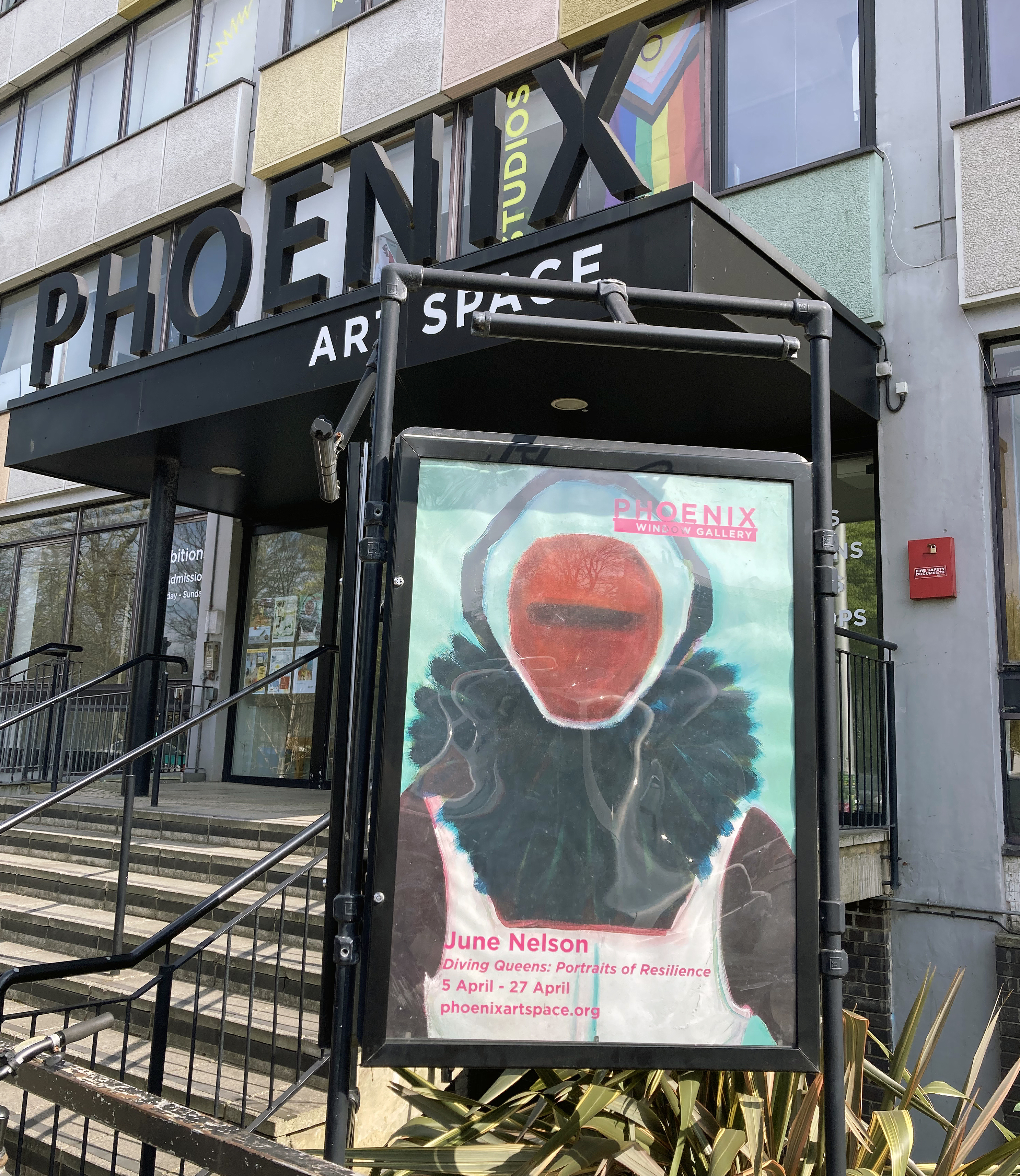
JUNE NELSON: The Gloves Are Off

Diving Queens: Portraits of Resilience

Phoenix Art Space, Brighton

5 to 27 April 2025

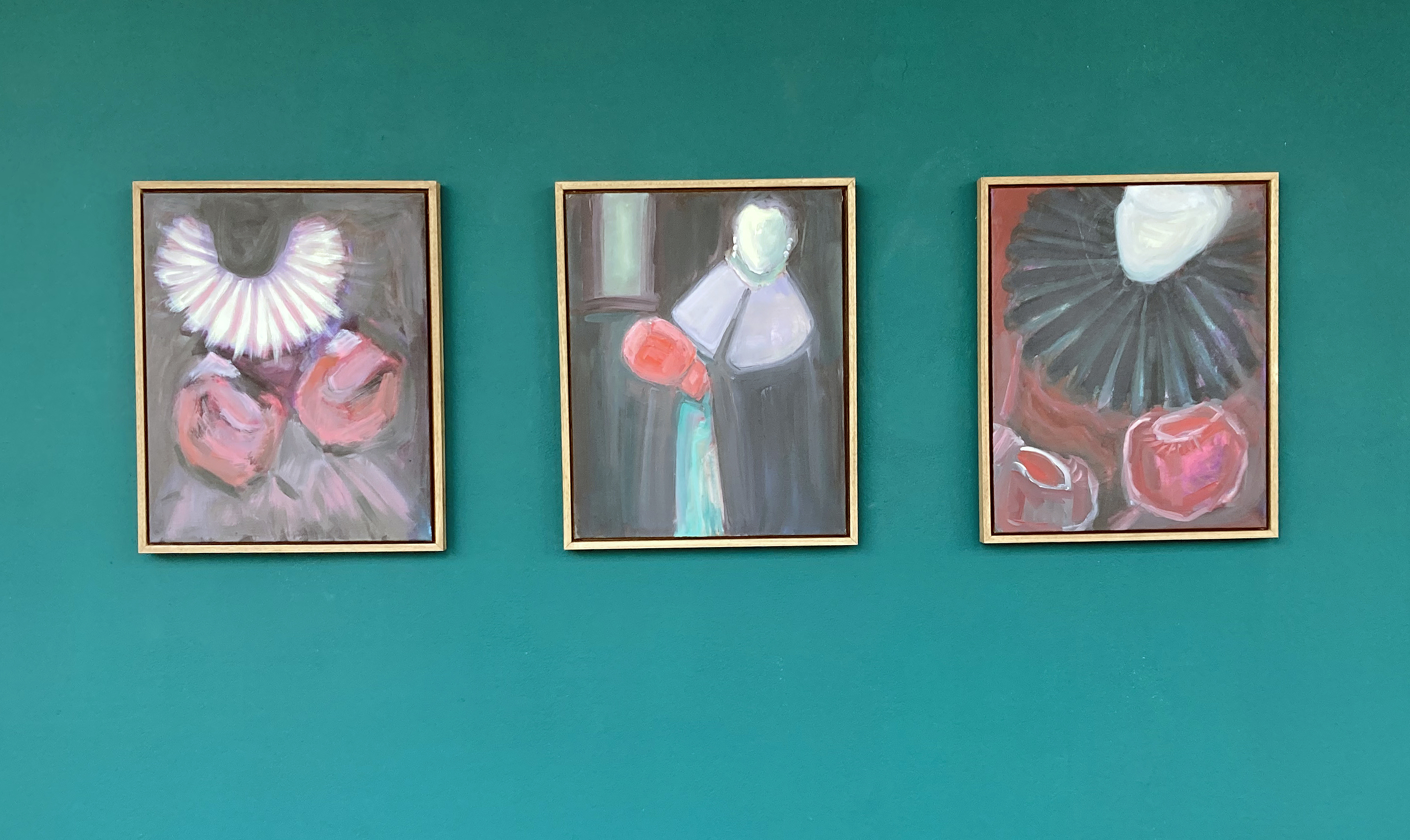
The gloves are off, or rather on. Diver’s helmets too, plus rigid ruffs and helmet-like attire from Elizabethan and Flemish portraiture. In this impactful exhibition by June Nelson the viewer will most certainly sense the presence of an implied wittiness and sense of humour conjoined in a serious and profound range of imagery.

The dramatis personae are unidentifiable as they are everywoman and, I surmise, the artist herself. It’s a clearly contemporary collection of works too, that take in historical references for the present day. What makes the choice of imagery for this exhibition at the Phoenix Art Space so pertinent for today are not only the almost cartoonish and comical images that might (but do not) undermine a serious visual discussion, but also forms a presentation of evidence of a dynamic and self-questioning undertaking aligning a feminist perspective with images to match. These portraits of resilience proclaim a contemporary voice operating from the painting studio, rather than from some alternative social media pulpit. Punches are not pulled.

June Nelson – Beyond Countenance, Regalia and At The Court of the Pugilist (all 2025)

Aligned to a notion of portraiture, that is in fact far from trite or superficial, the works create, with narrative devices such as gestures, gender related costume and the blank gaze, a stage on which to enlighten the viewer. In these sixteen paintings, Nelson holds back from presenting too much detail and is being cleverly and purposely simplistic in not overworking the visual language or the immediately readable content. There’s something here about proclaiming painting as relevant as any other medium too, with a feeling for the materiality of this colourful but sometimes crude substance that is what it is – just as any implied narrative is presented with a rawness of self-awareness and realisation through the crucial activity of painting. Paint, and painting, offers itself up as alchemical process, turning emotion, anger, thoughts and feelings (personal, social and, maybe, familial) into a positive, dynamic realisation and outcome.

In a statement on her website, Nelson has stated:

“I am fuelled by an interest in female agency and our sense of self, using history, mythology, and personal memories to stand witness to often hidden or silenced lives, particularly those of women.”

With this declaration in mind, I therefore assume that there is both a rallying cry, aimed at female observers who share a common sense of unfair, ingrained prejudices in society, alongside a wake up message to the male audience. This could be challenging subject matter for someone like me (a male, liberal, Late-Boomer) who likes to think that he is liberated from gender-based prejudices, when in fact he knows that he still has a lot to learn and to understand. Nelson therefore imposes, via engaging imagery and painterly expertise, a perspective and a position that should not be ignored or discounted.

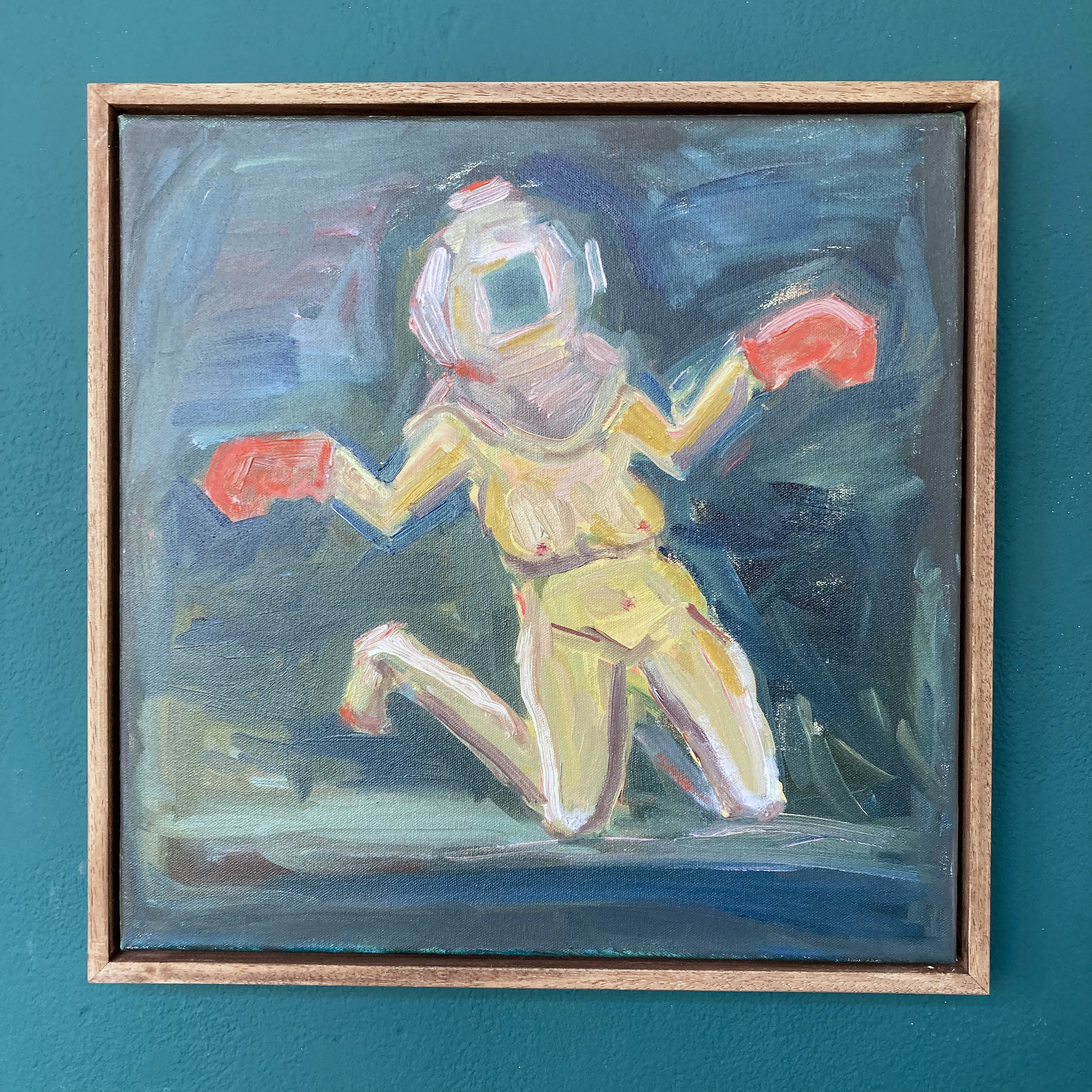
June Nelson – Diver, Deep Brown (2024)

The artist further explains that:

“Recent paintings… continue to explore the same themes and motifs – seeing and silencing, suppression and repression. In a union of the personal and the historical, paintings portray women wearing deep-sea diving helmets, ruffs or boxing gloves. Often taking Tudor portraits or medieval ‘Doom” paintings as a starting point, uncanny faces gaze out at or hide from the viewer. As a modern woman looking back along the matriarchal line, not much has changed.”

This is certainly an absorbing theme and the exhibition, which initially invites a stroll from one end to the other in the corridor-type viewing space, has enough range to encourage looking at individual works as well as carefully selected groupings of pairings or threesomes. This display policy creates a healthy sense of the artworks as an ongoing project, with further possibilities for all sorts of juxtapositions or giving individual paintings their own space. There is both a sense of self and of belonging to a community offered up in this project. With similarities in content, such as entrapment, silencing, battling against the odds, and understandable frustration with progressive developments in ‘modern’ society changing so slowly, there is yet the sense of a series growing quite organically rather than as a too forcefully premeditated or programmatic endeavour. On a more individualistic level for the painter herself, I sensed that there is a form of self-revelation through the practice of being a visual artist, expanding and advancing a challenging discipline, which might always be on the verge of failure. I mean this in a positive context, as both an exploration into conditions of identity and as a necessary condition of painting.

June Nelson – Red Gloves (2024)

There is also a sense of the work-in-progress, as the artist engages in a creative studio-bound journey that is open to trial and error and who refuses to fall into the trap of producing some colourful decoration for the living-room wall. This, I hope, is the kind of project that makes the viewer stop and think, to be unsure, and even to be left feeling a little uncomfortable – particularly if the image initially looks somewhat humorous. For example, as in ‘Red Gloves’ that reveals a naked woman, not conventionally delivered for the male gaze, but almost as a take on a crucifixion of sorts. The outstretched arms, with red bulbous, stump-like ends representing boxing gloves, rather than blood, has a potentially defeated feel to it, but, ironically proclaims a rising strength of character.

June Nelson – Helping Hands (June 2024)

I also felt (but could be totally wrong) a measure of sadness and loss. This unexpected reaction initially emerged from a very small work, ‘Helping Hands’. This was not so much from the caring yellow hands that cradle either side of the outside of the diving helmet, but there is something about the paint application and the gently applied, painterly wash of blues and greys, with perhaps three horizontal strokes of the brush blanking out the eyes, that implied a melancholic theme. A greenish oval floats beneath the helmet like a brooch, a medal or a heart. There is enough scope here for the viewer to bring his or her own interpretation to a subtle yet robust image.

June Nelson – detail from Silence Sealed (2025)

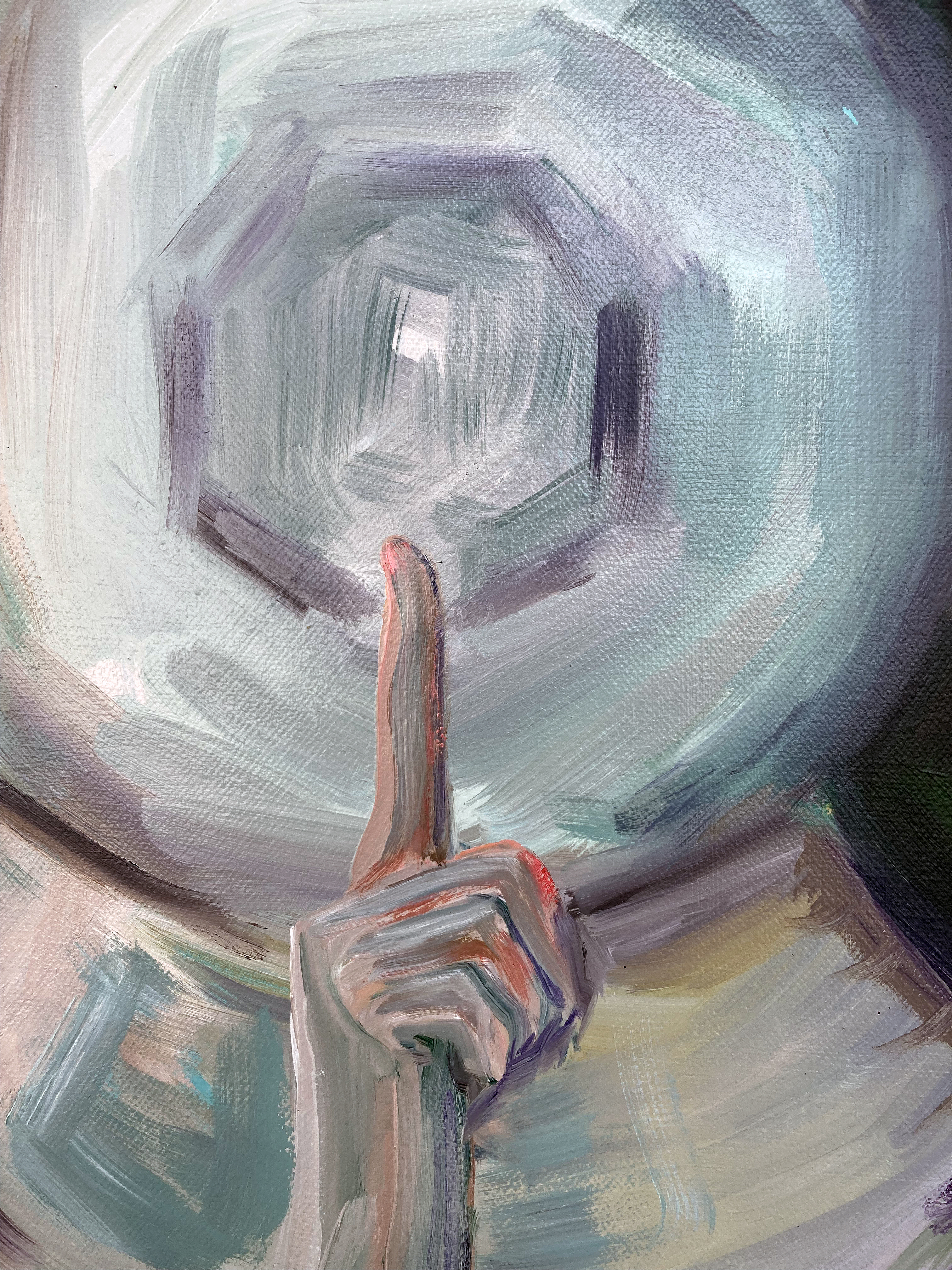
Above this small work was a more immediate kind of message, a hand gesture implying secrecy or suppression, conveyed in ‘In Silence Sealed’. This striking portrait brought to mind the anonymous imagery of a nun from a silent order, with an almost halo-like disc that hid the face of the unaccredited portrait. Yet the icon-like image was not so much religious in a denominational sense, but more universal and quietly empowering, representing a vow of collective, female, knowingness. These are paintings well worth taking time out to see and to allow the imagery to enter one’s own thought-space. To prompt recollection of the roles, say, that our historical (and/or family) predecessors played, or that our contemporaries in society undertake today. Nelson’s characters form a sort of Commedia dell’arte for the past, the present and the future. But any implied comedic element is wittily and unambiguously turned into serious content. The female viewer is both in the ring and in the audience.

June Nelson – Diver, Deep Brown, Pink Diver and Diver, Jade (all 2024)

LINKS:

June Nelson’s website

June Nelson on Axis web

Instagram

Phoenix Art Space

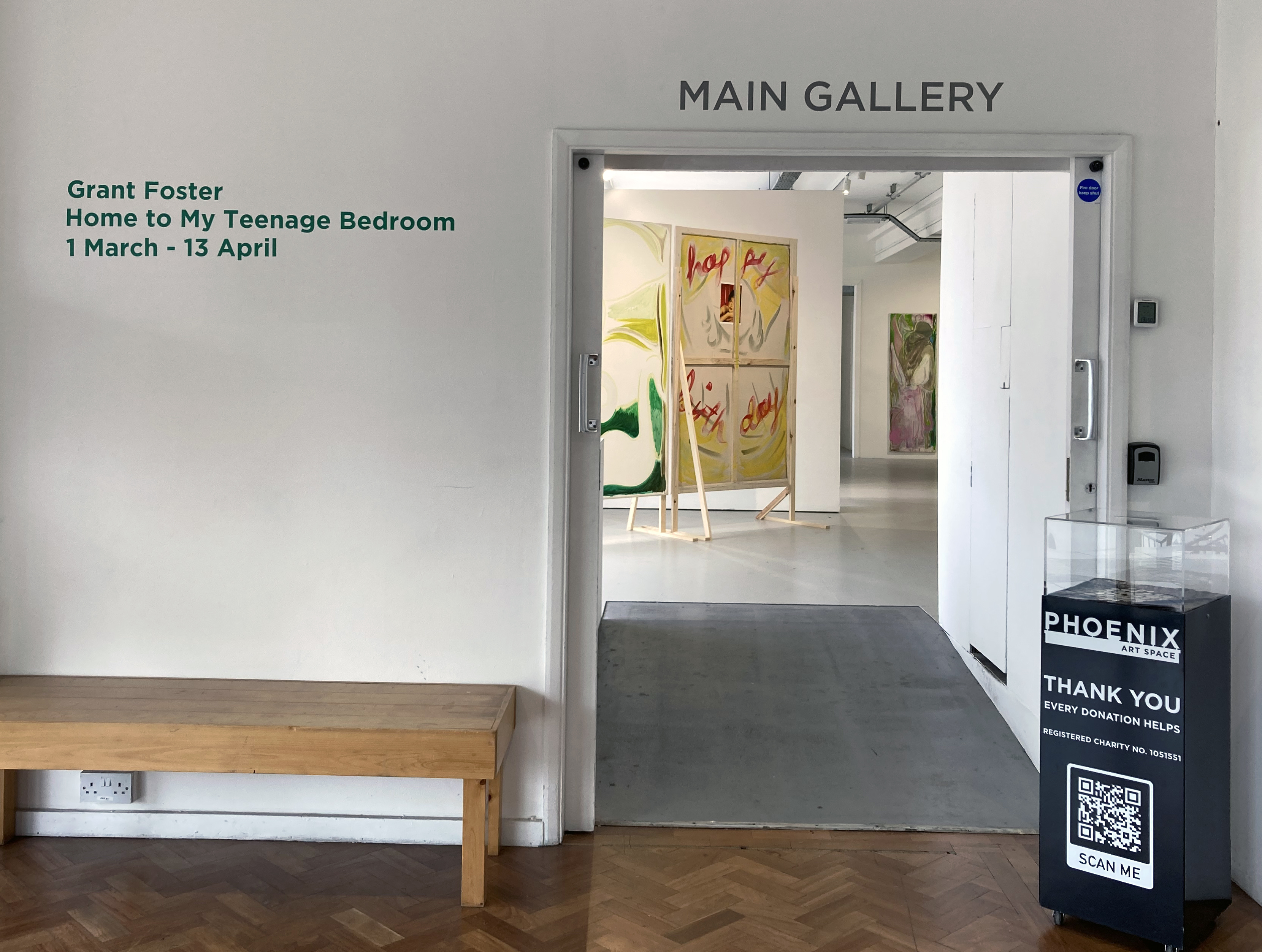
GRANT FOSTER: Home To My Teenage Bedroom

At Phoenix Art Space, Brighton

1 March to 13 April 2025

Often the best paintings, literature, music etc. take time to come through. The first impression may well be the one to not give too much credence to. A degree of complexity in any art form deserves a period of further thought. After five or six visits to Grant Foster’s exhibition at the Phoenix Art Space I know that I need to look again and again. This is good.

Q. What do you think about when you are looking at an exhibition of paintings?

What is the mind of any onlooker doing? Searching for something recognisable? Prepared and preconditioned by our shared culture we might be expecting something general or commonplace, such as a human figure, a landscape or objects constructing a narrative as a way into the work. What, potentially, could these visual references add up to? What might the storyline be, if there is one? And if the narrator/artist is describing something, making a serious statement or spinning a yarn, can you relate to the theme? Alternatively you might be more of a formalist with an eye for the aesthetic hit. The purely visual, via systems or improvisation, might be your thing. Either way, so-called content can be very complex or minimal. Of course, if the exhibition has a title you are already geared up with some expectations. Home To My Teenage Bedroom sounds perilously loaded.

There may be some idealised notion of preparing to see an exhibition as objectively as possible with the mind emptied. Ideally the extraneous thoughts of those other aspects of one’s life are put aside, at least for a while. It may be an artificial approach, but imagine entering a show with a mental blank slate. No preconceptions or expectations. What is experienced afresh? Nope. This is just not possible, or even desirable. Our various histories create our personalities (however flawed or enlightened) and enable a personal take on what we see and understand. In the case of this show we might consider that that teenage past was an under investigated portal that might throw some light onto who we became in adulthood. Grant Foster acknowledges this potentially rich period of life in a wall statement:

“It’s often said that our teenage years are the most decisive – our interests, obsessions, and passions are innocently formed and planted like seeds, taking root over time.”

But without any foreknowledge beyond the title of the show, visiting Foster’s exhibition at the Phoenix Art Space initially left me more impressed with the thoughtfully and dynamically prepared arrangement of works by the artist with the new Phoenix Art Space curator Laurence Hill, than with the paintings. I made no connection with the content, despite knowing the title of the show. I was surprised and sensed that this was a body of work requiring more viewings. In retrospect I guess I was a little overawed by the presentation. But I sensed that a few visits might be necessary, if only because my thoughts were probably too elsewhere – especially at an opening event that was extremely well attended as the crowds flooded in for three painting exhibitions under one roof.

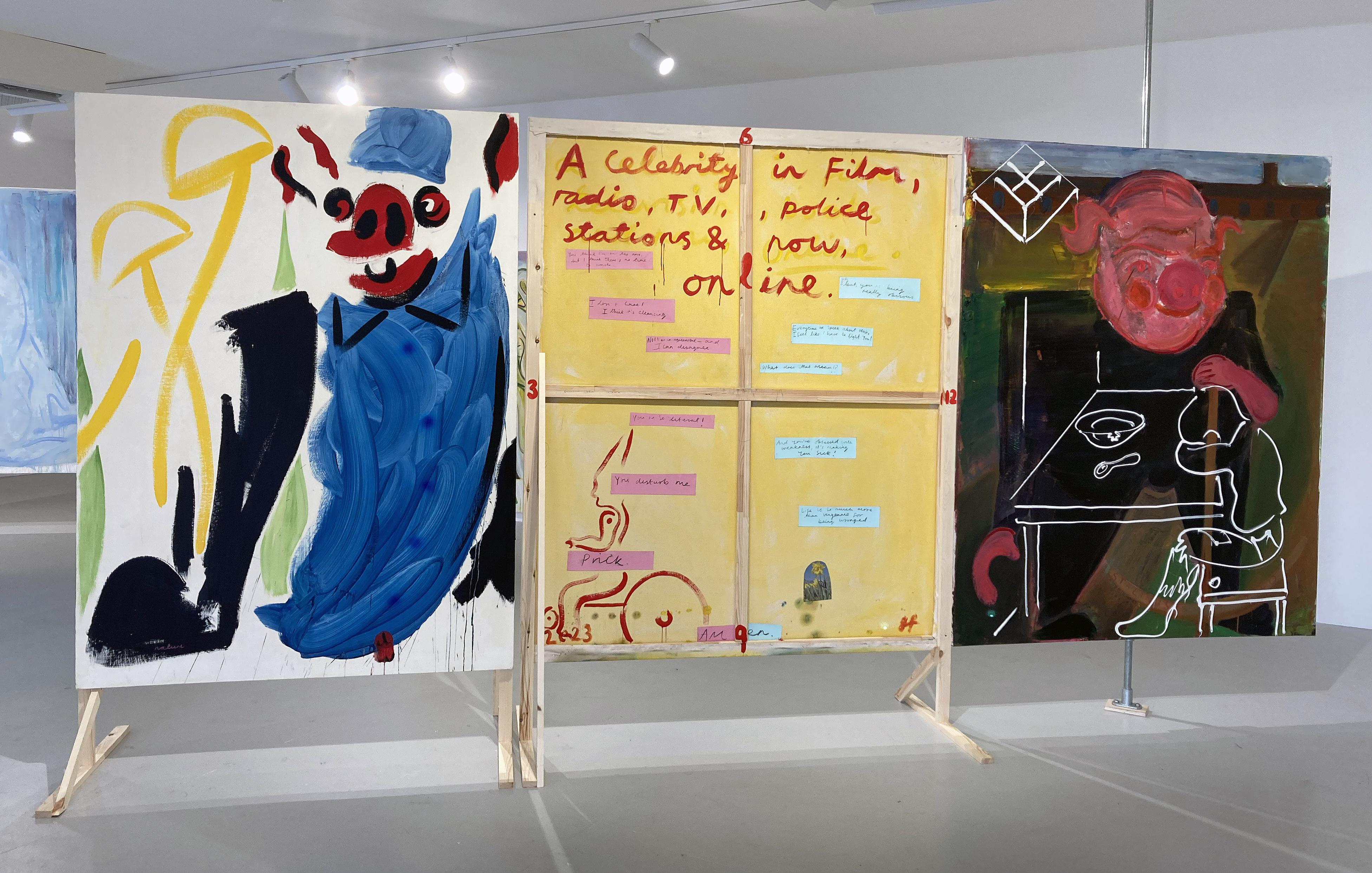
Grant Foster – Nature V. Nurture (2024) Help (2023) back and Psychiatric Hospitals, Full, No. 3 (2020)

Back home at the computer keyboard I recalled my first visit, and an all too brief second pop-in the next day, by describing, albeit generally, those initial impressions. The earliest typed out observations prompted the following text:

The visitor very much walks into this exhibition. Into a structured, planned space – but not forced, obliged or coerced to travel in a particular way. This installation invites a weaving, walking, stopping and starting, slow dance in, around and even through the works. In the large main gallery the majority of the fifteen paintings are free standing, fixed on wooden structures that are equivalent to the human scale. Some have vertical poles, like spines, attached from floor to ceiling to prompt the visitor to actually touch the work of art and to carefully turn it around, thereby opening a door of sorts and changing the arrangement where, in two instances, accompanying canvases are set up next to each other as a triptych…

Grant Foster – St Francis (To the Stars) (Matter without Hierarchy) (2024)

But I was clearly missing so much more. On my third visit I found myself tuning in to the echoes of the art historical that, generally, permeates all contemporary painting. Plus, the painterly visual language and the way that Foster generally draws with the paint media – perhaps as an expression of his personality – was immersing me into the imagery. For example, in the four St. Francis paintings, representing statuesque Giotto-type figures that are placed as two separate implied diptychs on the walls, the paint application is fluid and almost shorthand. The figures have turned away from the viewer. Are we to follow – through some kind of portal? Then there is evidence, no more than implied, of other figurative content. A cat in one composition and a swan in another. There may be some wings too and a building type passageway where there might otherwise be legs. Is there a rural environment too, with a little taste of landscape beyond? The uncertainty must be deliberate.

Grant Foster – Nature v Nurture (2024) rear

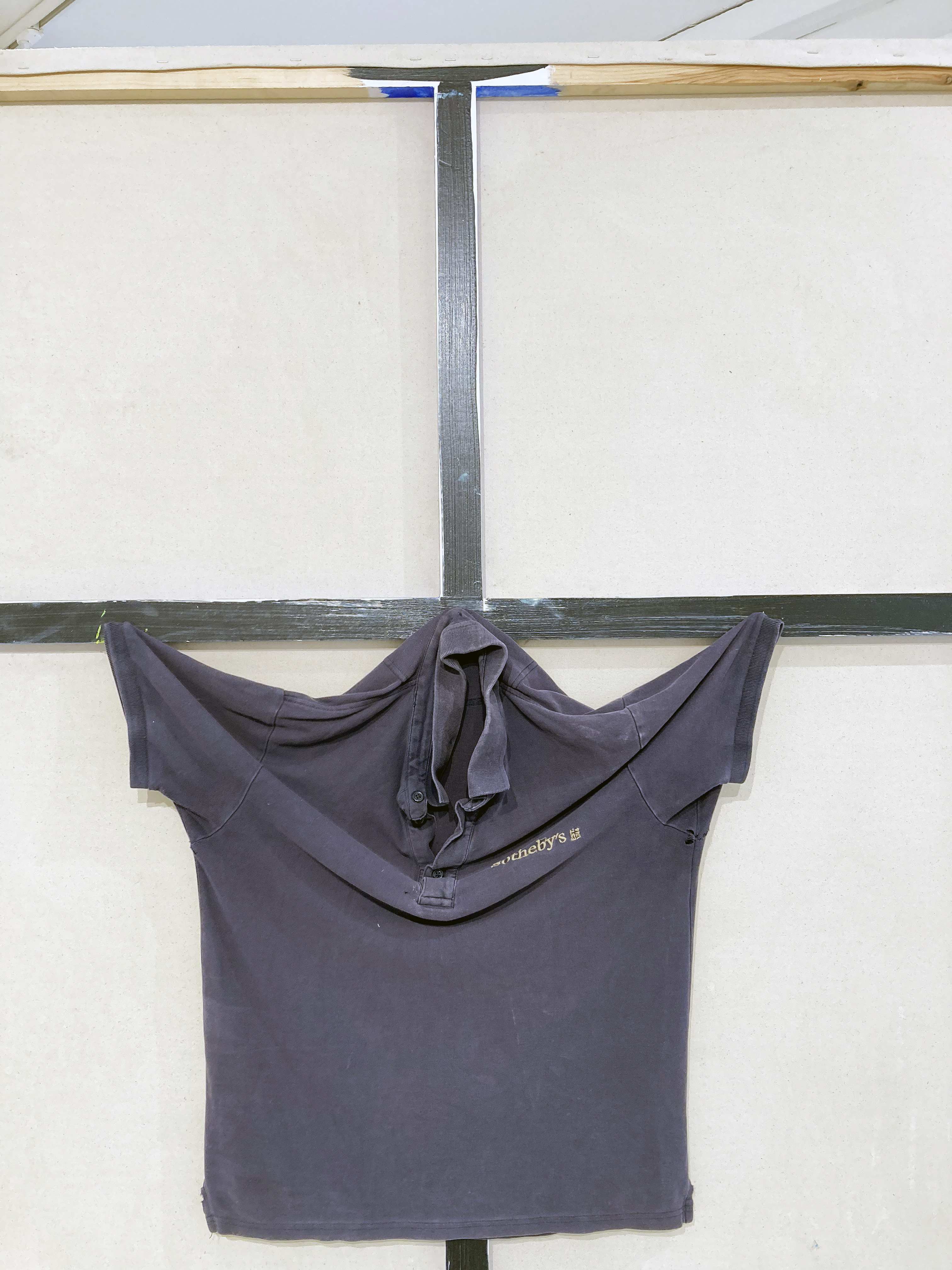
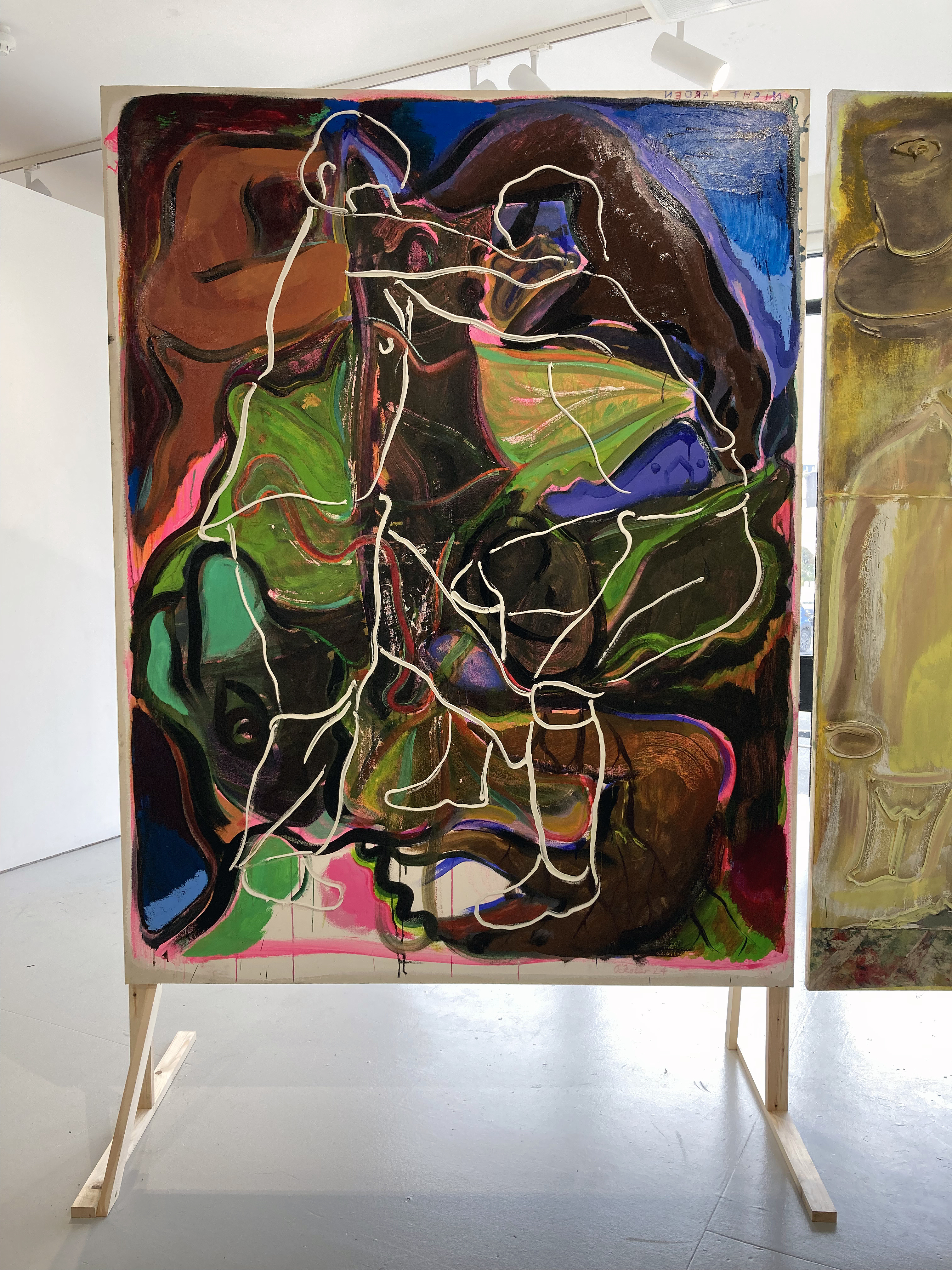
Another art historical reference might be the Sotheby’s work shirt fixed to the reverse of one of the freestanding canvases, Nature V Nurture, to suggest the Crucifixion. Perhaps I am reading too much into this, but others have made the same conclusion. On the front of this canvas a cartoon-like figure dressed in blue, but with red and black facial features appears animated by what might be two large yellow (psilocybin) mushrooms. This could be a retrospective self-portrait. It may not matter. Already, external contexts (facts or fictions) are expanding the reading of the works, even if I am mistaken. I am thinking again about the almost sketchy way that Foster applies the paint. In some of the works, many of them in fact, there’s a slightly underworked feel to the painterly execution, as if too much effort is to be avoided. This equates to a notebook-type intention, a formal device, which I interpret as a reference to a way of thinking and to the nature of mental recall. Events of the past, however strongly remembered or not, become a form of visual shorthand. Yet two canvases in particular stand out as comparatively overworked (even if they are not). These are Psychiatric Hospitals, Full, No 3 and Queendom which are each a part of two different floor-based triptychs.

Grant Foster – Nature v Nurture (2024) front

Each of these compositions appears quite different in subject and imagery. The former depicts a building (the hospital?) in mid-distance with a bloated pig-like character in the foreground, stood behind a table where a sad child sits with a discarded spoon and an empty bowl. In the latter, foregrounded figures appear to be involved in a judo move. Like the boy and table in the other painting these grappling forms are created with a squeezing out of white paint straight from the tube. Despite the two contrasting painting styles this incongruity works.

Grant Foster – Queendom (2024) front

Queendom is the more complex, visually loaded image. Over time the observer will make out other forms including a naked figure in the top left corner (which reminds me of figures from both Titian and Matisse); two animal forms (formerly cartoon characters from a childhood comic book?) and even a flat smiley face symbol, albeit with a nose, just below the centre of the composition but in shadow. I am sure that there is more here to emerge from a ghostly, shroud like confusion that threads throughout the composition. The looking experience is truly durational, suggesting that more could well emerge.

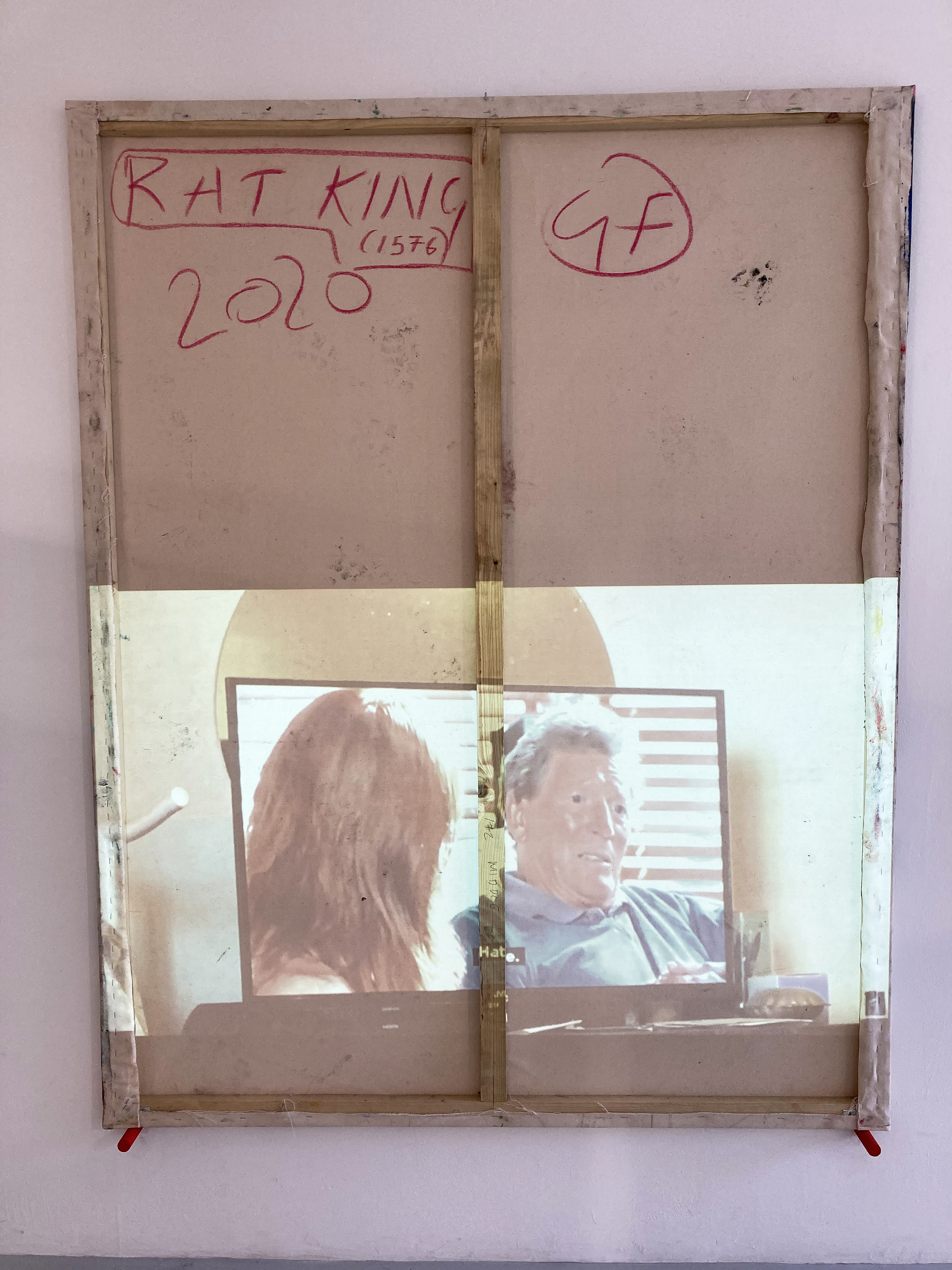
Grant Foster – Rat King (1576) (2024)

On this time-base note Rat King (1576), which has the de facto front pressed to the wall, adds a digital layer provided by the projection of the Telly with Mum video repeating every 43 seconds. This small element of the digital might be a pointer to future developments in Foster’s work – or a remnant of a past engagement with the once trendy art college digital projections that can be somewhat passé. But the projected content does provide a moving image element of collage that references watching television, which was the precursor to the computer screen and now the mobile devices that cling to our hands like an extra organ, back when Foster was a teenager.

Which brings us to a literal emergence: the backs of the paintings. The majority of the works have backs to be viewed as additional fronts, which will be an interesting challenge for collectors of Foster’s works. The convention of writing a title and adding a signature on the reverse of the canvas is developed from what might be seen as the private space (like a sketchbook or a notebook) that actually wants to be quite public. With the further addition of painted imagery, photographs and extended text, they are clearly beyond being auxiliary or supplemental to the conventionally expected paintings made on the front of the canvases. The stand out rear view to me was on Help, which included a small printed image of a daffodil, a painted pixie-type figure riding a bicycle, a possibly alternative title (‘A celebrity in film, radio, TV, police stations & now online’) and a conversational collage of hand written text that was a recalling of a conversation between the artist and his partner. Foster’s jokiness feels deadly serious.

Grant Foster – Help (2023) reverse

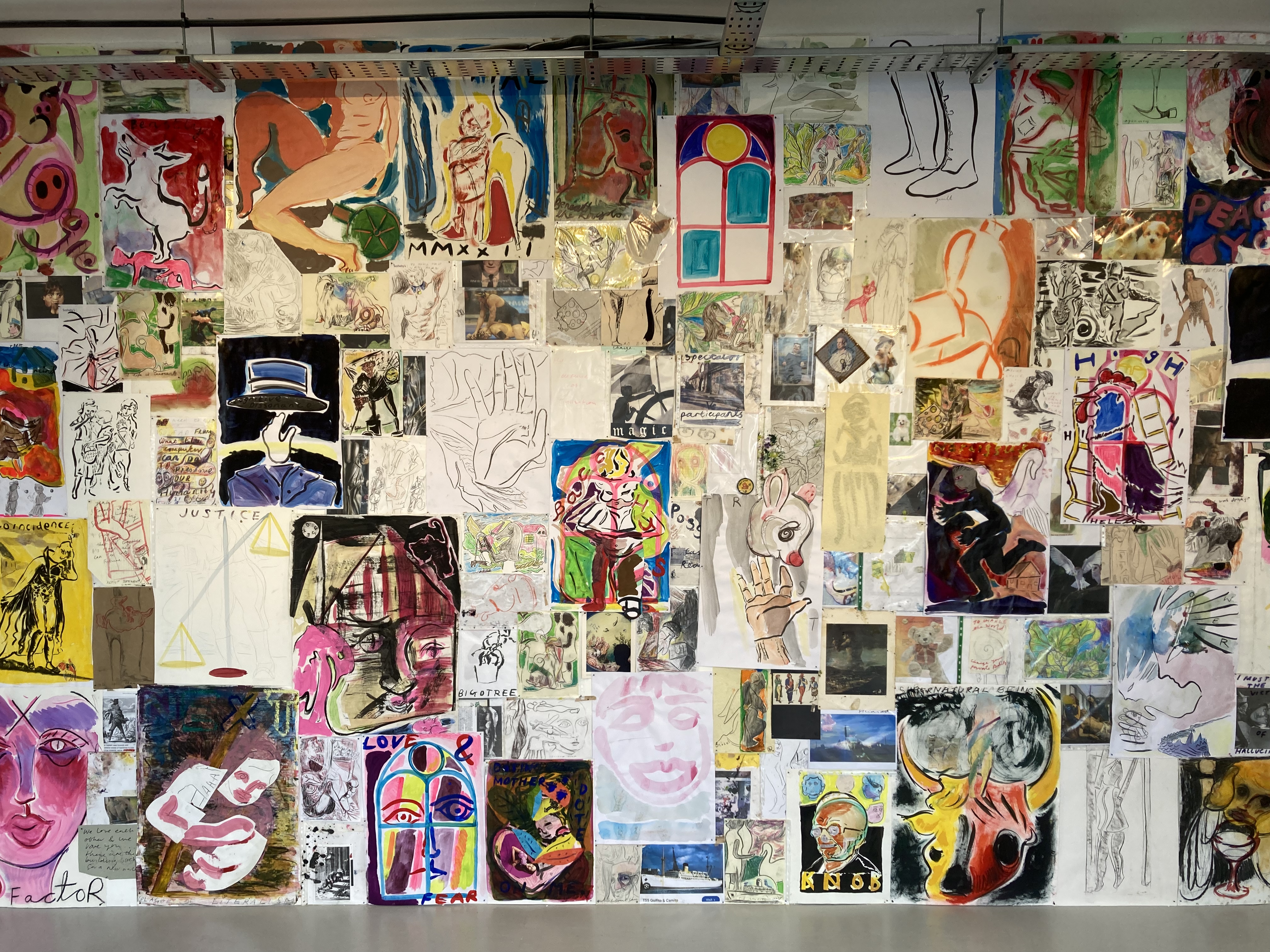
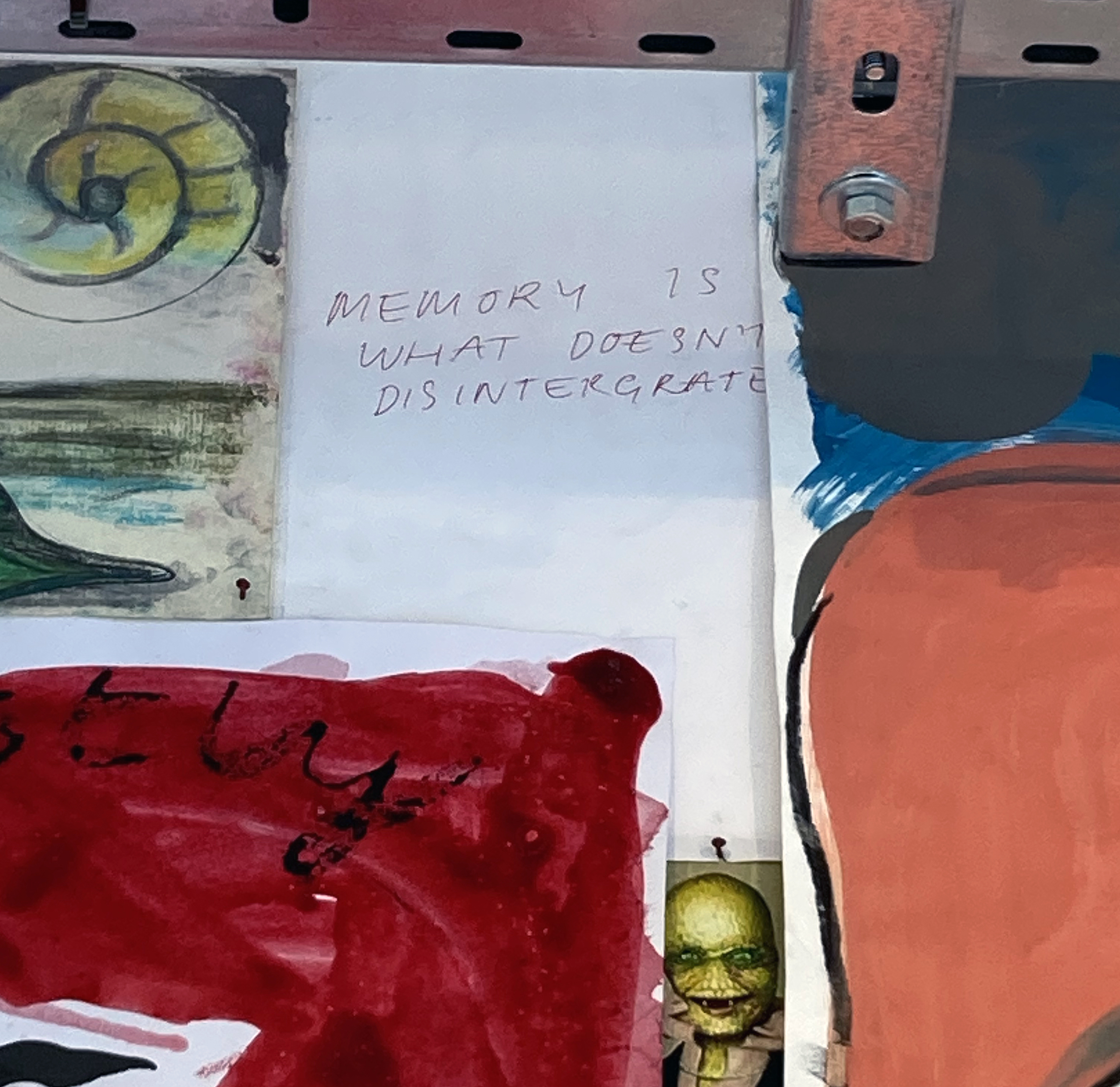
But delve further. Beyond this environment of paintings on the floor and walls the visitor, as a possible means of escape, enters what (in retrospect) may have been the implied bedroom of the artist’s youth. An annex off the main gallery with a large wall displays at least two hundred (I wasn’t counting) drawings, paintings, written notes and printed reproductions on paper. I jotted down a few of the phrases: Love and fear, All life is innocent, I must be the victim of a Hallucination, Innocence, Be Good People, and my favourite: MEMORY IS WHAT DOESN’T DISINTERGRATE (sic). Pictures (from books, art, TV, newspapers, magazines and the Internet) are so important to us all – and virtually unavoidable, then and now. Imagery from all and any context feed the imagination. There’s a sense of being inside an image-based thought process in Foster’s work that is constantly nourishing the potential of what the formative and the now fully realised artist continues to imbibe and assimilate. It’s the magical ordinary extracted from an image and text obsessed world – that was surely first started back in the caves of pre-historic humankind when the fundamental technology of mark making and visual language was really no different to now.

Grant Foster – Wall of works on paper installation

Foster’s wall text at the entrance explains more about the accumulation and assemblage of text and imagery:

“My studio is a haptic, experimental environment, where I continue to collect images, organising through free association: drawings, phone-screen grabs, newspaper clippings, children’s book illustrations, advertisements, and fragments of text.”

So, if the teenage bedroom was a place of seclusion that conversely expanded the imagination, then the adult studio clearly continues this function. Connected to thoughts and memories a touchy-feely collage type process, aided and abetted by literal touch as imagery that can be moved around, has expanded to and created the paintings in this show. On a more universal level we, as viewers, can surely connect with this phenomenon of the imagination, which runs alongside the everyday. Like the artist, we are always reconstructing and re-remembering: memories of memories, whether it was earlier today or decades ago, the happy and sad places, the images we made/make and those that we receive voluntarily or not. Narratives may not always be trusted as truth but new meaning or continuing misunderstanding may be of greater value and emotional impact as we age.

Grant Foster – Panspermia (2024)

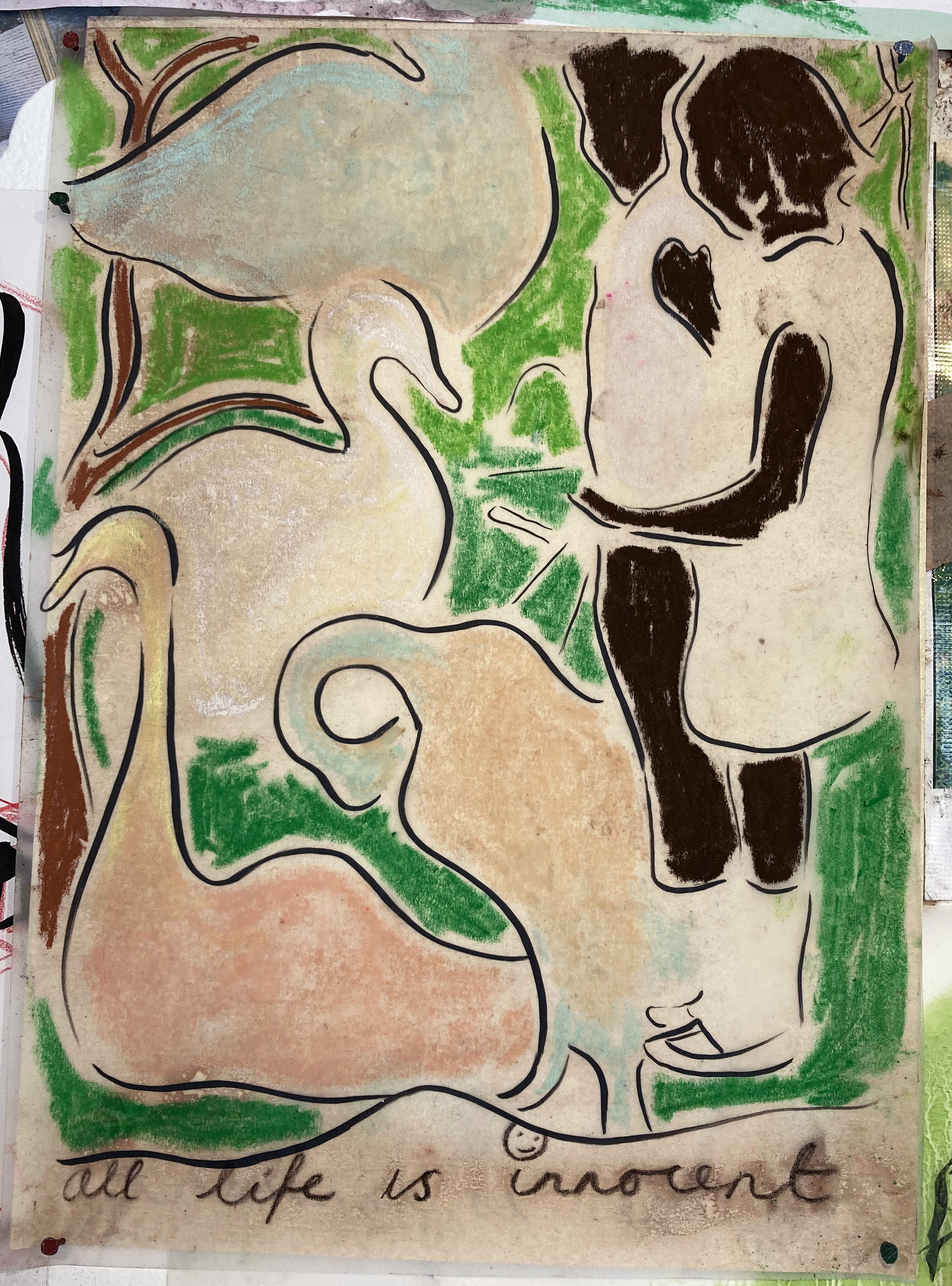
At this point as I consider wrapping up this review I recall a reoccurring image from the exhibition. There is just one photograph reproduced in the publication, A Year of Kindness that Foster has published and presented as the first listed work in Home to My Teenage Bedroom. It shows (I believe) the artist’s mother and uncle standing close to water where a swan has approached. The image is first encountered in the exhibition in the painting entitled ‘Panspermia’ (which Wikipedia informs us “is the hypothesis that life exists throughout the Universe, distributed by space dust, meteoroids, asteroids, comets, and planetoids…The theory argues that life did not originate on Earth, but instead evolved somewhere else and seeded life as we know it.”). The image crops up again on the amazing collage wall of imagery in what must be a preliminary drawing for the painting later on.  Now there are four swans, curvaceously morphing into organic shapes. The drawing could easily have been missed amongst so many images, but may have stood out for its line of handwriting at the bottom of the page: “all life is innocent”.

Grant Foster – Drawing for Panspermia

Returning to the painting, Panspermia, one sees that the swans could be read as decorative visual elements and that the black lines in the earlier drawing are now changed to a more yellowish green hue that visually suggests an organic environment. The branch of a tree fills the head shape of one of the two figures. Is that a wind farm sail in the top left hand corner that hints at the environmental concerns of today? It makes for a somewhat dreamy image whereby the unconscious is given as much credit as anything rational.

Near the start of my response to this exhibition I posed the question: What do you think about when you are looking at an exhibition? Perhaps, what you and I think about after seeing an exhibition is more pertinent. Our memories of previous experiences, times and places are embedded in our imaginations as we engage in recall. There might be hidden treasure in a photograph album too. Timelessly it’s all a here and now that, for some, becomes stronger as we get older. Foster provides much for the viewer to consider. Nothing is necessarily too clear to merely illustrate. This project sets us up. The viewer has work to do.

Geoff Hands (March 2025)

Grant Foster – From the works on paper installation

LINKS:

Grant Foster

Instagram

ExeterPhoenixGallery talk on Soundcloud

Phoenix Art Space

CALUM LOUIS ADAMS: an elephant, a room

At Gallery Dodo, Phoenix Art Space, Brighton

24 January to 9 March 2025

Friday 22 November, the original date for an elephant, a room at Gallery Dodo in Phoenix Art Space, came and went. Then a poster displayed on a window next to the front door of the main entrance announced that the exhibition had been postponed. Expectation supplanted by disappointment. But this was to be an exhibition presented by a conceptual artist, Calum Louis Adams. So, that’s it – wait with Godot. Brilliant I thought – the anti-climax palpably real. No show (yet) constituted a show. Or at least the idea of a show, which happened imaginatively in real time and space, constructed in my mind. The potential object of an exhibition that was fabricated by a poster (a form of text) to manifest itself as an illusion of sorts. But no.

Then a new poster appeared in the window just a couple of weeks ago. There is an exhibition after all. I was disappointed initially, as the joke was on me. But hang on; I am getting two shows for the price of one here so long as I visit the exhibition.

During the afternoon of Friday 24 January I got a sneak preview of an elephant, a room that Jon Carritt, Dodo organiser, has installed. You really have to see this space, a former toilet and washroom, to appreciate how unique and rather special it is. How fitting, therefore, it was to hear the soundtrack of a woman urinating, recorded on a single channel looped video, from a screen placed on the back wall floor. Or at least the phenomenon of a common sound from this electronic device would convince the perceiver of the actuality of a necessary kind of daily performance: now become art in this physical and conceptual context.

The door entrance (it’s just one room) was wedged open with a carefully folded up sheet of the single page A4 gallery handout that had to be the right thickness to hold the door in place. This was the second of the three works presented. The third was the text and digital image printed on the reverse of the handout, though the stack of handouts were placed on top of a wooden plinth, which might be counted as part of the installation. Extrapolating from this of course, the floor, ceiling and walls are the exhibition too. As is any visitor. I found myself taking some photographs of the partly renovated walls, wondering if an elephant might lurk somewhere.

This interestingly rambling/stream of consciousness text, written by Adams (I assume), consists of three paragraphs that link stories of a “startled crow”; the notion of a “Brood”, a collective spirit, a small car parking on the nut that the aforementioned crow has previously been eating, an abandoned house, smashed windows, a previous exhibition of the artist’s during which, on hearing a line from a song by the singer Clairo, changes their thoughts about a moment during which a window changes its functional self identity. Next there is a reference to a woman who drinks her own urine (from the American TV series My Strange Addiction) – which may or may not link to the urination soundtrack mentioned above. The final section of writing summarises these various parts as personal thoughts about choice and the possibilities of the crow’s possible awareness of the observer and the car having some sense of the crushed nut under its tyre. It is quite possible that the visitor who picks up the printed sheet will not read the text until later. A common habit (of which I am guilty) is to read the text handout on the journey home or even later. I would now guess that Adams wants the text read whilst in the show as it is listed as one of the exhibits. Although it is possible that this does not matter as the text read later, elsewhere, extends the exhibition and enables the reader to possess one of the artworks and to create something through the act of reading.

So where’s the elephant from the exhibition’s title? Well, to be literal, there is a minimalistic linear sketch of an elephant printed on the front of the handout. A visual representation, alongside the word elephant itself, which only makes cognitive sense if such a word (a label or name) is already in the viewer’s cognitive lexicon. Alternatively, the creature may actually reside in the mind of the viewer as the imaginative synonym of the elephant in the room – which may or not be in the room at all but perhaps appeals to an art practice that explores arty aesthetic ideas and objects. I wonder if there is a self-deprecating aspect here too, including a possible negation of the artist (a form of identity and an idea as well as a career choice for an actual human being, an object of sorts) as being worthy of explanation.
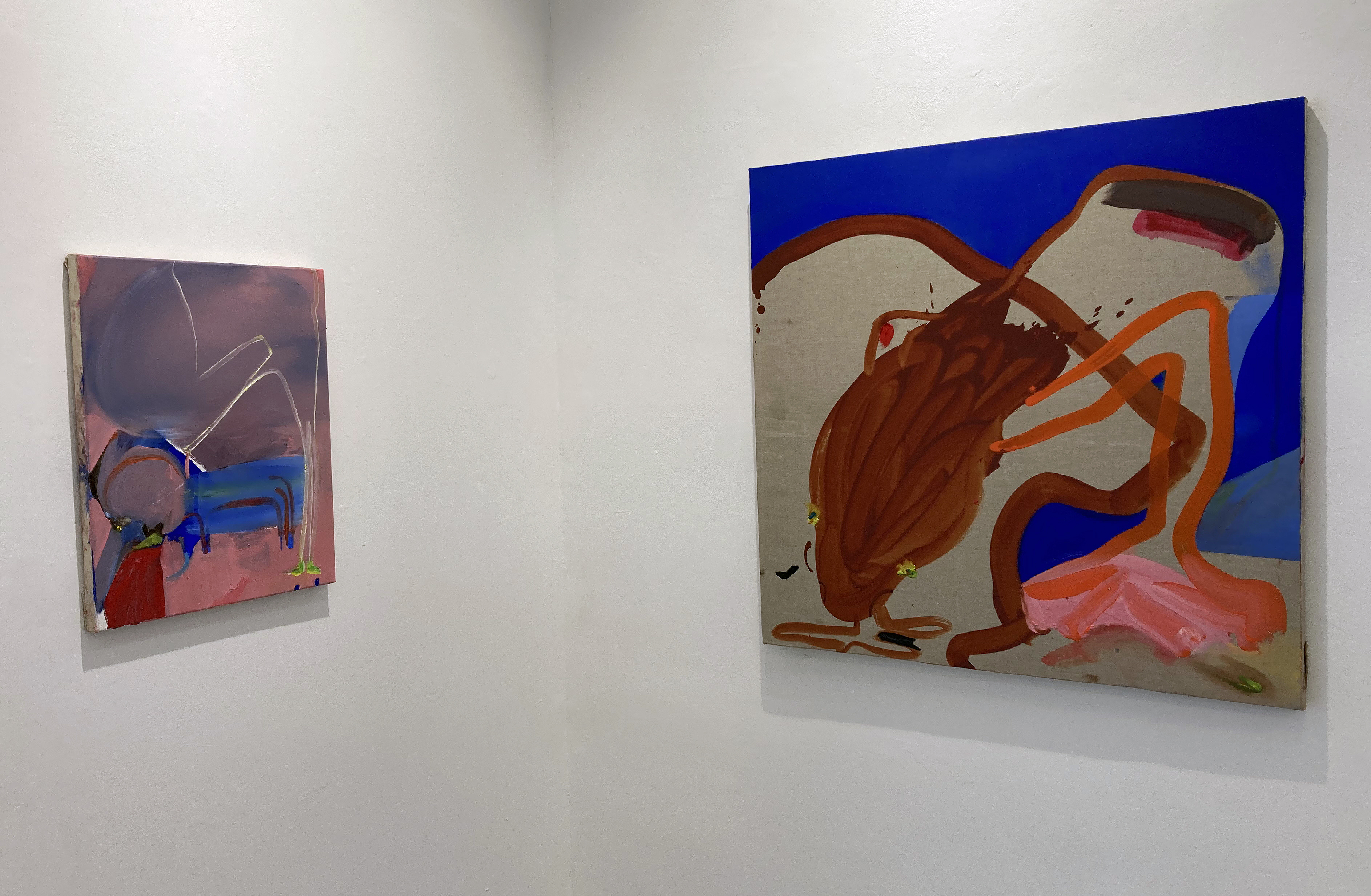
I was told that the artist would not be attending the opening evening due to rail travel difficulties during inclement weather conditions in Wales, where they live. Or perhaps this was fortuitous, as perhaps the physical presence of the artist is not so relevant as it could detract from the show, the physical work and the non-physical ideas or potential concepts. How suitably anti-climactic.

LINKS:

Calum Louis Adams

Gallery Dodo

Phoenix Art Space

OLIVIA GUILLOT: Swallowed A Fly

At Phoenix Art Space, Brighton

26 June to 30 June 2024

Wow! Some paintings, some actual, real, “look at me I’m a painting”, paintings. Sometimes the best things happen when you least expect.

It has been a busy day and I am rushing around town. Dad’s taxi, paintings to collect from the framer’s, pick up a few things from Sainsbury’s, park at the studio (yes! there’s a space), say ‘hi’ to people in the corridor (make out all is well), pick up a notebook, water the plants and then, as I almost depart… there’s a new show just been installed in the Project Space at the Phoenix. But there’s no time to stop, but one has to.

Olivia Guillot, a recent graduate from the University of Brighton, has installed a display of seven paintings and a sketchbook in her first solo show, Swallowed A Fly. I am immediately drawn in by the painterliness and the strong colour hit. I might only have a few minutes, maybe 10 or 15 if I can dismiss the future awhile. Painting is so much more than the here and now, of course.

Olivia Guillot – Swallowed A Fly 2024 (120x150cm) oil on canvas
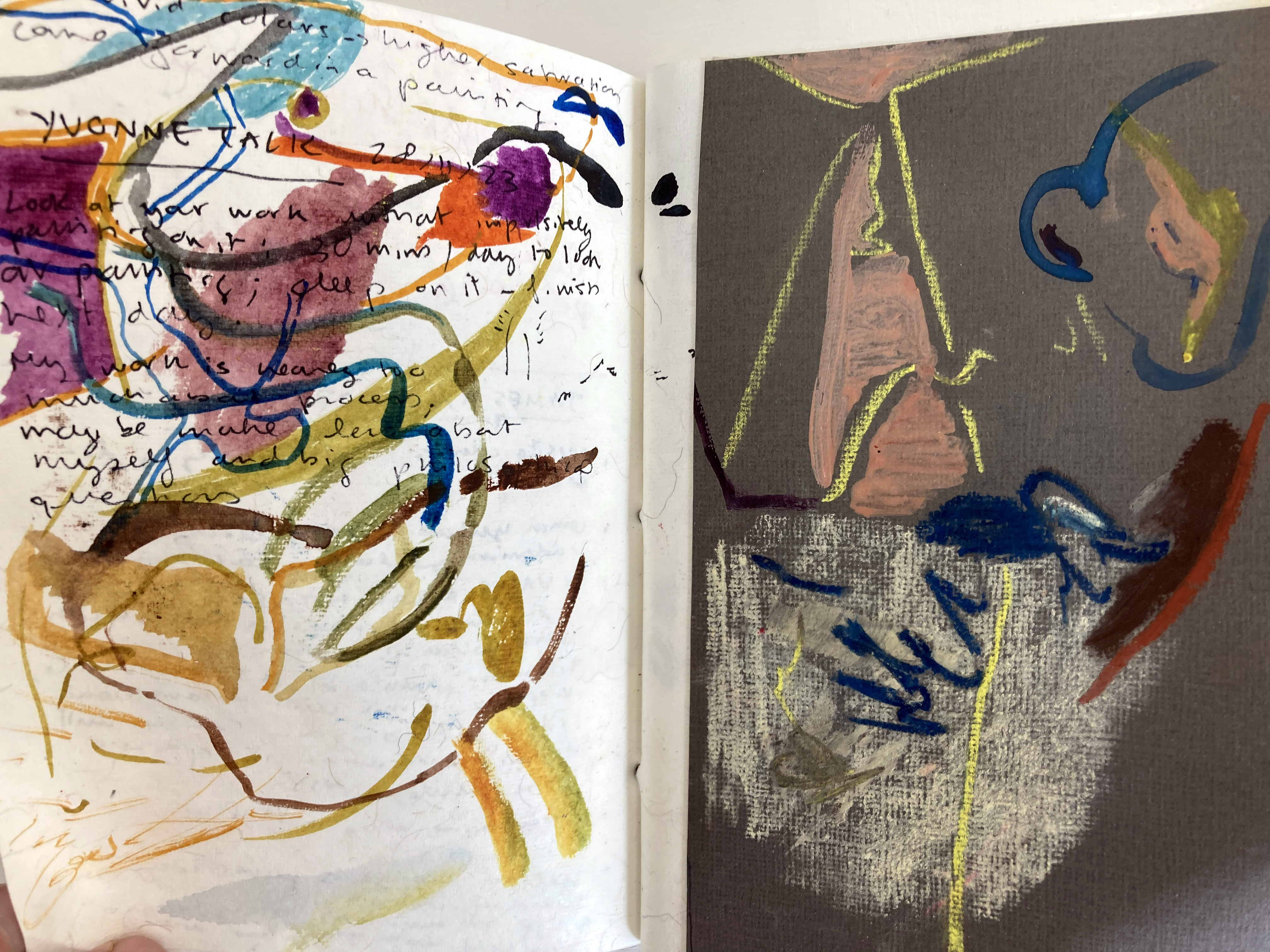
The works are lively and painterly, oh so painterly, and as fresh as the perennial daisy. This artist clearly has an almost unchecked love of paint and colour and image. I say ‘almost unchecked’ because there is a visual intelligence emanating from these canvases. There is a restraint too; revealing a painterly design sense that I suspect is intuitive. Whatever, these works are so refreshing to see with their vitality and energy. Paint and image are in transition, despite the fixed nature of the resolved canvas. What are these images peopled by? The figurative and the abstract meld. The act of painting, sucking something up from the imagination (whatever that is) makes new scenarios. Magic.

Olivia Guillot – Walkies 2024 (20x40cm) and Anteater 2024 (100x100cm) both oil on canvas

More joy: There’s a sketchbook (item no.3 on the exhibition plan, which gives an equal status with the paintings) that the visitor can leaf through. Why can’t artists show their sketchbooks more often? In some way this is an unusual, even a brave, decision. A document like this is such a personal document. Containing good and indifferent drawings and colour studies; notes from a tutorial; bare thoughts. But viewers should get the bigger picture (pun intended) and see some of the working and thinking process that determines the end result. That final canvas has a studio history. Discussions have taken place. Doubts work alongside discoveries and day to day planning. Ruminatory thoughts have floated by, sometimes recorded in scribbled notations. Perhaps there should be a clause that every painting exhibition includes a sketchbook or two.

Olivia Guillot – Sketchbook

Painters have to have confidence of course, a resolve to climb on board for the journey. It’s an attitude thing. Guillot has this in abundance.

For contemporary painters the gallery system is not always open enough. The Gatekeepers are not always into painting, after all. Painters have to raid the bank account and rent spaces. Painters have to be self-confident and brave. But, despite obsessions with alternative media, painting persists. Painting courses, such as the one at the University of Brighton, attract students of a highly visual persuasion. The medium encourages investigation and thought; self discovery and realisation. Out there in the ‘real world’ there are so many painters – and they are, for the most part, a national treasure.

The end result, like this small but expansive show, is akin to a music gig. The various parts are given extended strength by the grouping, the set list. See the show if you can, get the ‘hit’. Let the experience dissolve into your consciousness forever.

Geoff Hands, June 2024

Olivia Guillot – I Cant Stop Making Mush 2024 (100x100cm) oil on canvas

LINKS:

Olivia Guillot on Instagram@livguillot_

Update: Tracey Emin Foundation

H_A_R_D_P_A_P_E_R

At Phoenix Art Space, Brighton

2 March to 14 April 2024

Paper has been around for ages, maybe 5000 years, especially if we include papyrus from ancient Egypt. Artists love this material. Even digital images end up being printed on it. Just as there will never be a paperless office, there will never be a paperless art studio.

Abstract art may have been around even longer than paper – I am thinking of pattern-like marks made on the body with mud or blood, or in the sand with a stick – before any notion of symbolism or figuration advanced visual language. Today abstraction continues to interest many painters and in Brighton we have been fortunate enough to see a good range of the more geometric, non-objective formulations in the H_A_R_D_P_A_I_N_T_I_N_G shows at the Phoenix Art Space in recent years.

When I first heard about plans for the H_A_R_D_P_A_P_E_R exhibition a few weeks ago I was pleased that drawing and collage – maybe even 3D forms too – might get a look in alongside the painting that I assumed would dominate this project. I wasn’t wrong.

Paper can be passive or add agency – by way of an effect of literally underlying subtlety or more overtly pronounced and structural. In this exhibition there are examples of a suggestively drawing or print-based approach as well as monochrome or limited palette imagery. As expected from geometric abstraction, linear grid-type configurations, systems based structures through to colourful, almost (dangerously) painterly imagery is included. Just over fifty artists have contributed works that they selected themselves. Perhaps this was a risky decision not to completely control and steer the selection by the four H_A_R_D_C_U_R_A_T_O_R_S (my tongue-in-cheek term for Ian Boutell, Patrick O’Donnell, Philip Cole and Stig Evans) as they went for the light touch and allowed things to happen. Based on a first impression I felt that the decision had worked well enough and, as with the previous painting shows, the viewers are given a little taster to seek out more from these practitioners.

An alternative point-of-view, however, might demand a much tighter range and a smaller group of participants, with far more in common linking the cohort. This has certainly been my feeling after a third visit as, for if there is an argument being promulgated, it is possibly diluted through diversity. That desire to see more from several of the artists, and to make a tighter and less assorted grouping will not go away. Another personal quibble could be even more paper related in that the surface and structures of the medium could have come more to the forefront. Seeing works unframed or breaking free of the rectangle might also emphasize the paper aspect. At this more critical level, a viewer (or a selector) might well insist on an elevated role for the choice of paper as a support and/or main material feature in all of the works. Admittedly, some works, such as several of the paintings could have been applied to a smooth canvas and appeared much the same except for a paper edge or floated mount showing up. Several works adjust or undermine the expected rectangle and hint at an expanded, or extended, field arena for painting. The painting media are, understandably, wide ranging. Some works are closer to drawing, or employ gouache, ink or watercolour. The acrylic medium was present in eight works with some use of oil. Although the unifying factor is paper, even if subservient to the applied medium at times, there could be an argument that demands a less collegiate approach to the final selection in which participants from the second show invited an additional artist to contribute something.

There are so many works on display that I am reluctant to single out a favourite piece. There were three works that remained strongly in my memory after the first visit, but three others after the last. Some works exude expertise and decades of experience, whilst others suggest an experimental attitude or even a sense of humour or play. Three works could loosely be categorised as sculptures – and so I wanted more. For the curators I would like to think that this showing inspires another paper-based show in the future – or even a H_A_R_D_S_C_U_L_P_T_U_R_E survey. But it must not become gimmicky or too broad. They might return to the desires felt for the first exhibition in 2018, which produced a highly memorable show. On this occasion the press release explained that works on display would be: “Painting that is hard edged, non-figurative and abstract / Painting that endures / Painting that is a complex and esoteric distillation of ideas” 

On a very positive social note the Phoenix was jam-packed on the open evening with over 400 attendees and when I visited again over the first weekend there were many more visitors than usual. On my Thursday afternoon visit, often a very quiet time, a steady flow of people were turning up. If it’s a sign of the times, and of an interest in contemporary art, we need more artist lead shows at this primary Brighton venue.

The artists:

Mohammad Ali Talpur, Richard Bell, Biggs and Collings, Helen G Blake, Katrina Blannin, Isabelle Borges, Ian Boutell, John Bunker, Matthew Burrows, Belinda Cadbury, John Carter, Cedric Christie, Nina Chua, Philip Cole, Deb Covell, Gina Cross, Matt Dennis, EC, Henrik Eiben, Stig Evans, Catherine Ferguson, Martina Geccelli, Della Gooden, Richard Graville, Dom Gray, Charlotte Winifred Guerard, Alexis Harding, Rupert Hartley, Pete Hoida, Zarah Hussain, Ditty Ketting, Roman Lang, Jo McGonigal, Matthew Meadows, Johanna Melvin, Mali Morris, Morrissey and Hancock, Jost Münster, James William Murray, Patrick O’Donnell, Tim Renshaw, Giulia Ricci, Carol Robertson, Sonia Stanyard, Daniel Sturgis, Trevor Sutton, G R Thomson, David Webb, Lars Wolter, Eleanor Wood, Mary Yacoob, Jessie Yates.

LINKS:

HARDPAINTINGhttps://www.hardpainting.com/

Phoenix Art Spacehttps://phoenixartspace.org

Also see:

Sam Cornish on Saturation Pointhttps://www.saturationpoint.org.uk/Hard%20Paper.html

The first Hardpainting show reviewed for Abcrithttps://abcrit.org/2018/01/20/93-geoff-hands-writes-on-h_a_r_d_p_a_i_n_t_i_n_g-at-pheonix-brighton/

MICHAEL CLARENCE: Full Catastrophe Painting

At Phoenix Art Space, Brighton

21 February to 3 March 2024

Michael Clarence – ‘Devily Dyke‘ 2024. (30X21.3 cm)
Oil on board.

Don’t go looking for the punctum. It will find you, only you. Not just in photographs, as Roland Barthes explored in the now classic ‘Camera Lucida’ nearly fifty years ago, but in any visual situation.

I am expanding this compelling theory of Barthes’ beyond its intended scope within photography as I attempt to ascertain why one painting in a small exhibition made a connection that did not rely on it standing out from the other works as bigger, better or more beautiful. Its title is irrelevant (to me at least, for now…) and, for the record, it was possibly the second or third smallest work on display. Maybe there are eight works, or nine. There was ample space for double or triple the number. Overfilling a space is easy. Just getting it right is an impressive skill.

Mind you, if I could fully understand and explain why this one particular oil painting ‘hit the spot’ I would be venturing into the studium as not only the language and form of an explanation would betray the impact of the singular act of seeing something, but I would be obliged to discuss (in general terms) figuration and abstraction in painting. The present day, an aspect of the historical moment before it is truly placed in some kind of past, would oblige a discussion of identity politics too (in specific, contemporaneous terms, no doubt).

Sometimes we should allow ourselves the thrill of the extended moment and should, or at least can choose, to put aside the societally inflicted art appreciation straightjacket awhile. Such an act is difficult and might be achieved in some act of play or weariness. It may happen by chance, just once in a while. The cultural obligation to look at, and judge, ‘art’ with an overburdening requirement to apprehend a painting whilst looking through the lens of current ideology can be challenged. I admit a form of blasphemy here, but I do not regret such a stance, however brief I might be able to hang on to it. There is surely an elemental and unsophisticated rawness to seeing some phenomenal aspect of painting without a framework that might impair judgment that relies on the theory and the concept that the painting must necessarily serve. This painting did that for me (I say ‘did’ because I don’t know how it will greet me when I next see it, probably tomorrow) and I have some reluctance to stress over understanding why. I suspect it’s something to do with the use and application of the paint medium, the simplicity of the composition and the colour combinations. But I have said too much already.

The work in question has been selected from paintings made during 2023 in Michael Clarence’s role as the Freelands Foundation Studio Fellow at the University of Brighton. He explores themes surrounding identity and a sense of place, situated somewhere between figuration and abstraction. Full Catastrophe Painting at the Phoenix Art Space fulfills the culmination of this fellowship before the artist returns to his native Glasgow. Many people will see this exhibition when they turn up to see three other shows that are also open at the Phoenix. How fortunate we all are, sometimes.

Image © Michael Clarence

LINKS:

Michael Clarencehttps://www.michaelclarence.com/

Freelands Foundationhttps://freelandsfoundation.co.uk/artist/michaelclarence

Museum of Education (explanation of Barthes studium and punctum)

DENISE HARRISON: Seven Sacraments

Window Gallery, Phoenix Art Space, Brighton

2 to 24 September 2023

“Denise’s current body of work explores memory, loss and place using the rituals of the Seven Sacraments that marked the milestones of her family’s life-events and gatherings. These memories are then re-imagined with the additional knowledge that is acquired. This work is about exploring the loss of her mother to head and neck cancer. Each of the seven sacraments has a narrative, a memory. When exploring old photos and family memories, her relationship to these images change according to life experience, what was once a fleeting memory suddenly becomes a treasured and precious embrace that can now only be experienced in her thoughts and on her canvas.” (Phoenix Art Space website)

Entrance to Phoenix Art Space – Poster image ‘Baptism’

Why visit a painting exhibition? For pleasure, to be inspired, to engage in a sort of communion, to be challenged even? This is human behaviour best explained by an anthropologist, no doubt. I suspect we have performed this ritual in different ways and contexts for a wide variety of reasons, in many forms, since the era of the cave painting. Closer to home, and today, the introduction from the Phoenix web site (above) succinctly sets the visitor up for something more than a superficial aesthetic experience for Denise Harrison’s thought provoking exhibition, The Seven Sacraments.

I was able to initially see the seven paintings and two small mixed media works in advance of the official opening and before those last, final tweaks with wall labels and the switching on of a video player. This was usefully raw as the final polishing for display was still a day or two away. I had previously seen some of these works in progress in Harrison’s Phoenix studio over the past few months. But here they were, finally resolved and ready for viewing as a group rather than as singular items in various phases of completion. Perhaps the studio is the notional cave from which the work emerges, requiring a suitably lit and formal viewing context. There is no more disappearing into the depths of the earth to celebrate or ritualise through what we now call ‘art’. This is a truly powerful set of oil and acrylic paintings that carefully balance colour impact with emotional content. This is certainly not mere (contemporary) wall decoration made for interior design purposes; it’s a visual witness statement conjuring the moving, melancholic and sometimes distressing subject matter of religious expectations and obligations for the family – yet I believe reveals a thoughtful and affectionate reflection on the presence of love within a family across generations.

Denise Harrison – ‘First Communion’ – acrylic on canvas (120x90cm)

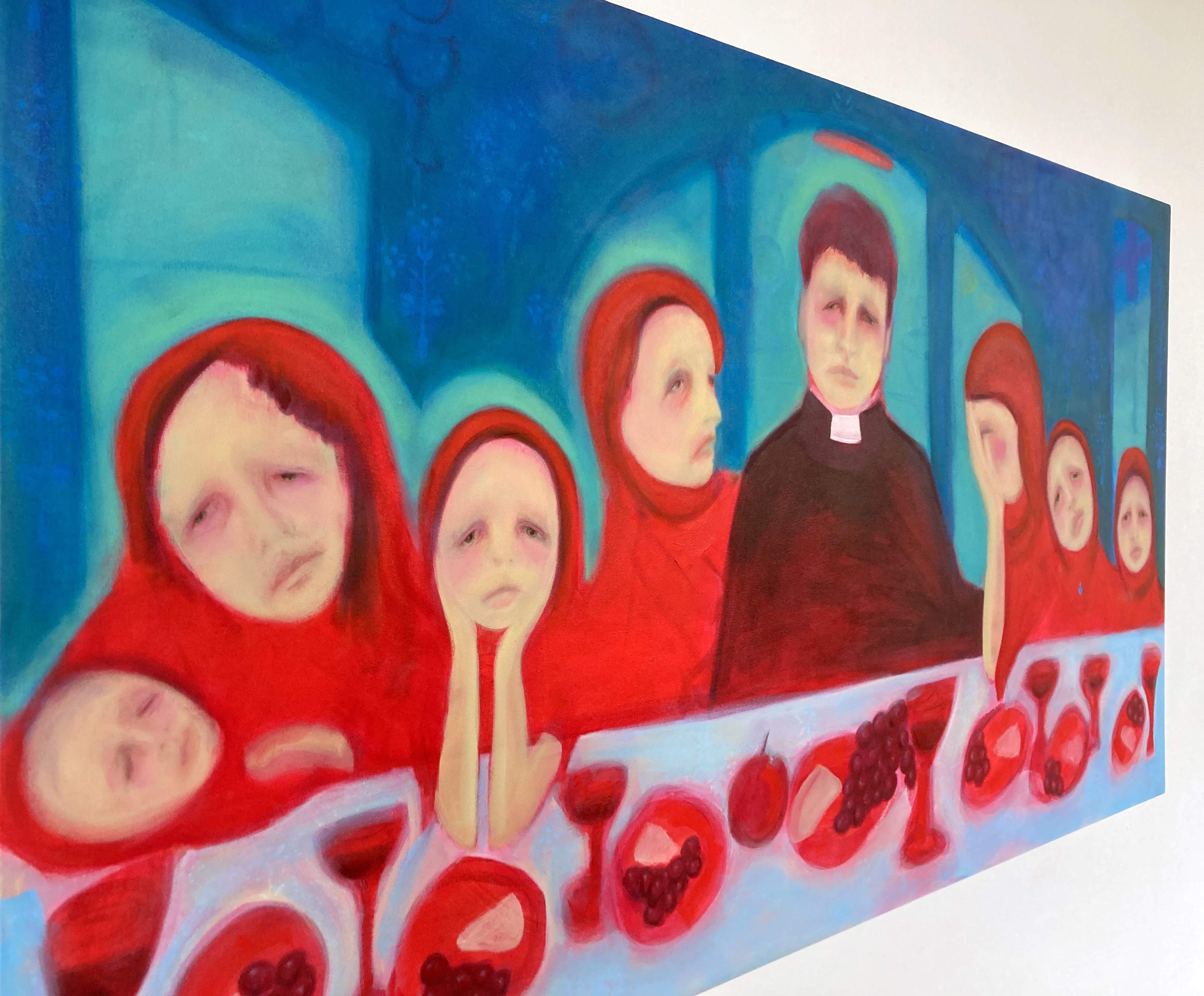
My first impressions were divided between a reading of the powerful narrative in the series of paintings, including a reconsideration of the notion of time, and the visual impact of the colour combinations and paint handling that pulled in the eye as well as the mind. The memorial content, based on individuals and familial groupings – from ten parents and children in ‘First Communion’, pairings in  ‘Baptism’ and ‘Wedding’, to a rather sad looking ‘St Bernadette’ displayed in the annex of the café – connected the works as forms of portraiture and stage settings. There are Shakespearian echoes here as we may well eventually realise that, “All the world’s a stage, And all the men and women merely players…” But the players here of course are set in a religious, Catholic context. As an outsider to this faith I cannot really comment knowingly on the lived experience of adhering to the Seven Sacraments or of being directly involved in what appears to be a range of disturbing experiences for one particular family. The priest in ‘Ordination: Fr. Shannon’, the centrepiece of the display, doesn’t seem to represent any spiritual joy for himself or for his flock of seven red-clad females. As a counterpoint to any notion of spiritual exultation another emotionally moving image is ‘Last Rites: Despair’ where the ailing mother/grandmother appears alone despite the presence of three younger but ghostly figures in the foreground. The content sounds harrowing, but its production ultimately feels strangely rapturous. This reading is, admittedly, personal and intuitive on my part, but I think it has something to do with the painting and this sense of love that I mentioned above.

Denise Harrison – ‘Ordination: Fr. Shannon’ – oil on canvas (90x152cm)

In a more general sense there is a sense of time as well. Of duration rather than moments, despite the imagery being derived from family snap shots, and the artist’s memory. This time aspect might be more strongly felt by the older viewer, although the younger visitor will ‘get it’ intellectually. The implied presence of the camera is here too as the imagery is akin to looking at a photograph, or a photo-album. There could be a desire to know who, where, when and why but art works on universal levels as well as with local, specific histories. Although it’s not the case here, one might have found the original photographic prints (not on display) in a house clearance but the treatment and editing of the information is clearly specific to the artist’s own history. A story now shared to expand from the individual and the familial to the communal. Paintings cannot escape this fate once they become public and face scrutiny.

Denise Harrison – ‘Last Rites: Despair’ and ‘Confession: Sinners’

Still ruminating on this sense of time it struck me that as we age, time and memories collapse in a sense. Some degree of linearity remains but as we can all look back at our own histories through time we also belong to a family, like or unlike the one recorded here. This may not necessarily be nostalgic in a truly celebratory sense – this sounds too rosy spectacled. But the filters are removed decades on, or perhaps replaced by something at least a little clearer. You have to be outside and beyond to look in, sometimes feeling like a stranger or third party. But you’re still in there, somehow, and this forms identity broadened beyond oneself. Paintings can present contradictions that we can allow ourselves to go with. Paintings are poems, not screen plays.

With regard to painting the viewer might be struck initially by Harrison’s use of glowing pinky reds and airy blues in addition to the strong figurative content representing facial features, especially the eyes and the expressions of the mouth. The various colour shapes morph with their surroundings producing a dream-like, visual connectedness that forces, or frees up, the figurative confines of the photographic content to flow and expand by use of the paint medium. With its various aspects of selection, composition, colour choice, painterly application and materiality the paintings somehow challenge the original photographs to attempt to say more than a superficial reading might offer. A painting, a good one, might read more like a poem that does not explain all. A straightforward story will need some openness for the viewer’s own interpretation and meaning to arise. Narrative is potentially unsteady, open to interpretation and unavoidably filtered and synthesised by the onlooker. Meanings might change from one gaze to the next. Or at the very least we might adapt the various scenarios to our own histories and experiences as a way of dealing with trauma that is beyond the individual, residing in the family and across generations. I am aware that I am probably getting carried away here, beyond the intentions of the artist, but a visitor could not walk through this space without exchanging a ‘look’ with the various individuals depicted and possibly find an echo in there.

An affirmation of painting is also powerfully and skilfully evoked by a suggestion of the purposely unsophisticated veering on apparent clumsiness. For example a limb such as a leg that is too straight, or a head too big or childishly bulbous. This somewhat unfair attribution emerges as there is clearly something of the lens-based / photographic record in the visual language that sparks an expectation for some category of the photo-realistic. But this combination somehow works. The apparent distortions and simplifications are deliberate. The colour is sometimes acidic and contrasts are crudely intentional. Detail, for example, is reserved for eyes and mouths, whereas bodies and surrounding forms and spaces tend towards a more abstract language as backdrops from the theatre of the everyday to make the imagery emotionally real. These people are us, vulnerable and loving, lost and found.

Visit this exhibit if you can. Support for artists is about engagement with their works and ideas. Be baffled and be sure. Participate and trust. We need to share our stories and painting does this so well.

Geoff Hands

Denise Harrison – ‘St. Bernadette’ – oil on canvas (66x46cm)

Links:

Instagram:

@deniseharrisonart

@phoenix_artspace

Shakespeare: “All the world’s a stage” speech from ‘As You Like It’ by William Shakespeare, spoken by Jaques. https://www.poetryfoundation.org/poems/56966/speech-all-the-worlds-a-stage

GIORGIO MORANDI: Masterpieces from the Magnani-Rocca Foundation

At Estorick Collection of modern Italian art

6 January – and now extended to 28 May 2023

“Remember, remember, this is now, and now, and now.”

Giorgio Morandi – ‘Still Life’ 1936

Visually primed from visiting the Cézanne exhibition at Tate Modern the day before, it was surely appropriate to move on to the Giorgio Morandi show the next day. Through his work Cézanne may have been saying, stop and look at the world (often the landscape) and construct it directly through the dynamic act of perception – but take your time. Calmly experience what is in front of you, he may have added, with the incomplete narrative of the here and now. Morandi appears to take this lesson from the master of modern art and subsequently devotes his painting mission to this, his unrelenting lifetime project.

The literature on Morandi confirms that he was interested in Cézanne’s work (especially in Morandi’s own still lifes of 1914-15 onwards) and the viewer will sense it in many of the examples from future works in this marvelous show at the Estorick Collection in London. The exhibition has travelled from the Magnani-Rocca Foundation in Mamiagno in northern Italy – not so far from Bologna where Morandi lived and worked for the whole of his career. Normally for the UK based artist or keen gallery visitor, to see and contemplate Morandi’s works the opportunities are severely limited as there appear to be less than a dozen paintings in public collections. Outside of London, visits would be required to such places as Norwich, Birmingham and Edinburgh but one would only see individual works. The best and most obvious option is a weekend trip to Bologna to visit the collection in the Museo Morandi, part of the Museum of Modern Art of Bologna (better known as MAMbo). Fortunately, as the Magnani-Rocca Foundation undergoes some refurbishment, the Estorick has the honour of displaying seventeen paintings and 33 works on paper, including etchings, for four months.

Oddly, as I felt compelled to write about this exhibition I also had a contrary sense of there being no necessity to do so. What more can one say about such a relatively straightforward range of imagery. Morandi’s works, especially the oil paintings, are so matter-of-fact painterly that they are surely just what they are, no more, no less – or as Dan Flavin the American minimalist sculptor once said: “It is what it is and it ain’t nothing else”. So I hesitated for a couple of weeks or so, during which time I happened to read Italo Calvino’s ‘Six Memos for the Next Millennium’ and came across some ideas that could be applied to considering Morandi’s paintings – most especially the still life compositions. For example, Calvino writes about the transition from word to image and vice versa as a crucial aspect of writing for novelists. So I wondered if Morandi, perhaps instinctively, takes the viewer from image to image, but in the same work. That is, as an inseparable combination, conjoining the material object (the oil painting) and the mental image (the viewer’s) as one phenomenon. Referring to St. Ignatius, Calvino also wrote of the “…visual contemplation or meditation”. This viewing approach is crucial for any work of art, but especially so for Morandi. This point also reminded me of Giotto’s frescos in Assisi and most especially to the palette that Giotto had access to. This link, however pertinent or not, was realised as I flicked through an old copy of ‘Forma e Colore – Giotto Gli Affreschi di Assisi’ by Roberto Salvini (1965) that a friend had recently passed on to me. There’s probably more detail in Giotto’s work, and a clear religious narrative of course, but the overall sense of the essence of form and a restricted palette renders an insistence on contemplation, both spiritual and commonplace for both of these pre-eminent Italian painters.

Giorgio Morandi – ‘Still Life’ 1953

In a more modern sense (post Freud and Jung), Calvino brings psychological experience and time into the creative equation: to the individual or collective unconscious, for example, or to time regained through sensations that rise up from lost time, or to epiphanies or concentrations of being in a single point or moment.” Such experiences may be rare unless programmatically sought through meditation and so do we learn from Morandi that time, by extension, returns the viewer to a concrete notion and an awareness of now? His still-life paintings appear to acknowledge the past as present, even beyond his own lifetime. Or, to put it another way, Morandi realises the metaphysical nature of perception of the world without recourse to limiting or tying himself to the illustrational or imaginary aspects of Metaphysical artists such as Carlo Carrà and Giorgio di Chirico, both of whom he knew personally in his formative years. Morandi’s imagery is utterly solid and direct: he sees the wood for the trees.

Morandi must have dedicated countless hours of actively looking whilst painting, just as Cézanne did. We might wonder what Morandi may have been thinking about his restricted subject matter that was essentially local to Bologna and to his studio tabletop for so many years. Perhaps many days were necessary to make one small work, one more little addition to all of the pictures in the world. But the apparent narrative of the imagery, as there is always a context, returns to the moment when, typically, a group of objects that have been arranged to be studied, for no other reason than to make a painting that replaces the original objects, the lighting conditions and the local colours. This may suggest a very limited artistic programme, bordering on the absurd, for recording the instant in paint at least, requires great time and effort even to conjure something so simple. Would a photograph have sufficed? The problem with a photograph might be that it is, literally, an instant, albeit a split second, but a painting comes loaded with at least a notion of commitment to a long-winded task that can appear ridiculous considering the time and effort required to reach some kind of conclusion – again and again.

Giorgio Morandi – ‘Flowers’ 1942

Painting can be unashamedly romantic too. Does Morandi seduce the viewer? The artist is doing no more than selecting, composing, looking, recording and painting his direct experience with an implied narrative of light, colour and form overtly realised in a particular arrangement of an apparently small collection of very ordinary objects – though sometimes a small bunch of picked flowers will appear. But Morandi shows us that the human gaze can rest upon something as simple, as pedestrian and as everyday, as a few mundane bottles, jars, and vases – and utterly captivate the viewer. Anticipating Object Orientated Ontology and contemporary metaphysics, Morandi’s paintings might be convincing the viewer that these objects and/or the paintings will exist eternally whether we are there to witness them or not – despite the contradiction that the paintings, his collection of domestic items and the occasional building from his window views were designed, made and contextualised by humans in the first place. The sound of the falling tree may not need a witness after all.

Returning to Calvino, pictures are starting points (imagined or real) and he makes reference to the playwright and author Samuel Beckett “…reducing visual and linguistic elements to the bare minimum…” This reductive tendency could equally be applied to Morandi’s imagery. His still life paintings in particular need no extra content than that which has already been selected, arranged and recorded. The viewer can look and wait knowing that Godot will probably never arrive after all. But we are here with the painting, nonetheless.

Giorgio Morandi – ‘Courtyard on Via Fondazza’ 1954.

Just before, eventually, writing this essay I had the speculative thought that Morandi’s work might be of interest, his paintings in particular, because there is no overt or political narrative? Due to the omnipresence of the media and rolling news streams, notwithstanding the politically correct themes and causes that arts organisations have to embrace to secure funding, the curator and the viewer might sometimes lose sight of the aesthetics of the image? This is not to suggest that issues and contemporary subject matters are unimportant or unnecessary, but I sometimes fear that the immediacy of the painted image, including its inherent materiality, the appropriate choice of physical application and visual content becomes secondary to a particular narrative that ticks a societal, and therefore political, box.

The viewer might find some unexpected joy in visiting this exhibition. Luigi Magnani, the collector of these works said himself that Morandi’s “…works have no content”. So by not fulfilling a manifesto with which to frame the work Morandi does not appear to take sides or to insist upon a message. The work has to speak for itself, or as Stefano Roffi writes in the catalogue: “Just like angels, the works Magnani chose had to possess a soul, be characterized by essentiality, purity, formal perfection, a lack of agitation, of vain philosophizing; to convey silence rather than clamour, peace rather than anguish.”

Giorgio Morandi – ‘Still Life’ 1960

In writing this purposely ruminatory essay, and in not being bound by a publisher’s deadline, I was also able to ponder and let the work sink in further, albeit from my own photographs and others kindly provided by Alison Wright (PR) on behalf of the Estorick. As a painter myself I have a conscious bias of concentrating on the paintings in the exhibition, but I chose not to discuss any particular work on display in this instance. But as I check my scribbled notes from the day I visited, I am reminded that I returned to view three works on paper before I headed for the bookshop to buy the catalogue. Each titled, ‘Still Life’ (from 1963, 1959 and 1963) they verge on the edge of abstraction with a minimalist aesthetic. The viewer could indeed start from the final works and study Morandi’s visual journey in reverse chronological order to find that he was a proto-minimalist after all. As, perhaps, Cézanne was too.

Notes:

Review title from: “Remember, remember, this is now, and now, and now. Live it, feel it, cling to it. I want to be acutely aware of all I’ve taken for granted.” (Sylvia Plath, letter to Eddie Cohen, 1950)

Links:

The Estorick Collection – https://www.estorickcollection.com

The Magnani Rocca Foundation – https://www.magnanirocca.it/magnani-rocca-foundation/

Bologna Museum of Modern Art – http://www.mambo-bologna.org/en/

All artwork images images – Fondazione Magnani-Rocca © DACS 2022

KIKI STICKL: Drift

A Poetic Exploration of Space in Lines

At Window Gallery, Phoenix Art Space, Brighton

2 – 24 July 2022 (Wednesday – Sunday, 11.00 – 17.00)

Outer space is right here, right now. It’s in front of us and in us, one and all – for there’s an inner space too. In terms of individual consciousness the two may as well be the same. When we think, we travel too, even if we remain physically still. When there is nowhere left to go, when we are trapped, marooned or sheltering from the storm we can rely on mental space. Still, but adrift in time, when memory kicks in to take us out of ourselves there is a palpable sense of space as an extension of self. Such are the conditions of splendid isolation, afforded most recently during the early months of the global pandemic.

Kiki Stickl – ‘Breath In Breath Out V’, 2020

Kiki Stickl clearly made the most of her own experiences of her family’s six months spent in countryside near Munich during the first lockdown in 2020 when she produced her ‘Breath in Breath out’ series of drawings, several of which appear in Drift. Here she encountered ideal conditions for creativity: time and space, duration and environment – and possibly sound as well – especially when the world is hushed. In fact, as I awoke on the morning after seeing Drift being installed at the Phoenix Art Space a couple of days before the opening I was semiconsciously thinking of Stickl’s drawings as visual soundworks. Not necessarily apropos Cage’s 4’ 33”, but literally, and deafeningly, silent. Stickl’s drawings suggest small arenas of silent sound consisting of visual counterpoints, full of emptiness inviting a form of meaningful mark making as an abstract response to recalling time and space. These are drawings made as an end result as they are not subservient to, or necessarily leading to painting as might traditionally be the case. Stickl conjures drawings from a meditation in the everyday physical realm of being that amount to sensory, environment-based studies. From a landscape environment to the literal sheet of paper that she works on, the drawings map out themselves. Sometimes she cuts the paper to reference, literally, a sense of layering as well as amalgamating marks on the paper surface as a form of recording what has been seen and remains to be seen: Cartesian, with Buddhist overtones.

Kiki Stickl – ‘Breath In-Out (A Walk)’, 2020

Drift presents 19 works. One is a temporary wall drawing (employing paint); another is a painting (titled, ‘Lines of Disruption’); plus seventeen square format drawings on paper, simply but immaculately framed. The painting is placed in the adjoining coffee shop, but cannot be missed on the main show wall as a little taster of her painting practice. The wall-based work, ‘Drift’, at about two metres square, is the centrepiece in the long Window Gallery space. Composed as an essentially linear structure from two tones of grey paint on the white wall, with the addition of ground up glass beads applied to the lightest grey paint when it was still wet, the darker grey mass suggests a resting figure, perhaps in meditation pose. An ephemeral, time-based work such as this will disappear at the end of the exhibition later this month. This work, therefore, demands that we hold it in our memories, just as we may do from our personal experiences of places beyond the gallery.

Kiki Stickl – ‘Breath In Breath Out (Cosmic Matter)’, 2020

The bulk of the show consists of the drawings that have been selected from a much larger body of works, the aforementioned ‘Breath in Breath out’ series. From drawing to drawing, as they are arranged in blocks and rows, there is great variety of imagery and mark making. Subtle use of colour is occasionally employed, although they still read as essentially monochrome iterations. In many, linear rhythms consisting of scribbles, dots and short or flowing lines are accumulated suggesting light and weather conditions. Forms are deconstructed to some extent, invoking that sense of recall that does not rest, preferring flux and instability as performative, shorthand approximations. Imagery that might be solid is no longer fixed as a conventional photograph might replicate for the viewer. The paper cut-out sections present voids and absences, shadow and light, useful contrasts and visual paradoxes. Implied shapes and lively line is reductive though essential as imaginative remnants of remembrance celebrated. These are motion pictures, mapping the psyche as much as the terrain.

Kiki Stickl – ‘Breath Walk Dance’, 2020

Stickl is not so much taking a line for a walk (re: Paul Klee) as inventing and playing with accumulations, sometimes in counterpoint mode, un-egotistically presenting a notion of drift through time and space.

Geoff Hands

Links:

Phoenix Art Space – https://www.phoenixbrighton.org/Events/kiki-stickl-drift/

Kiki Stickl – https://www.kikistickl.com

MICHELLE COBBIN: ‘I’d Be Enlightened Now If It Wasn’t For You’

Window Gallery, Phoenix Art Space

2 to 24 April 2022

Phoenix Art Space, Brighton

The Window Gallery at Phoenix Art Space in Brighton offers studio members an exhibition opportunity close to home and the latest show celebrates the abstract paintings of Michelle Cobbin. After an email exchange of questions and answers in anticipation of the exhibition I had the pleasure of helping her to hang the show and so literally saw the work very close up. I mention this, as a viewer would normally step back to view the larger works. But despite the apparent visual simplicity of many of her canvases the colourfield experience really does pull the viewer up to the surface and into an atmospheric, non-objective, realm. The weave of the canvas, however, reminded me that I was not floating in some sort of meditative dreamland but was experiencing concrete reality.

Michelle Cobbin – ‘Atmosphere’ acrylic on canvas (130 x 130cm)

I have often thought that abstraction in painting without overt reference to a particular narrative, scenario or specific space lends itself to a notion of timelessness, or of historical time collapsed into simply the experience of looking at and experiencing a work of art – something one might unashamedly describe as the aesthetic experience. This notion of the material here and now counterpoised by a more expanded sense of place is philosophically, as well as artistically, intriguing. Such an experience is not exclusive to abstract painting of course, as might paradoxically be seen in still-life painting (I am thinking of works by Giorgio Morandi and Peter Dreher) that both acknowledges a social reality and a particular time and place yet exudes a sense of ongoing visual engagement irrespective of the date on the back of the canvas. A kind of meta-reality embedded in paint and its various qualities.

Michelle Cobbin – ‘Atmosphere’ (detail)

In Cobbin’s oeuvre you will find that the landscape is implicit but not essential to identify and in this selection of six works the viewer will travel across the colour spectrum and from dark to light. The titles are generally broad and non-specific, although ‘Bridge’ and ‘In The Top Field’ keep our feet on the ground alongside ‘Atmosphere’, ‘Lament’, ‘Phosphorescence’ and ‘Hidden’.

To start the discussion with Michelle Cobbin I borrowed John Bunker’s first question for Peter Lamb from the new series of ‘Abstraction in the Now’ interviews from Instantloveland“Can you remember the first abstract painting to make a real impression on you?” is a brilliantly simple gambit to open up a deeper conversation that delves into the past to relate to the present, and implicitly the future, in one’s practice.

Michelle Cobbin – ‘Hidden’

Interview with Michelle Cobbin (February/March) 2022

Geoff Hands – Can you remember the first abstract painting to make a real impression on you?

Michelle Cobbin – The first would be Tibetan Mandalas and Thankas that I saw whilst travelling in Nepal in the early 1990s.  If you want a western fine art example it would be the Rothko room of Seagram murals at what we now call Tate Britain in the mid 1990s. I was struck by how much presence they had, how they made me feel melancholic and introspective.

GH – That’s interesting. I recall looking at reproductions of Mandalas in my studio on my degree course (late ‘70s) and being dissuaded by my tutor from doing so as I could not possibly relate to them. He would have been okay with Rothko of course. Your paintings invite a long slow look. A meditative state may not be necessary but I assume that you would like the viewer to take time to contemplate the imagery.

MC – I am interested in how people respond to colour and abstract imagery – I’m interested in how it makes them feel. So this could be an instant instinctual response. But yes, with contemplation the viewer may drop into their body and feel their response more fully. 

Aside from contemplating an image in a meditative way I’m also interested in how abstract imagery and colour has been used to divine insight. For example Rorschach’s Inkblot tests, the Lüscher Colour Test and the Aura Soma system. 

I title my paintings which may lead the viewer to see them in a particular way, but people read images based on their own experiences, likes and dislikes, which goes back to sensory responses again.

GH – You have made and continue to develop several series of paintings, which is a fairly common way of grouping paintings for artists today. Your website is well illustrated with examples from these various series where a viewer can see ‘Transitions’, ‘Gaia’ and ‘Terra Verde’ which relate to landscape experiences, or ‘The Breath’, ‘Semblance’ and ‘Sumptuous Contentment’ which are more specifically yoga and meditation related. I am particularly fascinated, but for different reasons, by the ‘Inscape’ series that summons up memories from East Anglia, with a minimalist Zen Haiku guiding principle, and ‘Kenshō’ which is more programmatically ‘abstract’, with a clear reference to Zen calligraphy. The sense of family history and landscape related impressions from childhood in the former and a more formalist expression of abstract mark making in the latter gives rise to quite stark imagery.

But I wonder if the notion that, if I can reference Neil Young, these “are all one song”, by which I mean that the series titles and subjects might fall away to reveal a process of expression and communication that ties everything together as a record of one voice – in your case a visual and intuitive, feeling sensibility that manifests itself as abstract painting?

MC – Yes, of course my work is ‘all one song’ in some respects. I am interested in keeping things simple both in how the work looks and in making things clear. I know that abstract painting can be difficult to relate to and I think by working in series and titling paintings it goes some way to bridging that difficulty. 

Working in series also gives me boundaries to work within – that might be a particular palette, mood, or conceptual idea. It helps me to focus, but no I’m not suddenly going to start painting people or objects as that would deviate from the message or ‘song’ that I want to convey.  

As you mentioned, I grew up in East Anglia, near the Fens. The ‘Inscape’ series was my internalised and perhaps nostalgic impression of that landscape. It was the first series where I began using a horizon line in my work. I was hesitant about this – blocky colours with a straight-ish line, I was concerned it would scream “Rothko!” Of course his work has been hugely influential upon me. I included lots of little scribbles in the ‘Inscape’ series to begin with, to make the paintings less ‘empty’. It took me a while to have the confidence and to find my way into accepting I’m influenced by but not deriving my work from anyone else.

My forthcoming show, ‘I’d Be Enlightened Now If It Wasn’t For You’, at the Window Gallery, Phoenix Art Space is, if we keep with your musical reference, going to be a Greatest Hits show. I will be selecting works from various series. The criteria will be size. It is such a great window – literally – into Phoenix, and out into Brighton. Personally, I want to use this opportunity to survey how my large canvases sit together and show how, to quote Bob Dylan, I “keep on keeping on…”

GH – I expect that such a selection would work well in a linear type space that necessitates hanging most of the works in a straight line. Not necessarily in a chronological sense but in taking the viewer on a short but visually loaded journey from period to period.

The experiential link to a particular landscape is, to some degree, an historically “English’ trait too. Perhaps, for many painters and viewers the landscape is a way into abstraction?

MC – Yes the show could be a short visual journey. That could be an inward journey provoking an emotional response. I like the idea of colour bathing: standing close to large swathes of colour and noticing what you feel. The arts are a gateway to our emotional life and a way of connecting to other humans. In my case, I do this through paint. I hope viewers are drawn in, intrigued, and perhaps, as you say, the landscape nature of some of the paintings might be a way into abstraction. 

I think that being linked to a landscape experientially is universal. I took a course with psychologist Sharon Blackie on finding and creating myths in one’s contemporary and ancestral landscapes. It has certainly helped me to relate differently to the little bit of downland near to where I live as well as to draw comparisons with the chalk land of East Anglia where I have traced my roots as far back as 1600. None of my ancestors moved outside of a 30-mile radius. This research will underpin my next series of paintings.

GH – Thank you Michelle, there is clearly so much more to contemplate from your broad body of work and I look forward to seeing and experiencing your mini-retrospective at the Phoenix in April, and, at some future date, the following series.

Michelle Cobbin – ‘In the Top Field’ exhibition installation shot (early evening)

Michele Cobbin – ‘Phosphorescence’ in the Canvas Coffee Co. bar at Phoenix Art Space

Links:

Michelle Cobbin – https://www.michellecobbin.art/about-my-work

Instantloveland – https://instantloveland.com/wp/2022/02/10/4891/

Phoenix Art Space –

Peter Dreher – https://fineartruminations.com/2017/04/14/ce-nest-pas-un-verre/

Sharon Blackie – https://sharonblackie.net

TANIA RUTLAND: Chip of flint – fragment of chalk

Tania Rutland: Chip of flint – fragment of chalk

Window Gallery, Phoenix Art Space, Brighton

2 – 24 November 2019

TR - Poster

‘Crowding the solitude’, ‘Ghost white path’, ‘Night’s first light’, ‘Silent reach’ and ‘Restless lane’ might be headings in a list of poems from a collection that constituted a volume of landscape inspired verse, but they are selected from the titles of drawings and prints from Tania Rutland’s exhibition at the Phoenix Art Space.

Another title, ‘Chip of flint – fragment of chalk’, makes reference to commonplace Sussex downland geological material that could have been gathered from her visits to Iron age Mount Caburn and Neolithic Cissbury Ring in East and West Sussex and is the intriguing title of this exhibition.

040 - TR - Chip of flint - fragment of chalk (28x21cm) pencil and graphite on paper.jpg
Tania Rutland – ‘Chip of flint – fragment of chalk’ (28x21cm). Pencil and graphite on paper.

The very idea of a ‘chip’ or a ‘flint’ suggests the collection of a memento, a physical token from a walk, picked up to place on a shelf when home. Such an item might be revered as a memory of a time and place spent in solitude or with a partner or friends from a Sunday walk. The cultural pursuit of walking might be a form of escape from everyday life, most especially the ‘working week’. A leisurely stroll or demanding hike, especially in the countryside, can be rejuvenating and refreshing. It might also be consoling during a time of stress. A walk is healthy for both mind and body; and for a landscape artist a place for research, inspiration and hard work.

Though superficially a landscape exhibition, on reflexion, ‘Chip of flint – fragment of chalk’ is loaded with speculative and thought provoking possibilities enabling the visitor to take away the non-physical souvenir: not to be placed on the mantelpiece but constituted in the form of ideas to consider and discuss further and, ultimately, leading to environmentally focussed action.

From the very start of the corridor space Window Gallery, making a de facto antechamber, two wall-mounted assemblies of small, unframed, preparatory drawings make it clear that drawing is at the core of Rutland’s practice. As an introductory display, sufficient in itself as a stand-alone exhibition, the 28 studies make an implied proposition that drawing is still of paramount importance towards painting, especially in landscape art. Whilst an en plein air approach is also possible, the drawing in advance of the essential schema for a final painting, even without colour content, provides the opportunity for intense consideration of composition and content; and for revision of the essential rectangular format. Rutland’s methodical approach also develops the initial ‘sketch’ to a more ‘finished’ state and therefore requires a more prolonged period of execution. In this respect, the lengthening of time to make what might simply become no more than a preliminary part of production, adds to the inherent conceptual aspect of Rutland’s greater project, namely that of time and duration.

001 - TR - Untitled 1 (Fatigue of early light - Mist's cover) (14x16) prep drawing
Tania Rutland – ‘Untitled 1 (Fatigue of early light – Mist’s cover)’ (14x16cm) Preparatory drawing.

Annotated on half a dozen of these relatively intense drawings are more titles, including: ‘Ghost lines’, ‘Eroded slope’, ‘Frozen light’ and ‘Fatigue of early light’. Without mounts, but with clearly measured and demarcated perimeters for consequent development into paintings, these studies may have come straight from the studio wall in her Phoenix studio. This informality in presentation might have initially diminished an observer’s attentive reaction to these works, but throughout the opening evening many visitors could be seen both standing back to view each of the two groupings of drawings and then be observed stepping closer to scrutinise each image as if through a magnifying glass. In relation to time a second aspect, that of concentrated visual observation of various locations, loaded with evidence of human interaction in and on the land (and sea), also implied itself in the bigger project.

029 - TR - White ghost path (200x150cm) pencil and graphite on paper.jpg
Tania Rutland – ‘Ghost white path’ (200x150cm). Pencil and graphite on paper.

Continuing into the main display space the biggest piece in the show first greets the visitor in contrast to the small studies just encountered. The pencil and graphite ‘Ghost white path’ impresses not just by size alone (200x150cm), but also by a display of controlled elegance in mark making and an example of compositional skill in which the viewer might literally fall into this Downland vista. As a completed drawing, ‘Ghost white path’ is as consummate and exhaustive as a painting might be and therefore expands the notion of drawing as going beyond the supportive role that it often takes.

In this significant work the viewer will certainly gain a sense of the past and the present day in one hit. In the bright distance, where the intense light dissolves the sea from sight, the Rampion wind farm turbines that now dominate the view from the Sussex coast have been recorded. Whether these technological structures please the viewer or not, like the telegraph poles we may barely notice anymore, or the electricity masts that cannot always be buried beneath the ground, we will inevitably have to become accustomed to this burgeoning technology for generations to come.

The past and present (an ancient landscape and an off-shore development) combine in one monumental vista so that a viewer has to contemplate a challenging and controversial journey to the future in this era of climate change awareness and necessary proactive behaviour.

031 - TR - Mound duskily glowing (24x24cm) etching.jpg
Tania Rutland – ‘Mound duskily glowing’ (24x24cm). Etching.

Four monochromatic etchings are displayed next, including ‘Mound duskily glowing’, a title merging topography with time and light, which again suggests a poetic counterpart (a haiku perhaps) that may one day be written. In ‘Silent reach’, telegraph poles located in a flattened mid-grey rhombus in the central area of the composition leads the eye from foreground to mid-distance. The poles could be traversing alongside a coastal area, or trace a communications route a few miles inland, leading to the next village or town. Very few regions of this relatively small island will be without such evidence of human habitation, as if such evidence of technology was as natural a phenomenon as the trees.

033 - TR - Silent reach (24x24cm) etching.jpg
Tania Rutland – ‘Silent reach’ (24x24cm). Etching.

With a change of process and medium Rutland allows a weathered, washed-out look in the thinned ink layers transferred from the surface of the metal that she has etched with. For example, in ‘Selvedge edge’ the distant hills are visually subject to mist dissolving form, whilst rain falls as weather conditions change appearances. In the bottom section of the image fence posts create a small enclosure, a signifier of order and land ownership. A telegraph pole, like a crucifix, in middle ground, merges at its base into foliage. Dark parallel lines in the foreground, perhaps suggesting the selvedge edge of fabric for the title, foretell the flint seams in the set of the four ‘Flint Seam’ drawings that are to follow.

032 - TR - Selvedge edge (24x24cm) etching.jpg
Tania Rutland – ‘Selvedge edge’ (24x24cm). Etching.

These more minimalist compositions, ‘Flint seam 1, 2, 3 and 4’, are placed at the centre of the show. They are undoubtedly complete in themselves but may well hold the prospect for further development as abstract paintings. Each is placed behind a clear acrylic sheet, rather than mounted in a conventional frame. Like its counterparts, ‘Flint seam 2’ is composed of a series of vertically placed horizontal bands of smudgy, burnished graphite drawn on to a gesso (i.e. chalky) coated, paper ground. Within these thin, dark, cloud-like strata are more defined linear marks suggesting a compressed handwriting with a slightly nervous, quivering organic edge.

035 - TR - Flint-seam 2 (66x46cm) pencil and graphite on gesso paper.jpg
Tania Rutland – ‘Flint seam 2’ (66x46cm). Pencil and graphite on gesso paper.

These often flat and smooth, mark-like shadow shapes are found in split flint nodules originating from sedimentary chalk that litter the farmland in Sussex and have been used as building materials for walls and buildings since the Roman era. Further back in time flint was fashioned as a Stone Age tool. But way beyond any human presence on earth they are a literal compression of geological time and materiality that seems beyond comprehension and may well suggest a natural kind of drawing. Dark and wave-like, these markings made from the chalk seabed reveal fissures of implied energy. As a form of visual poetics, the past is metaphysically now in these teasingly simple, but thought provoking and elegant drawings.

039 - TR - Crowding the solitude (28x21cm) pencil and graphite on paper.jpg
Tania Rutland – ‘Crowding the solitude’ (28x21cm). Pencil and graphite on paper.

At what appears to be the end of the display, a group of five framed drawings (including the title piece of the exhibition) are presented in suitably mounted and framed studies that, like the etchings, read as ‘finished’ works. They include ‘Crowding the solitude’ which is a similar composition to the aforementioned ‘White ghost path’. In the mid-ground the land builds steeply to two bulbous hills; to the right on the implied horizon are the perspectival rows of 14 vertical masts from the Wind farm out at sea. In the space between the hillocks, and particularly on the left hand feature, is a meandering configuration of chalky pathways. The closer foreground is patterned by a gentle arrangement of subtle tones that visually pock mark the paper surface. The notion of the landscape as corporeal and libidinous is difficult to deny.

042 - TR - Flint (42x42cm) pencil and graphite on paper.jpg
Tania Rutland – ‘Flint’ (42x42cm). Pencil and graphite on paper.

The last of these five drawings is titled ‘Flint’. Initially it could be a drawing that goes unnoticed, such is the insistent or subtle presence of so many of the other works. One feature, however, hooks the gaze as one might head for the coffee bar and the prospect of seeing a painting from Tania Rutland. Within this rendering of what may be a recently ploughed and almost featureless field, a tiny but visually dominant grid-like structure interrupts the shallow curve of the land, just before the dark masses of a thicket of trees on the close horizon, revealed contre-jour, emphasising a sense of infinite space beyond. Its identity is a mystery: could it be a wooden or metal framework? From the bottom right-hand corner of the drawing a purposely trodden pathway leads to the unknown construction and it could be that the track across the field has been rendered into the surface by either animals or humans.

043 - TR - Remote dwellings (40x40cm) oil on canvas.jpg
Tania Rutland – ‘Remote dwellings’ (40x40cm). Oil on canvas.

Outside of the Window Gallery, but in a suitable display space that extends all of the exhibitions, one of Rutland’s oil paintings, ‘Remote dwellings’ is presented on a dark grey wall. This provides an example for those who do not already know her work and is now interestingly and more than adequately informed from seeing the drawings and prints. One painting is probably just enough exposure in this context and holds out the prospect of seeing a future exhibition of Rutland’s paintings.

Significantly, this work in the more ecologically minded attitudes of society today is made more potent by its combined references to the past, present and future. The human conquest of the environment is, of course, aided and abetted by the genius of technologies, open to interpretation and revision. The drawings and prints presented in ‘Chip of flint – fragment of chalk’ not only record and reflect the history of particularly special locations, but provoke the observer to contemplate the future too.

Geoff Hands (November 2019)

All images © Tania Rutland

Links:

Tania Rutland’s website – http://www.taniarutland.com

Phoenix Art Space – https://www.phoenixbrighton.org/events/tania-rutland/

Rampion Wind Farm article from The Guardian –

https://www.theguardian.com/commentisfree/2017/nov/11/brighton-rampion-wind-farm-turbines-renewables