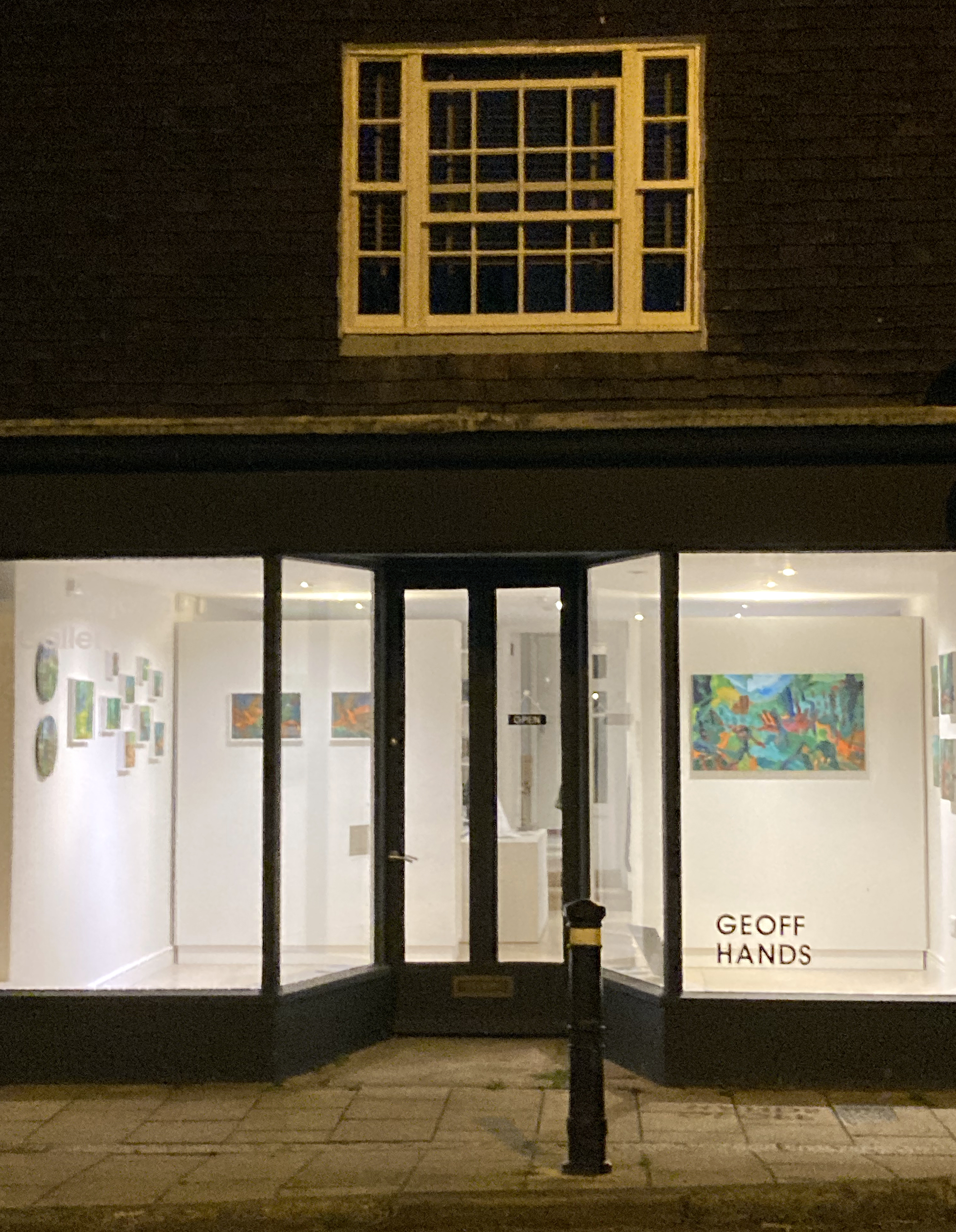
Meiklejohn Gallery, Lewes
5 September to 24 October, 2026
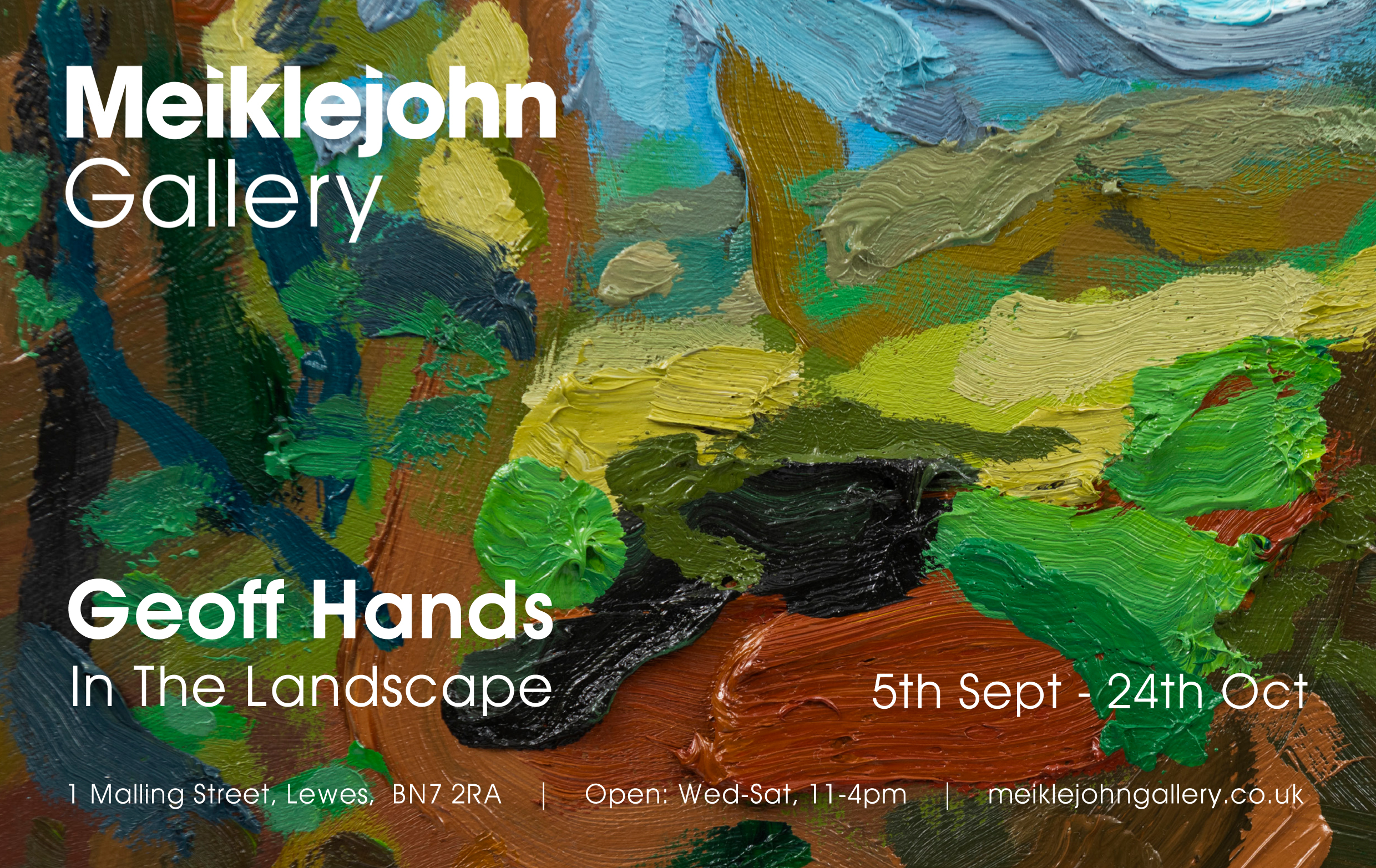
This essay began as a short statement for my exhibition, In The Landscape, at the Meiklejohn Gallery in Lewes. Given some free time whilst waiting for the opening event, I sat at the computer and started the text. This is certainly not a review, but something of a objective/subjective rumination on my painting practice that references landscape subject matter – but with the added benefit of having co-curated the selection of works with the expert lead taken by Claire Meiklejohn. I shall add and amend the content over the course of the exhibition, including the photographs. (Note: Currently this is the fourth version.)
In the landscape we often walk, jog or cycle, pass through on the train, the bus or in a car. When in drawing mode (it all starts from drawing, as my art education from school to college to university has instilled in me) the connection to the physical environment becomes closer. For the past few years an interest in psychogeography has encouraged me to walk and draw at the same time.
Inevitably one will stop to more fully capture something, more often close up than far away; a leaf, the interesting contortions of a tree branch or the potential focal point of a post, or an architectural feature such as the pointed top of a roof. For a while the drawing is also considered, though I prefer not to make too quick a judgement. Looking at the drawing would take me into a more academic, measured category of recording and I would no longer be observing the subject matter in the intended way. I deem to keep the seeing in the unfolding moment, never really still and only measured by footsteps rather than the pencil and one closed eye.
Most often the walks are made alone, but drawing whilst walking with friends is not uncommon. They walk and talk as I generally get left behind as I stop and start. If an interesting comment is made I might scribble the words onto the back of the sketchbook page (e.g. a small oval series of paintings from walking the Egrets Way has the sub-title, “at the moment”). More commonly I write anything down that comes into my head, oblique or descriptive, so long as it feels connected to the experience of moving through the environment at that time.
The sketchbooks, often the concertina type, inevitably fill up in one walk to take back to the studio. Here, some books might be put aside; others are ever present and regularly flicked through. A few generate paintings. Some of the books are further drawn into and/or painted. Often a sketchbook will be laid out across the studio floor, from corner to corner. As one page literally morphs to the next, the notion of the book of many pages becomes a larger elongated piece in itself.
Note: A larger space than the Meiklejohn Gallery would ideally be necessary to display these books and some readers may have seen a selection of these books exhibited at the Phoenix Project Space in 2025 in collaboration with composer/musician, Tobias Wheal.)
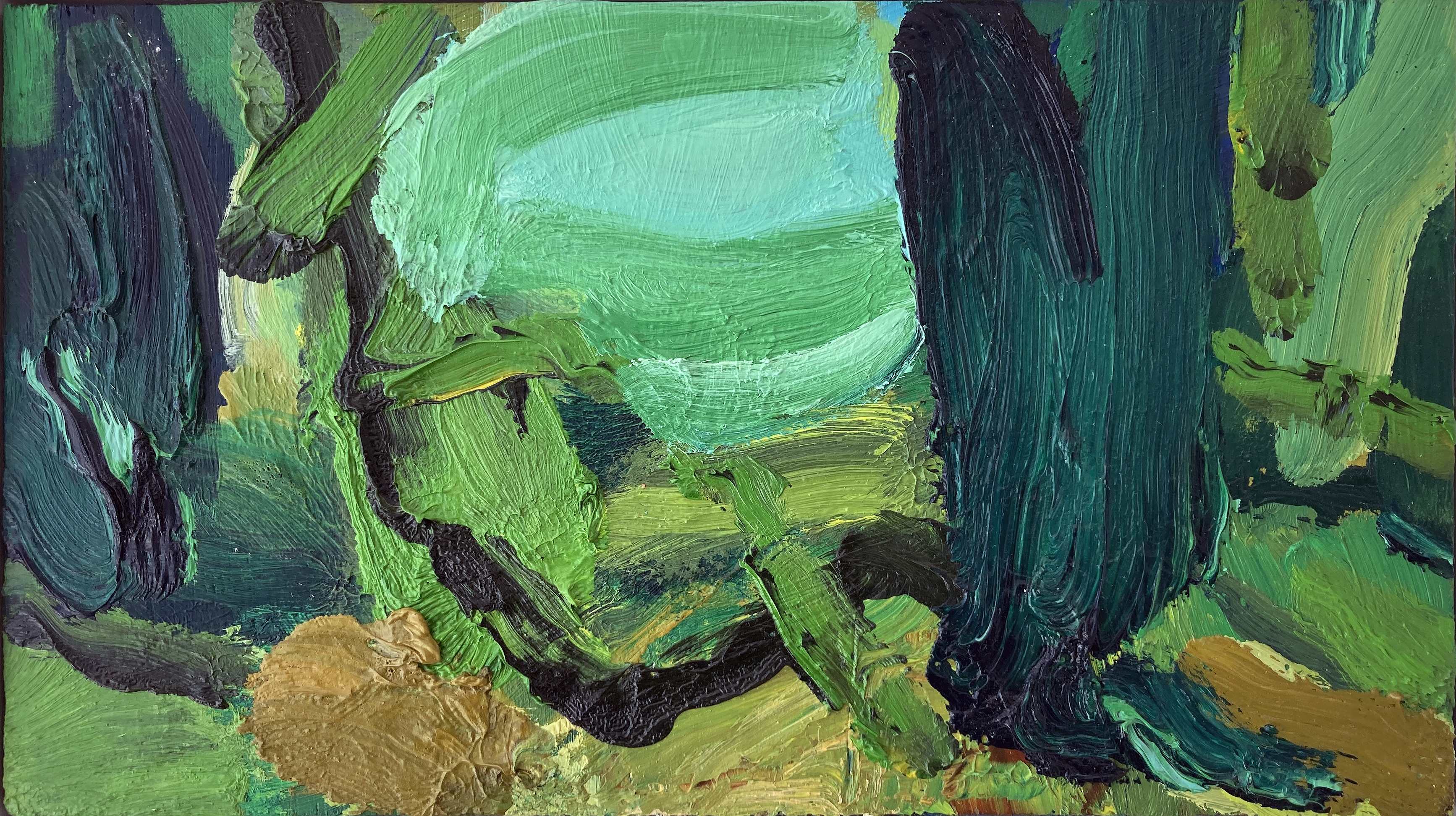
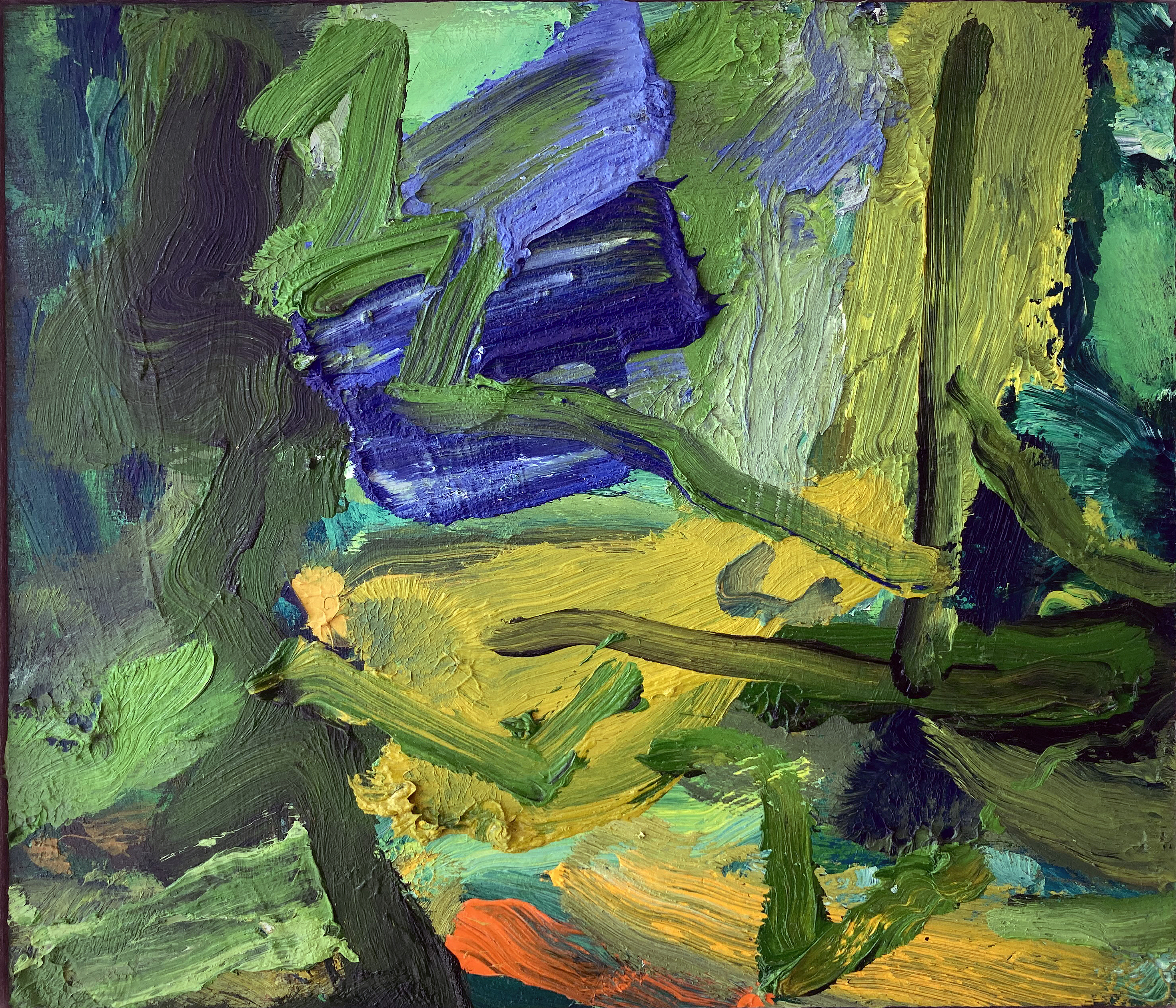
But ultimately the paintings are the main outcome – and a selection from the past five years comes together for In The Landscape. The final studio practice that provides the time, space, activity and concentration to make acrylic or oil paintings takes on a status at least equal to any form of preparation in the form of drawing, writing or visual recollection. This might explain why some paintings bare little pictorial resemblance to a particular landscape location. Every step of the way is the means to the end. But I would hope that this end is not a termination, but rather a visual ground that most often invites a submersion, wherein conventional perspectival visual language plays no great part. There is also a significant compulsion to improvise with the paint medium and its inherent qualities of colour, texture and physical substance, orchestrated by not only compositional outcomes but also an aesthetic sense of completeness. By aesthetic I do not mean some kind of universal standard, as I am not so sure that there is one. It’s a loaded term, for sure. In this painting practice, literally ending in the studio, I strive for a sense of completeness. Embodied in the act of panting – after being similarly embodied in the experience of making drawings in the landscape. An embodied aesthetic? Working towards the final brushstroke that is a full stop, in effect. I have tried this without the back up or prompting of the drawings too, but (I assume due to my training) it only feels valid and informed by some degree of visual context.
As a pointer to any conceptual background I envisage the whole landscape as the Hortus Conclusus of the natural world that can enable the artist to paint freely. To reach some understanding of this rather generalised position I choose, for now, to make paintings rather than overtly intellectualise. Developing imagery in the studio from walking and drawing directly in the landscape allows a certain degree of improvisation and engagement with the qualities of colour relationships, heavy and light painterly surfaces and compositional invention. This working methodology enhances my feelings both about the landscape as subject and painting as process, wherein permission is given to invent and improvise as necessary – but with a certain degree of disciplined decision making.
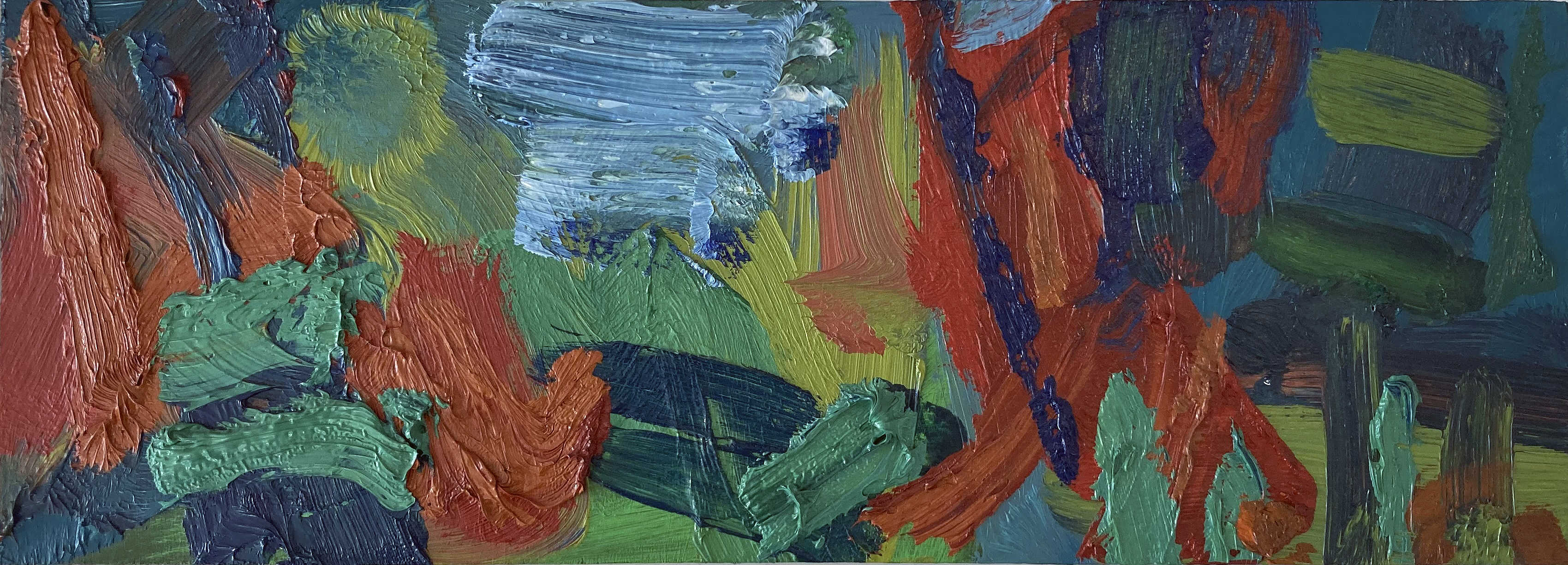
With an interest in visual aspects of psychogeography (where responses are physical and visual, in addition to generating purely intellectual reactions) I have explored both the broad, panoramic view and the more immersive close-up of small, often unnoticed spaces. These latter, often ignored or inaccessible without effort, areas are of especial interest. The view that might be missed as one heads for the glorious scenery that anything from a holiday snapshot to the Romantic landscape imagery from art history, to the commercial landscape image of many successful contemporary artists often captures, intrigues me. Some aspects of cultural notions of the landscape as being a space to pass through on tour, or to visit as a special treat are fine, but there is also a universe at our feet and before our eyes wherever we may be going. I am aware that this generalises something that might be more accurately explained by the personal unconscious urges that prompt and provoke this predilection. I must have unconsciously sensed this as a young art student cycling out to the countryside around Shrewsbury with watercolours and a sketchbook. The urge remains to set off into the Sussex countryside, or into a particularly special garden in Wales. Perhaps, ultimately, it is all one space and so I shall continue to explore this territory as my lifetime’s project.
LINKS